Jun 10, 2024
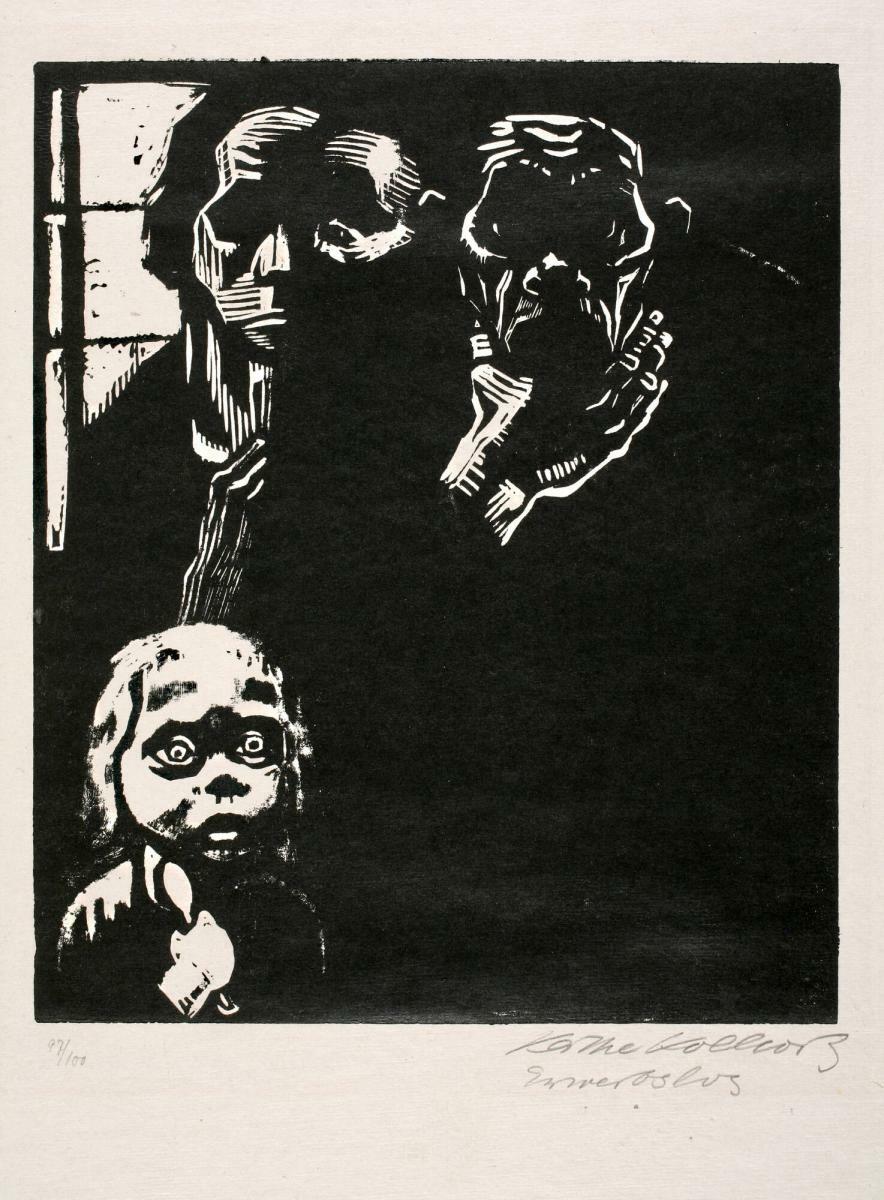
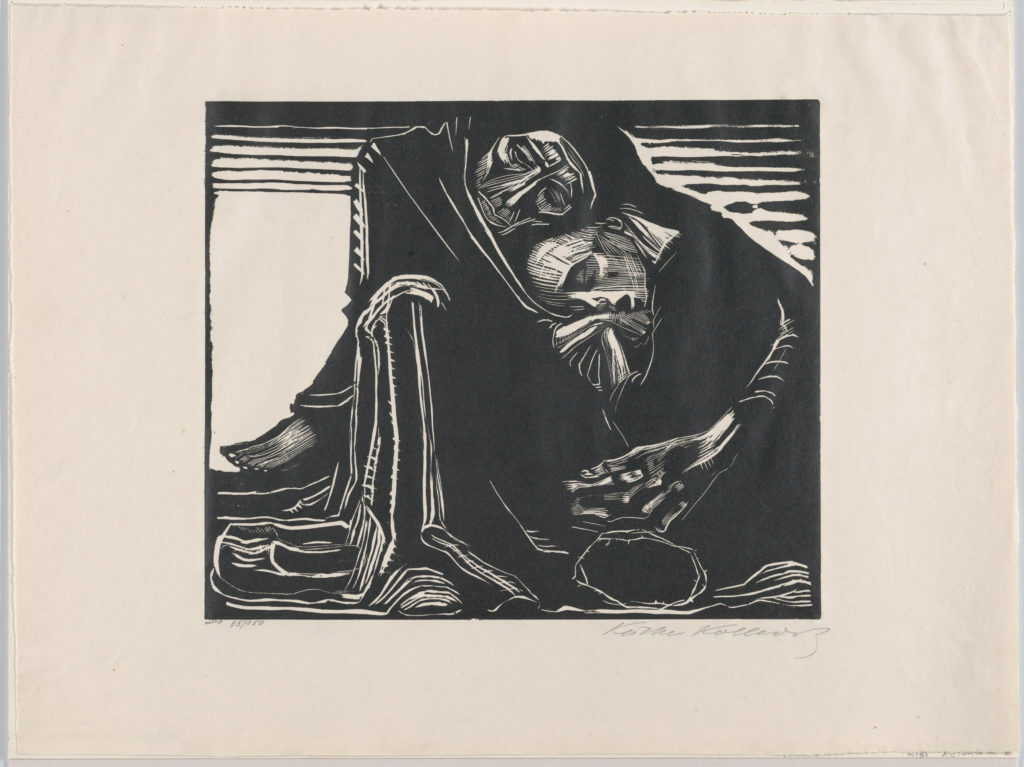
“Erwebslos” (Unemployed) from the Proletariat Series, by Käthe Kollwitz, 1925. Image courtesy of the Allen Memorial Art Museum, Gift of the Carl Schurz Memorial Foundation.
INTRODUCTION
As the war continues, we are collecting Yiddish literary responses that help us think with the present moment, including translations like this one of historical texts with contemporary resonances. This work does not necessarily reflect the political opinions of In geveb or its editors, but speaks to the way Yiddishists are finding their work meaningful in a time of crisis. We welcome further additions to these efforts. Send your submissions and suggestions to [email protected].
Warsaw-born poet Yoysef Papyernikov (1899-1993) is known for his profound poetic and biographical ties to Palestine/Erets Yisroel (Land of Israel), where he lived from 1924 to 1929 and again from 1933 until his death in 1993. His most famous and enduringly popular poem, “Zol zayn” (“It May Be”), was penned in March 1924, just before or shortly after his departure from Poland. 1 1 Yoysef Papyernikov, Heymishe un noente (dermonungen) (Tel Aviv: Farlag Y. L. Perets, 1958), 186. Yet, the majority of his poetry was crafted in his adopted “homeland,” capturing the landscape and experiences of the Jewish colony in Palestine as it transitioned into statehood. His debut collection, In zunikn land: Palestine lider (“In the Sunny Land: Palestine Poems”), published in Warsaw in 1927, resonated widely with the secularizing, politically active Jewish youth in Poland. Its sentimentally orientalizing verses were often recited at gatherings of young Zionists preparing to “leave their homes and go to the sunny land.” 2 2 Yoysef Hilel Levi, “Y. Papyernikov,” in Gezamlte shriftn (London: Miryem Levi, 1958), 197-199.
Active from a young age in the Zionist socialist labor movement, Papyernikov infused his poetry with a strong social awareness, addressing the struggles and dire conditions of the working class. His second poetry collection, Royt oyf shvarts (“Red on Black”; Warsaw, 1929), marks a temporary shift away from “palestiner motivn” (“Palestine motifs”) to focus on social issues. 3 3 The expression “palestiner motivn” in reference to Papyernikov can be found, for example, in “Kaboles-ponem far dem yungn palestiner dikhter Papyernikov,” Lubliner Togblat, October 17, 1929, 4; and Moyshe Shimel, “A lirisher grus fun erets-yisroel,” Haynt, January 14, 1938, 7. A notable poem from this collection, “S’geveyn fun hungerike kinder” (“The Cry of Hungry Children”), 4 4 Yoysef Papyernikov, “S’geveyn fun hungerike kinder,” in Royt af shvarts (Warsaw: Naye kultur, 1929), 16-17. Republished with minor punctuation changes as “Geveyn fun hungerike kinder” in Yoysef Papyernikov, Geklibene lider fun heym, bunt, krig un khurbn (New York: Ikuf farlag: 1946), 21. translated here, is rooted in the reality of the impoverished working class in interwar Poland. This poem is often highlighted as a prime example of Papyernikov’s empathetic portrayal of the working class’ suffering. 5 5 Yoysef Hilel Levi, “Y. Papyernikov,” in Gezamlte shriftn (London: Miryem Levi, 1958), 198; Khayim Leyb Fuks, “Yoysef Papyernikov,” in 40 yor Papyernikov in erets-yisroel (Tel-Aviv: Farlag Y. L. Perets, 1965), 93; M. Tsanin, “Der dikhter fun zayn folk” in ibid., 99-101. According to Yoysef-Hilel Levi, the poem was also popular as a song among Polish Jewish youth, set to melody by Papyernikov himself probably, as he had done with other works, including “Zol zayn.”
The poem does not anchor its portrayal of unbearable hunger in any specific social or historical context. Although it concludes with a reference to the Jewish ritual of placing candles near the deceased’s head, the depicted horror transcends particular circumstances, acquiring a universal quality. Some motifs in the poem might nevertheless be drawn from personal accounts found in Papyernikov’s 1958 autobiography, Heymishe un noente dermonungen (Familiar and Intimate Reminiscences).
Early in these memoirs, Papyernikov recounts his impoverished childhood in Warsaw, mentioning that children engaged in playful tasks to “forget the hunger,” a phrase that resonates with the poem’s opening lines. The children in the poem report to their parents: “Mir hobn alts geton shoyn, alts – / Dem hunger tsu fargesn” (literally: “We have tried everything, everything / to forget the hunger”). In the rhymed translation here, these lines are rendered differently to highlight hunger as the dominant psychological force shaping the children’s experience.
At the end of the poem, within the children’s dream, the narration shifts away from them, increasingly revealing the horrible reality that was previously concealed. We see children deformed by hunger, with large heads and twisted legs, a depiction that parallels Papyernikov’s memoir of the catastrophic hunger during the German occupation of Poland in 1918: “as the hunger brought to the world newborn children without nails on their hands and feet, and took away from children who had already been walking for a while their ability to walk and stand, and made them sit down with their paralyzed little legs below them.” Following this passage, Papyernikov recalls the desperate attempts by his older brother Kive to make a soup from dried potato peels he found in the garbage. This motif resembles the children’s actions in the poem: “Mir hobn dare shtiklekh / Lang un gut gepruvt tsekayen” (literally: “We tried to chew on dried scraps, long and well”). In the translation, the decision to concretize “dare shtiklekh” as “dry potato skins” is consciously informed by the passage in Papyernikov’s autobiography.
My motivation to translate this poem arose from the harrowing reality of children starving in Papyernikov’s adopted homeland today. This is not a dream within a poem, but an intolerable truth. This reality becomes even more unbearable in light of those who, on the other side, attack aid trucks meant to alleviate this hunger, spilling food bags onto the road. As the idealistic dreams of Papyernikov’s generation disintegrate into a man-made humanitarian catastrophe, may the profound humanism and universalism of his poem serve as a call to halt this relentless destruction, striving to restore hope to that once sunny land.
I wish to thank Natalia Krynicka, David Forman, Shahar Fineberg and the editors for their comments on the translation.
Click here to download a PDF of the text and translation.
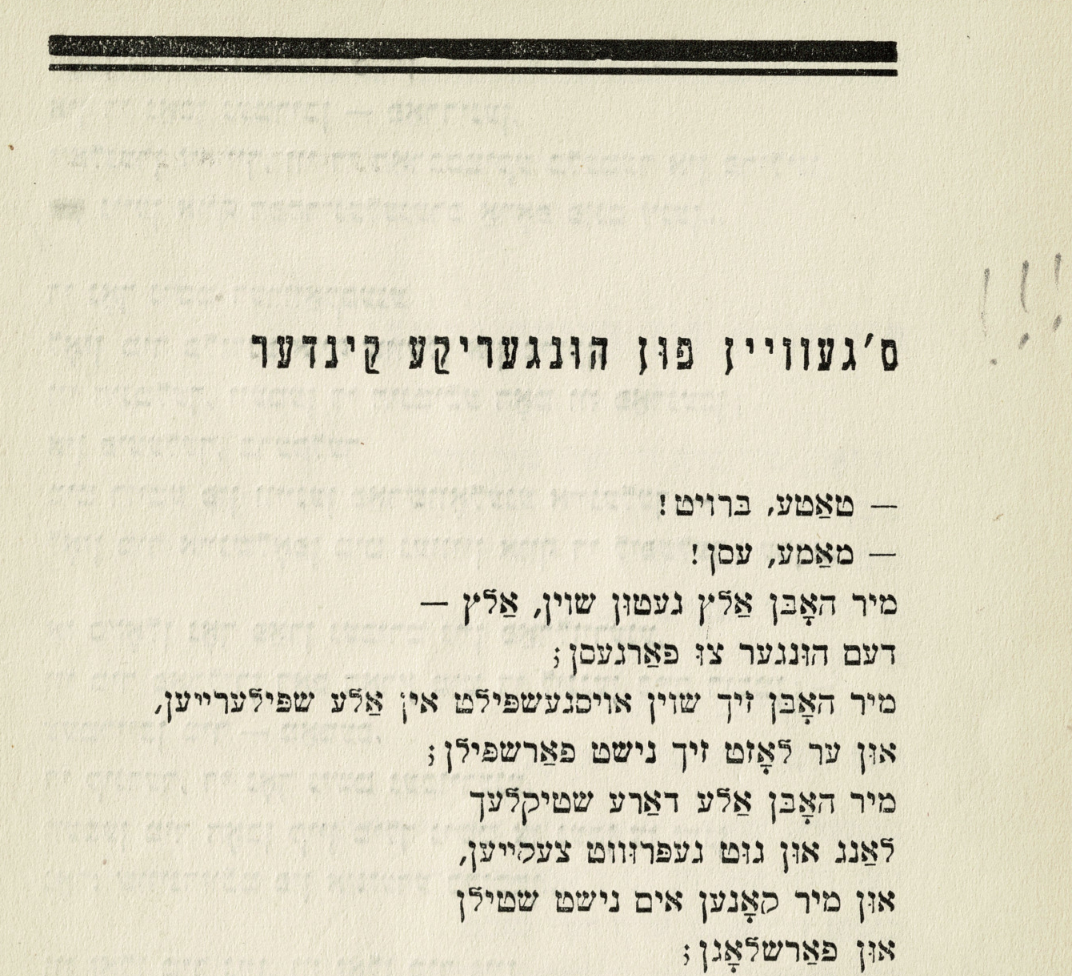
ס’געוויין פֿון הונגעריקע קינדער
— טאַטע, ברויט!
— מאַמע, עסן!
מיר האָבן אַלץ געטאָן שוין, אַלץ —
דעם הונגער צו פֿאַרגעסן;
מיר האָבן זיך שוין אויסגעשפּילט אין אַלע שפּילערײַען,
און ער לאָזט זיך נישט פֿאַרשפּילן;
מיר האָבן אַלע דאַרע שטיקלעך
לאַנג און גוט געפּרוּווט צעקײַען,
און מיר קאָנען אים נישט שטילן
און פֿאַרשלאָגן;
מיר האָבן שוין די פֿינגער ביז די ביינדלעך אויסגענאָגט
און — ס'הערט נישט אויף צו נאָגן;
מיר האָבן מיטן הונגער שוין געפּרוּווט
זיך לייגן שלאָפֿן —
לאָזן זיך די אויגן־לעפּלעך נישט פֿאַרמאַכן, —
ליגן מיר אַזוי, די אויגן אָפֿן,
שלאָפֿן אומרויִקע,
ווי מיר וואָלטן וואַכן,
חלומט אונדז : אַ שטוב — אַ קבֿר,
ס'לויפֿן מײַז פֿון ליידיק קאַלטע טעפּ,
אין מיטן שטוב — פֿיר ברענענדיקע ליכט,
אויף דער ערד — צוויי טויטע,
נעבן זיי — מיט גרויסע קעפּ
און פֿיסלעך אויסגעדרייטע —
וויינען קינדער,
רײַסן פֿון זיי טויטערהייט
און בעטן מיט די לעצטע כּוחות:
— מאַמע, עסן!
— טאַטע, ברויט!..
The Cry of Hungry Children
– Mommy, food! – Daddy, bread!
We’ve done everything to think of something else instead
But we cannot forget the hunger.
We’ve played every game we know
But hunger always wins.
We’ve tried chewing on dry potato skins,
Chewing long and chewing well.
It doesn’t quell the hunger.
We’ve gnawed our fingers to the bone,
But hunger doesn’t pause.
It gnaws and gnaws.
We’ve tried to go to bed unfed.
Our eyelids will not close.
And so we fall into a restless doze
With open eyes as if we were awake.
In our dream: a room – a grave.
Mice pouring out of cold and empty pots.
At the center of the room
Burning, candles four.
Two corpses lying on the floor.
And next to them, large-headed
And with twisted legs,
Children cry,
And with their final breath
They nag their parents
As if they were not dead:
– Mommy, food! – Daddy, bread!