Feb 23, 2026
INTRODUCTION
This teaching guide is part of a series designed to make translations of Yiddish literature accessible for use by educators in a variety of settings.
We’d like your feedback to make these guides as useful as possible. Please write to [email protected] to tell us what you found helpful, what needed clarification, what you would like to see more or less of, and what texts you would like us to produce guides for next. If you are interested in creating a similar guide please also write to [email protected].
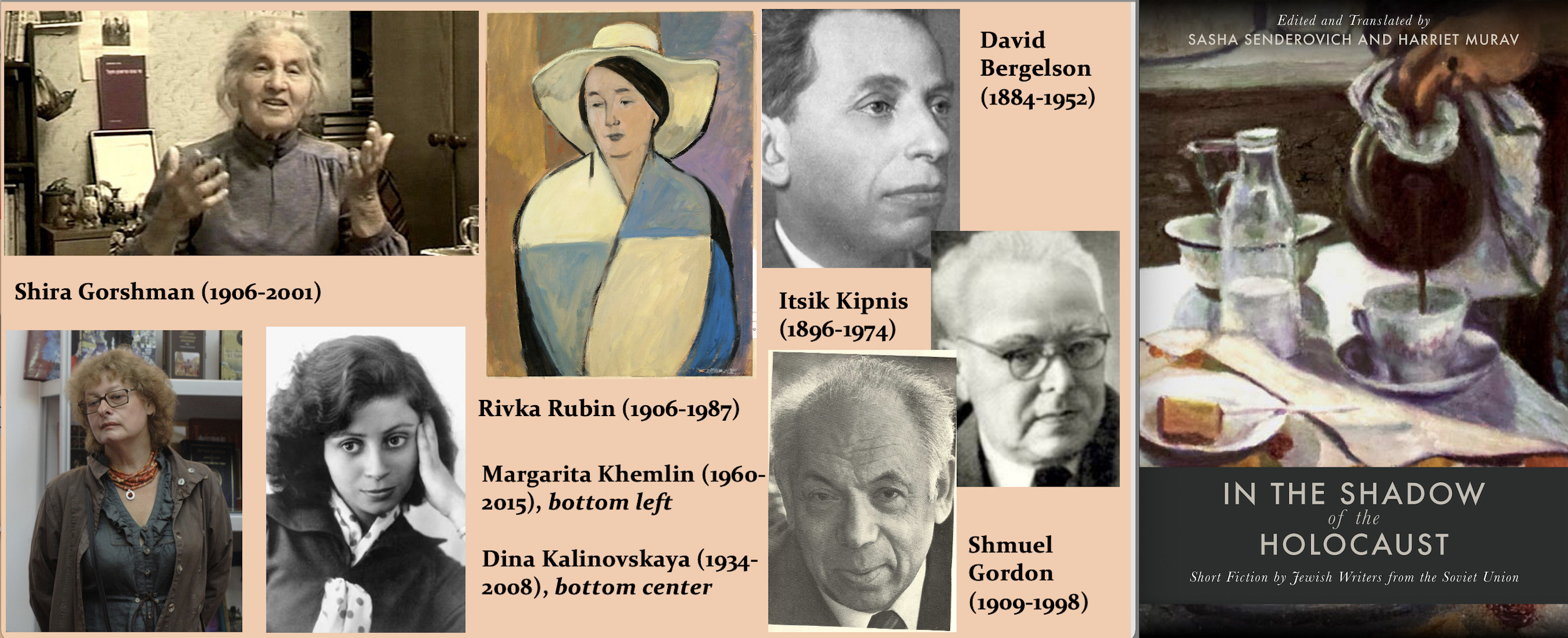
The stories we collected and translated in In the Shadow of the Holocaust: Short Fiction by Jewish Writers from the Soviet Union offer distinctive vantage points on how people continue to live after a catastrophe. These stories were written in Yiddish and Russian and published starting in the 1940s. While not all of them avoid the dramatic representations of suffering and death that readers may associate with Holocaust literature, the stories approach catastrophe obliquely. They ask how survivor testimony is mediated; they describe postwar domestic routines amidst ruined landscapes; and they enact improvised rituals of commemoration that are not immediately recognizable as Jewish but are distinctly Soviet Jewish. For students and general readers alike, the Holocaust often appears here less as a narrated event than as a shaping of an absence, embedded in language and everyday life in the shadow of genocide.
This indirection poses a challenge and an opportunity for teaching. Students frequently arrive with strong expectations about what Holocaust literature should look like: testimonial, morally unambiguous, emotionally overwhelming. At the same time, their knowledge of Jewish life in Eastern Europe before the Second World War is often fragmentary or filtered through popular representations. A small set of framing questions can therefore set the stage for productive reading: What do students know (or think they know) about prewar Jewish life? What experiences have shaped their understanding of Holocaust literature? What kinds of narratives do they anticipate when opening such a text?
The stories gathered in In the Shadow of the Holocaust invite a different kind of engagement. They ask readers to attend not only to wartime suffering but also to its aftermath over the decades after the end of World War II: to how memory is mediated by language, how past and present interpenetrate, how places register erasure, and how ordinary life absorbs historical rupture. In the classroom, these texts are especially well suited to teaching literature as a mode of ethical attention rather than as a repository of historical information (though we, as editors, made plenty of historical information available as well—the book contains detailed maps, an introduction, and notes on each text). We suggest four thematic clusters, around which a fruitful discussion in class could be organized: language and mediation, memory and temporal layering, place and return, objects, ritual, and everyday life. Together, they offer a framework for approaching postwar Soviet Jewish writing as literature of persistence rather than of catastrophe alone.
Language and Mediation
David Bergelson’s “A Witness” provides an especially clear point of entry into questions of mediation. A survivor appears in an unnamed Soviet city and insists that his story be written down. His Yiddish testimony is translated, at the very moment of being relayed, into Russian by a Jewish woman named Dora, herself the only surviving member of her family, and read by Kirill, a non-Jewish Red Army veteran. The narrative reaches the reader only through this chain of transmission, calling attention to how witness testimony becomes known.
Comparison can be pedagogically useful here. Some students may know Elie Wiesel’s Night or Tadeusz Borowski’s This Way for the Gas, Ladies and Gentlemen; others may be encountering Holocaust literature for the first time. In either case, the story invites reflection on expectation. Kirill hesitates before reading the transcript, imagining that he will encounter something overwhelming. What he finds instead is restrained, fragmentary, and emotionally muted. Instructors might invite students to consider what this kind of text—whose protagonist inside that text stands in for the reader—reveals about assumptions concerning ways in which personal and historical trauma should be narrated. What kinds of testimony do we expect, and why?
Dora’s role further complicates the scene. She does not simply transmit the survivor’s words but inserts her own wartime memories onto the same pages. Testimony becomes collaborative, layered, and unstable. Students may be encouraged to ask where authority resides—in the survivor, in the translator, or in the reader who assembles meaning from fragments.
Rivka Rubin’s “The Wall” extends these questions. The story’s narrator recounts two encounters with an unnamed older woman, one set during the war and one about a dozen years after its end. She and the older woman speak first in Russian, the USSR’s official language, but then switch to Yiddish, the familiar tongue in which tragedy can be shared and discussed in more intimate terms. Instructors might frame discussion around how language marks belonging and displacement, and how translation becomes a record of historical rupture rather than a neutral vehicle.
Margarita Khemlin’s “About Yosif,” the only story in the collection that was written and published after the fall of the Soviet Union, adds another dimension. The narrator reproduces a hybrid Soviet-Jewish idiom saturated with ideological clichés and multilingual residue of life in Ukraine before and after the Holocaust, while the title character himself remains nearly silent, both in word and in internal thought as represented on the page. Yosif’s inner life is conveyed through music, craft, and collecting rather than through discourse. Here, silence is not absence but narrative strategy. Instructors may invite students to consider how consciousness can be represented without interior monologue. What other strategies does the writer employ to reveal facets of the character? Instructors may also want to draw students’ attention to translation itself through this story, asking how translation attempts to preserve rhythm, awkwardness, and collective habit in the speech of characters surrounding the story’s main protagonist.
Across all the stories in the book, language itself becomes historical evidence. Testimony, translation, and silence are not secondary to experience but constitutive of it. Students learn to read not only what is said but how it is said, who gets to say it, and how mediation shapes memory.
Memory and Temporal Layering
Rather than presenting memory as retrospective narration, many of these stories embed it within the rhythms of ordinary time. Past and present coexist, interrupt, and reshape one another.
Rivka Rubin’s “That Kind of Day” unfolds over a single afternoon in Moscow in 1975. Shopping, cooking, and birthday preparations coexist with memories of wartime evacuation and of the artistic labor of the narrator’s late husband. Instructors might draw attention to the coexistence of multiple temporal registers—Soviet civic time, Jewish ritual time, and private mourning—and invite students to consider how routine becomes a carrier of historical consciousness.
Dina Kalinovskaya’s “The Picture in the Teacup” similarly situates memory within domestic routine. Wallpaper, old newspapers, and inherited china open pathways to wartime loss and prewar fantasy. Instructors may ask how family conflict, desire, and grief intersect in everyday settings, and how memory attaches itself to small, personal objects rather than (or in different ways than) to public monuments.
Shira Gorshman’s “From House to House” offers a particularly striking case. Hannah, the sole survivor from her Lithuanian shtetl, dreams her way through a proliferating catalogue of the dead. Each vignette records a life marked by poverty, illness, or eccentricity, often without sentimentality. The repeated refrain—a variation on “they ended up in the mass grave like everyone else”—invites sustained attention. Instructors may ask students to reflect on the emotional effect of this kind of repetition. Does it shock, numb, or accumulate force? Does it soften the blow at the end of each vignette or sharpen it?
This story also unsettles romanticized expectations of shtetl life. Students familiar with idealized portrayals—often reinforced by popular culture such as the musical and the film Fiddler on the Roof—may find Gorshman’s harsh social landscape disorienting. Instructors might frame discussion around how the students experience this shock, and how it jolts them as readers into a less sentimental understanding of prewar Jewish society and its destruction.
Context can further enrich this reading. These stories appeared in Yiddish and Russian during the Cold War; several of the texts that were written in Yiddish were also translated into and published in Russian. Instructors may ask students to reflect on their knowledge of the historical context. Is it surprising that such texts circulated at this historical juncture? What do students know about Soviet cultural politics, Jewish publishing, and the place of Holocaust memory in late socialism? Asking such questions prod students to deeper historical thinking and often illuminates both the silences and the possibilities within the narratives themselves. Instructors may ask students to pool their knowledge about this historical moment to help each other understand the stories more deeply, and then provide additional information to support students’ understanding.
Living On Amidst Ruins
Encounters with damaged landscapes recur throughout the stories in In the Shadow of the Holocaust. Cities, cemeteries, ravines, and shtetls that lost most of their Jewish population during World War II become sites where memory must be read spatially.
Itsik Kipnis’s “Babyn Yar,” written on the third anniversary of the 1941 mass execution of Kyiv’s Jews, invites the reader to walk to and through the ravine where mass shootings had occurred. History is measured through bodily movement rather than retrospective explanation. Instructors might ask what kind of knowledge emerges from traversing a site such as this. How does pilgrimage function as ethical practice rather than commemoration?
In “No Matter When,” also by Kipnis, the cemetery becomes a place where mourning and erotic tension coexist. Rather than isolating grief from desire, the story intertwines them, suggesting continuity amid loss. This juxtaposition might unsettle some readers, productively challenging them to consider how a range of human emotions can persist across rupture.
Shmuel Gordon’s “Pohrebyshche” offers further possibilities for asking questions about the workings of a return. The narrator initially sees only absence: vanished houses overlay the Soviet present during his visit to the eponymous shtetl in the 1960s. Gradually, perception recalibrates as the present begins to hold its own, hinting at continuity amidst loss. Instructors may invite students to consider how memory distorts and then adjusts vision, and how the “most modern shtetl” that the story’s narrator is searching for emerges as a hybrid of continuity and transformation.
Rubin’s “The Wall” again provides a focused case. Two women exchange wartime histories beside a ruined house in Vilna more than a decade after the end of World War II. The house had been the older woman’s residence before the Nazi invasion and before her evacuation to Central Asia. She returns to Vilna as soon as it’s liberated by Soviet troops and visits the remnants of her prewar home daily. The city becomes legible not through monuments but through conversation between the women. Instructors can frame questions about how the experience of return in this story is not one of recovery of the home but instead, one of discovering a place that is no longer a home.
Across these stories, geography becomes an ethical category. Return is not restoration but confrontation with absence and layered habitation. Students learn to read place as a kind of archive—one that records erasure as well as persistence.
Objects, Ritual, and Everyday Life
One of the most distinctive features of the texts collected in In the Shadow of the Holocaust is their attention to small gestures, objects, and improvised rituals. Memory survives not only in testimony and pilgrimage, but in kitchens, woodworking workshops, and train schedules. These stories suggest that after catastrophe, remembrance often takes forms that are partial, understated, and embedded in the routines of daily life. This is especially so in the Soviet context, in which deaths of Jews during World War II were understood as part of the overall losses among the Soviet people, not a destruction that befell Jews as Jews. The lack of specific memorialization meant that the memory of genocide was not isolated as a historical event, but instead the trauma and the losses, sometimes without being specifically named as such, lingered in the daily lives of Soviet Jews after the war.
In Gorshman’s “Not Far from Saki,” a father and son travel to Crimea to commemorate a dead wife and mother by speaking a few words and eating a tomato together. The scene is striking in its spareness. There is no named prayer, no explicitly Jewish liturgy, and no elaboration of feeling. Instructors might frame discussion around how ritual is reinvented when traditional forms are unavailable or insufficient. What does this modest ceremony accomplish? How does repetition—returning to the site on the same day each year—create continuity without formal religious structures? Students may notice that the ritual’s power lies not in symbolic fullness but in its persistence.
In Kalinovskaya’s “The Picture in the Teacup,” inheritance disputes crystallize around household objects. The eponymous teacup becomes a site of rivalry, contested family history, and longing, carrying traces of a prewar world that can no longer be fully recovered. Instructors might invite students to consider how material culture carries emotional and historical residue. Instructors may also invite a conversation about the role of domestic conflict in this story. How does such conflict become a medium for transmitting loss—and the trauma of loss—across generations? The story suggests that memory does not always appear as solemn commemoration; it often emerges through desire, resentment, and the pressure of living together in confined spaces.
Khemlin’s “About Yosif” offers something of a counterpoint. Yosif preserves fragments of Jewish life through collecting, woodworking, and music rather than through speech. His relationship to the past is tactile and material, oriented toward making and repairing rather than narrating. Instructors might ask how such practices function as forms of remembrance in a context where public language about Jewish loss is constrained or exhausted. What kinds of memory become legible when objects and manual skills replace verbal testimony?
Taken together, these stories invite readers to attend to the quiet infrastructures of memory. Ritual, objects, and everyday practices do not simply supplement historical narrative; they constitute it. In the classroom, this attention to the ordinary can open space for thinking about how memory persists when official forms of commemoration are absent, compromised, or inadequate—and how literature renders those forms of persistence visible without elevating them into symbols.