Jun 11, 2026
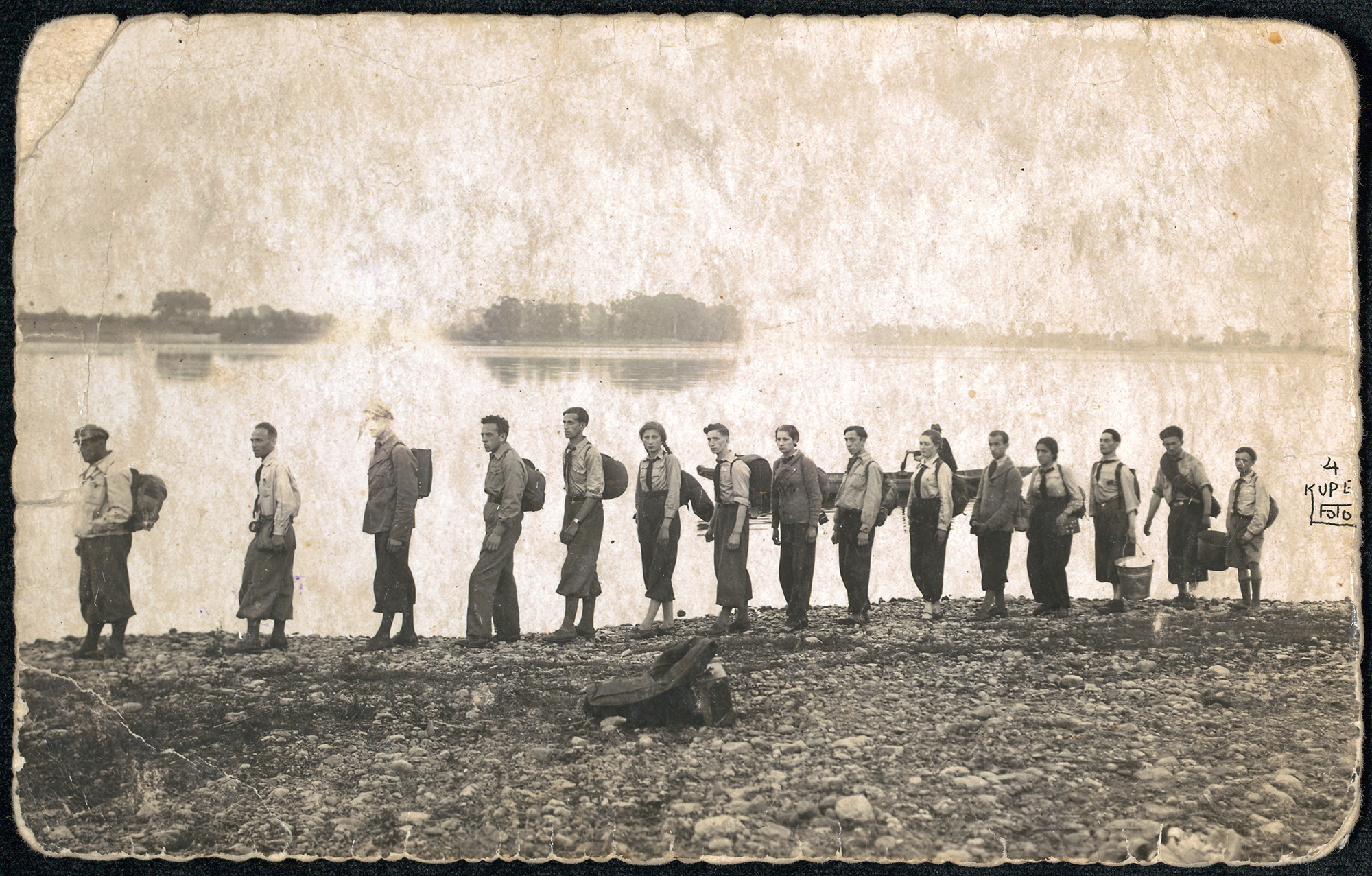
Members of the Warsaw branch of Tsukunft on a hike to a camp in Gąbin. Photograph courtesy of the YIVO Encyclopedia of Jews in Eastern Europe.
INTRODUCTION
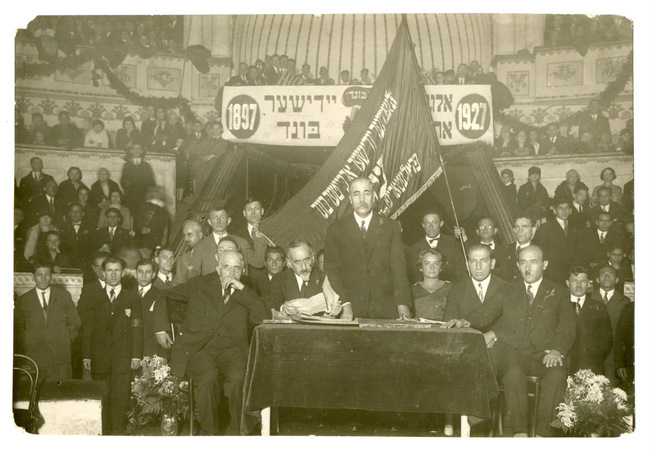
Polish Bundist Leivick Hodes published “Facing the Future: Reflecting on Fifty Years of Zionism and the Bund” in late 1947 in the New York–based Bundist newspaper Unzer tsayt, of which he was an editor. 1 1 Leyvik Hodes, “Mitn ponim tsu der tsukunft,” Unzer tsayt, nos. 3–4 (November–December 1947): 11–14. The essay is republished in Leyvik Hodes: Byografye un shriftn, ed. Sofia Dubnov-Erlich (Farlag undzer tsayt, 1962). It reflects on the fiftieth anniversary of the Bund and Zionism, both of which mark their founding in 1897. I first encountered Hodes and this essay in 2012 while researching the term do’ikayt for my dissertation. 2 2 Hodes and this essay are discussed in David Slucki’s The International Jewish Labor Bund after 1945: Toward a Global History (Rutgers University Press, 2012). See especially Chapter 6 for a full history of the Bund’s responses to the founding of Israel and discussion of Hodes’s writings against Zionism in the late 1940s, including this essay. It became a key text for my work because it remains the earliest example that I have found of a Bundist using the term do’ikayt to refer to the Bund’s belief in fighting for continued and improved Jewish life in diaspora. 3 3 My colleague Michael Casper has, however, found use of the term by the Lithuanian Folkspartey in the interwar period, suggesting that Folkists were the ones to popularize use of the term do’ikayt in the political context of contrasting diasporic autonomism and Zionism before Bundists adopted the term. See Michael Casper, “‘Principled Diasporism’: Folkists, Zionists, and the Meaning of Doikayt,” Jahrbuch Des Dubnow-Instituts 17 (December 2018): 57–85. For my discussion of do’ikayt see Madeleine Atkins Cohen, Here and Now: The Modernist Poetics of Do’ikayt. (University of California Berkeley, 2016), and Madeleine Cohen, “Do’ikayt and the Spaces of Politics in An-Sky’s Novella In shtrom,” East European Jewish Affairs 50, nos. 1–2 (2020): 6–20. This is surprising given how the term has come to be used as a shorthand for that ideology both by Bundists and in recent scholarship. But the embrace of the term do’ikayt by Bundists appears to have been an innovation of the immediate postwar period, of which this essay is an excellent example. While earlier uses of the term may be waiting to be discovered in not-yet-digitized archives of the Bundist press, my interpretation is that while it has since been used to describe the work of the Bund especially in the interwar period in Poland, the term itself seems to have been popularized in the period of struggle after the war, when hundreds of thousands of Jewish displaced persons were faced with the unimaginable task of restarting and rebuilding their lives. Even in the aftermath of the war and the Holocaust, many Bundists continued to argue that do, here in Europe, is where that rebuilding should take place, rather than dort, there in Palestine, as Zionist activists were promoting. Hodes’s essay takes stock of the fifty-year struggle between Bundist and Zionist movements at a moment when that struggle is existential for both: the Bund “losing” and Zionism on the cusp of victory, measured by the continued flow of Jews out of Europe, many of them choosing Palestine among their limited options. In Hodes’s opinion, this victory could not be more bitter, however, resting as it did on the millions of war dead and victims of genocide. The essay argues, with the raw emotion of the postwar moment, that Zionism’s victory is driven by fear, while the Bund continues to advocate for a future based on hope and belief in mankind.
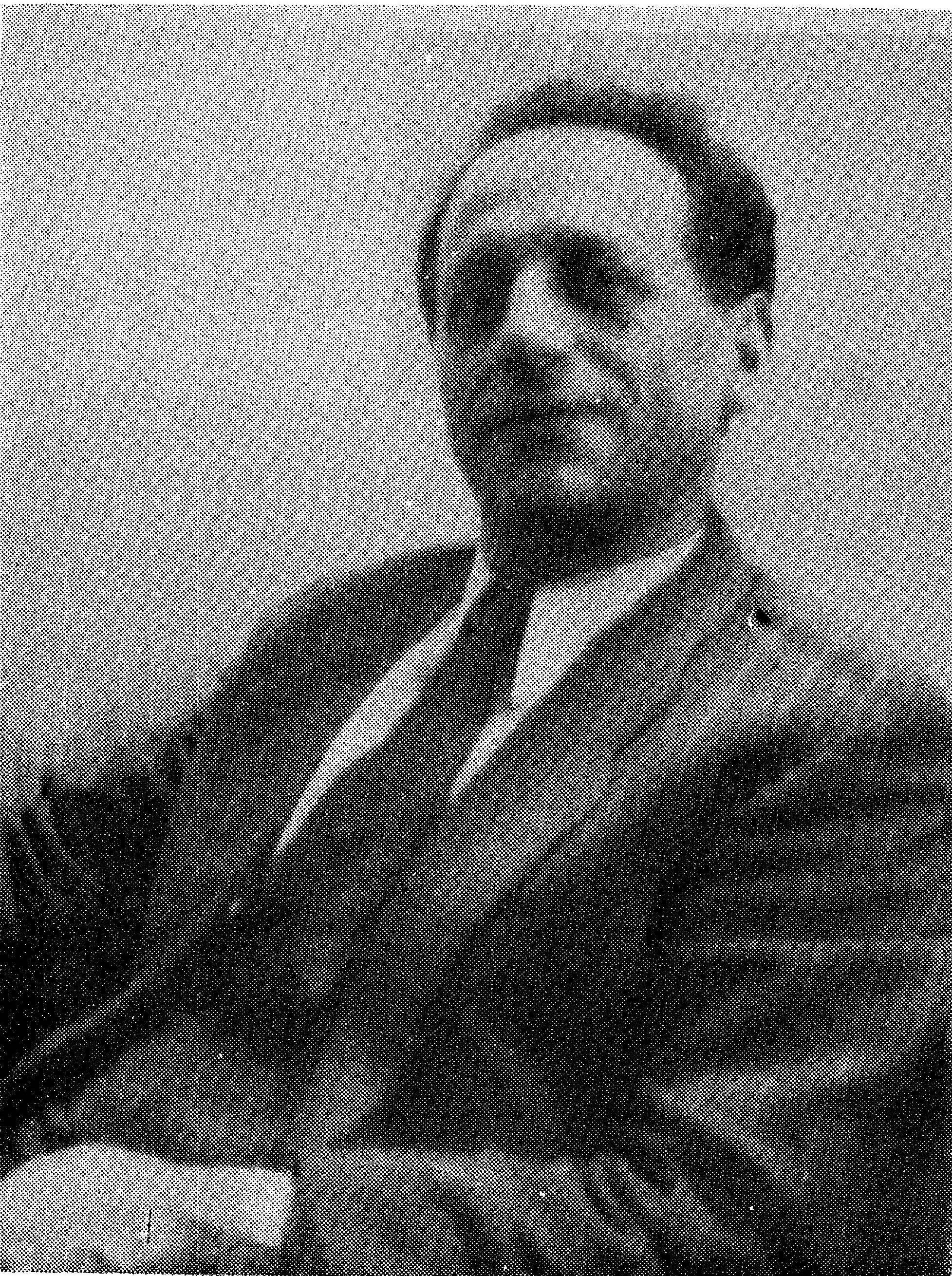
Leivick Hodes
Leivick Hodes (1892, Lepel, Vitebsk Gubernia–1957, New York) was a prominent leader in the Bund in several key periods and aspects of the Bund’s work. These included his agitation among soldiers during World War I; his leadership roles during the 1917 revolution and civil war period in the Bundist organizations in Smolensk and Vilna and later throughout Russia, Lithuania, and Poland; his key role as educator and theorist for SKIF, the Polish Bund’s youth movement, in the interwar period; his vast and varied editorial work and writing for the Bundist press; and his leadership in the postwar Bund despite his declining health. 4 4 Biographical information about Hodes comes from Dubnowa-Erlich’s excellent biographical essay in Leyvik Hodes: Byografye un shriftn, which she edited following his death. Hodes escaped Poland in 1939 with a group of Bundists and lived in New York for the rest of his life—miraculously joined in 1946 by his wife, who had survived the war in Europe. Suffering for most of his adult life from poor health resulting from a life-threatening case of typhus contracted when he was in his late 20s, by the mid-1940s his health was in permanent decline, and his political activity was limited to writing and editing. As David Slucki writes, “his work covered a gamut of issues, and he wrote a series of articles, in the years after the war, that took aim at Zionist aspirations to establish a Jewish state, that vehemently opposed the Zionist policy of ‘ingathering of exiles,’ and that defended the ongoing importance of doykayt and the diaspora in the resurrection and future survival of world Jewry.” 5 5 Slucki, The International Jewish Labor Bund, 176–7. “Facing the Future: Reflecting on Fifty Years of Zionism and the Bund” is an example of this period and focus of his work.
Beyond the context of the struggle between do and dort in the postwar period, Hodes’s commitment to the idea of do’ikayt is reflected in his lifelong love of nature and in his commitment to SKIF, for which he was theorist, teacher, and scout leader on many hiking and nature expeditions for its young members (some of whom went on to be leaders in the Warsaw Ghetto). On the occasion of Hodes’s yortsayt, Yosl Mlotek, a former member of SKIF, spoke of Hodes’s lifelong “love for beauty and the sublime”: “Perhaps it was for this reason that Comrade Hodes became the founder of socialist scouting, to promote a sense of connection and affinity with nature, the love of hiking and camping out on the open land or in the deep forest.” 6 6 Dubnowa-Erlich, Leyvik Hodes, 36.
Leivick Hodes is one of many tireless activists for a socialist, diasporist, Yiddishist future whose stories we can continue to learn with and from today. I discuss some of what Hodes’s work has meant to me and others in an afterword following the translation.
Click here to download a PDF of the translation. The editors have chosen to publish this essay without a parallel Yiddish version due to time constraints, but a PDF of the Yiddish can be downloaded above (on the righthand side of the page) and is also appended to the end of the PDF of the translation.
This year marks the fiftieth anniversary for both the Bund and Zionism as organized social-political movements. These have been fifty years of pulsating social life in the Jewish world and on the Jewish street.
Both movements arose among masses whose spiritual life was fulfilled by religion. Both movements had a modern secular character. The Bund was completely secular, while Zionism had a touch of secularism. At the time of their founding, both movements offered a challenge to all those for whom Jewishness was tightly bound to religion. The creation of a secular movement eventually provoked the Orthodox movement to organize itself politically as well. Over the course of this half century, Orthodoxy, Zionism, and the Bund became the three most important driving forces on the Jewish street. In certain moments of this half century, assimilationism also had its influence. Connected with emancipation and enlightenment, the ideas of assimilation took on varied forms among different parts of the Jewish people at different times. These ideas began with the hyper-patriotism of “Polish of Jewish faith” (in other countries “German,” “French”) among the wealthier classes and continued with the naive cosmopolitanism of the Jewish socialist intelligentsia, which was disconnected from the life of the Jewish masses. In these and other forms the aspiration toward assimilation never completely disappeared from the surface of Jewish life. So, in addition to the three previously mentioned driving forces in Jewish society, the idea of assimilation also played a sometimes larger and sometimes smaller role.
Over the course of this half century, these four schools of thought—Zionism, socialism (embodied by the Bund), Orthodoxy, assimilation—competed against each other, often fighting bitterly over the soul of every Jew and the correctness of the path they each laid out for the Jewish folk. In the course of this competition, each doctrine influenced the others, and each was influenced by life itself. For example: Bit by bit, Orthodoxy has accepted the most important elements of Zionism, while Zionism itself has lost its secular character, and an influential religious tendency developed within it (Mizrahi). At the same time, other ideological tendencies have been incorporated into Zionism: In recent years there has been democratic Zionism, fascist Zionism, and communist Zionism. All are housed together under the shared Zionist roof. In the interwar period, the period of the greatest tension within Jewish cultural creativity, assimilationism as a movement lost a true foothold in Jewish life. But at certain moments, it had also found touch points with Zionism, beginning with Jabotinsky’s “Hebrew or Russian” and ending with a pilgrimage of assimilationist Jewish intellectuals to the ranks of Zionism at the start of the 1930s. This expansion allowed Zionism to describe itself as a popular movement. But even at its widest spread before the war Zionism never successfully penetrated the workers’ movement. The strongest and most numerous workers’ organizations in Poland and other countries were usually free of Zionist influences. The majority of organized Jewish workers were true followers of the Bund. The social battle on the Jewish street therefore played itself out essentially as a fight between two main organized forces: On one side, Zionism (with religious, democratic, fascist, socialist, or communist tendencies), and on the other side, the Bund as the embodiment of the fight for socialism and do’ikayt. There have been times when Zionism had the upper hand. And there have been times when the Bund had the broadest masses behind it. In the last years before the war, the Bund was backed by the majority of voting Jews in the largest cities in Poland, while Zionism (in all larger cities) commanded an insignificant minority. But even then, no one was fooled into believing that the competition was over. Fifty years of the Bund and fifty years of Zionism is also the anniversary of a competition that still waits to be decided by history. The dynamic national forces in this arena are the Bund and Zionism. But in real life, as stated above, other schools of thought were also at play among Jews. After fifty years, what is the outcome of this strenuous contest among the various ideologies on the Jewish street?
Let us attempt to give an overview.
On the surface, the balance today appears to be: good for Orthodoxy, good for assimilation, outstanding for Zionism, and bad for the Bund.
Today the Jewish street echoes with the call: “Back to the old Jewish tradition.” This is a phenomenon that is easy to understand. After every great national catastrophe in Jewish life in the course of the long history of the Jewish people there has always been, on one side, a resistance to senseless suffering, and, on the other, a yearning to find comfort and oblivion in the mystical and irrational. Shabbetai Zvi, Jacob Frank, and the movements they created, as well as those who immersed themselves in Kabbalah, were products of such mass events; these were all different ways of rebelling, or of seeking oblivion in visions of an imaginary world. None of us today is yet capable of observing our contemporary epoch with a generational perspective. But we can grasp that the experiences of our time have made fertile soil for all kinds of irrational longing. We have witnessed how some Jews around the world have increasingly taken up the call, “Back to the shul!” It is a call for atonement, a growing desire for an uncritical apologetic for all things having to do with the Jewish past, with Jewish tradition, with old Jewishness. There is no country today where these calls are strong enough to constitute a mass movement. The speakers and purveyors of these sentiments in public are often people who are far removed from Jewish orthodoxy but who nevertheless express a sentiment that is auspicious for organized Jewish orthodoxy and for its desire to make a greater impression on Jewish life. In America, for example, the slogan “Back to Jewishness!” has manifested itself in the growth of the number of yeshivas and increased funding for religious institutions and the like.
Secular Yiddish culture suffered a severe blow with the destruction of the most vibrant Jewish communities, such as Warsaw, Vilna, and Białystok, where secularism had imprinted itself so deeply on all forms of Jewish life. Since the destruction, the pursuit to identify Yiddishkayt with religious belief has only grown. Having noted all the above facts, a clear account of their import must be given. Yes, the sentiment for “Jewishness” has grown, but that is certainly not a victory for Orthodoxy. It would be more accurate to say that this is one reflection of Hitler’s victory over the Jewish people. The catastrophe annihilated the healthiest and most creative and productive part of the people. The tragedy has manifested psychologically in the tendency to nostalgic revisionism, as well as in the fact that Jewish life has regressed by several generations in terms of cultural richness and creativity.
Assimilation among Jews also had a better chance after the catastrophe of the war. In recent years newspapers have reported on epidemics of conversions among Jews in various countries. Even if the reports are overblown, they possess a kernel of truth. And this surely cannot be understood as a religious phenomenon. The “Christian” idea of love among peoples has certainly not triumphed in recent years to the extent that the Christian faith would have become more attractive. And if the Christian idea of forgiving all sins has triumphed, it is primarily applied to the sins of Nazis and the murderers of Jews—again, far from an attractive phenomenon for the victims of the murderers. Rather, what we are seeing is a growing desire to throw off a heavy burden that has caused such inhuman suffering. Parallel to this, the roots of the Jewish tree have been severely damaged. During the war in Europe, hundreds of thousands of Jews attempting to survive were forced to swallow their language. Speaking a Yiddish word meant a death sentence. Small children were taught to forget Yiddish. The youngest generation has grown up not knowing they are Jewish, or not admitting it. These are the circumstances in which waves of assimilation have overtaken Yiddishland. But again, it is hardly necessary to point out that this is not a victory for the specific ideological concept of assimilation, but rather an expression of Hitler’s triumph.
Today Zionism celebrates victory. The Zionist idea has apparently won on all fronts. The Jewish Yishuv in Palestine has grown to over six hundred thousand souls. Jews from the camps long to go to Palestine. Many Jews from the eastern European countries are ready to travel there. A Jewish state in Palestine is no longer restricted to the realm of Zionist fantasies; it has instead become a problem for the United Nations. A number of bourgeois and workers’ organizations that were previously neutral or opposed to Zionism now support the idea of a Jewish state. Could there be greater reason to celebrate victory? Nevertheless, the cup of Zionist celebration also contains a large measure of gall. Leave aside for the moment that this all revolves around a tiny statelet with a large Arab minority, where differences in growth rates between Arab and Jewish communities could in a very short time transform the Arab minority into a majority and the Jewish state into an Arab one; leave aside that this statelet, even according to the suppositions of the UN commission, would always require an influx of support from Jews in other countries, and that this would necessitate entrusting the half-million Jews in the Yishuv to the custodianship of the Jewish people who remain in “golus”; leave aside that the statelet would find itself surrounded by hostility, and every increasing shock would transform Palestine itself into one of the most dangerous places for Jews in the world; leave aside all that, and it is easy to demonstrate that the entire triumph of Zionism is a result of Hitler’s victory. The Jewish Yishuv in Palestine has become much more significant in the eyes of many Jews because European Jewry has decreased by six million. The lucky circumstance of the war, in which the entire Nazi war machine was unable to roll through El-Alamein, helped the Zionists spread the illusion that Jewish lives are safe only in Palestine. The despair after the slaughter helped create among many survivors the impulse to run as far as possible, and the propaganda for “a land of our own” easily took root in orphaned hearts. Therein lies the chief reason that Zionism cannot fully enjoy the cup of “victory.” A dance of celebration would be a macabre dance over the dead. In actuality, it is not Zionism that won—it was Hitler, and the Zionist movement reaps the benefits.
In the light of these observations, one can more clearly see the full picture of the fifty-year conflict on the Jewish street. Whatever the outcome of this competition appears to be from the outside, it is clear that life has not yet resolved this conflict. The tragedy in the life of our people created more favorable circumstances for Orthodoxy, assimilation, and Zionism—above all, for Zionism. But can we learn anything from these changes that reflects the vitality of each school of thought? Absolutely not! They are the results of a historic catastrophe that no one foresaw and no one in the world thought possible. It was a volcanic eruption of bestiality and barbarism. It erupted in Poland. It annihilated the greater part of European Jewry. With the tiniest alteration in the course of the war—if the Nazis had made it from North Africa to Asia Minor and temporarily occupied the Asian coasts of the Mediterranean Sea—the volcano would have poured on the heads of the Palestinian Jews with no less elemental a force, and instead of six million victims there would have been six-and-a-half million, and of the Jewish Yishuv in Palestine not a remnant nor refugee would remain. And that too would say nothing about the conflicts on the Jewish street.
The great Jewish catastrophe weakened the position of the Bund. In Poland, the land of the greatest Jewish creativity, millions of Jews are gone—hundreds of thousands of workers, craftspeople, and common folk, from whose lives’ rich black soil the Bund drew strength to grow and develop. This is not only the tragedy of the Bund, but of the entire Jewish people. One cannot speak of winners and losers on the Jewish street. The war defeated every part of the Jewish people.
After fifty years of struggle the contest of ideas on the Jewish street remains undecided. And the central ideological content of this struggle remains, now as before, a crossroads between the Bund’s path and all others.
The idea of the Bund is deep belief in humankind. All of the movements opposed to the Bund rest on a lack of such belief. The pious Jew awaits aid from heaven; the assimilated Jew thinks they can change sides, go over to the dominant camp; the Zionist thinks they can run away from evil. Belief in humankind is not popular today. In these last years we have all seen it become debased, trampled, and spat upon. But if man is by nature a beast, no amount of running away will help. If there is no tikkun, no redemption for mankind, then there is no redemption for the Jews. The beast will hunt those who run from it and find them everywhere. If the belief disappears, then every hope disappears. The victory of the Zionist idea is a victory of a failure to believe in mankind. It is a total victory for hopelessness.
The Bund has always placed its cards on socialism, which means a better future for all humanity, for all peoples. If the socialist dream comes true, there is no one to run away from. If the dream dissipates, like so many of mankind’s better dreams, then there is nowhere to run to. The mirage of the statelet set amongst enemies is no amulet to protect against antisemitism and extermination.
The Bund has always believed that the best defense against murderous antisemitism and against national oppression in all its forms is the success of worker-led governments and of broad democracies that actualize the power of the worker. Opponents of the Bund start from the premise that antisemitism is eternal. Today the countries where workers have the greatest influence are precisely the places where Jews feel most secure, and at the same time antisemitism takes ever deeper root exactly in that land which the Zionists call upon Jews to run to, in the very soil of the planned Jewish state.
The Bund has always fought for continuity, for creative national life, for do’ikayt, for the right to remain rooted in the ground where the Jewish masses live and fight. Nazism dealt this idea its most painful blow. The remnants of the Jewish masses waste away in the camps, wander homeless along the roads, or float like splinters on the foaming waves of the stormy postwar world. But with every day it becomes clearer that the path to healing these wounds leads not through increasing the number of helpless wanderers, not through further uprooting, but through building and rebuilding. The work of rebuilding in Poland and the development of Jewish communities in France and Belgium are gigantic achievements not only for the remaining Jews in those countries: They can rightly be viewed as acts of the greatest historical importance for Jewish survival, in the broadest sense of the word. The efforts to rebuild and to secure Jewish life in Europe robs Hitler’s heirs of the fruits of their victory over the Jews. The Bund has always pushed the Jewish people toward a creative national life, and even the smallest project—a workers’ cooperative, an orphanage, a school, a library—that is built and secured in the countries that should, according to Hitler, be “Judenrein” is an expression that this force still lives, that in the depths of Jewish life in Poland and in other countries, there are springs still trickling, which want to flow, which must flow again in fruitful streams of national creativity and continuity.
For over fifty years there has been an ideological fencing match on the Jewish street: on one side, the doctrines that arise from distrust and despair, and on the other—the Bund, which still believes and which turns its gaze to the horizon of a new and liberated world. Despair and doubt have been nurtured today by the most bitter tragedy in the life of humankind: a pain never before witnessed in history, Hitler’s death machine. But if humanity has any future, it is a future based on belief in socialism and national equality; that is the future, a vision brought to the dejected Jewish masses fifty years ago by the General Jewish Workers Bund.
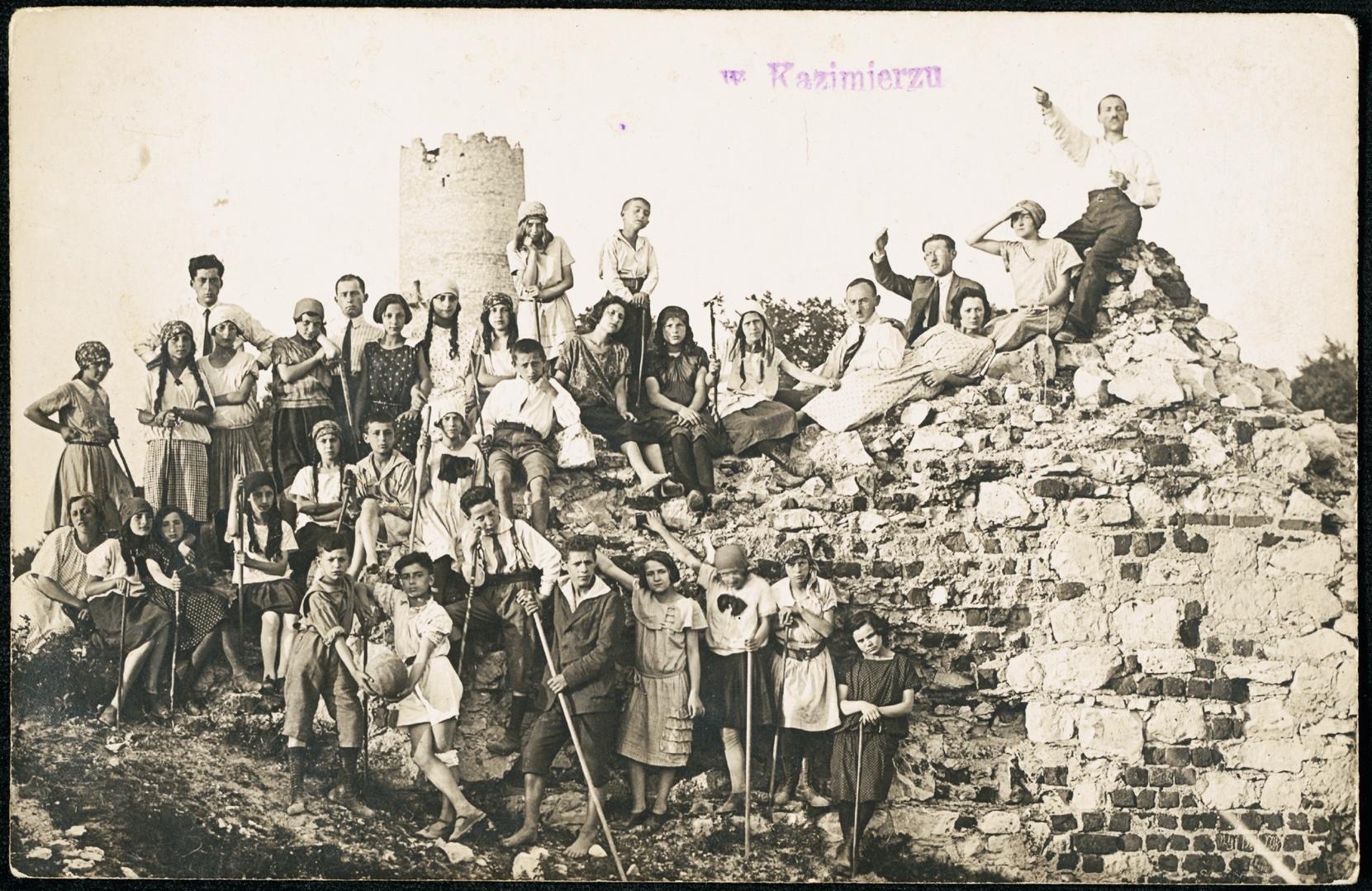
A group of Bund youth, Poland, 1930s. Photograph from the YIVO Encyclopedia of Jews in Eastern Europe.
Afterword: Facing the Future Today
Certain works travel with you. They become companions that grow and change in meaning over the years as we, their readers, grow and change. Ideas from these works echo and resonate more loudly, differently, as the world around us changes. This essay has been with me for almost fifteen years. I first shared excerpts from it in 2014, during that year’s war in Gaza. 7 7 The quotation was published in a piece I wrote for Yiddishkayt, reflecting on my experience teaching in the Helix Fellowship in eastern Europe in the summer of 2014. See Mandy Cohen, “On the Frontiers of a Divided World,” Yiddishkayt, August 2014, https://yiddishkayt.org/border-lessons/. I returned to the essay after October 7, 2023, and was moved to complete my translation and publish it at long last after being contacted by Molly Crabapple as she prepared for the publication of Here Where We Live is Our Country: The Story of the Jewish Labor Bund. Molly had found my translated quotations and gotten in contact back in 2018 when she was working on her essay for the New York Review of Books, “My Great-Grandfather the Bundist” (Oct 6, 2018). The quotation stayed with her over the years, as it has stayed with me, and is included in the book. 8 8 Molly Crabapple, Here Where We Live is Our Country: The Story of the Jewish Labor Bund (Penguin Random House, 2026), 370–1. The quoted passages are from the paragraphs beginning “The idea of the Bund is deep belief in humankind . . .” (fifth paragraph from the end) and “The Bund has always fought for continuity . . .” (second to last paragraph). In her acknowledgments she calls the concluding passage of this essay a “moral touchstone for the book.”
I feel the same. Today we can read this essay with the “generational perspective” on the Holocaust and the complexities of Jewish politics in that period that Hodes knew he and his contemporaries did not yet have. His deep partisanship for the work of the Bund, the rawness of the staggering losses of life and community he had witnessed, his lifelong sacrifice for causes declared “losers”—at the time of writing, Hodes had no emotional or political distance from these things, and he knows it. Nevertheless, his concluding point—whether we read it as moral, ethical, or political—has been a touchstone for me for many years now, growing only ever more heartbreakingly urgent: The work to become safer in our homes will never be achieved by denying the safety of home to others. This is work that cannot be done alone. It must be done together.
I am grateful to the students, scholars, and activists who have reached out to me over the years, expressing how Hodes’ words in my translation have mattered to them. 9 9 For one published example, see Dan Sinykin, “On the Jewish Question,” May 11, 2026, https://sinykin.substack.com/p/on-the-jewish-question. I am also grateful to Julian Svedosh for giving me enthusiastic permission to share his grandfather’s words. He is also researching and planning to write about Hodes.