Apr 29, 2026
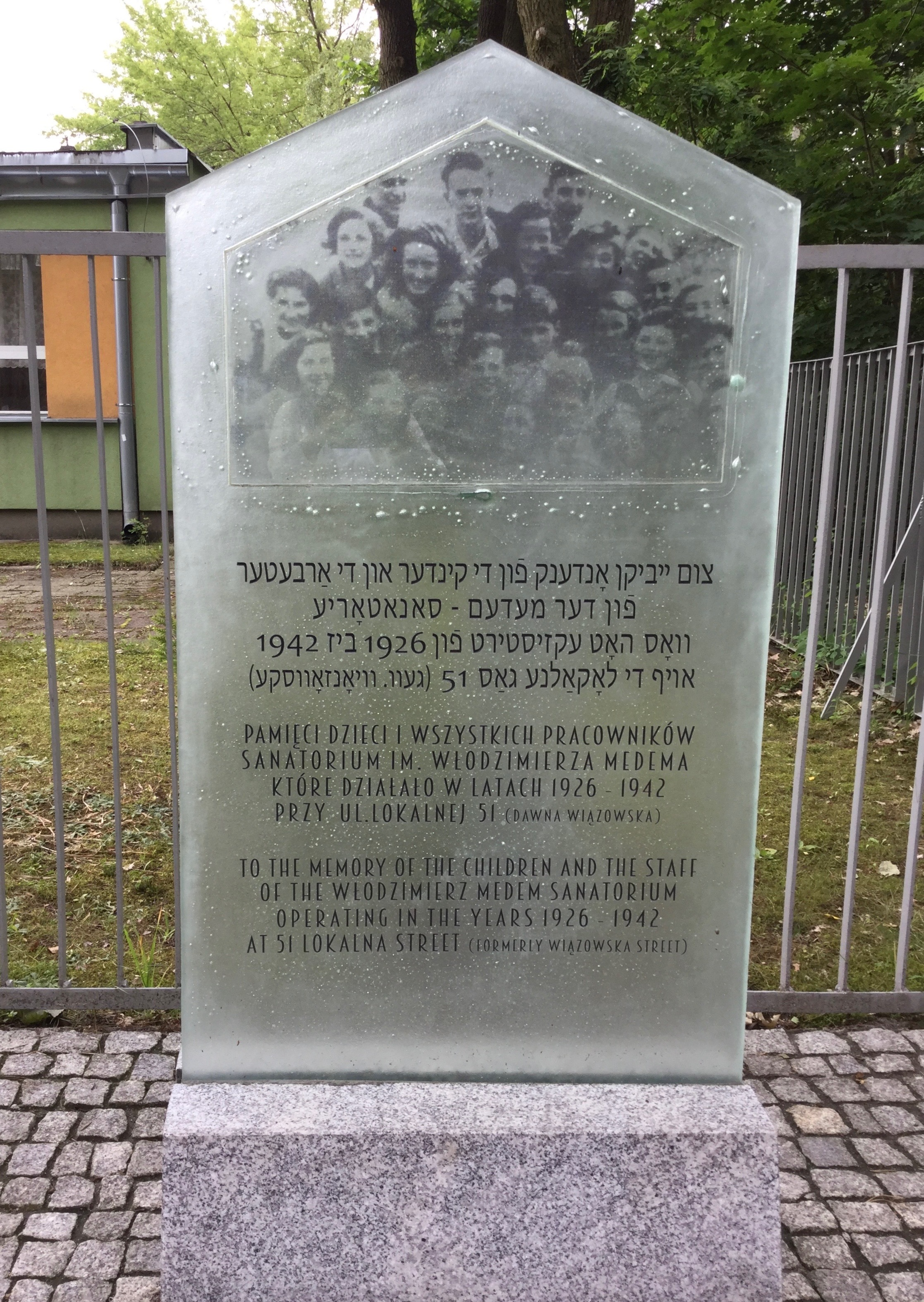
The memorial to the Medem Sanatorium in Międzeszyn. Photo courtesy of Irena Klepfisz.
Translator's Introduction
by Irena Klepfisz
Growing up among a community of Bundist Holocaust survivors, I (over)heard endless conversations and reminiscences about their experiences and activities in interwar Poland as Bundist teenagers and later as young adults during the war. A frequent topic of their discussions was their childhood experiences in the Medem Sanatorium. Dubbed the “crown jewel” of the Jewish Labor Bund’s achievements in interwar Poland, 1 1 Jack Jacobs, “The Medem Sanatorium,” in Bundist Counterculture in Interwar Poland (Syracuse University Press, 2009), 62–81, here 62. the sanatorium was committed to aiding poor Jewish children suffering from tuberculosis and at-risk children who were malnourished and deprived. Named in honor of Vladimir Medem, the early Bundist leader who died in 1923, the sanatorium functioned from 1926 to 1942, when the Germans liquidated the institution and the children and teachers still living there. During the sixteen years of its existence, it cared for more than nine thousand children, the majority from poor Jewish families. Within a short time, it became internationally known for its pedagogical philosophy and practices. 2 2 See Jacobs, “The Medem Sanatorium,” and Miriam Udel, “The Storm Within: The Medem Sanatorium and the Inner Lives of Children,” in Modern Jewish Worldmaking Through Yiddish Children’s Literature(Princeton University Press, 2025), 115–36. For more data and a detailed description of the children’s activities, see Vi azoy lebt dos kind in medem-sanatorye (How a child lives in the Medem Sanatorium), 1932, available through the National Yiddish Book Center, https://www.yiddishbookcenter.org/collections/yiddish-books/spb-medemsanatorye00farv/medem-sanatorye-in-myedzeshin. Though this brochure doesn’t bear his name, Shloyme Gilinski is listed as its author in the Leksikon fun der nayer yidisher literatur, https://congressforjewishculture.org/people/5912/Gilinski,%20Shloyme-Fayvish%20(December%2015,%201888%E2%80%93September%204,%201961. See also interviews (in Yiddish) recalling childhood experiences in the Medem Sanatorium with Itzhak Luden and with Chana Szlang Gonchor, 12:30–28:37. The 1938 Alexander Ford documentary Mir kumen on (Children Must Laugh) was used to raise money in the US for the Medem Sanatorium; see https://www.youtube.com/watch?v=vozD_XbGHGA.
Because of the loving ways the adults depicted it, I always pictured the sanatorium as an Eden-like, magical place. I would often visit it in my imagination and fantasize about what it must have been like to be a child member of its community. The sanatorium was so vivid for me that in 2017, when I was on an extended visit to Poland, I asked Paula Sawicka, my Warsaw host, to take me to Międzeszyn, the small rural town about twenty miles outside of Warsaw where the sanatorium had been located. Paula agreed, and one day she drove me there.
Actually there is really nothing to see. There is not a shred of physical evidence left of the grounds and buildings of the sanatorium. But there is a small, modest marble memorial on a sidewalk near a local school charged with its upkeep. The upper part of the memorial encases a photograph of a group of young teens at ease and laughing at the camera, and below the photograph, it provides the viewer with the following inscription in Yiddish, Polish, and English:
To the [eternal]
3
3
The word “eternal” appears in the Yiddish inscription but not the English.
memory of the children and the staff
of the Wlodzimierz Medem Sanatorium
operating in the years 1926–1942
at St. Lokalna Street (formerly Wiazoska Street)
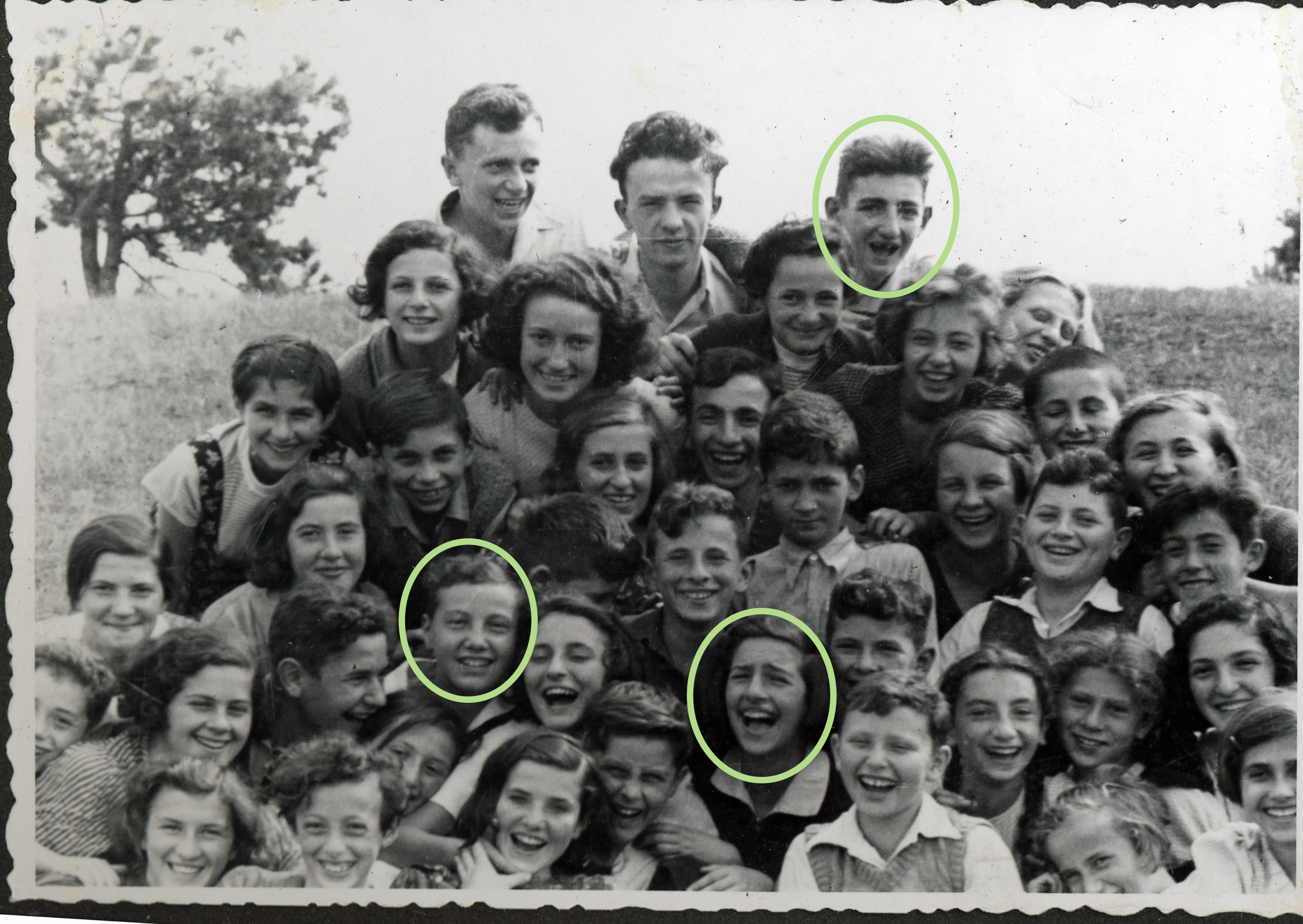
The photograph on the memorial to the Medem Sanatorium. Highlighted in photo: Marek Edelman (top), Vladka Meed (bottom left), and Hannah Fryshdorf (bottom right).
I was familiar with the photograph. It had been shown to me many times many years earlier, and I recognized three of the teenagers: Marek Edelman (the future resistance fighter, cardiologist, and human rights advocate), Vladka Meed (the future underground courier and memoirist of the Warsaw ghetto resistance) and Hannah Fryshdorf (the future partisan and secretary of YIVO). The memorial and its photograph confirmed for me the existence of the sanatorium. But even more startling was seeing young Marek, Vladka, and Hannah directly in the sanatorium in its original surroundings; the memorial seemed transformed and became amber-like, allowing me to glimpse the living, dynamic sanatorium as it existed before the war. It’s as close to the Medem Sanatorium as I’ve ever gotten.
Just a couple of years later, I don’t remember how or why, I began browsing through the Medem-sanatorye-bukh (Hamenora, 1971), a massive collection of essays commemorating the sanatorium. Among the tributes and analyses listed in the table of contents was an essay by Shoshke (Rokhl) Fleigl-Erlich. The essay, “Mayne zikhroynes fun Medem-sanatorye” ("My Recollections of the Medem Sanatorium"), describes the institution, its leaders, and their interactions with the children. 4 4 Shoshke (Rokhl) Fleigl-Erlich, “Mayne zikhroynes fun Medem-sanatorye” [My recollections of the Medem Sanatorium], in Medem-Senatorye-bukh, ed. Kh. Kazdan (National Yiddish Book Center, 1971), 373–79. I was focused on it for obvious political reasons, but perhaps even more so for personal ones.
Shoshke’s daughter Miriam (“Mimi”) Erlich was one of my oldest friends, and she and her family belonged to the same tightly held group of Bundist survivors that raised me. I always considered Mimi to be Jewish royalty. She was the great-granddaughter of the historian Shimon Dubnov and the granddaughter of Henryk Erlich, the martyred Bund leader, and Sophia Dubnov Erlich, a feminist writer and activist. In addition, in the early 1970s, Shoshke had been my mentor/tutor when I was a post-doctoral student in the Max Weinreich Center for Advanced Jewish Studies (YIVO). So when I saw her name in the collection’s table of contents, I was at first surprised and excited and then very moved by what I read. Of course, I contacted Mimi, who, I learned, did not know her mother’s essay, and within a couple of hours of receiving it, she quickly produced a first draft of a translation. Then, a few days later, before we had a chance to talk, she became ill, and after a long struggle, Mimi Erlich died in 2021. I became committed to completing the project for her.
However, the COVID-19 pandemic and my own challenges kept me from finalizing Mimi’s translated text until now. And though I regret the delay, I also realize that now is actually an appropriate moment for bringing attention to the history of the Medem Sanatorium. This year, 2026, will mark the one hundredth anniversary of the founding of the institution, and I have heard that some events are being planned in Poland in honor of this. Simultaneously, more than any other period during my lifetime, young activist Jews in the US have begun questioning everything about American Jewish life and are raising concerns—political and moral—in major American Jewish institutions about antisemitism, racism, the Israeli-Palestinian conflict, Zionism, anti-Zionism, diversity, freedom of speech, and, in general, the content and meaning of Jewish identities, both observant and secular. Struggling in today’s difficult political environment, many have turned to the Jewish Labor Bund specifically to support their stated anti-Zionist politics; in doing so, some have begun calling themselves Bundists.
But though well intentioned, this identification is misplaced. It is, of course, true that the Bund was an anti-Zionist movement; but equally important was its fostering of the concept of do’ikayt/“hereness,” the belief that Jews can be fully Jews anywhere in the world and have no need of a nation-state. And it was precisely this do’ikayt that the Polish Bund was primarily concerned with: the spiritual and material conditions of Jews in interwar Poland. Thus, the Bund was a complex socialist political movement that addressed all issues that affected diaspora Jews, most of whom were extremely poor and in great need. It was committed to establishing institutions that would help Jews lead meaningful, creative, and productive lives. To that end, it organized and supported schools and libraries, labor actions, health collectives and hospitals, artwork and theaters, all the while fighting antisemites who tried to bar Jews from engaging fully in Polish life.
Also important was the Bund’s conscious mission to reach and integrate a “younger generation” into its institutions; to help usher youth into the movement, it created SKIF and Tsukunft. 5 5 For the history of SKIF (Sotsialister Kinder-Farband [Socialist Children’s Union]) and Tsukunft (“future,” the Young Bund), see Jacobs, Bundist Counterculture, 8–47. The Medem Sanatorium was a major part of this mission. Organized by Bundists, it specifically addressed the health and material and social problems of poor Jewish children. Believing that health is dependent on social and economic conditions, the Medem Sanatorium tried to instill the children in its care with socialist principles, including collective responsibility for each individual member; participation in democratic, self-governing councils; and education in science, biology, history, and world news. It also introduced the urban poor to the beauty of the rural and natural surroundings of Międzeszyn.
Today some younger Jews are recognizing the breadth and richness of the Bund legacy as witnessed by the recently founded multichapter international Jewish Labor Bund. 6 6 For information about this new organization, see https://www.jewishbund.org. For those interested in Bundist principles, learning about the Bund’s “crown jewel” is essential.
As appropriate as publishing the translation of Shoshke’s essay in 2026 is, I also sense a terrible loss in the delay. Shoshke Erlich’s “Mayne zikhroynes” is neither chronological nor historical. Rather, through a series of vignettes, it offers us glimpses of significant moments and events at the sanatorium that evoke the spirit of the Bund, its socialist ideology, and the pedagogical approaches of its caretakers and teachers. These become evident through Shoshke’s animated descriptions of the exchanges and interactions among teachers, children, and famous cultural guests. Through these recollections we are provided with the living practice of socialist theories.
But I wish we had more information about Shoshke herself, a very young woman during the sanatorium’s existence. Born in Białystok in 1909, Shoshke Fleigl-Erlich became a member of the local Bund at an early age. When still in her teens, she left for Warsaw, probably arriving shortly after the opening of the sanatorium in 1926 and quickly became active as a member of the Bund’s Warsaw Central Committee focused on SKIF and Tsukunft. Unfortunately, we do not know exactly what her relationship was to the sanatorium. Did she visit it as an official of the Central Committee to observe and report? Or was she the person assigned to accompany the literary guests who were so eager to visit the children at this famous institution? Was she personally a witness to the scenes that she describes, or are some based on stories that others brought back to Warsaw and that she still remembered in New York thirty years after the war?
If Mimi and I had had more time together I would have plied her with questions about her mother’s connection to the sanatorium and perhaps about other memories that Shoshke had shared with Mimi and not included in her essay. Mimi might have been an ideal source for this information. Maybe. But we never got the chance to have that conversation, and I am conscious of how fragile hemshekh/continuity can be and how easily the thread can be broken. I was left to find out whatever I could through research and questions to friends and scholars.
We will probably never be able to address any of the issues that Shoshke’s essay raises. Nevertheless, Shoshke’s “Zikhroynes” are important and moving because they give us vivid images of the children’s relationships with the teachers who fed them, taught them, sang and played with them, and helped them heal physically and emotionally. Many of the Bundist survivors I knew who had been to the sanatorium and had been members of SKIF and Tsukunft had internalized their teachers’ socialist dreams to such a degree that decades after the war they remained loyal to their Bundist ideals. Shoshke articulates a similar awareness and commitment to hemshekh and the Bund’s dreams for a Jewish future. More than fifty years ago, in 1971, she posed a series of questions to her readers ending with, “Who are the heirs who will inherit these dreams?” It is a haunting question written in Yiddish, a language most American Jews do not understand. But if translated and absorbed, it is perhaps more possible that today’s younger generation will take it upon itself to answer when reflecting upon our present do’ikayt.
I am grateful to a number of people who helped me with factual information, translations, visuals, and with finalizing both the introduction and translation: Zachary Baker, Jack Jacobs, Steve Meed, Paula Sawicka, Gabi von Seltmann, Alex Weiser, and Vital Zajka. Special thanks to Barbara Ann Schmutzler and to the editors and proofreaders of In geveb for their patience, diligence, and vigilance: Dalia Wolfson (re: my introduction), Claire Breger-Belsky, and Eliezer Niborski. I take full responsibility for any errors.
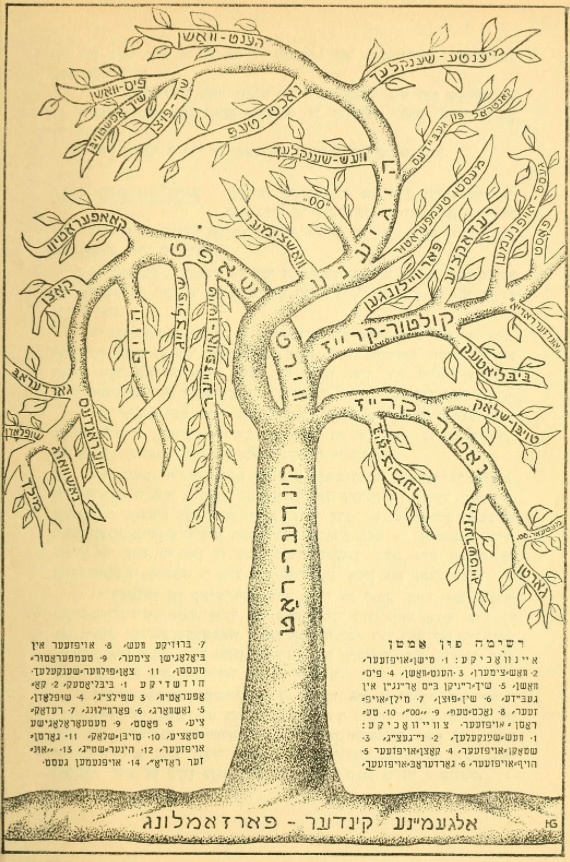
The image of a tree that hung in the club room. The trunk and limbs represented the children’s steering committee and various assemblies, councils, and work groups that governed the activities at the Medem Sanatorium. Illustration from Vi azoy lebt dos kind in Medem-sanitorye (1932).
נישט אַלץ, וואָס איז געווען געדענקט מען, נישט אַלץ, וואָס מען געדענקט, אָדער וואָס מען טראַכט בײַם געדענקען, לאָזט זיך אָנטאָן אין פֿאַרשריבענע ווערטער פֿאַר אַלעמען צום לייענען. זענען דעריבער פֿאַרשריבענע זכרונות טאָפּל סעלעקטיוו: מיר זענען נישט אַלע מאָל בכּוח צוריקצורופֿן אין זכּרון דאָס אַוועקגעגאַנגענע; נישט אַלץ, וואָס איז אונדז שוין יאָ געראָטן צוריקצורופֿן זעט אונדז אויס צו האָבן גענוג האַפֿט פֿאַר הײַנט.
די מעדעם־סאַנאַטאָריע איז דאָך געווען ערבֿ היטלער, ערבֿ חורבן פֿון ייִדישער מיזרח־אייראָפּע, ערבֿ טאָטאַלן אונטערגאַנג פֿון אַ דור מיט אַ גראַנדיעזן חלום וועגן דער יושרדיקסטער פֿון אַלע וועלטן. וואָס ווערט פֿון חלומות, ווען זייערע טרעגערס ווערן פֿאַרשניטן? צי גייען חלומות איבער בירושה? וווּ זענען די בעלנים אויף צו ירשענען יענע חלומות? אָן אַ שיעור פֿרעגצייכנס שטעלן זיך אין וועג און לאָזן נישט אויספֿורעמען קיין כראָנאָלאָגיש גלאַטיקע מעשׂה־שהיה.
„אַ קינד פֿון מעדעם־סאַנאַטאָריע” איז געווען אַ טיטל וואָס מען האָט געקריגן, אַז מען איז אָפּגעווען אין סאַנאַטאָריע אַ חודש צי מער. מען איז דעמאָלט געוואָרן אַ גראַדואַנט פֿון אַן אויסטערלישער שול, וואָס איז געווען האַלב חלום האַלב וואָר. אין דער מעדעם־סאַנאַטאָריע, וווּ פּראָפֿילאַקטישע מעדיצין האָט פֿאַרהיט ייִדישע אַרבעטער־קינדער פֿון טובערקולאָז, האָבן זיך צונויפֿגעשפּונען דער קאָלעקטיווער חלום פֿון „בונד” מיט די אינדיווידועלע חלומות פֿון אידעאַליסטישע דאָקטוירים און פּעדאַגאָגן, און פֿון דעם איז געבוירן געוואָרן אַ זיכערע ראַיה, אַז אויב מען וויל זייער שטאַרק, קען די וועלט זײַן טאַקע שיין.
*
קיינער האָט נישט געדענקט, ווי אַזוי דאָס איז געשען, אָבער די קראַנקן־שוועסטערס האָט מען אין סאַנאַטאָריע גערופֿן „לערערינס”: „לערערין בערנשטיין”, „לערערין דאַנציס”; דער טראָפּ איז געווען נישט אויף קראַנק זײַן, נאָר אויף פּעדאַגאָגיק. אָט האָט אַפֿילו די לערערין וויטשיק, וואָס האָט זיך פֿאַרנומען מיט פּלאַנירן די מאָלצײַטן, גלײַכצײַטיק אַרײַנגעפֿירט נײַע ווערטער אין דער סאַנאַטאָריע־שפּראַך: וויטאַמינען, פּאָמידאָרן, שפּינאַק, קאַלאַפֿיאָר, פֿאַרנאַכט־עסן. מען האָט בײַ איר געמוזט וויסן וואָס מען עסט.
*
ווי הויך איז דער לערער טראָופּיאַנסקי? די קינדער מיינען, אַז ער איז דער העכסטער. זײַן שוואַרצע טשופּרינע טורעמט איבער די קינדערשע קעפּלעך, און פֿונעם טונקעלן פּנים זײַנעם לײַכטן צו זיי אַראָפּ צוויי שוואַרצע שמייכלענדיקע אויגן און צוויי שורות ווײַסע פֿינקלענדיקע ציין. צעלאַכט ער זיך אויף אַ קול, קלינגט דאָס געלעכטער מיט אַ פֿאַרבעטונג צו שטיפֿערײַ, צו שפּילן זיך אין יאָגעלעך, אין כאַפּערלעך, אָדער אין הוידען זיך אויף אַ צווײַג פֿון אַ סאָסנע מיט איין האַנט צי מיט ביידע. אַ מאָל טרעפֿט, אַז טראָופּיאַנסקי הייבט אָן גלאַט אַזוי שטעלן גיכע טריט, הייבן אָן די קינדער אים נאָכלויפֿן; גיט ער זיך פּלוצלונג אַ שטעל אָפּ, נעמען די פֿונאַנדערגעלאָפֿענע קינדער פֿאַלן איינס אויפֿן אַנדערן און ס'ווערט אַ לאַכעדיקער קוויטשעדיקער כאָר.
טראָופּיאַנסקין זעט מען אָפֿט מיט זײַן קאָנצערטינע אין האַנט. אַ מאָל שטייט זי נעבן אים אויפֿן טיש אין עסצימער בעת אַ מאָלצײַט. דאָס מיינט, אַז מען וועט באַלד זינגען. אין קעשענע ליגט בײַ אים אַלע מאָל אַ פֿײַפֿל, וואָס די קינדער האָבן אַ נאָמען געגעבן דאָ, ווײַל נאָך יעדן פֿײַף זינגט דער לערער: דאָ־אָ־אָ!
טראָופּיאַנסקי איז אַ ווילנער. ער האָט געענדיקט דעם ווילנער לערער־סעמינאַר; ער איז אַ בונדיסט פֿון דעם יונגן דור פֿון צווישן ביידע וועלט־מלחמות אין פּוילן. אין מעדעם־סאַנאַטאָריע שטעלט ער זײַנע ערשטע לערערשע טריט, אָבער זײַן גאַנג איז שוין אַ פֿעסטער: ער איז אַ לערער פֿון געזאַנג. אַלץ הייסט אַ לערער פֿון געזאַנג! ער איז אַ קאָמפּאָזיטאָר, ער איז דורך און דורך מוזיק. די קינדער האָבן אַפֿילו געהערט, אַז דער לערער טראָופּיאַנסקי האָט „געשאַפֿן אַן אָפּערע”. מען האָט אָפֿט געזונגען שטיקלעך פֿון זײַן מוזיק צו מ. ווײַנרײַכס פּורים־שפּיל מכירת־יוסף, וואָס דער ווילנער לערער־סעמינאַר האָט אַזוי געראָטן אויפֿגעפֿירט. אָבער זיי האָבן דאָך אַליין געפֿילט דעם קינסטלער אין אים און דערפֿאַר האָבן זיי זיך צו אים אַזוי געקלעפּט. מאַני לייב האָט אָנגעשריבן אַ ווינטער־מעשׂהלע אין פֿערזן, וואָס מען האָט געלערנט אין די ייִדישע שולן, אָבער מען האָט געדאַרפֿט הערן ווי טראָופּיאַנסקי זינגט פֿאַר די קינדער „בלימעלעך, קרענצעלעך מאָלט אויף די שויבן דער פֿראָסט”, כּדי צו וויסן, אַז מוזיק קאָן פֿאַרכּישופֿן ווערטער.
טראָופּיאַנסקי פֿלעגט שפּילן מיט די קינדער אַ שפּיל אין גרינס. די מעלה פֿון דער שפּיל איז געווען, וואָס מען האָט זי געקענט שפּילן וואָכן נאָך אַנאַנד. עטלעכע אירע (די צאָל איז נישט באַגרענעצט) מאַכן אָפּ צווישן זיך, אַז זיי וועלן שטענדיק האָבן בײַ זיך עפּעס אַ סימן גרינס: אַ בלעטל, אַ גרעזל, אַ שטענגל, אַ גרינעם עפּל, אַ גרינעם ווײַנטרויב, וואָס עס זאָל נישט זײַן, אַבי גרין. ייִנגלעך פֿלעגן זייער גרינס האַלטן אין קעשענע, מיידלעך האָבן אָפֿט געמוזט צושפּיליען דאָס גרינס מיט אַ שפּילקע צום קליידל, אָדער אויב מען האָט געהאַט צעפּלעך, האָט מען עס אַרײַנגעפֿלאָכטן אין צעפּל. מען איז טאַקע געווען כּסדר אַרומגערינגלט מיט גרינס, אָבער מען האָט נישט אַלע מאָל געדענקט צו האָבן עס בײַ זיך. איז גאָר נישט אַזוי שווער געווען צו פֿאַרשפּילן. אָבער צום שווערסטן איז געווען צו כאַפּן אָן גרינס דעם לערער טראָופּיאַנסקי, ווײַל ער איז שטענדיק אַרומגעגאַנגען מיט אַ גרעזל, אָדער אַ בלעטל אין מויל. איין מאָל האָבן עטלעכע קינדער זיך צונויפֿגערעדט אָפּצוּוואַרטן אים בײַם טויער פֿון דער סאַנאַטאָריע, ווען ער האָט געדאַרפֿט צוריקקומען אַ שטאָטיש אויסגעפּוצטער פֿון וואַרשע. דעמאָלט וועט ער זיכער האָבן פֿאַרגעסן אָנעם גרינס. דערזעט טראָופּיאַנסקי פֿון דער ווײַטנס, אַז חבֿרה שטייט בײַם טויער, האָט ער אַ שפּרונג געטאָן אין דער הייך, האָט מיט די ציין אָפּגעריסן אַ פּאָר גרינע נאָדלען פֿון דעם נאָענטסטן סאָסנעבוים און עס געהאַלטן אין מויל. ווען ער איז צוגעקומען צום טויער, האָבן די קינדער אויסגערופֿן: גרינס! האָט דער לערער געעפֿנט דאָס מויל און געוויזן אַ פֿולן מויל גרינע נאָדלען. האָט אָבער אַ קליין ייִנגעלע געפֿרעגט: „פֿאַר וואָס האָט דער לערער געגעבן אַ שפּרונג צום בוים?” „ווײַל איך האָב נישט געהאַט קיין גרינס”, האָט דער לערער געענטפֿערט. און די קינדער האָבן געוווּנען.
*
People don’t remember everything that happened—not everything. And not everything that people do remember—or think they remember—can be dressed up as literature for all to read. And memoirs are doubly selective because we aren’t always capable of recalling the past and because today not everything we do recall seems relevant enough.
Obviously the Medem Sanatorium existed before Hitler, before the khurbn of the Jews of eastern Europe, before the total extinction of a generation that had dreamed a dream of the most just of all worlds. What happens to dreams when their dreamers are exterminated? Are they inherited by the next generation? And who are the heirs who will inherit these dreams? So many questions stand in our way and prevent us from creating a smooth historical chronology.
A child that stayed in the Medem Sanatorium for a month or more—that child earned the title of “child of the Medem Sanatorium.” The child was then deemed a graduate of a strange school which was half fantasy, half reality. In the Medem Sanatorium, where prophylactic medicine protected Jewish working-class children from tuberculosis, the collective dream of the Bund was interwoven with the individual dreams of the sanatorium’s idealistic doctors and teachers. And from this union a distinct belief was born: If the will is strong, the world can, indeed, become a beautiful place.
*
No one remembers how it began, but the nurses at the sanatorium were all called lererin 7 7 In English, “teacher”; di lererin (f), der lerer (m), di lerers (pl). —“Lererin Bernstein,” 8 8 Riva Bernshtein was the first nurse to begin working in the sanatorium in 1926. See Y. Sh. Herts, “Rive Bernshteyn,” in Doyres bundistn, ed. Y. Sh. Herts, 3 vols. (Farlag undzer tsayt, 1968) 3:395–96. “Lererin Dantsis.” The emphasis was not on being ill, but on learning. So even Lererin Vitchik, 9 9 Polye Vitshik was a committed and admired teacher in the Warsaw shules and worked in the Medem Sanatorium from 1926 to 1937. When confined to the Warsaw ghetto, she ran a soup kitchen. Together with her parents, she was caught and murdered during a German action. See Lerer yisker-bukh: Di umgekumene lerer fun CYSHO shulin in poyln, ed. H. Sh. Kazhdan (Komitet tsu fareybikn dem ondank fun di umgekumene lerer fun di tsisho shuln in poyln, 1952–1954), 146–47, https://archive.org/details/nybc218937/page/146/mode/2up. who planned the meals, would simultaneously introduce new words into the sanatorium vocabulary: vitamins, tomatoes, spinach, cauliflower, night snacks. She insisted that everyone be able to identify the food they were eating.
*
How tall is Lerer Traupianski? 10 10 Yankl Traupianski (1909–1944) was a musician and the composer of the music for the Bund youth anthem, “Mir kumen on.” See: L. Y. B., “Yankl Trupyanski,” in Doyres bundistn, 3:470–71. The children believe he is the tallest of them all. His black forelock hovers over their heads, and shining down on them from his dark face are a pair of smiling black eyes and two rows of sparkling white teeth. He starts to laugh, and his laughter sounds like an invitation to clown around—to play tag or catch, or to swing with one or two hands from the branch of a pine tree. Sometimes Lerer Traupianski begins walking with quick steps, and the children start to run after him; suddenly he stops short and the children tumble over each other and become a laughing, squealing chorus.
Traupianski is often seen holding his concertina. Sometimes during meals it lies near him on the dining room table, a sign that soon there will be singing. Traupianski always has a pennywhistle in his pocket; the children call it “do” because after each toot, the teacher would sing “do-do-do.”
Traupianski is from Vilna, a graduate of the Vilna Teachers Seminary. He’s a Bundist and a member of the young generation that lived in Poland between the world wars. He took his first steps as an educator at the Medem Sanatorium, but his pedagogical path was already set: a singing teacher. But what a singing teacher! He’s a composer, a musician through and through. The children had even heard that Lerer Traupianski had “composed an opera.” They often sang selections of M. Weinreich’s purim-shpil, Mekhires-Yoysef, 11 11 Prof. Max Weinreich (1894–1969) was a linguist and historian and one of the founders of YIVO. There are no references to Weinreich ever having written a purim shpil. However, in 1923 he did publish a literary/modern retelling of Mekhires-Yosef. In 1928 YIVO devoted an evening to ethnography during which scenes from a purim shpil Mekhires-Yoysef were performed. It is possible that, writing thirty years later, Shoshke may have conflated the texts referenced that evening. For the Weinreich text, see https://archive.org/details/mekhiresyosef00wein/page/n2/mode/1up; for a description and photograph of the 1928 purim shpil at YIVO, see https://encyclopedia.yivo.org/media/1018. for which Traupianski had written the music and which the Vilna Teachers Seminar had staged so successfully. They sensed the artist in him and clung to him. Mani Leib had written a short winter story in verse that was taught in the Yiddish shules. 12 12 Mani Leib (1883–1953) was a poet. But you had to hear Traupianski when he sang for the children “The frost paints flowers and leaves on the windowpanes” to understand how music creates magical words.
Traupianski used to play a game with the children based on the “greens” found in nature. The virtue of this game was that it could be played for weeks on end. Several children (there was no limit on the number) would agree among themselves to have something green with them at all times: a leaf, a blade of grass, a stem, a green apple, a green grape—whatever, as long as it was green. Boys kept their green in their pockets; girls pinned theirs to their dresses or, if they wore braids, wove them into their hair. Actually everyone was always surrounded by green. But some didn’t always remember to have it with them, and they were eliminated from the game. So it wasn’t so difficult to lose. But the most difficult task was to catch Lerer Traupianski without any green because he always went around with a leaf or a blade of grass in his mouth. Once a few children decided to wait for him by the gate of the sanatorium when he was all dressed up and supposed to be returning from a trip to Warsaw. Surely he would have forgotten about the green. But Traupianski spotted the group at the gate, took a high leap into the nearest pine tree, and bit off some pine needles. When he reached the gate, the children shouted, “Green!” and Lerer Traupianski opened his mouth to show a mouthful of green pine needles. But one little boy asked, “Why did Lerer jump into the tree?” “Because I didn’t have anything green,” Traupianski replied. And so the children won.
*
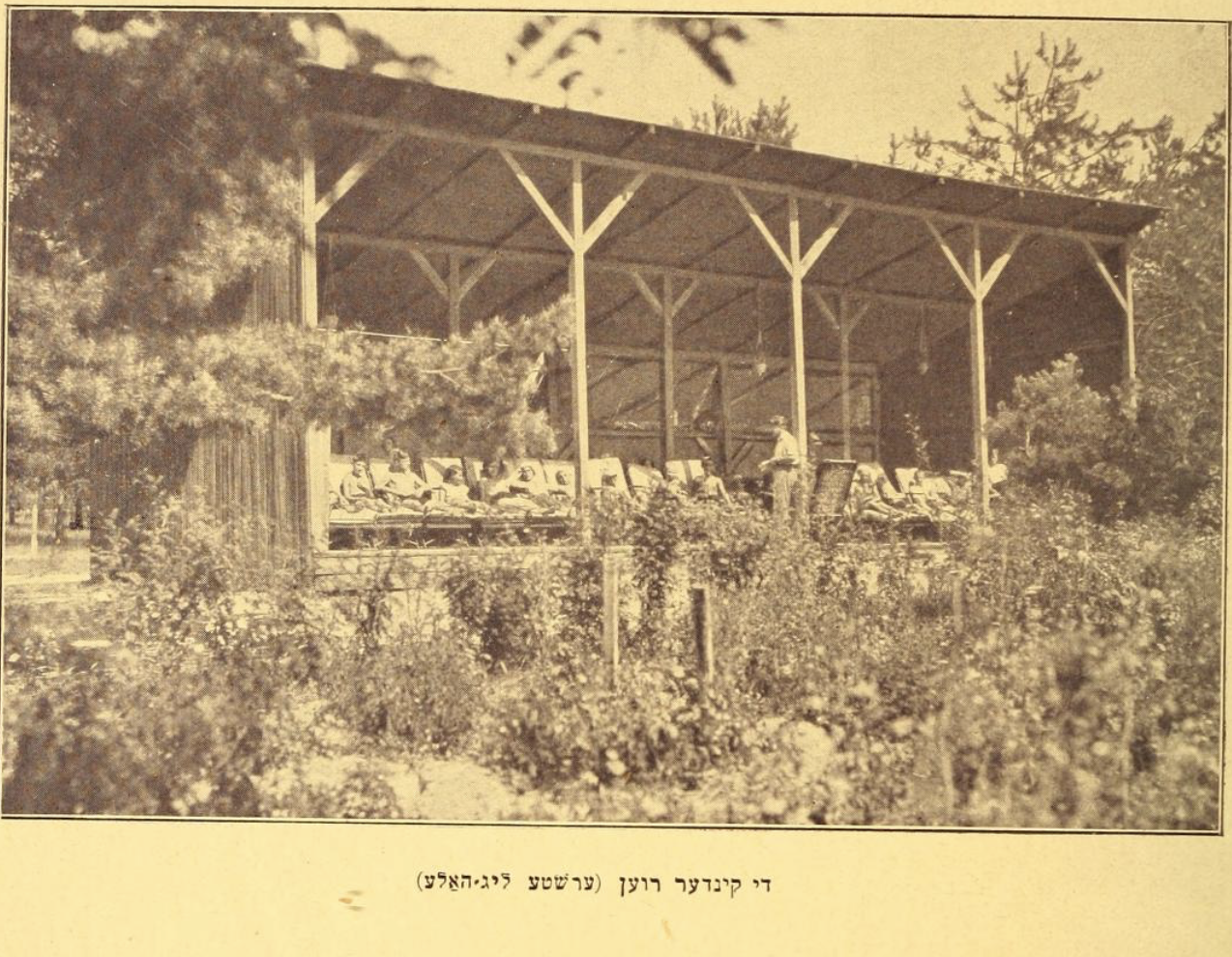
Children in the Medem Sanitorium rest on a porch beside a garden. Photo from Vi azoy lebt dos kind in Medem-sanitorye.
אין סאַנאַטאָריע טומלט זיך הײַנט. שלום אַש איז געקומען צו גאַסט. איין קלייניקייט, שלום אַש! מיט אים איז מיטגעקומען אַ גרופּע שרײַבערס און זשורנאַליסטן פֿון וואַרשעווער ליטעראַטן־פֿאַראיין. די קינדער מאַכן אַ גרויסע ראָד און נעמען אַרײַן אַלע שרײַבערס אין מיטן. די פֿרייד איז גרויס. איין קינד באַגריסט די שרײַבערס, אָבער באַזונדער שלום אַשן, דעם „פֿאָרשטייער פֿון דער ייִדישער ליטעראַטור”. שטייט שלום אַש, אַזאַ ריז אין אַ שוואַרצער פּעלערינע, און קוקט אַריבער אַלץ און אַלעמען. ער זאָגט עפּעס, אָבער אַזוי שטיל, אַז מען הערט קוים. שפּעטער האָט ער אַרײַנגעשריבן אין דעם גאַסטבוך אַ לויב „פֿאַר די ייִנגלעך און מיידלעך, וואָס בויען די מעדעם־סאַנאַטאָריע.” וועמען האָט דאָ שלום אַש געהאַט אין זינען? די קינדער, די לערער? איז געבליבן אַ קשיא.
*
משה נאַדיר איז געקומען פֿאַרברענגען אַ טאָג אין דער מעדעם־סאַנאַטאָריע. גייט צו צו אים אַ קינד און הייסט אים זאָגן: „גיב מיר”. זאָגט ער : „גיב מיר”. גיט אים דאָס קינד אַ פּאַטש איבערן האַנט און זאָגט: „נאַ דיר”. איז משה נאַדיר געבליבן שטיין מיט דער אויסגעשטרעקטער האַנט און געזאָגט: „זע נאָר ווי זיי האָבן געכאַפּט מײַן סטיל. כ'בין מיך אַזש אַליין מקנא”.
*
ווען משה נאַדיר איז מיטאָגצײַט געזעסן אין עסצימער בײַם טיש מיט די קינדער, האָט ער זיך שטאַרק איבערגענומען מיט דעם ווי דער לערער שלמה גילינסקי פֿירט טיש. צווישן איין מאכל און אַ צווייטן האָט דער לערער גילינסקי געהאַלטן איינע פֿון זײַנע באַרימטע רעדעס צו די קינדער. דער ענין איז אַ האַרבער: ווער זאָל אויף זיך נעמען די נישט־אָנגענעמע אַמטן? אויף דער אַלגעמיינער קינדער־פֿאַרזאַמלונג וויילט מען אַ פֿאָרזיצער, אַ סעקרעטאַר, אָבער אויף אַן אַמט דאַרף מען זיך אַליין פֿאָרלייגן. מען דאַרף טאָן די אַרבעט פֿרײַוויליק. פֿאַר טייל אַמטן, למשל, ביבליאָטעקאַר, אײַנלייגן די דעקעס פֿון די ליגבעטלעך אויף דער וועראַנדע, פֿונאַנדערטיילן די טערמאָמעטערס און פֿאַרשרײַבן די היץ, זענען אַלע מאָל פֿאַראַן אַ סך קאַנדידאַטן אָבער קיינער הייבט נישט אויף די האַנט און זאָגט נישט: איך וויל זײַן אַן אויפֿזעער איבער די נאַכטטעפּלעך. מיר האָבן אין סאַנאַטאָריע קליינע קינדער און מיר מוזן האָבן די נאַכטטעפּלעך פֿאַר זיי. ווער זשע זאָל אויף זיי אַכטונג געבן? קיין אָנגענעמער אַמט איז דאָס טאַקע נישט, אָבער עמעצער מוז דאָך דאָס טאָן. בײַ אונדז צווינגט מען קיינעם נישט צו נעמען וואָסער נישט איז אַמט. בלײַבט נישט קיין אַנדער ברירה, נאָר אַז די אינטעליגענטסטע קינדער, וואָס פֿאַרשטייען ווי וויכטיק דער אַמט איז פֿאַר אונדז אַלעמען, זאָלן פֿרײַוויליק זיך פֿאָרלייגן צו דער שווערסטער, נישט־אָנגענעמסטער אַרבעט. משה נאַדיר האָט אין זײַן קליינינקן נאָטיצביכל פֿאַרשריבן: נאַכטטעפּלעך – זייער אַן אינטעליגענטער אַמט.
*
אין קלובצימער אויף דער וואַנט איז געהאָנגען אַ גרויסע צייכענונג: אַ שטאַרק פֿאַרצווײַגטער בוים מיט אויפֿשריפֿטן אויפֿן שטאַם און אויף די באַזונדערע צווײַגן. דאָס איז געווען דער סימבאָל פֿון דער סאַמע דעמאָקראַטישסטער רעפּובליק, די קינדערשע אַליין־פֿאַרוואַלטונג. די העכסטע אויטאָריטעט איז געווען די אַלגעמיינע קינדער־פֿאַרזאַמלונג. אָט דער בוים איז געווען אַ טייל פֿון שלמה גילינסקיס חלום. ער פֿלעגט כּסדר טענהן: די קינדער וועלן אונדז אויסלערנען ווי אויפֿצובויען אַ יושרדיקע וועלט.
*
הײַנט איז ערבֿ יום־כּיפּור. דער לערער גילינסקי איז הײַנט געקומען פֿון וואַרשע און ער וועט שוין דאָ בלײַבן נעכטיקן. מאָרגן איז דער וואַרשעווער סעקרעטאַריאַט פֿון דער מעדעם־סאַנאַטאָריע געשלאָסן, וועט שוין דער לערער פֿאַרברענגען דעם טאָג אין סאַנאַטאָריע. צום אָוונטברויט האָט מען הײַנט סערווירט וואַרשעוועריש געקאָכטע קאַרפּ (געפֿעפֿערט און געצוקערט) מיט קלוסקעלעך באַגאָסן מיט פֿישיויך. אין עסצימער איז נישט אַזוי ליכטיק ווי געוויינטלעך בײַם אָוונטברויט. נישט אַלע לאָמפּן האָט מען אָנגעצונדן. דער לערער ש. גילינסקי רעדט צו די קינדער וועגן דעם, ווי מען פּראַוועט יום־כּיפּור אין פֿאַרשידענע היימען; אַ קינד לייענט יהואשעס אַ יום־כּיפּור־מעשׂהלע. אין עסצימער איז זייער שטיל, די שטימונג האַלב פֿײַערלעך, האַלב שרעקעוודיק, אָבער מודה זײַן זיך, אַז מען איז איבערגענומען, פּאַסט נישט. די עלטערע קינדער האָבן אויף צו מאָרגנס געהאַט טענות צום לערער: די סאַנאַטאָריע איז אַ וועלטלעכע אינסטיטוציע, צו וואָס איבערשרעקן די קליינע קינדער? דער אמת איז, אַז קליינוואַרג האָט תּיכּף אָנגעהויבן שטיפֿן ווי קיין מאָל גאָרנישט, איבערגענומען האָבן זיך גראָד די „וועלטלעכע” עלטערע קינדער. דער לערער גילינסקי האָט זיך פֿאַר זיי פֿאַרענטפֿערט: כּדי צו קענען זאָגן ניין, דאַרף מען פֿריִער גוט פֿאַרשטיין דעם יאָ. די דיסקוסיע אַרום רעליגיע, וועלטלעכקייט, דערציִונג, דערוואַקסענע, קינדער – האָט מען געמוזט איבעררײַסן אין מיטן, אויפֿן האַלבן וועג צו דער באַנסטאַציע אין מיעדזעשין. נאָר ביזן האַלבן וועג האָבן די עלטערע קינדער געמעגט באַגלייטן דעם לערער. זיי האָבן זיך נישט געטאָרט צו פֿיל פֿאַרמאַטערן מיט גיין.
*
אין 1926 איז נאָך אין מעדעם־סאַנאַטאָריע קיין עלעקטריע נישט געווען. אין עסצימער האָבן געברענט הענגלאָמפּן. אין די שלאָפֿצימערן פֿלעגט מען זיך אויסטאָן בײַם שײַן פֿון אַ ליכטל. דאָס לײַכטערל מיטן אָנגעצונדענעם ליכט האָט מען געדאַרפֿט היטן ווי אַן אויג אין קאָפּ: ביידע בנינים פֿון דער מעדעם־סאַנאַטאָריע זענען געווען הילצערנע. האָט מען אויף גיך געדאַרפֿט זיך אויסבעטן, אויסטאָן זיך, אָנטאָן דאָס נאַכטהעמד און תּיכּף אַרונטערקריכן אונטער דער קאָלדרע. די לערערס זענען דערנאָך אַרומגעגאַנגען פֿון צימער צו צימער צונויפֿנעמען די ליכט, געזען די פֿענצטער זאָלן זײַן אָפֿן אויף בײַ נאַכט און געזאָגט אַלעמען „אַ גוטע נאַכט”. מען איז געשלאָפֿן צו צוויי, צו דרײַ אין אַ צימער. די קליינינקע פֿלעגן באַלד אײַנשלאָפֿן, די עלטערע אַ ביסל שפּעטער. פֿריִער האָט מען נאָך איינס מיטן אַנדערן געפֿירט אַ שעפּטשעדיקן שמועס ביז מען איז מיד געוואָרן און נישט־ווילנדיק פֿאָרט אײַנגעשלאָפֿן. האָט אַ מאָל געטראָפֿן, אַז אין איין צימער, וווּ קיין קליינע קינדער זענען נישט געשלאָפֿן, זענען צוויי עלטערע קינדער געפֿאַלן אויף אַ נישט־כּשרן פּלאַן: לייענען אַ בוך פֿאַרן אײַנשלאָפֿן. אין דער סאַנאַטאָריע־ביבליאָטעק האָט זיך גראָד באַוויזן ראָמען ראָלאַנס זשאַן קריסטאָף, איין עקזעמפּלאַר בסך־הכּל און לייענערס – אַ סך מער. אין סאַנאַטאָריע האָט מען קיין זאַך נישט פֿאַרשלאָסן, האָבן די עלטערע קינדער פּשוט גענומען בײַ טאָג פֿון אַן אָפֿענעם צימער אַרויס: אַ לײַכטער, אַ ליכט און שוועבעלעך. בײַ נאַכט, נאָך דעם ווי די לערערס האָבן געזאָגט „אַ גוטע נאַכט”, האָט מען אין צימער ווידער אָנגעצונדן אַ ליכט, געשטעלט דאָס אויף דער ערד, מען זאָל פֿון דרויסן נישט זען קיין באַלויכטענעם פֿענצטער און מען האָט געלייענט. דעם אמתן טעם פֿון לייענען זשאַן קריסטאָף האָט מען ערשט דערפֿילט, ווען מען איז געלעגן אויפֿן בויך האַלב אַרויסגעהאָנגען פֿון בעט און געהאַלטן דאָס בוך גענוג נידעריק, אַז דער שײַן פֿונעם אָנגעצונדענעם ליכטל זאָל פֿאַלן פּונקט אויף די שורות, וואָס מען האַלט אין לייענען. דער תּענוג האָט געדויערט עטלעכע נעכט בסך־הכּל. ווידער האָט דער לערער גילינסקי געהאַלטן איינע פֿון זײַנע רעדעס צו די קינדער. ער האָט גערעדט גלאַט אַזוי, וועגן ייִנגערע קינדער און עלטערע קינדער און וועגן דעם, אַז די עלטערע קינדער דאַרפֿן זײַן אַ מוסטער פֿאַר די קלענערע, זיי דאַרפֿן ווײַזן די קלענערע קינדער, וואָס עס מיינט זײַן אַ פֿאַראַנטוואָרטלעכער סאַנאַטאָריסט. אַן עלטער קינד דאַרף אויפֿקלערן די קלענערע, למשל, פֿאַר וואָס די לערערס גייען אַליין אַרום איבער די צימערן און לעשן בײַ נאַכט אויס די ליכט, פֿאַר וואָס ס'איז נאָך בײַ אונדז נישטאָ קיין אַמט פֿאַר לעשן ליכט. מער האָט מען שוין בײַ נאַכט נישט געלייענט.
*
Today there is a great commotion at the sanatorium. Sholem Asch is here on a visit. 13 13 Sholem Asch (1880–1957) was a novelist. Sholem Asch! No minor matter! He is accompanied by a group of writers and journalists from the Warsaw literary union. 14 14 The Warsaw literary union was the Association of Jewish Writers and Journalists in Warsaw and existed from 1916 to 1939 (Yid., Fareyn fun Yidishe Literatn un Zhurnalistn in Varshe; Pol., Związek Literatów i Dziennikarzy Żydowskich w Warszawie). “In 1926, Jewish journalists established an autonomous section of the association, recognized by the authorities as the Jewish section of the Polish Journalists Syndicate. In the following year [1927], thanks to the organization’s efforts, Yiddish was accepted as a member language within the international writers’ association PEN with branches in Warsaw, Vilna, and New York. Arn Zeitlin served as chair of the Yiddish PEN club and Sholem Asch was its honorary president.” Nathan Cohen, “Association of Jewish Writers and Journalists in Warsaw,” in the YIVO Encyclopedia of Jews in Eastern Europe, accessed April 10, 2026, https://encyclopedia.yivo.org/article/274. The children form a big circle and place all the writers in the middle. There is great joy. One child greets the writers but addresses Sholem Asch separately as “the representative of all Yiddish literature.” Asch, a giant in a black cape, examines everyone and everything. He says something, but so softly that his words can barely be heard. Later Asch wrote admiringly in the guest book, “For the boys and girls who are building the Medem Sanatorium.” Whom did Sholem Asch have in mind? The children? Di lerers? The question remained.
*
Moyshe Nadir has come to spend a day in the Medem Sanatorium. 15 15 Moishe Nadir (1885–1943) was a poet. A child approaches and orders him to say, “Give me!” Moyshe Nadir says, “Give me!” So the child gives his hand a slap and says, “Here!” 16 16 The child in this scene is playing with the poet’s last name, which in Yiddish can be translated as “Here [take it].” Moyshe Nadir stands with his hand outstretched and says, “Look how he’s captured my style. I’m jealous of my own self!”
*
When Moyshe Nadir sat with the children at a dining room table during dinner, he was very impressed with the way Lerer Shloyme Gilinski presided over the meal. 17 17 Shloyme Gilinski (1888–1961) was director of the Medem Sanatorium from 1926 to 1939 and described the sanatorium in his pamphlet Vi azoy lebt dos kind in medem-sanatorye (How a child lives in the Medem Sanatorium; Warsaw, 1932). See https://congressforjewishculture.org/people/5912/. Between one course and the next, Lerer Gilinski gave one of his famous talks to the children. The issue was a thorny one: “Who will take on the responsibility for the unpleasant chores? At the children’s general assembly, we vote for a chair and secretary. But we have to nominate ourselves for the other chores. That work has to be voluntary. For some positions, there are always many candidates—for example, for the librarian, or for the one responsible for folding the covers for the lounge chairs on the porch, or for the one distributing thermometers and recording temperatures. But no one raises their hand to say, ‘I want to be in charge of the bedpans.’ We have small children in the sanatorium and we need bedpans for them. Who will take care of them? It’s not a pleasant position, but someone has to do it. We do not force a chore on anyone. So we are left with only one choice: The most intelligent children, who understand how important this chore is for us, must volunteer and offer to do this most difficult and unpleasant work.” Moyshe Nadir wrote in his small notebook, “Chamber pots—a very intellectual chore.”
*
On a wall in the clubroom hung a very large drawing: a tree with many branches and with writing on its trunk and on each branch. This was the symbol of the real democratic republic—the Children’s Steering Committee. The highest authority was the Children’s General Assembly. This very tree was part of Shloyme Gilinski’s dream. He always claimed, “The children will teach us how to build a just world.”
*
Today is Erev Yom Kippur. Lerer Gilinski has come from Warsaw and will stay overnight. Tomorrow, the secretariat of the Medem Sanatorium in Warsaw will be closed so der lerer will spend the day at the sanatorium. For dinner the cooks serve Warsaw-style carp (peppered and sweetened) with noodles and covered with fish broth. The dining hall is not as bright as usual at dinner time. Not all the lamps have been lit. Lerer Gilinski speaks to the children about how Yom Kipper is observed in different homes; one child reads a Yom Kippur story by Yehoash. 18 18 Yehoash is the pen name of Solomon Blumgarten (1871–1927), a poet and translator into Yiddish of numerous literary texts, the most famous being his translation of the Tanakh. The dining room is very quiet. The atmosphere is half solemn, half fearful. But it would be unseemly to admit to being upset. It’s just inappropriate. The next morning the older students complain to Lerer Gilinski: “The sanatorium is a secular institution, so why frighten the little ones?” In truth, the little ones were quick to begin joking around right after dinner, as if nothing had happened. It was actually the older, “secular” children who felt upset. Lerer Gilinski answered them this way: “In order to be able to say no, one has to have a good understanding of the yes.” The discussions around religion, secularism, upbringing, adults, and children had to be cut off when the group was halfway to the Międzeszyn train station. The older children had been allowed to accompany der lerer only halfway for fear they would become overtired if they went any further.
*
In 1926 the Medem Sanatorium still had no electricity. The dining room was lit by hanging lamps. In the bedrooms the children undressed by candlelight. The lit candles had to be guarded and watched closely; both Medem Sanatorium buildings were made of wood. One had to prepare for bed, undress, pull on nightclothes, and climb quickly under the comforter. Then di lerers would go from room to room collecting the candles, making sure the windows were open for the night, and wishing everyone good night. Two or three children slept in one room. The little ones fell asleep immediately; the older ones a little later. They carried on whispered conversations until they grew tired and reluctantly fell fast asleep. Once, in one of the bedrooms where none of the little ones slept, a couple of the older ones hatched a slightly not-so-kosher plot: to read a book before going to sleep. The sanatorium library happened to have Romain Rolland’s Jean Christophe, 19 19 Roman Rolland’s French classic Jean Christophe would have been read by the children in Yiddish translation. just one copy for many readers. In the sanitorium, nothing was ever locked up. So during the day, the older children simply took a candleholder, a candle, and matches from one of the open rooms. At night, after the teachers had told everyone good night, the children lit the candle again, placed it on the floor so nobody outside could see the light through the window, and they read. The true flavor of reading Jean Christophe was especially relished when the readers were lying on their stomachs, hanging half out of their beds, and holding the book low enough so the light of the candle fell directly on the line they were reading. All in all, the delight continued for several nights. Then Lerer Gilinski gave another of his talks to the children. He began talking casually about younger children and older children—that older children must set an example for the younger ones. They have to show the younger children what it means to be a responsible “sanatoriumist.” For example, an older child must explain to the smaller ones why the teachers themselves have to go around every night putting out the candles in each room and why putting out lights is not one of the positions designated for children. That ended the nighttime readings.
*
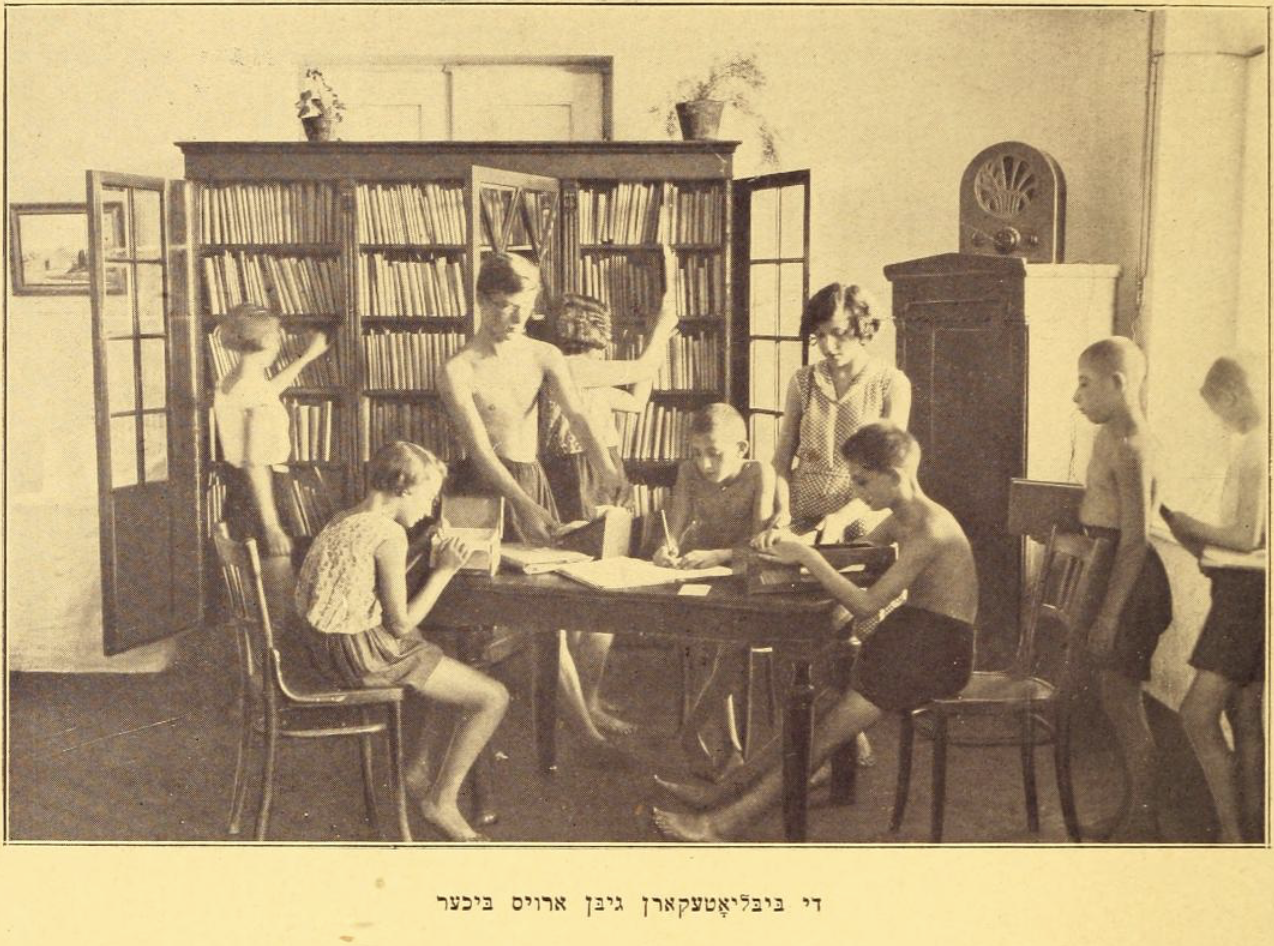
The sanitorium library. Photo from Vi azoy lebt dos kind in Medem-sanitorye.
אין סאַנאַטאָריע זענען געוואַקסן בלומען. אינעם טרוקענעם סאָסנעוואַלד, וווּ די סאַנאַטאָריע איז געשטאַנען, זענען געוואַקסן גאַנץ ווייניק פֿעלדבלומען, האָט מען אין סאַנאַטאָריע פֿאַרזעצט אַ בלומען־גאָרטן. עס זענען דאָרט געוואַקסן נאַסטורציעס, חנהלעס אייגעלעך, געאָרגיניעס, אַסטרעס – און אַלץ פֿון פֿאַרשידענע קאָלירן. קיינער האָט אַזוי נישט אָנגעקוואָלן פֿון די בלומען ווי דער לערער גילינסקי. אַז ער פֿלעגט זיך אַראָפּכאַפּן אויף אַ טאָג אין סאַנאַטאָריע, האָט ער פּונקט אַזוי געוואָלט וויסן, וואָס עס מאַכן די בלומען ווי וואָס עס מאַכן די קינדער. איין מאָל אין אַן אינדערפֿרי, ווען דער לערער גילינסקי האָט גענעכטיקט אין סאַנאַטאָריע, האָט אַ ייִנגעלע אָנגעקלאַפּט אין זײַן צימער און מיט אַ ציטערדיק קול געלאָזט וויסן: „לערער גילינסקי, מען האָט אויסגעריסן אַלע בלומען, קיין איין בלום איז נישט געבליבן.” ס'האָט נישט לאַנג געדויערט און אויף דער וועראַנדע האָט זיך באַוויזן דער לערער גילינסקי מיט אַ צעשויבערטן קאָפּ האָר, אָן ברילן אויף די זייער קורצזיכטיקע אויגן, אַ צעשראָקענער. אָבער איידער ער האָט נאָך צײַט געהאַט עפּעס צו פֿרעגן, האָט אַ צעשמייכלטער שטיפֿער זיך מודה געווען: „כ'האָב געמאַכט אַ שפּאַס”. צעלאַכט זיך דער לערער, צעפּאַטלט בײַם חבֿרה־מאַן די האָר אויפֿן קאָפּ און זאָגט: „אַוודאי אַ שפּאַס. ווער וועט דאָס וועלן, אַז די סאַנאַטאָריע זאָל בלײַבן אָן בלומען?”
ש. גילינסקי האָט מיט די בלומען נאָר געמאַכט אַן אָנהייב. שפּעטער איז אין מעדעם־סאַנאַטאָריע אָנגעקומען אַרבעטן דער לערער ביבער, דער ביאָלאָג, וואָס האָט אײַנגעפֿירט גאָר אויסטערלישע זאַכן: אַ טויבנשלאַק מיט טויבן, שטײַגן מיט קראָליקעס און הינער, און אַפֿילו אַן אינקובאַטאָר אויף אויסצובריִען הינדעלעך. צי קען זיך עמעצער פֿאָרשטעלן אַ מער גליקלעך ייִנגל ווי אַ ייִנגל אַן אויפֿזעער איבער טויבן? דערקענען פֿייגל לויט זייער צוויטשער איז געוואָרן אַן ענין פֿאַר קינדער וויסנשאַפֿטלערס און קינדער פּאָעטן צו גלײַך. מען האָט זיך געיאָגט נאָך אַ פֿויגל, וואָס האָט געצוויטשערט זי־זי־ביי און מען האָט אים טאַקע גערופֿן זיזיביי. דעם לערער גילינסקין איז פֿון דעם אַלעמען צוגעקומען אַ שטיק געזונט. די חבֿרים זײַנע פֿלעגן זאָגן: דאָס איז שלמה גילינסקיס טעריטאָריאַליזם, וואָס ער האָט אַריבערגעשמוגלט פֿון דער עסעס־פּאַרטיי אין ,בונד” אַרײַן. די מעדעם־סאַנאַטאָריע איז זײַן טעריטאָריע.
שלמה גילינסקי האָט געשמט פֿאַר אַן אויסערגעוויינטלעך טאַלאַנטירטן לערער. פֿון די צײַטן, ווען ער האָט אין פֿאָלקשול געלערנט אַריטמעטיק און קולטור־געשיכטע, זענען אַרומגעגאַנגען לעגענדעס. זײַנע געוועזענע תּלמידים פֿלעגן דערציילן, אַז דעם לערער גילינסקיס אַ לעקציע איז געווען ווי אַ פֿאַנטאַסטישע נסיעה אין ווײַטע לענדער אַרײַן. אין דער מעדעם־סאַנאַטאָריע האָט שלמה גילינסקי אויסגעפּרוּווט זײַנע פּעדאַגאָגישע טעאָריעס, אָבער ער האָט זיך אויך אַליין אידענטיפֿיצירט מיט די קינדער פֿון דער ייִדישער אָרעמקייט, וואָס האָבן געבענקט נאָך שיינקייט.
מען האָט געהאַט גרויסע טענות צו שלמה גילינסקין אויך:
די מעדעם־סאַנאַטאָריע איז אַן אומרעאַלע וועלט. זי איז צו ווײַט פֿון די קינדערשע היימען. די סאַנאַטאָריע פֿרעמדט אָפּ דאָס קינד פֿון זײַן היים. עס קומט צוריק אין שטאָט און נעמט קוקן אויף זײַן היים פֿון אויבן אַראָפּ. אים געפֿעלט נישט מער דאָס עסן, ער פֿאָדערט נײַע פֿירונגען: צאָנבערשטלעך, באַזונדערע האַנטעכער, אָפֿטע בעדער. טייל עלטערן קענען דאָס נאָכגעבן, אַנדערע נישט. צו וואָס שאַפֿן קאָנפֿליקטן מיט דער היים? די סאַנאַטאָריע איז דאָך נאָר אויף דערווײַל, די היים – אויף כּסדר.
האָט שלמה גילינסקי געענטפֿערט:
נישטאָ קיין צו גוט פֿאַר אונדזערע קינדער. עס וועלן נישט זײַן קיין קאָנפֿליקטן מיט דער היים, ווײַל מיר, צוזאַמען מיט די קינדער, ווילן דאָך טאַקע אַרײַנפֿירן נײַעסן אין דער היים. די עלטערן, וואָס שיקן צו אונדז זייערע קינדער, האָבן צו אונדז צוטרוי, און זיי איז ליב, וואָס די קינדער ברענגען פֿון דער מעדעם־סאַנאַטאָריע אַהיים. די קינדער זענען נאָר די ערשטע שוואַלבן, וואָס זאָגן אָן דעם פֿרילינג. צוזאַמען מיט זיי וועלן מיר שענער מאַכן דאָס לעבן אין זייערע היימען.
צוליב דעם וואָס די סאַנאַטאָריע איז געווען אַזוי ליכטיק און שיין, צוליב דעם וואָס דער פּעדאַגאָגישער ניוואָ אירער איז געווען אַזאַ הויכער, איז זי געוואָרן אַ שם־דבֿר מחוץ דער פּראָלעטאַרישער סבֿיבֿה אויך. ס'האָבן גענומען אָנקומען ווענדונגען פֿון דער ייִדישער אינטעליגענץ: אַקטיאָרן, זשורנאַליסטן, מענטשן פֿון פֿרײַע פּראָפֿעסיעס – „נעמט אַרײַן אונדזערע קינדער אין דער מעדעם־סאַנאַטאָריע אויף אַ ווײַלע.” האָט מען אין טייל פֿאַלן נאָכגעגעבן, איז געקומען אַ פֿרישע טענה:
די מעדעם־סאַנאַטאָריע איז געשאַפֿן געוואָרן פֿאַר קינדער פֿון עלטערן, וואָס קענען זייערע קינדער נישט שיקן אין קיין פּריוואַטע סאַנאַטאָריעס, וואָס קענען זייערע קינדער אין ערגעץ נישט שיקן, ווײַל ס'איז קיין געלט נישטאָ. פֿאַר וואָס זשע נעמט מען אָן קינדער, וואָס קענען יאָ פֿאָרן ערגעץ אַנדערש?
האָט שלמה גילינסקי געענטפֿערט: די טענה איז אין תּוך אַ גערעכטע, אָבער מיר האָבן זיך אַרומגעזען, אַז אויב מיר נעמען אָן אין סאַנאַטאָריע פֿאַר אַ פֿולן קאָסטנפּרײַז עטלעכע קינדער, וואָס זייערע עלטערן געהערן צו דער סאָציאַליסטישער אינטעליגענץ, געווינען מיר עפּעס אויך. די קינדער פֿון די פֿאַרשידענע היימען לערנען זיך איינער בײַם צווייטן און דאָס ברייטערט אויס זייערע האָריזאָנטן. די קינדער דערציילן איינער דעם אַנדערן, וואָס זייערע טאַטע־מאַמע טוען, וואָס זיי אַליין טוען אין שול, ווי זיי פֿאַרברענגען די צײַט מחוץ דער שול. מיר האָבן שוין אַ ביסל פּראַקטיק אין דעם. די פֿרײַנדשאַפֿט פֿון די קינדער פֿון פֿאַרשידענע היימען האַלט אָן אין שטאָט אויך. קינדער באַגעגענען זיך, און אַפֿילו די עלטערן אויך. דאָס איז אַ גרויסער פּעדאַגאָגישער געווינס, דאָס איז אַ גרויסער סאָציאַליסטישער געווינס: אַ פּראָלעטאַרישע אינסטיטוציע האָט גענומען לערנען אַ פֿאָלק ווי צו לעבן.
*
אויף צו באַשרײַבן דעם סוף פֿון דער מעשׂה דאַרף מען נאָך ערשט שאַפֿן אַ נײַע שפּראַך.
Flowers bloomed in the sanatorium. Since it stood in a dry pine forest which had only a few wildflowers, they planted a flower garden in the sanatorium. It grew nasturtiums, pansies, dahlias, asters—all in a variety of colors. No one enjoyed the garden more than Lerer Gilinski. Whenever he popped in for a day to the sanatorium, he was as eager to know how the flowers were doing as how the children were doing. One morning, when Lerer Gilinksi had stayed at the sanatorium overnight, a small boy knocked on his room and with a trembling voice announced, “Lerer Gilinski, all the flowers are torn up! Not even one is left.” It wasn’t long before Lerer Gilinski appeared on the veranda, his hair disheveled and without his glasses (he was very nearsighted). But before he could ask anything, the smiling little clown confessed, “I was joking! I didn’t mean it.” Der lerer burst out laughing and tousled the little brat’s hair and said, “Of course it’s a joke. Who would want the sanatorium to be without flowers?”
Sh. Gilinski’s focus on flowers was only the beginning. Later, Lerer Biber, 20 20 Dr. Israel Biber (1898–ca. 1943) was director of Vilna’s Teachers Seminary and was remembered for his commitment to incorporating the natural sciences into Yiddish school curricula. For eight years he was associated with the Medem Sanatorium. Biber would spend summers and his vacations at the sanatorium, where he organized and led science classes and laboratories—famously the most popular among the children. In 1937, he published the illustrated Friling in vald (Spring in the forest), a children’s introduction to the natural sciences. In his foreword, Biber wrote, “The Medem Sanatorium has dedicated time and effort to bring the child closer to nature.” The book addresses former child members of the sanatorium as well as those who had not had the privilege and includes stories about the children’s activities and illustrations of animals and birds and even maps of the constellations. Biber was murdered in Estonia, where Jews were sent during the Vilna ghetto’s liquidation. See: https://www.yiddishbookcenter.org/collections/yiddish-books/spb-nybc201220/biber-israel-friling-in-vald. Extended descriptions and recollections of Biber’s activities are included in CYSHO’s yizker-bukh, with entries by (among others) Regina Weinreich and Sh. Gilinski. See the Lerer yisker-bukh, 146–47. the biologist, came to work at the Medem Sanatorium and introduced extraordinary things: a dovecote for pigeons, cages with rabbits and hens, even an incubator for breeding chickens. Can anyone imagine a happier boy than the one in charge of pigeons? Being able to identify birds by their tweets was equally important to the child-scientists and the child-poets. They chased a bird which chirped “zee-zee-bay.” In fact, they actually named it “Zeezeebay.” Lerer Gilinski was always delighted by this. His comrades used to say, “This is how Shloyme Gilinski’s smuggled in territorialism from the ZZ party into the Bund.” 21 21 “ZZ” (or “SS”) was an acronym from the Russian title of the Zionist Socialist Workers’ Party, which Gilinski joined as a young man in the early 1900s. Party members were territorialists who believed in establishing a Jewish state, but not in Palestine. People joked that Gilinski had injected the idea of territorialism (via the bird’s name) into Bund ideology. The Medem Sanatorium was his “territory.”
Shloyme Gilinski was famous for being an extraordinary, talented teacher. Legends circulated about the time he taught mathematics and cultural history in the folkshules. His former pupils used to describe his lessons as fantastic journeys to distant lands. Lerer Gilinski tested his pedagogical theories in the Medem Sanatorium. But at the same time, he also identified with the children born into Jewish poverty who yearned for beauty.
There were some who complained about Shloyme Gilinski:
The Medem Sanatorium is an unreal world; it is too different from the children’s homes. The sanatorium alienates the children from their homes. Children return to the city and begin examining their homes from top to bottom. They no longer like the food. They demand new things: toothbrushes, separate towels, more frequent baths. Some parents can adjust—others can’t. Why create conflicts within the home? After all, the Medem Sanatorium is only temporary—the home is permanent.
Shloyme Gilinski replied:
Nothing is too good for our children. There will be no conflicts within the home. In fact, together with the children, we want to bring new things into their homes. The parents who send us their children trust us, and they like what the children bring back home from the Medem Sanatorium. The children are but the first swallows who are the harbingers of spring. Together with them we will make their lives at home more beautiful.
Because the sanatorium was so bright and beautiful, because its educational level was so high, it also became famous outside of the proletariat class. Requests began to come from the Jewish intelligentsia: actors, journalists, and professionals. They would plead, “Take our children into the Medem Sanatorium for a little while.” Sometimes the sanatorium gave in, which led to a new complaint:
The Medem Sanatorium was established for children whose parents can’t afford to send them to a private sanatorium, who can’t send their children anywhere because they have no money. Why take in children who can, in fact, go somewhere else?
Shloyme Gilinski replied: “The complaint is, in essence, correct. But we observed that if we accept a few children to the sanatorium who pay the full price and whose parents belong to the socialist intelligentsia, we gain something too. The children from diverse homes learn from each other and broaden their horizons. They tell each other about their parents, what they themselves do in school, how they spend their time outside of school. We’ve already had some experience with this. The friendships between children of different backgrounds also continue back in the city. The children and the parents get together. This is a great pedagogical victory; this is a great socialist victory. A proletarian institution has begun to teach a people how to live.”
*
To describe the end of this story we must first create a new language.