Apr 22, 2025
INTRODUCTION
In March 2023, In geveb and Yale’s Fortunoff Video Archive for Holocaust Testimonies announced a call for proposals with the goal of unlocking and activating the Yiddish-language materials in the archive’s nearly 12,000 hours of audiovisual survivor testimony. Together we sought to fund meaningful scholarship and creative productions based on these unique Yiddish oral histories. This blog is one in a series from our 2023 In geveb/Fortunoff fellowship cohort. Each fellow writes about the unique and innovative ways they engaged with the Yiddish-language material housed at Yale’s Fortunoff Video Archive for Holocaust Testimonies.
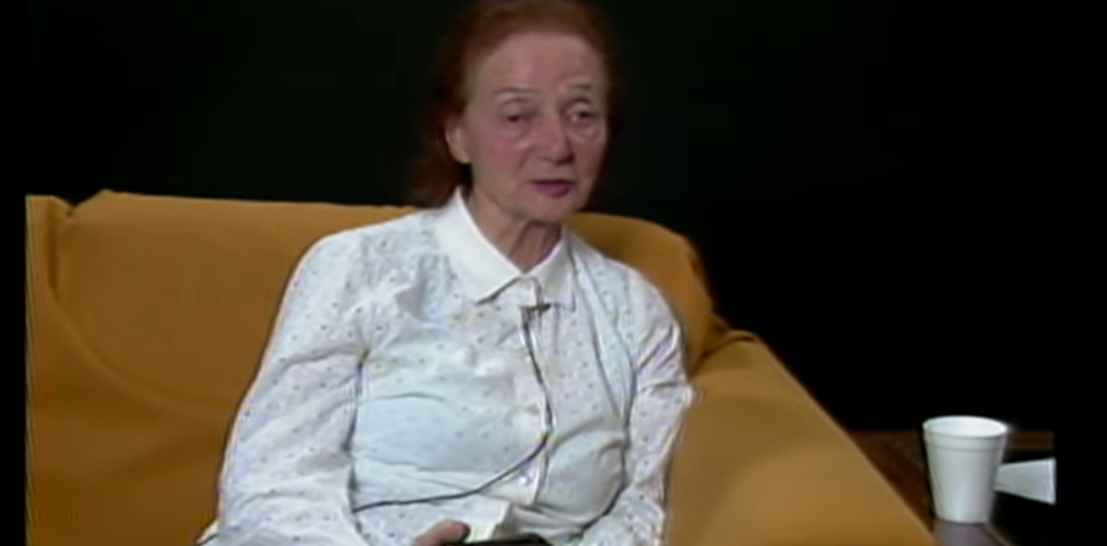
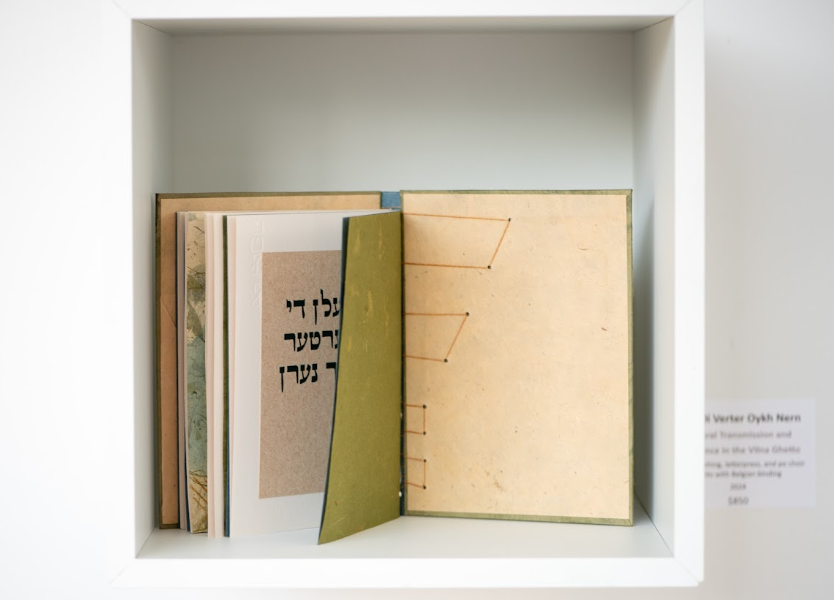
Veln Di Verter Oykh Nern (The Words Will Also Nourish) is a body of work, including an edition of artist books and twelve accompanying prints, that I created between Fall 2023 and Spring 2024 as part of a joint fellowship with Yale’s Fortunoff Video Archive for Holocaust Testimonies and In geveb: A Journal of Yiddish Studies. The work emerges from Paja L’s Yiddish testimony about her experiences as a young woman, teacher, and library worker in the Vilna Ghetto. The prints featured in this collection situate Paja’s testimony amongst broader narratives of cultural resistance in the Vilna Ghetto, drawing on both Paja’s direct quotes and supplementary historical documents including cultural event posters from the Vilna Ghetto. The title of this body of work comes from a line in the ’s poem, Kerndlekh veyts (Grains of Wheat) in which Avrom Sutzkever reflects on efforts to hide and preserve Yiddish books in the Vilna Ghetto through the metaphor of grains of wheat buried in a coffin until they bloom again in the future. As I listened to Paja’s testimony, her descriptions of cultural life in the ghetto recalled Sutzkever’s understanding of how language can create a bridge between the limitations of a confining present and a future in which latent possibility is given space to unfold. This orientation towards the future provides a kind of nourishment to the present, a reason to continue engaging in collective acts of creation and meaning-making.
Vilna, in Yiddish, or Vilnius, is located in what is mapped today as Lithuania, and historically was a contested space which many nation-state borders crossed. My personal connection to Vilna was solidified in 2013 when I spent time there as part of The Helix Fellowship and the Program in Yiddish Language and Literature at Vilnius University. As I learned to navigate the sidewalks and bus routes of modern day Vilnius, I simultaneously inherited an overlay of pre-war Jewish Vilna from texts and Yiddish walking tours led by librarian and former partisan Fania Brancovskaja. I learned to understand the history of Jewish Vilna as an often overlapping venn diagram of librarians and partisans and poets. I learned that you might tell Vilna as a story of books: the famous Strashun library, the Romm family’s printing house, the writers of Yung-Vilne, and the many organized and autonomous efforts to smuggle and hide Yiddish books under Nazi rule. Vilna’s literary history was a strong influence on the form of this project: it seemed artwork about cultural resistance in Vilna belonged in the form of an artist book that could be cradled in a reader’s hands like so many of Vilna’s books before.
When In geveb put out a call for proposals to work with Yiddish language video testimony in the Fortunoff Archive, I was immediately drawn to an excerpt from Paja’s testimony because she mentioned attending self-organized literary evenings in the Vilna Ghetto. Paja was a young woman and a newly credentialed teacher at the beginning of the war. Under Nazi occupation she taught in clandestine schools for children in the ghetto and secured a job as a library worker at the Strashun library. Paja’s testimony offers a perspective on cultural transmission in the Vilna Ghetto not as a leader of a particular effort or a well-known cultural figure, but as a participant-observer. As Paja herself emphasizes in the final statements of her testimony, there was a dense and intermingled constellation of resistance efforts, physical, intellectual, and spiritual in nature.
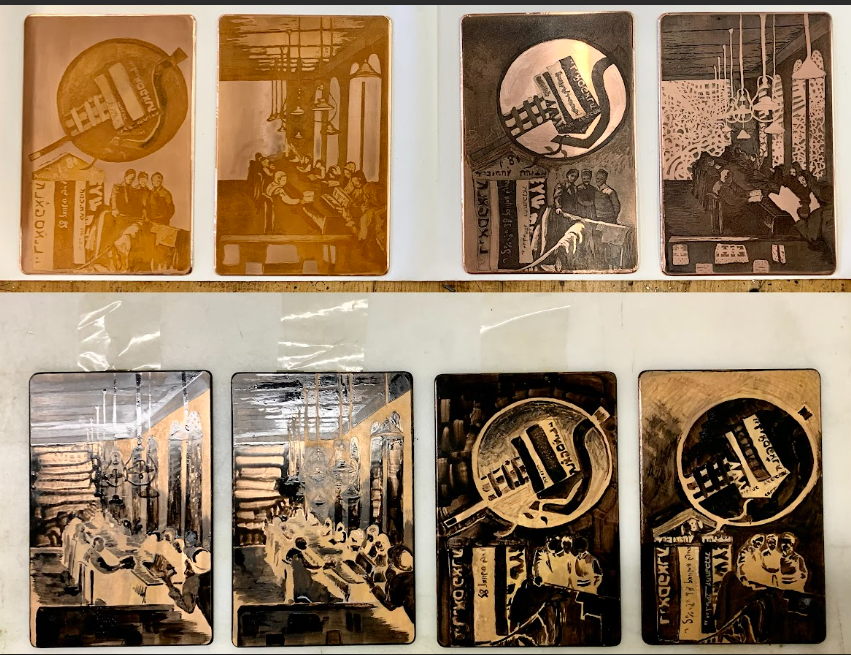
In-progress etching plates
I grouped Paja’s recollections into four sites of cultural resistance: youth education, the library, lectures and organized discussions, and partisan organizations. These groupings provided a framework for developing a visual narrative alongside excerpts of Paja’s quotes and their English translations. Paja’s testimony as well as other primary sources on cultural activity in the Vilna Ghetto demonstrate that these categories of resistance were by no means mutually exclusive, and often the same names and faces appear across these sites. It interested me that Paja’s speaking patterns emphasized the commonality between different forms of intellectual and physical resistance by weaving one into the discussion of the other. For instance, when talking about lectures and discussion gatherings, Paja says, “The gatherings sustained people’s sense of self, their humanity. One didn’t become an animal. The circumstances of the ghetto forced one to become an animal… Creating a partisan organization was also a way of resisting and holding onto one’s humanity: We are not animals, we think and we know what we want.” Here Paja understands the different acts of organizing a literary evening and organizing armed resistance both functioning as re-humanizing mechanisms: a refusal of the dehumanization that exists across genocidal and colonial projects that often compare people to animals in order to justify their oppression and murder.
One of the many times we hear Paja exclaim, “s’iz geven a vunder” [it was a wonder, it was astonishing], is in reference to the vitality of the Strashun library under Nazi occupation. Paja’s description of what she witnessed in the library requires that we form a different understanding of the inhabitants of the ghetto as readers: “People living in the ghetto read books. When they didn’t know what tomorrow would be, what would happen to them, people were coming to borrow books.” As part of my supplemental research on cultural activity in the Vilna ghetto, I saw Paja’s characterization of the ghetto library as “azoy aktiv un azoy bazukht” [so active and sought after] reflected in documentation of the library’s readership. A 1941-1942 report published by the Strashun library, “geto- bibliotek un geto-leyner,” features an in-depth record of library activity and reading habits complete with line graphs and infographics about quantity, language, and genre of borrowed books.
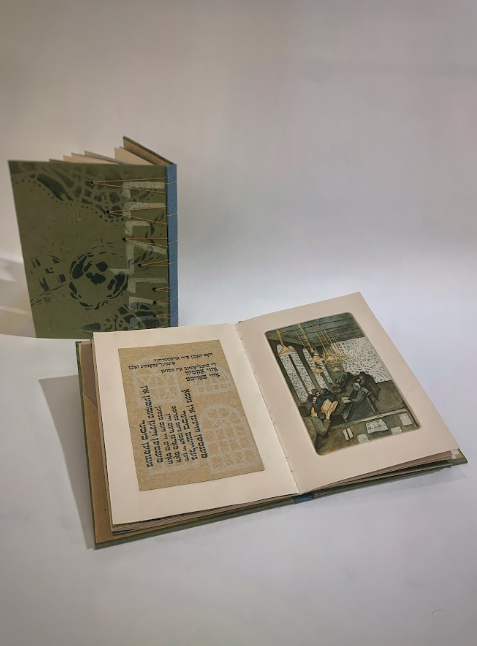
Drawing of the Strashun Library’s iconic reading room facing the etching of Paja’s quote about the library.
Imagery from the Strashun library appears multiple times in my prints. First, in the etching facing Paja’s quote about the library’s activities, I drew the library’s iconic reading room. The figures are slightly blurred; whether they are the readers of the library’s pre-war bustling hall or visitors to the ghetto library is up for interpretation. The scene is embedded with a series of papercut portals, through the high arched windows and below the desk in the foreground. I further explored the legacy of the library and Vilna’s books through my two larger prints: Imperfect Mishkan, which incorporates some of the archival signage from the library’s shelves, and What do we learn from the ruins of a library?, which depicts the rubble of the library upon liberation of Vilna. This afterimage of the library struck me not only because of the generations of Jewish cultural life it once housed but also because it evoked the images of Israeli-bombed libraries and archives in Gaza that I was witnessing in real time. While I intentionally chose to focus on resistance rather than destruction in the visual narratives of this project, the ruins of the library felt important to include as a discussion piece about why we so often see the destruction of centers of knowledge in tandem with genocidal violence.
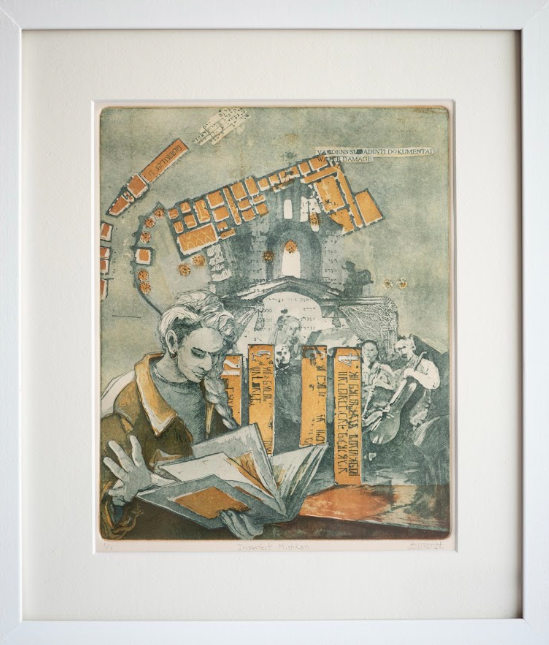
Imperfect Mishkan
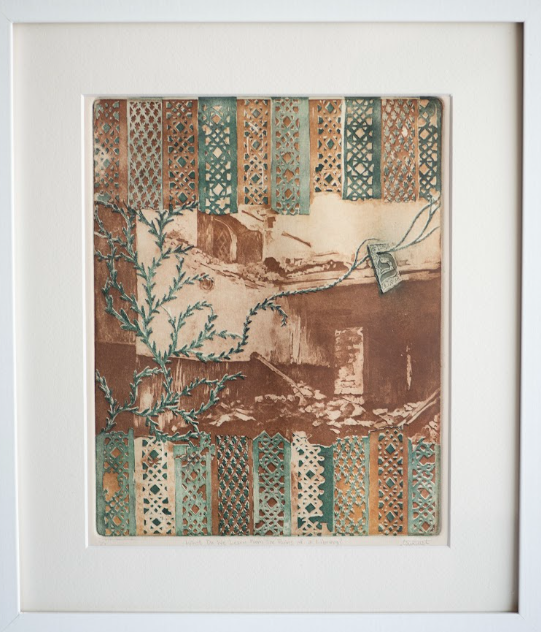
What do we learn from the ruins of a library?
One motif that runs throughout this body of work is the window: there are translucent windows printed behind the Yiddish text, windows or “portals” throughout the book’s illustrations, and the prominent two window panes in the print, Testimony, A Window. As I was looking at archival photos, I was caught by the striking arched windows of the Strashun Library and other buildings that were cultural pillars of pre-war Vilna. This visual form became a shorthand for how I thought about my relationship to Paja’s testimony. Through her words, I glimpsed pivotal moments of her life and the collective experience of her local community. I inherited these stories across partitions of geographical distance (from Vilna to Buenos Aires where Paja recorded this testimony, to Hyattsville, MD where I listened to it), time (from 1990 to 2024), and language (from mameloshn Yiddish to Yiddish learned in a classroom). Paja speaks of the way that cultural events created spiritual or intellectual windows into an entirely different world, “in gantsn oyf an andern oylem.” In many ways, the world of the Vilna Ghetto that Paja relates is entirely foreign to me. And yet, in having access to these glimpses I locate our relationship on either side of these many divides.
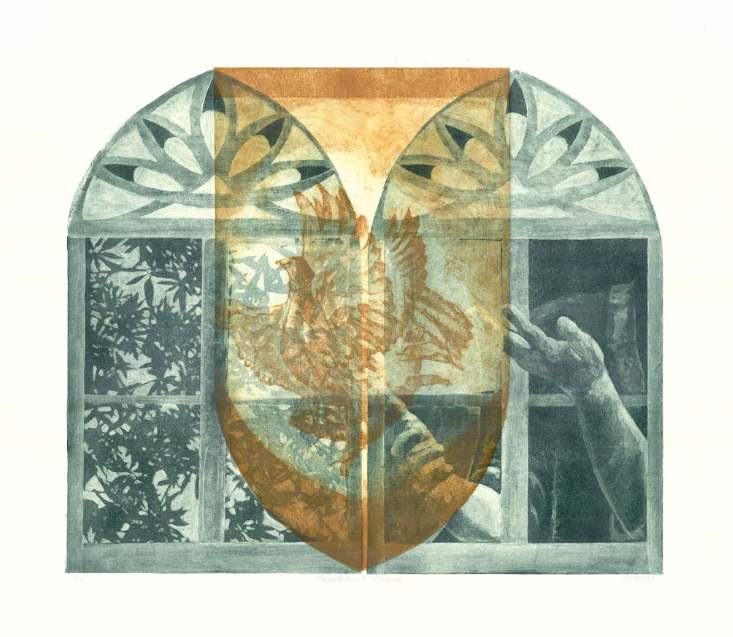
Testimony, A Window
In closing, I would like to express my gratitude and share an invitation for further connection around this project. A sheynem, hartsikn dank to the Fortunoff/In geveb Fellowship for funding and instigating this project; to Yael Horowitz for their beautiful, literary editing of the book’s translations and for serving as a crucial thought partner for this project; and to Paja L for her insight and generosity in recording her testimony. I am grateful for the work space of communal print shops and binderies where I etched and printed these plates and bound them into books: at Zygote Press in Cleveland, OH, Penland School of Craft in Penland, NC, and my home studio of Pyramid Atlantic Art Center in Hyattsville, MD. It is my hope that these books will pass through many eager hands that are up to their own versions of cultural organizing today and can find some nourishment in these words and images. If you would like to bring Veln Di Verter Oykh Nern to your community, or have ideas about how you would integrate this into your curriculum, please email me at [email protected].
In geveb is turning t(s)en! We need your help to launch our second decade and help In geveb to continue to grow and thrive and remain a central address for the study of all things Yiddish online. Our goal is to raise $20,000 by our official tenth birthday: August 15, 2025. We invite you to donate to support In geveb and to honor everyone who has got us this far.
In geveb is turning t(s)en! If we want In geveb to continue to grow and thrive and remain a central address for the study of all things Yiddish online, we need your help to launch our second decade. Our goal is to raise $20,000 by our official tenth birthday: August 15, 2025. We invite you to donate to support In geveb and to honor everyone who has got us this far.