Jun 08, 2026
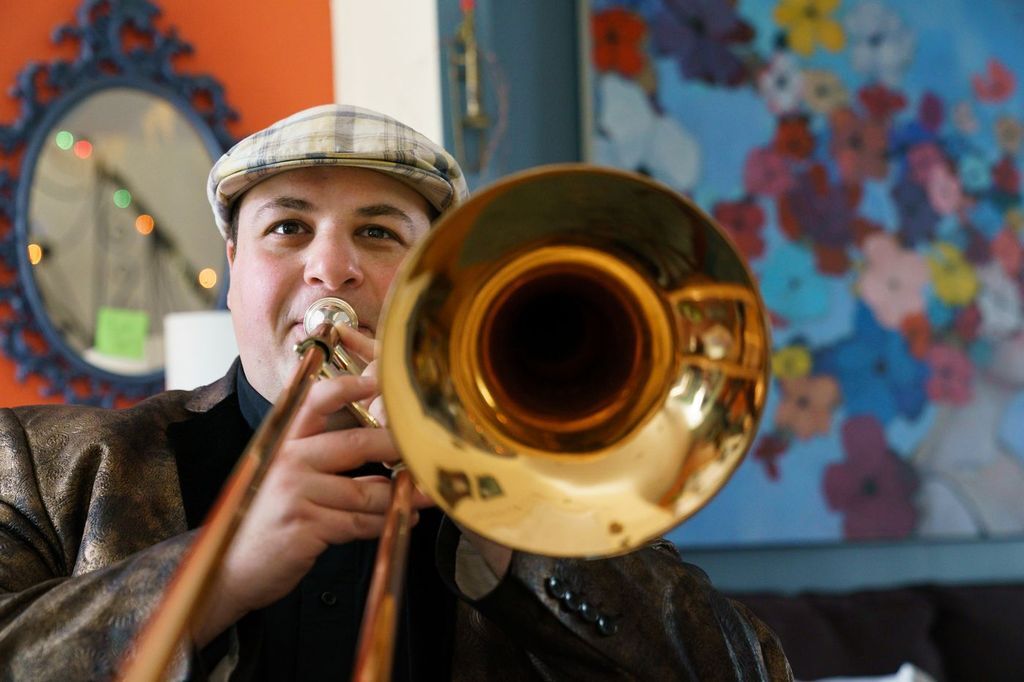
Welcome everyone . . . to a completely new format for the Radiant Others Podcast! I’m your host Dan Blacksberg and I’m writing this blog from my West Philly basement on the same computer I use to record all my audio for the Radiant Others Podcast, a series of informal conversations with people whose work has made them an integral part of the klezmer world. I’m a klezmer trombonist who performs and teaches klezmer and many other forms of music in Philadelphia and all around the world. I’m thrilled to have the opportunity to share all about my podcast with you in the (web)pages of the awesome journal, In geveb! If you’re a regular listener, expect this to be a lot like one of my longer-winded episode intros, and if you’re new to the podcast, here is a great chance to find out who we are, what we’ve done, and what exciting plans and dreams we have moving forward.
Now in its ninth year, I created Radiant Others way back in 2017 to share casual, in-depth, wide-ranging conversations with musicians, dancers, scholars, actors, and poets—from people who have been part of our beloved Yiddish world since the very beginnings of the “klezmer revival” (and before) to those just breaking onto the scene today. The name Radiant Others came from the title of my album that I released that same year, the first klezmer album to feature the trombone as the sole lead instrument. Just like the podcast, it was my offering to the Yiddish music tradition, one that hoped would add something beautiful while also revealing new possibilities for growing that tradition. The name began simply as two words that I liked the sound of, which felt creatively connected to the music I recorded and also to the podcast I was starting.
From 2017 until mid-2020, I did all the work of the podcast—the interviewing, recording, editing, distribution and promotion—on my own. In those three years, I put out many deeply informative and fun conversations with musicians like Veretski Pass, Susan Watts, Michael Winograd, and Sanne Möricke; Yiddish scholars like Mark Slobin and Barbara Kirshenblatt-Gimblett; and musical legends like Ethel Raim and Ray Musiker. After a few years’ pause, I started up again in 2023 with the help of my producer Beila Ungar and we’ve been going strong since then with new episodes about once a month. In our forty or so episodes together we’ve showcased big projects, new releases, and decades-old scholarship, and had casual hangs where we do nothing but share our lives and common stories.
So who gets to be a Radiant Other? At first, the “Radiant Others” I covered were the people in the klezmer and Yiddish music scenes who inspired me, whether they were my mentors or my peers. I wanted to build an oral history of the klezmer scene while so many of the folks who helped grow it into what it is today were still with us. But rather than making it an archive, I wanted to tell it the way we musicians actually do: in “the hang,” the conversations and connections we musicians make after the show. These kinds of conversations usually happen over drinks or late-night food, while staying at the venue way too long or wandering all night through a city we are touring or visiting. It’s a magic time where some of the most fun, ridiculous, and creative ideas are born.
I treasure “the hang” so much because it was there that I was first inspired to dedicate my life to klezmer music and Yiddish culture. I remember the very night it happened: I was at my second KlezKamp in 2003 at the ill-suited Swan Lake Hotel (a very moldy place). Klezkamp had just returned to the Catskills from a few years in Cherry Hill New Jersey, after its original location, the Paramount closed due to a catastrophic fire. I was a 20-year old young whippersnapper, so eager to play and to be around the musicians, like Frank London and Merlin Shepherd, who I was eagerly learning from and trying to follow. And there I was! Over in some side corridor off the goldenly gaudy lobby, like a fly on the wall, watching my musical heroes drink an assortment of Eastern European alcohols (I was too scared to try any) and telling increasingly outrageous stories of gigs at home and abroad, full of hard-to-believe exploits. I was hooked.
In the years since, I’ve realized that it’s a privilege to be in on the hang. Even in a scene as open and welcoming as our klezmer one, it can easily become a space full of gate-keeping and other alienating behaviors. So I decided to recreate the hang in the form of a podcast, an open invitation for anyone to join in what can feel like a private, insidery space. Can’t get to KlezKanada, Yiddish New York, or Yiddish Summer Weimar? You’re always invited to our semi-contrived hang on the Radiant Others podcast. We can’t offer you pálinka, but we can offer our stories and our back-and-forth to everyone and at any time. My dream is that our listeners get mesmerized by our Yiddish world—and inspired to invest themselves, to do the work to create a place for themselves in it—just like I was all those years ago.
When I re-ignited the podcast in 2023, I found that everything had changed in our scene from when I’d let the podcast sputter out back in 2019-20. How could it not have, after the lockdowns, after years of not being together in person, after Zoom upon Zoom upon Zoom? We had gone through some hard times, to be sure, but the coolest part of what was now emerging was that a whole new generation of performers was quickly coming into their own: folks like Ira Temple, Zoë Aqua, The Magid Ensemble, Mikhl Yashinsky, Anthony Russell, Isabel Frey, Fran & Flora, and, of course, Aaron Bendich’s Borscht Beat Records, the label that has given many of these and other musicians a home and an impetus to make albums, and lots of them! We are now swimming in such a big playground of new klezmer music and Yiddish culture that we couldn’t make enough episodes to cover it all!
After chasing down some of my favorite people for our first few episodes of the revived podcast, I started to notice that not only had the klezmer music scene changed, I myself had also changed in the intervening years. I felt more solid, more grounded, more full of my own ideas and perspectives, not just about klezmer music, but about the entire process of becoming and existing as a person dedicating their life to exploring and bearing culture. I realized I had grown (and simply aged) into a new role in my life as an artist, and as a pillar of our klezmer community. And I also found that all my work grounded me in a sense of myself, my place in life, and my Jewishness. I found a stability that even the hurricane forces of our post-October 7th world couldn’t shake. I am still growing into this realization, and I now want it to be the main offering of this podcast: sharing with my mostly klezmer-connected audience knowledge and perspectives that could help them build a similar sense of solidity and resoluteness.
While this new focus represents a big shift inside my brain, it will be a subtle, but, I hope, significant shift for our listeners. We still plan to present a combination of musicians, scholars, and people talking about current projects, or just telling their stories, with new episodes about once a month. Underneath, though, it feels very different. This difference comes not only because I regularly present artists from a musical generation younger than me, but also because I am approaching the conversations with an eye to a broader perspective. I want to share the work of people outside the Yiddish world who are working on and with ideas that resonate with my own. A closeby, Jewish example of this is in our recent episode with Sephardic Studies historian Devin Naar. Hearing him talk about the shared geographies of Sephardic and Ashkenazi people in the past, and his concept of “Multi-Rootedness” (as complementing and contrasting the common “Rootless Cosmopolitan”) blew open my ideas of how Jewish people’s historical, geographic, and cultural connections could form the basis for creating new webs of solidarity and connection.
Realizing the podcast’s work of revealing these kinds of real and potential connections runs up against the classic and most boring of obstacles: money and time. As any regular listener knows, no intro is complete without me asking you to support our work. Right now we cover about 80% of our costs through our Patreon supporters and a few other private donations, which allows us to release about 12 episodes a year. With such a small release schedule, we miss getting to cover so much great new music, and more than that, we miss out on the chance to respond to current events, like the giant splash and ripples being made by Molly Crabapple’s new best-selling book about the Bund in a timely manner. I know many of my colleagues and I have so many thoughts and Radiant Others would be a perfect place to let it all fly! My dream would even be to put our Yiddish cultural scene’s knowledge, experience, and, of course, our strong opinions in conversation with performers and scholars from other cultures and beats who find their way to similar themes. To do that, we do need your help. Please consider visiting the links at the bottom of this article and support us financially, or at least rate, review, and share our episodes far and wide.
I came up with the title Radiant Others simply from an artistic feeling, but I increasingly love meditating on what “radiance” could mean. In truth, we are all Radiant and none of us should be Others, but in our society, whether by choice or not, we who find ourselves “othered” get to joyously and even gleefully inhabit multiple worlds with various degrees of belonging. Yiddish Culture, especially as it exists today, is so good at celebrating many different kinds of beautiful Radiant Others. It gifts us traditions, politics, and practices for traversing and being not just Rootless Cosmopolitans, but, in Devin Naar’s conception, “multi-rooted beings” living in this world. So from our home to yours, the Radiant Others podcast will continue to share the lives, ideas, and interconnectedness of it all. As I say in most intros, that’s it from me, so please tune in and enjoy an episode of Radiant Others.
Radiant Others is produced by Dan Blacksberg and Beila Ungar. Listen at https://radiant-others-a.blubrry.net/ or wherever you get your podcasts. Please support our work on https://www.patreon.com/RadiantOthers, and tip us as https://tiptopjar.com/RadiantOthers.