May 27, 2025
INTRODUCTION
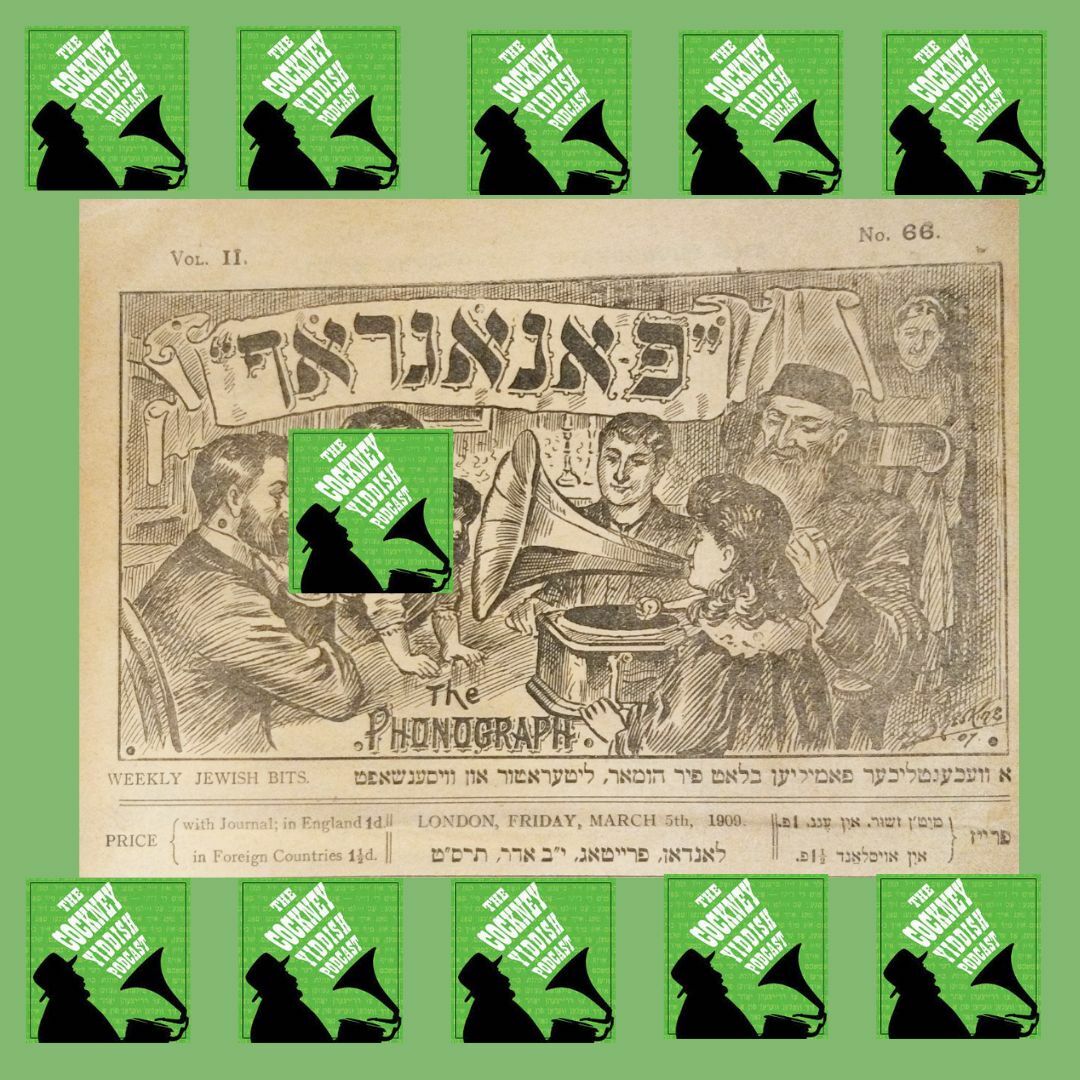
The Cockney Yiddish Podcast explores the unknown Yiddish popular culture of London’s East End through an array of newly discovered stories and songs from the 1880s to the 1950s. Historians Nadia Valman and Vivi Lachs share their passion for the tunes and words of Jewish Londoners encountering the Cockney culture of music halls, street markets and rhyming slang. The Cockney Yiddish Podcast is written and presented by Nadia Valman and Vivi Lachs, produced by Natalie Steed at Rhubarb Rhubarb for Queen Mary University of London. Funded by the Arts and Humanities Research Council (AHRC).
Rachel Gordan, Shorstein Professor of American Jewish Culture and Society and host of “Writing It! The Podcast About Academics & Writing” recently spoke to Valdman and Lachs about their project.
Rachel Gordan: Vivi and Nadia, it’s so great to be in conversation with a fellow podcaster! Your series, “The Cockney Yiddish Podcast” is beautifully done, with episodes addressing themes including humor, politics, theater, an nostalgia in East End Yiddish culture. It’s a very enjoyable listen! Each episode gave me the feeling of going on a journey into British Yiddishland. It’s really a gift to listeners – those who know the East End and want to revisit and those of us who knew nothing about it before and are grateful for such knowledgeable and entertaining guides.
Why was it important to you to uncover and display this world of East End London Yiddish culture?
Vivi Lachs: We’ve both given many talks about and tours of the East End, so we know how engaged people are by the subject. And that there’s a large mixed audience. On the tours of the East End that I give, there are people of all backgrounds: non-Jews, people with an interest in urban history and London’s history, people who know a few words of Yiddish and those with ancestors who spoke Yiddish, so we knew there was the potential for large, interested, diverse audience.
Nadia Valman: Vivi had also recorded some amazing audio clips: interviews and music that make great podcast material.
VL: It’s also an opportunity to tell this history through popular culture, which engages people.
RG: How did your backgrounds prepare you for creating this podcast? And why did you want to make use of the popular culture sources that you do, for this podcast?
VL: My work is as a historian of the immigrant East End through the lens of Yiddish language immigrant popular culture of the 1880s onwards. These texts come from non-official sources but display the conversations and debates and details of the immigrant world that may have been overlooked by historians relying on mainstream sources in English. The importance of uncovering this East End culture is twofold. Firstly, it clearly lays out the important political and social debates about work, ideologies, relationships, and the nature of the cultural Yiddish institutions of the theatres and music halls and the popular press. But secondly, through Nadia's work on East End Jewish literature in English, we see the place where generations of Jewish writers move apart and come togetherand make choices about writing in Yiddish or English or a mix of the two. It shows how Anglicization encouraged the disappearance of Yiddish and integration into Anglo-Jewish British culture. The podcast also specifically locates the Yiddish speaking East End as a part of the non-Jewish East End it resides in and exposes the influence in both directions in language, culture and work.
RG: What does “Cockney Yiddish” in your title refer to?
VL: Cockney refers to the local London Yiddish, as well as the immigrant experience and the interactions among different immigrant communities.
RG: The podcast explains that a Yiddish renaissance occurring in British society now. What are the stages of that renaissance?
VL: What has happened here in London is not independent from what was happening in the US. The British Yiddish renaissance occurs on the back of what’s going on in America. We lost Yiddish about a generation before the US, when the East End was bombed in the Blitz in 1940-1941. In the US,it was still being created in the mid-twentieth century (in part, thanks to organizations such as the Workmen’s Circle). So, the British Yiddish culture that once produced newspapers, theater, stories, and Yiddish song music was, by the mid-1950s, more limited to a weekly Yiddish press, a monthly literary journal, and small music and reading circles, mainly frequented be elderly Yiddish speakers. By the 1990s-early 2000s, Oxford University offered Yiddish, and the revival of Yiddish culture and song began to draw renewed interest from a younger generation, and this is now beginning to flourish. British Yiddish language culture has been neglected by Americans, in part, because there’s so much Yiddish culture to study in the US. Through the podcast, we hope we’re letting people know about the rich Yiddish cultural history of the East End.
RG: The podcast is mostly about immigrants and children of immigrants. How did immigration policies and issues affect the Yiddish culture you’re examine?
NV: The podcast looks at three broad periods, the immigration period c.1882-1905; the 1930s and the 1950s. During the earlyperiod, there was growing hostility to immigration, which culminated in a change of the law that restricted immigration for the first time, in 1905. But although this was discussed in the Yiddish press, the immigrant generation could not directly engage in the public debate in parliament and the English press: they were mostly not English speakers, and did represent not themselves in this debate (with the exception of British-Jewish writer Israel Zangwill). What they do write about is the struggle to improve working conditions, and in entertainment culture they satirize their experiences of the shock of change and the temptations of assimilation.
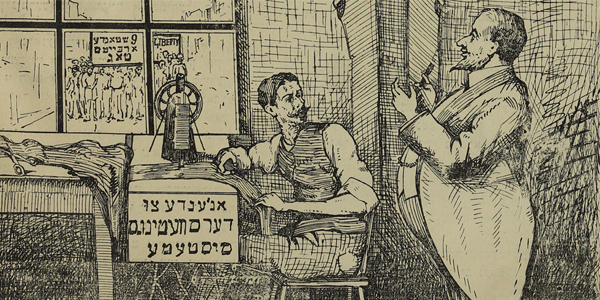
“The Tailors’ Victory in the Fight for a 9-Hour Working Week”
Scab (to master): What? No more than 9 hours’ work a day. Where will I get money to bet on the horses?
Master Tailor: Don’t worry, my friend. You’ll work 9 hours before lunch and 9 hours after lunch.
Protesters’ banner: “9 hours a working day”
Tailor’s table sign: “An end to the sweating system”
Der bloffer, 1912. From the collection of the National Library of Israel, sourced (with this caption) from the website of the Cockney Yiddish Podcast.
RG: Something that will feel timely to many listeners is the way East End Jews were fighting fascism. Can you explain why this activism takes root?
NV: By the 1920s, Jews felt very much at home in the East End and had established a rich cultural and social infrastructure. But in the 1930s they also, simultaneously, experienced increasing harassment (shop windows being smashed, street violence) by supporters of the British Union of Fascists. This was vigorously resisted by various organised Jewish and non-Jewish groups within the East End, and we touch on the culture of the Workers’ Circle where Yiddish-language debate and lectures happened every night — many writers refer to this club in memoirs and novels. The important thing to note is that in the East End, Jews regarded the threat of fascism as one that impacted everyone in the East End, not just them. British fascism was using the ideology of antisemitism opportunistically (e.g. blaming Jews for economic hardship) as a way to appeal to the working-class vote. And certainly Jews in London would have been especially aware of how fascism in Germany was targeting Jews in ever more frightening ways. But the threat of an authoritarian, militaristic regime that wanted to disrupt the existing diverse community and institute a restrictive idea of the nation, was something that they felt threatened everyone. Most of the evidence of this activism is in the political organizations rather than in literature, but Jews did also write in Yiddish publications like the newsletter of the Workers’ Circle to galvanize other Jews to join this struggle, and in English for the wider East End readership.
RG: Something I had to ask: I came to this podcast not knowing much about British Yiddish culture beyond what I think is an American saying, and that is, “Dress British, Think Yiddish.” I’d love to hear your thoughts on this expression.
VL: We were both intrigued by the phrase "Dress British, Think Yiddish" because neither of us had heard it before. But it seems to be that “Dress British, Think Yiddish” suggests that British and Yiddish are two diametrically opposed ways of being. But in the Cockney Yiddish Podcast we are interested in a contrary proposal: that in theworking-class East End of London, Cockney English and East European Yiddish cultures came together, mixed and merged, and produced a cultural flowering in the twentieth century.
RG: The podcast suggests that Yiddish culture has become an alternative way of affiliating Jewishly for you Brits. Why do you think this is appealing now?
NV: Yiddish culture was and is a culture of the Jewish diaspora, which is appealing to a generation that does not identify with Zionism. The radical elements in Yiddish culture also offer a historical grounding for people in Britain to create solidarities with other groups. Yiddish culture, which is appealing to young Jews and non-Jews in London, has been a way to build bridges within our own local communities. In London, we feel the threat of fascism from Europe, and in the Yiddish culture of the 1930s, we find inspiration for fighting fascism, and ways to forge links across cultures.
All seven episodes of The Cockney Yiddish Podcast are available at: https://cockneyyiddish.org/

In geveb is turning t(s)en! If we want In geveb to continue to grow and thrive and remain a central address for the study of all things Yiddish online, we need your help to launch our second decade. Our goal is to raise $20,000 by our official tenth birthday: August 15, 2025. We invite you to donate to support In geveb and to honor everyone who has got us this far.