May 21, 2026
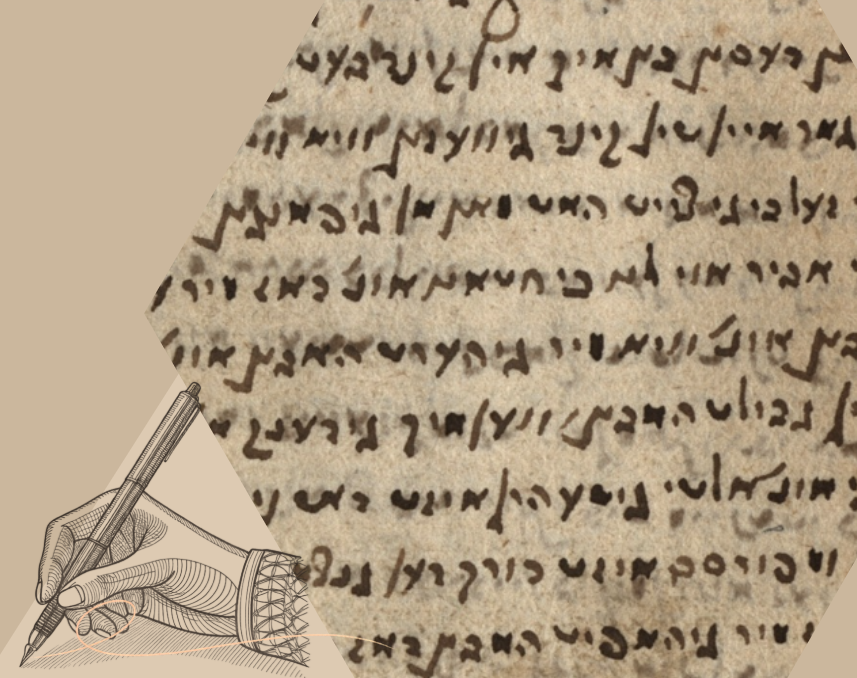
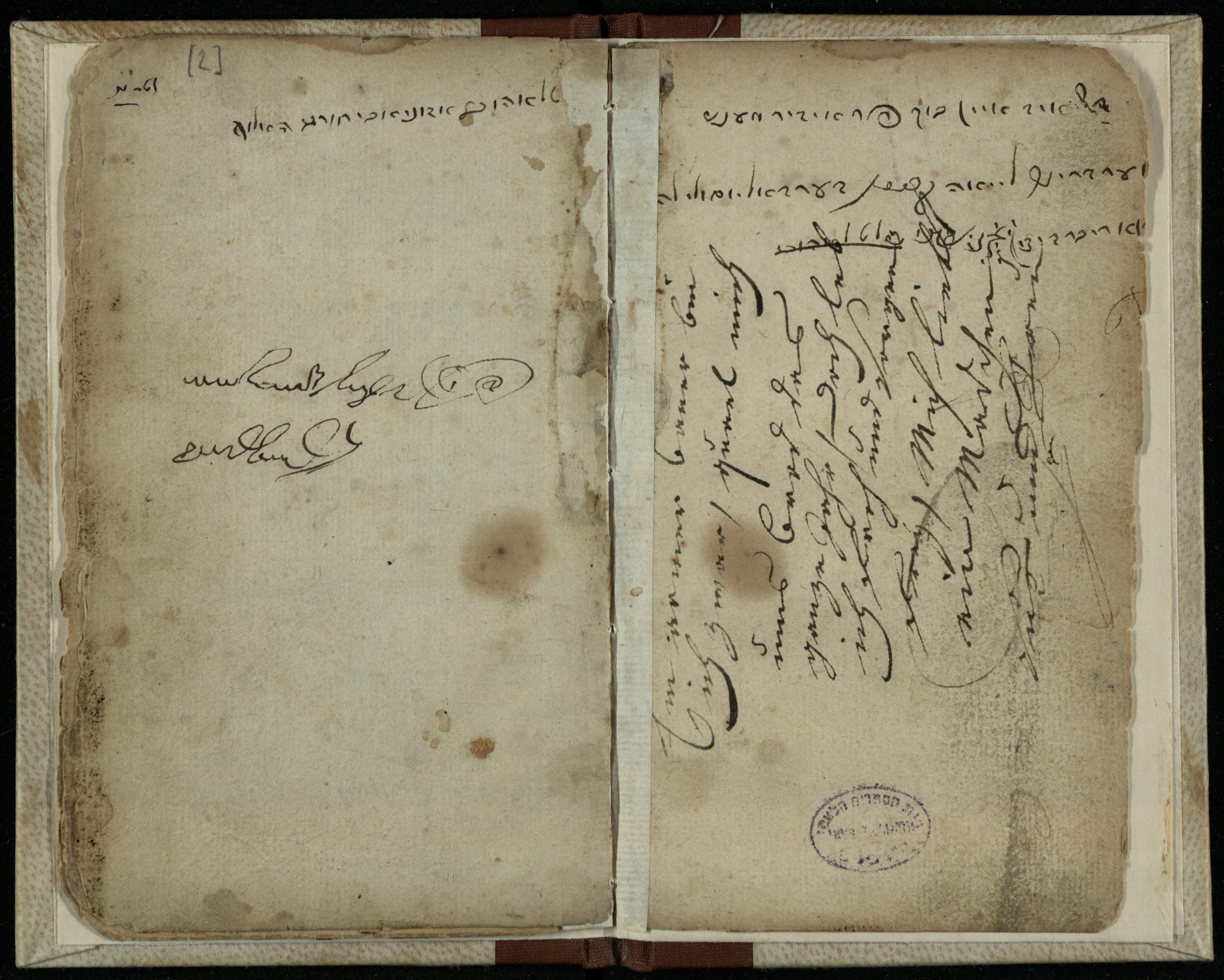
A fragment of Glikl’s manuscript in the collection “Hebrew Manuscipts” within the University Library Frankfurt Johann Christian Senckenberg: http://sammlungen.ub.uni-frankfurt.de/mshebr/content/titleinfo/1759801 in a collage with a line drawing of a hand writing with a pen.
Glikl of Hameln—or Glikl bas Judah Leib, as she is also called—began to nudge at my thoughts two years ago. I had seen her on a list of Jewish memoirists, alongside more familiar names like Primo Levi, Eli Wiesel, Viktor Frankl. And there was Glikl, somewhere in the middle of this catalog of distinguished writers, not a voice shaped by the Shoah but a figure who came from centuries before. Out of curiosity—some instinct that her story might lead me to draft a poem or two—I ordered two translations of Glikl’s memoirs.
Many years before, I had written a book in the persona of an imaginary Yiddish poet, a woman I named Ida. I placed Ida in a fictional town in Poland, which I called Zawsze-Zima. Always-Winter. She came to me like a literary haunting during a four-month research fellowship at the United States Holocaust Memorial Museum. Slowly, as I stood in the archives, reading yizkor books and psychological studies of survivors, I started to hear Ida’s poems, fragments translated from Yiddish, a language I still do not know and cannot read.
After I ordered the translations, Glikl’s memoirs sat on a shelf in my office for many months. Maybe I had forgotten briefly why the books interested me. Maybe I was nervous that I would find no inspiration in those pages. But when I finally began to read her words, I realized that here was a whole life of poems waiting to be written. This time, a real woman who once wrote in Yiddish was talking to me.
Born in 1645, Glikl composed her memoirs from 1691 to 1719, initially while she was grieving the death of her first husband, and later, after her second husband died and left her destitute and dependent on her grown children’s charity. In these writings, Glikl chronicles the uncertain fortunes of her family’s business, cases of hatred and persecution of the local Jewish community, reports of pogroms in Eastern Europe, as well as ongoing worries about the bubonic plague, an illness that led frequently to violence against Jews, often perpetuated by Christian neighbors. Her memoirs include tales of deaths and births as well as descriptions of marriage feasts, a horrific crowd collapse at a synagogue in Metz, and even rumors of the supernatural.
Scholars describe Glikl’s book as the only extant premodern Yiddish memoir written by a woman. As Chava Turniansky explains, Glikl’s book has “turned out to be a singularly important social and historical document and at the same time one of the greatest literary achievements of Ashkenazi prose—in Yiddish or Hebrew—at least until the end of the eighteenth century.” 1 1 Chava Turniansky, “Introduction,” in Glikl: Memoirs, 1691-1719, trans. Sara Friedman (Brandeis University Press, 2019), 19. I believe the anxieties that Glikl articulates about Jewish life in the Diaspora will be relevant to many contemporary readers. Her narrative is one of resilience, of learning how to remain adaptive and agile during times of enormous political instability.
My book-length sonnet sequence, A Bit of Martyred Clay, takes its title from a passage in which Glikl mourns the death of one of her children, an infant whose name she never tells us:
It was a lovely, well-built child, but it came down at once with the selfsame fever as mine. Though we summoned doctors and every mortal aid, it proved of no avail. The child suffered fourteen days, and the God took back his share and left us ours, a bit of martyred clay. And me He left, a mother brought to bed—without her babe. 2 2 Glückel of Hameln, The Memoirs ofGlückel of Hameln, trans. Marvin Lowenthal (Schocken Books, 1977), 142.
These sentences, as translated by Marvin Lowenthal, exemplify Glikl’s ability to bring her own humanity to the page and to erase the distance between the seventeenth century and the right-now. In these sentences, she could be any devastated mother lodged deeply inside her own hard grief.
The past is always a distant country whose inhabitants speak as if in a foreign language. That I cannot read either Old Yiddish—the language in which Glikl’s memoirs were written—or modern Yiddish, and therefore cannot translate Glikl’s words myself, only adds to that distance. Whenever poets write about the long-ago, we must find ways to bridge the wide water between the past and the present. In working on A Bit of Martyred Clay, I look to key passages from Lowenthal’s translation of The Memoirs of Glückel of Hameln (1932; 1977) as well as Sara Friedman’s more recent translation, Glikl: Memoirs 1691–1719 (2019). Lowenthal’s translation is the more elegantly worded of the two, but it is also overly concise in places. His translation omits lengthy religious passages, including those that open the first section of Glikl’s memoirs. Reading Lowenthal’s version of the memoirs has allowed me to identify anecdotes that might lend themselves to poetic reinterpretation. Meanwhile, the language that Friedman uses is far less condensed (and occasionally less beautiful). Her translation was edited by Chava Turniansky and is richly footnoted; the annotations provide essential insights about the political, literary, and devotional elements of Glikl’s memoirs. While Lowenthal’s translation serves as the lyrical starting point for many of my sonnets, Turniansky’s exhaustive scholarship has been particularly useful during the revision process, as I am trying to find a balance between music and meaning, between elegance and accuracy.
Other poems come out of my study of early modern material culture, including research on the sumptuary laws of the Jews of Altona and the seed pearl trade in Danzig, the Polish port city now known as Gdańsk. Ekphrasis—in this case, poems that describe and reflect on specific art objects—help to make Glikl’s world feel more tangible as well as three-dimensional, an embodied space through which real people once moved.
And a few poems in the manuscript emerge entirely out of my imaginings of the memoirist and her milieu. In the way that a midrashist might fill in narrative gaps in the tale of Isaac’s binding, so do I look to the places where Glikl omits information from her book. I ask myself: What is missing from this account? What silences can my poems undo? While Glikl describes dowries and business deals in minute detail, she frequently leaves out the kinds of stories that could make for fascinating poems. For example, the memoirs contain very few intimate recollections of her marriage to her first husband, Chaim, no discussion of when or how they fell in love. I would like to know if Glikl had a sweet tooth, perhaps a favorite dessert. And her second marriage, which she describes in gloomy and bitter terms—were there any moments of happiness in that union before its grim conclusion? These absences in Glikl’s text become opportunities for invention and creativity, a means of approaching her inner life and of considering what she chose to keep entirely to herself.
Glikl spoke in a seventeenth-century voice. I try to avoid ventriloquizing Glikl here. Instead, my sonnets braid together contemporary speech with my study of the period, creating what I hope is a lyric embodiment of this historical figure.
The sonnet—a fixed form developed in Italy in the thirteenth century, before making its way into English in the sixteenth century, and into German literature by the early seventeenth century—seems ideally suited to the task of this collection. Maybe I am drawn to the sonnet because fourteen appears to have been a significant number for Glikl. She was married at fourteen. She had fourteen children, twelve of whom survived into adulthood. After her beloved Chaim died from internal injuries—what doctors called a “rupture”—Glikl waited fourteen years before marrying again.
The sonnet is appealing too because of its capaciousness, its ability both to tell stories and to sing songs. I use the form to depict tiny scenes from Glikl’s memoir. Sonnets can serve as letters to the reader. They can be lovers’ laments, elegies, prayers to the divine, arguments and explanations, self-portraits and still life paintings. Many of the sonnets in A Bit of Martyred Clay are Shakespearean. In some poems, however, I choose to merge the rhyme schemes of the Petrarchan and Shakespearean versions of the form to produce a sonnet that blends the musical constraints of the former with the lyrical resolution of the latter, that epigrammatic, closing rhymed couplet that should sound to a listener like a door clicking shut. And, in the style of many early modern sonnets, I have left the poems untitled.
In contemporary poetry, working in traditional forms—using iambic pentameter and a strict rhyme scheme—is often understood as a bit audacious. When Jewish women poets such Marilyn Hacker, Rachel Wetzsteon, and Jacqueline Osherow have chosen to write extensively (and with great skill) in fixed forms, it’s an act of defiance, an insistence on being admitted to a literary conversation that has favored men’s perspectives and that has seldom admitted Jewish writers altogether. I hope that A Bit of Martyred Clay will be seen as part of this same subversive legacy.
Turniansky writes, at the start of Glikl: Memoirs 1691-1719: “I spent many years editing, annotating, and translating Glikl’s fascinating work, in the writing of which she found comfort following the death of her husband. Similarly to Glikl, this endeavor gave me solace after the loss of my husband.” 3 3 Turniansky, Glikl, xiii. I began to write these poems not long after my own husband faced a severe health crisis that caused me to wonder if I might soon become a widow as well. Entering Glikl’s story allowed me to escape my own terror, the panic attacks that possessed me with dread in the middle of the night like some kind of malicious spirit. The formal restrictions I imposed on the manuscript helped me to seal each of my fears inside the narrow container of the sonnet’s fourteen lines.
In the past few months, as I’ve become increasingly immersed in this project, my mother has asked me (somewhat anxiously), Is every poem in your book going to be about sadness, loss, or tragedy? Her question surprises me because Glikl writes with such resilience and faith that it’s easy to forget how much loss surrounded her. She is not a tragic figure. She is smart, resourceful, and constantly strives to be wiser and more generous in her assessments of other people.
Glikl is imperfect, too. When her second husband loses most of their money, goes into hiding, and then dies, the writer expresses both regret and anger for their marriage. She acknowledges that, for most of his life, the man was tremendously successful in business, a revered member of his community, someone who wielded power. But she cannot forgive him for having brought her to the financial ruin she spent so many decades attempting to avoid. Their union is contaminated by his failures. Of course, Glikl’s inability to relinquish her fury—at herself, at her second husband, at his grown children—only makes her a more compelling and human character.
My wish for A Bit of Martyred Clay is that it will offer a vivid picture of what it meant to be a Jewish woman in seventeenth-century Germany and that it will encourage readers to ask: What can Glikl’s experiences teach us about the importance of preserving Jewish texts and history? Reading Glikl’s story, what do we learn about Jewish peoplehood, about the tension between separation and the longing to engage with the larger world?
*
My mother always fed me apple cake
to teach me that our joy is like a crumb.
It’s small and has a tendency to break
when lifted to the tongue. How troublesome
the world, how dashed with salt. My mother said
our worries are like butter knives—they scrape
but seldom cut. And so, she spoke instead
of fruit and flour, the honey’s shifting shape.
She handed me a piece of cake. No plate.
No fork. We stood together taking bites.
The sugar in our mouths, we’d concentrate
on nothing but our little appetites.
The taste of cinnamon was transient,
the apples and their sweet, dissolving scent.
*
When I was barely three, the German Jews
were driven out of Hamburg by decree.
Back then—as it is now—catastrophe
was like a neighbor coming to accuse
us all of clipping coins or tainting stews.
A baby dying in its crib would be
our fault. In Hamburg every tragedy
belonged to us. These hatreds were the dues
we paid on waking up or falling back
to sleep, on meat and milk and braided dough.
We paid a lump then waited for attack.
It came each quarter like a toll, and so
we paid. The city gave us a receipt.
We paid with every beating in the street.
*
We heard a woman died while giving birth.
And then her grave was vandalized. Her shroud
was torn, a cloth the color of a cloud,
or pale as milk, or like December earth
when laid beneath the snow. They said she stirred
within the box. She pushed the dirt aside
and visited the town. Unmollified,
she haunted us. When she was disinterred,
they found her body bare, no cotton wrapped
around the form that used to hold her soul.
We sewed another shroud. No buttonhole,
no pin or fastener to keep her trapped
with us, the living ones. We told the phantom,
go—we’ll find you in the world to come.
*
I should remember that the world is not
for long. Its vanities are like the lead
an alchemist converts to gold. Distraught
at cheats and frauds—so often I’ve misread
a man, believed him good when he was base—
I can’t forgive. I cherish discontents
as if they’re prized. And yet it’s commonplace
that men are made of impure elements,
and some are metals barely worth their weight.
No science can transmute their souls, no grudge,
no vitriol. I shouldn’t calculate
how much I’m owed. Hashem is judge.
He weighs our deeds against a lump of tin
and melts us down, a sacred discipline.
*
The women wore no colored silks, but dark
on darker cloth. No borders stitched with gold,
no silverwork, but unadorned and stark.
The ways we could be judged were manifold—
too much alike, too different in our dress.
The men could not wear velvet trimmed with lace.
No sable, lynx, or any soft caress
of fur against the skin. We learned to place
ourselves along the fringes of the town.
We were the smudge of shadows on a hem.
We were the secondhand, the hand-me-down.
No glittering. No pearl or precious gem.
Our neighbors’ envy kept us plain, austere.
We wore the somber garments of our fear.
*
That death could be so commonplace—he tripped
and fell against a stone the way a mind
might stumble at a thought. So nondescript,
that stone, a rock that anyone might find
on any street. My mind returns again
to how that pebble came to be and why.
I sift it through my thinking, wonder when
it settled in its fatal spot. That he should die—
I want my husband’s death, the circumstance
of it, to glitter like a ruby set in gold.
Instead, his accident was dull mischance:
a boring afternoon, a stone that rolled
beneath a boot, a man preoccupied
until he felt the sharpness in his side.
*
Those seven days, I was a bird that swooped
across the wreckage of the sky and waited for
the waters to recede. My feathered grief
displayed an iridescent shine. It cawed.
It hunted for a perch and was adrift
in loneliness. My sorrow searched for land
beyond the flood. It couldn’t understand
how easily the world is drowned, the swift
obliteration of a life. I clawed
in anguish, tore my sleeve. And no relief
arrived to rescue me, no untouched shore
appeared, no dove or olive branch. I drooped,
a scavenger of loss, a raven left
without its mate, my squawking sharp, bereft.
*
Suppose the body is a silver case,
its surface filigreed with fine designs.
Suppose it’s chased with gold. Suppose the lace
is soldered by a maker who defines
the point of everything—the case and all
it holds, its only function to protect
the scroll that’s rolled inside of it, the scrawl
of words. Suppose the body can’t neglect
this parchment it contains. Suppose the soul
is written on. Then there must be a hand
that inks the sentences, the letters whole,
the words unblotted, clean, and each command
no bigger than a poppy seed, a glint
of light perhaps, a tangled piece of lint—