Mar 15, 2026
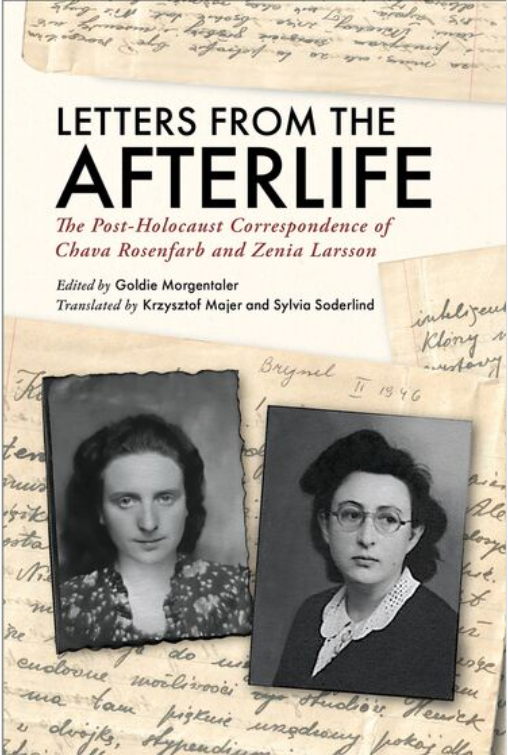
Letters from the Afterlife: The Post-Holocaust Correspondence of Chava Rosenfarb and Zenia Larsson. Edited by Goldie Morgentaler. Translated by Krzysztof Majer and Sylvia Söderlind. Montreal & Chicago: McGill-Queen’s University Press, 2025. ISBN 978-0-2280-2466-8
This book contains a priceless treasure: hundreds of letters, methodically recovered and translated, which document the profound bond between two women, a bond strengthened by shared trauma and creative endeavor. Editor Goldie Morgentaler has done the world a great service by making this correspondence—so rare in its completeness and so rich in detail—available in English to scholars, students, and readers of all kinds.
Opening Letters from the Afterlife, readers will find three hundred pages of engrossing, heart-wrenching correspondence between two girlhood friends. They grew up in Łódź, Poland. Together, were interned in the ghetto, deported to Auschwitz, and survived Bergen-Belsen. Only when the camp was liberated did they separate: Chava (Ewa in Polish) Rosenfarb (1923-2011) went to Belgium and eventually Canada, while Zenia Larsson (née Marcinkowsten) (1922-2007) relocated to Sweden. This volume recovers twenty-seven years of their correspondence, from December 1945 through 1971, although the pair kept exchanging letters until 1996. The letters collected here document the women’s profound struggles with survivors’ guilt, immigration, and cultural during the postwar years. Readers can trace how Rosenfarb and Larsson painstakingly built new lives but always lived in the shadow of the war. The friends served as each other’s confidantes, spiritual guides, creative coaches, and touchstones to the past. Letters from the Afterlife is a remarkable source for anyone interested in Holocaust and its aftermath, art and trauma, and life writing.
The story of how these letters were discovered is almost as fascinating as the letters themselves. Goldie Morgentaler, now a retired professor of Yiddish literature, stumbled across her mother Chava Rosenfarb’s letters after her death in 2011. Once she learned that Zenia Larsson had published many of her own letters in 1972, Morgentaler set about putting the two halves of the conversation back together. The original letters were written in Polish; however, the only surviving copies of Larsson’s letters were the published ones she translated into Swedish. Two translators, Krzysztof Majer and Sylvia Söderlind, did a miraculous job converting both the Polish- and Swedish-language letters into English. They seamlessly recreate this epistolary bond in all its complexity, allowing the reader to feel moments of tenderness and reproach with equal poignancy. In addition to procuring the letters, Morgentaler contextualizes the correspondence with a detailed introduction, curates a gallery of two dozen photographs, clarifies many of the textual references through footnotes, and shares excerpts of Larsson’s introduction to her publication of the letters. Morgentaler groups the letters into chapters that mark various phases of Rosenfarb’s and Larsson’s epistolary friendship: from the postwar years and the pair’s literary success at midlife to the disillusion of their friendship. Full of heartache and hope, this deeply introspective and profoundly intimate letter exchange is punctuated by three thematic tensions. The first is between intimacy and isolation; the second connection and miscommunication; and the third creation and destruction.
Intimacy and Isolation
Letters from the Afterlife illuminates a myriad of additional traumas that Holocaust survivors underwent after liberation. The ordeals of relocation, social isolation, and “linguistic homelessness” (xxiii) were so devastating to Rosenfarb and Larsson in part because they were unexpected. Faced with death every day in Bergen-Belsen, the prospect of a peaceful postwar life seemed like a dream. And yet, experience of being in quarantine after liberation felt like another imprisonment (6). Rosenfarb and Larsson were safe, but they ached with loneliness, living in countries where they did not know the culture or speak the language. Above all, the experience of losing one another was simply “unbearable,” as Larsson put it (8). Larsson became particularly disconnected from Jewish community because she relocated to Scandinavia. “I am also totally, utterly alone,” she confessed, “more than anything else, I feel my homelessness here” (9). Rosenfarb’s younger sister, mother, and boyfriend (later her husband) survived, but she too felt unmoored living in Belgium even though she did find a community of Jewish refugees there. Larsson experienced this only in 1969 when an influx of Jews, escaping a surge in antisemitism in communist Poland, fled to Sweden (303).
At the same time, Larsson’s social isolation was, to a degree, chosen. It was a way for her to insulate and protect herself from agonizing memories. As she reflected in the 1970s, Larsson admitted that parting from Rosenfarb “felt at the time—despite everything—almost like a relief” (320). Needing a clean break from the past, Larsson refused to associate with any Jews who returned to Germany (4). “For me,” she explained, “Germany is a dead, cursed land, which I cannot stop hating” (13). She also pulled away from the Bund, a move that caused a temporary rift between friends (104, 106, 109). But the friends never flagged in their efforts to help each other find peace and stability. Rosenfarb encouraged Larsson to open herself up to new connections, advising her in May 1947 to “tear down the walls and barricades.” Although new connections meant new vulnerability, Rosenfarb assured Larsson: “You are strong enough” (66). “It impossible to live even in solitude, even on an island, with just your own throbbing head for a companion,” she wrote, “I am always with you, Your Ewa” (25).
Larsson’s conflicting desires for a close personal bond and for emotional distance stemmed from the particular challenges she faced as a trauma survivor and refugee. At the same time, this tension between connection and detachment is a hallmark of all epistolary relationships: how can the writers narrow the unbridgeable gap between their vibrant, often turbulent, thoughts and feelings and their written expression of them? The correspondence between Rosenfarb and Larsson is an exquisite example of this. Wanting nothing more than to sit and chat cozily together, the pair constantly wrestled with the filters and barriers that accompanied the act of writing. At times, their shared history together allowed them to feel and infer despite the written word: “I choked on my tears while I read your words,” Rosenfarb wrote to Larsson in May 1946, “I know everything and understand and feel still more” (17). And Larsson replied, “you are the only person, Ewa, who binds me strongly to life” (21). Rosenfarb was her literal lifeline. “Our conversations,” Zenia added that December, “even if they are only by mail, are a constant source of spiritual nourishment for me” (46).
At the same time, they chafed against the formality that came with conventions of letter-writing. “To hell with letters!” Rosenfarb declared, “sometimes it really angers me, all this writing, when what I really want is to have you sitting next to me, flesh and bone, and not have to sift through stupid words and put them on paper (40). Zenia, who also longed for face-to-face communication, found it excruciating and insincere to take the swirl of thoughts in her head and put them into an artificially coherent narrative form. “How can I open my heart to you, Ewa, when everything is so unclear? How to create order in what is nothing but chaos” (42).
Connection and Miscommunication
As much as the friends longed for direct, unmedicated connection, they often held back information or withdrew contact by choice, especially during particularly trying times. Rosenfarb, for instance, often gave Larsson a good deal of advice about her love interests, urging her not to settle. “You need someone who can elevate you, inspire you, give you wings!” she wrote (65-66). At the same time, Rosenfarb omitted to tell her friend about unhappiness in her own marriage. In fact, it was only in 1965 that Rosenfarb fully admitted that she was deeply unhappy in her own marriage. Her husband had a string of infidelities (271).
The passage of time added other obstacles to communication. During the 1950s and 1960s, as both women married and launched writing careers, the time that elapsed between their letters grew to two months or more. This created feelings of doubt and resentment, which frequently had to be assuaged. “I understand perfectly,” Rosenfarb wrote after several months without receiving a letter from Larsson, “but my heart,” she admitted, “tries to contradict such rationality; I get upset” (83). During these gaps, both correspondents worried that the delay was due to some offense she had caused. Indeed, the correspondents did need a cooling off period after a particularly poignant exchange (45).
Complicating these factors was the growing reality that the language of their exchange, Polish, was no longer their main language of communication. “These days, I rarely use Polish,” Rosenfarb observed in February 1948, “so verbalizing my emotions and thoughts has become difficult.” But the perceived emotional distance was just as daunting as the linguistic. “You have become incredibly distant,” she continued in that same letter, “did we really hope that this irregular correspondence would allow us to create an adequate image of each other?” (109). Rosenfarb’s trepidation mounted as she prepared to relocate to Canada, putting three thousand additional miles between her and her friend. But Larsson was unflappable: “I won’t let myself be scared off by such letters as your last one; my thoughts reach you everywhere” (111).
Larsson’s commitment to the correspondence was steadfast, yet her decision to publish her side of the conversation almost destroyed it. The apogee of miscommunication between the friends came in 1970 when Larsson asked Rosenfarb to return her letters without clearly explaining that she intended to publish them and donate the originals to an archive (306). The request wounded Rosenfarb, who felt like “part of my life was being ripped away” (315). She thought Larsson was ending their friendship and only felt assuaged when Larsson sent her a copy of Letters from a New Reality in 1972.
Letters from a New Reality is emblematic of the tension between connection and miscommunication that colored the decades-long correspondence. First, Rosenfarb unable to read the letters, which Larsson translated into Swedish. Second, as Goldie Mortgentaler discovered, Larsson made numerous edits and omissions when she prepared them for publication, removing some of her own letters, changing all the Jewish names into new ones, and making other “necessary deletions” (318), as she noted in the introduction to the published collection, an excerpt of which is included in Letters from the Afterlife. These interventions provide additional filters, adding to the distance and the potential for miscommunication that routinely dogged Rosenfarb and Larsson.
Creation and Destruction
No doubt the greatest communicative obstacles that Rosenfarb and Larsson faced were the unspeakable, indescribable horrors that saturated their childhoods. They survived starvation, selections, and captivity together. Rosenfarb was the one who discovered the body of Larsson’s father, who committed suicide in the ghetto. And while the ghetto was being liquidated, Larsson and her stepmother hid with Rosenfarb’s family in a room concealed by a large wardrobe. Letters from the Afterlife beautifully captures the double trauma of the Holocaust and the subsequent loss of community during postwar emigration. The pain proved inescapable: in order for Rosenfarb and Larsson to salvage the latter, they had to resurrect memories of the former. In their early letters, the pair returned to the Holocaust many times. It became a source of pain and, strangely, of comfort to them because it was then that they had each other. The friends recalled the times they laughed together in the ghetto—“I can no longer laugh,” Larsson wrote in December 1945 (8), ‘the more I try to flee, the more violently all that had happened throws itself over me” (5). “Do you remember our walks in the ghetto?” Rosenfarb asked in one January 1946 letter, reminiscing about how it felt to be arm-in-arm and speak heart-to-heart (11).
The women’s struggles with survivor’s guilt is meticulously and excruciatingly documented in their correspondence. “Battling ghosts” daily, Larsson exorcised some of her demons on the page. She told Rosenfarb how she blamed herself for her father’s suicide in the ghetto and her stepmother’s death. She died from refeeding syndrome after liberation. Moreover, Larsson berated herself for every misstep she made as a child during the 1920s (22, 24). Rosenfarb’s letters also seethe with expressions of guilt, but her strategy was to combat these feelings them rather than be beaten down by them: “I grab my conscience by the throat and I shout: ‘shut up or I’ll strangle you!’,” she explained (23). But, judging from the letters, neither strategy worked. Both women remained at war with themselves for years to come.
Creativity was a crucial salve for these destructive impulses. They turned to it in the ghetto, when Rosenfarb began composing her first poems, and both women became professional artists the postwar years: Rosenfarb with verse and prose, Larsson with clay and with text. Art after Auschwitz was essential. “To be able to create something,” Rosenfarb observed, “is the most divine thing under the sun!” (26). They were often nostalgic for their youth when, perhaps because they faced imminent death, had fewer creative inhibitions. “How I miss those times in the ghetto,” Rosenfarb recalled in August 1947, “when the slightest vibration of my soul poured itself out onto the paper, when I understood myself so well and was in harmony with myself.” The guilt she felt as a survivor turned up the volume on her inner critic. “Now, I have two souls inside me who humiliate and mock each other,” Rosenfarb reflected, “the soul of my body and the soul of my unwritten songs keep fighting” (70). Also a veteran of these inner battles, Larsson reassured her friend that from these warring, “contradictory impulses” they would grow, develop, and “form our complicated personalities” (73).
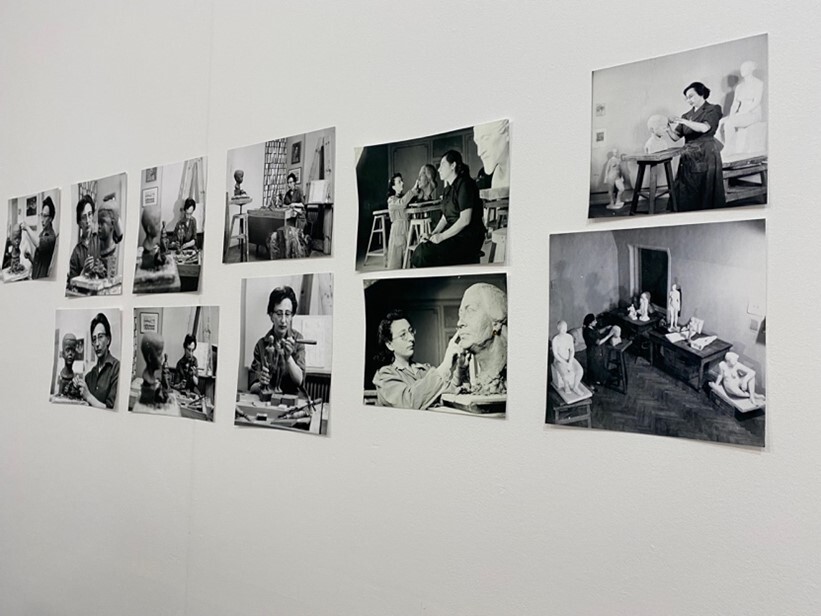
Creativity was not only essential for their healing; both women knew it was incumbent upon them to bear witness to the Holocaust. Larsson cheered Rosenfarb’s ghetto-themed poems as “indispensable,” to her and to the world (47), calling them “the most precious gift ever!” (60). “Thank you, Ewa,” she added, “for having understood in your literary creation the mission that fate has placed in our hands and that we must fulfill” (87). Rosenfarb went on to write additional poems, plays, and the trilogy The Tree of Life in Yiddish. Likewise, Larsson’s moving sculptures of emaciated prisoners and anguished mothers as well as her published letters and trilogy of novels (Shadows by the Wooden Bridge, Long is the Dawn, and Meeting Life) were among the first works on the Holocaust to be published in Sweden.
The imperative to write against oblivion, against the annihilation of amnesia and erasure struck Rosenfarb particularly strongly when she returned to Łódź in the summer of 1948. She was horrified to see Poles living where the ghetto once stood, “their children playing in the debris of the houses,” standing on the graves those who were so dear to her. “And not the smallest plaque anywhere to mark that this was once the ghetto,” she told Larsson, “Soon no one will know” (96). Letters from the Afterlife is a critical corrective to that, a testament to Rosenfarb’s and Larsson’s commitment. Moreover, in recent years, the city of Łódź has recognized the pair’s massive documentarian and aesthetic contributions. Łódź declared 2023 the Year of Chava Rosenfarb, who published in Polish, and celebrated with a literary conference and a street named in her honor. In 2024, Łódź hosted an exhibition featuring Larsson’s sculptures. As part of the festivities, two murals were installed on opposite sides of a narrow alley in the city. One mural bears a portrait of Chava Rosenfarb and the other of Zenia Larsson. Both feature phrases from their letters. The murals are a fitting tribute to this beautiful and complex friendship. At last, Rosenfarb and Larsson can lovingly gaze at each other and communicate without the artifice of words or the impediment of distance. They are together again. The long separation, which began with the moment of liberation, is over.