Mar 15, 2026
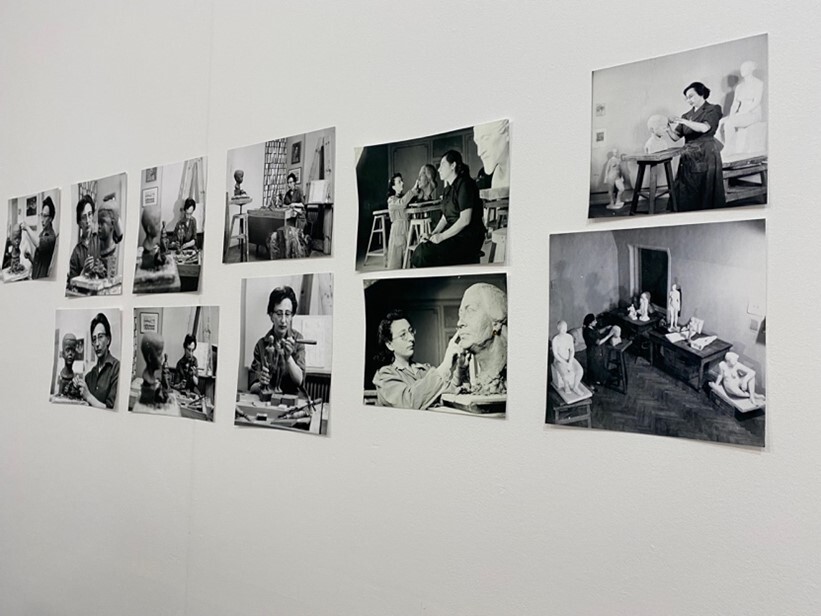
Photo from Zenia Marcinkowska Larsson. Sculptures. Memory. Words, 25 August–24 October 2024, the first exhibition in Poland dedicated to the artist. The exhibition was organized by Centrum Dialogu im. Marka Edelmana and the Miejska Galeria Sztuki in Łódź as part of events marking the eightieth anniversary of the liquidation of the Litzmannstadt Ghetto. (Photos by Izabela Maciejewska, 2024)
Przysięgłam sobie, że temu, co się stało, o ile moje siły mi pozwolą, postawię pomnik, by świat miał zawsze przed oczyma swoją zbrodnię!
I pledged to myself that, if my strength allows, I would erect a monument to what had happened, so that the world would always have its crime before its eyes.
(Zenia Marcinkowska Larsson, from her original Polish, first letter to Chava Rosenfarb, written in Sweden on 26 December 1945) 1 1 Unless otherwise noted, translations from Polish and Yiddish are my own.
Zenia Larsson (born Szajna Marcinkowska, Łódź, Poland, 1922) was a Swedish sculptor, writer, and essayist whose work was shaped by her wartime experiences. Addressing Jewish identity and survival after the Holocaust, her artistic practice transformed trauma into a powerful affirmation of life. She began creating her first sculptures in clay—works produced under conditions of extreme deprivation, yet constituting a formative moment in her artistic trajectory—during her imprisonment in the Nazi-established Litzmannstadt (Łódź) Ghetto. These early sculptural attempts, fragile and provisional, emerged within a system designed to eradicate both corporeal presence and individual voice. In defiance of that dehumanization, Larsson’s early works marked the beginning of a lifelong commitment to artistic expression.
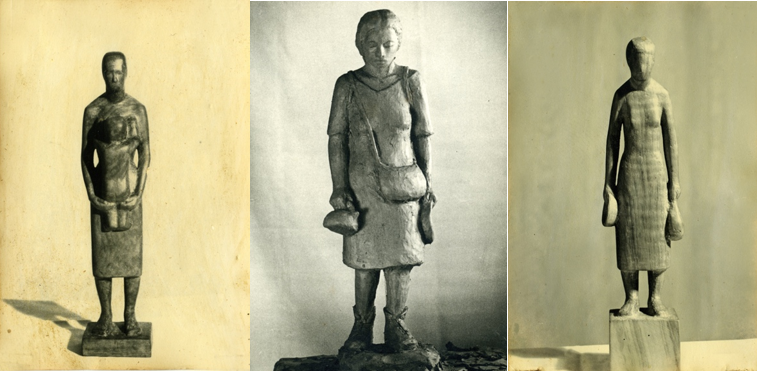
Zenia’s early sculptures, ca. 1948, from the Zenia Marcinkowska Archives, discovered in 2023 and now being organized at Stockholm’s Holocaust Museum (Sveriges museum om Förintelsen).
After the war, sustained by remarkable determination, Zenia Marcinkowska Larsson continued her education at the Royal Academy of Fine Arts in Stockholm, where she became the first foreign woman admitted to study sculpture at the Konstakademien. Sculpture dominated her early postwar practice; however, from the 1960s onward, her creative focus gradually shifted toward literature. She began publishing novels, short stories, and essays that addressed the experience of war, family memory, displacement, and the fate of European Jews in the postwar world. Writing offered Larsson a discursive space in which personal testimony intersected with broader historical and ethical reflection.
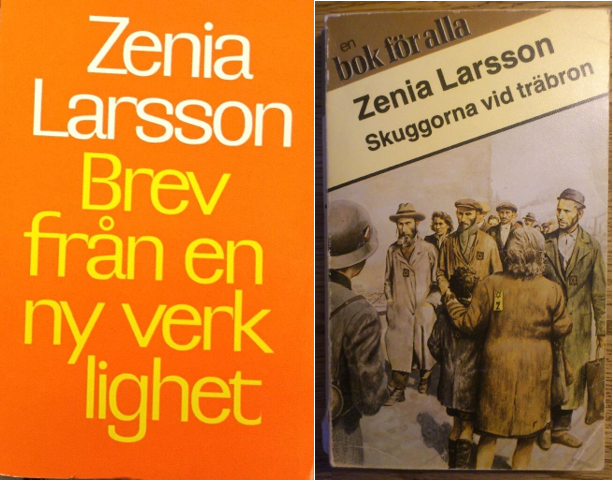
Swedish adaptation of Zenia Larsson’s letters to Chava Rosenfarb, correspondence 1945-1970, Brev från en ny verklighet (Letters from a New Reality), 1972; Zenia Larsson’s first novel, Skuggorna vid träbron (Shadows by the Wooden Bridge), 1960.
Within the Swedish literary context, Zenia Larsson emerged as one of the most significant voices articulating Holocaust experience from the position of exile and survival. Her work occupies an important place in postwar Holocaust literature in Sweden, combining autobiographical elements with reflective narrative strategies. In 1961, she published the novel Lång är gryningen (The Long Dawn), the second book in a trilogy; this publication was followed by Livet till mötes (Toward Life), which appeared in 1962 as the trilogy’s third and final book. She recounts the story of a Polish Jewish woman who, after 1945, is left without family or home and with scarcely any prospects. Yet, through extraordinary determination, she rebuilds her life and finds a form of happiness. Despite Larsson’s prominence during her lifetime, following her death in 2007 both her artistic and literary contributions gradually receded from public and scholarly attention, a marginalization that calls for critical reassessment.
Since 2020, in the context of teaching Yiddish women’s writing in Sweden (first at the Paideia European Institute for Jewish Studies and subsequently at Lund University), I have turned to Zenia Larsson’s work as both an object of study and a pedagogical resource. Not only have I taught her work, using Zenia Larsson’s essays and letters to explore the experiences of Polish Jews who arrived in Sweden in 1945 in the aftermath of wartime atrocities, but I have also made a sustained effort to bring together an extraordinary network of collaborators, working in close cooperation with the Centrum Dialogu im. Marka Edelmana in Łódź under the directorship of Joanna Podolska and the Galeria Miejska Sztuki (Municipal Gallery in Łódź) to curate an exhibition of her work. This was done with curatorial support from Małgorzata Dzięgielewska, whose collective engagement made the exhibition possible and opened Larsson’s work to a broader public.
Through my steady engagement with Larsson’s work I have come to see her oeuvre as not only a testimony of historical catastrophe but also a meditation on persistence, artistic agency, and the ethical necessity of narration. Larsson’s work demonstrates that storytelling in the aftermath of violence is not confined to retrospective documentation. Rather, it constitutes an active, future-oriented practice, an insistence on meaning, form, and creative continuity as a response to historical rupture. In this sense, her artistic and literary production may be read as an expression of hope grounded in form, discipline, and the enduring capacity of human creativity.
This essay, written on the occasion of the publication of Letters from the Afterlife, 2 2 Goldie Morgenthaler, ed., Letters from the Afterlife: The Post-Holocaust Correspondence of Chava Rosenfarb and ZeniaLarsson (McGill-Queen’s University Press, 2025). the English translations of the correspondence of Zenia Larsson and her lifelong friend Chava Rosenfarb, the postwar Yiddish writer whose monumental work is likely familiar to most In geveb readers, aims to introduce In geveb readers to Larsson’s oeuvre and argue for its significance.
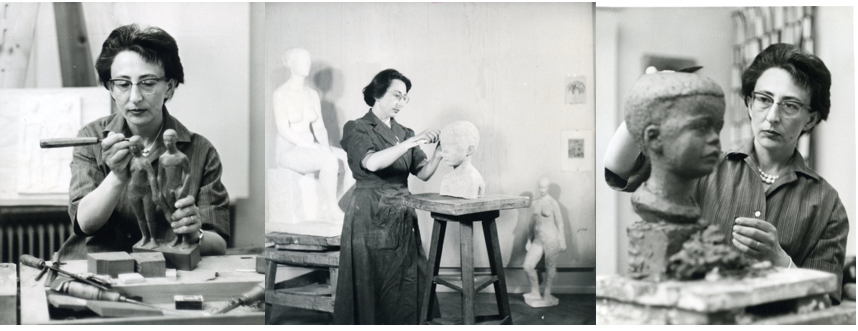
Zenia Marcinkowska Larsson working in her studio, probably in the mid-1950s to early 1960s. (Sveriges museum om Förintelsen)
In December 1945, Zenia Marcinkowska Larsson wrote a long, meticulously composed letter to her high school (gymnasium) friend Chava Rosenfarb. This letter marked Zenia’s first communication from Sweden since her arrival at the end of April 1945 on the shores of Helsingborg. Having decided to part ways with her friends and leave Bergen-Belsen, Zenia seized the opportunity to leave on the White Boats (a rescue operation of the Swedish Red Cross), thus beginning a new chapter in her life. 3 3 The “White Boats” (Vita båtarna) formed a Swedish humanitarian mission in the spring of 1945, conceived as a maritime continuation of the White Buses operation. Organized primarily by the Swedish Red Cross and carried out under the authority of Folke Bernadotte, the operation enabled the evacuation of thousands of severely ill and starving prisoners from German concentration camps. Among those rescued were many Jewish survivors of the Holocaust. Further details about the White Buses scheme are available from the Swedish Holocaust Museum. Additional perspectives can be found in the transcript of the EHRI podcast episode “A Paper Heart for Wanda.” It took until the end of the year for Zenia to reach out to Chava—a close friend from her happy gymnasium years, and someone with whom she had survived the Łódź Ghetto, Auschwitz, Bergen-Belsen, and several other concentration camps along the way. Zenia was not the first to write. It was Chava, who remained in Bergen-Belsen while awaiting another opportunity for relocation, who made the initial effort to find Zenia’s address. Chava wrote to her for a few months, perhaps even weeks (the exact date remains unknown), before Zenia’s response came, and Chava’s letters express feelings of hurt and abandonment.
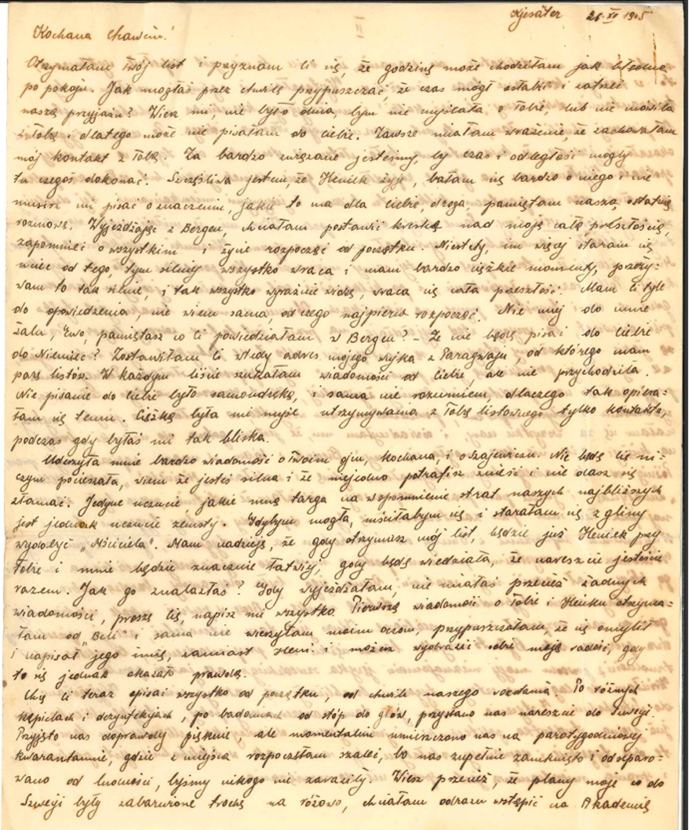
Zenia Marcinkowska, later Larsson, first letter from Sweden to Chava Rosenfarb. Sveriges museum om Förintelsen 26.12.1945
In her December letter, Zenia reassured Chava that she had not forgotten her. At the same time, she made striking confessions about her desire to forget and about her reasons for coming to Sweden: to never again remember what had happened. She also declared that she would never again write a letter addressed to Germany. This letter stands as a testament to Zenia’s longing for forgetting, her dream of not remembering, her need for closure, and her desire for change. It is possible that, as part of this transformation, Zenia considered not maintaining contact with people from her past—those who may once have been her closest family. Silence, forgetting, and restraint were instinctive strategies for this young twenty-three-year-old woman, who had endured unimaginable hardship again and again.
In the same letter, the artist—the sculptor—is also, in a sense, born. Zenia writes about Kurt Gordon, then head of the Jewish Congregation, who would help connect her with established Swedish artists and support her efforts to enter the Royal Academy of Fine Arts. From this moment on, she began to see artistic work as a form of testimony: a way to tell her story, to survive, and ultimately to allow herself happiness. She would go on to create her own path, as she later wrote in 1951:
“Uważam, że nie istnieją żadne przepisy, jeśli chodzi o tworzenie. Każdy ma rację, jeśli znajdzie swoją własną drogę… Najlepiej jest, jeśli można swą drogę znaleźć w sobie, w samym sobie, wśród czterech ścian atelier…”
“I believe that there are no rules when it comes to creation. Everyone is right if they find their own path . . . It is best when one can find that path within oneself, in oneself, within the four walls of the studio.”
(from a letter to Chava Rosenfarb, January 27, 1951)
In her book 1947: Where Now Begins, published in Swedish in 2016 and in English translation in 2018, Swedish author Elisabeth Åsbrink proposes the year 1947 as a threshold year: the moment when the world, emerging from the chaos of the Second World War, began, haltingly and very unevenly, to confront the catastrophe of the Holocaust. At the same time, this reckoning unfolded under the shadow of a new geopolitical order, as the Cold War quietly took shape. Åsbrink writes incisively about another, more uncomfortable reality: the continued presence of Nazi perpetrators living undisturbed in places such as Malmö, and the long-standing silence surrounding this chapter of Swedish history. 4 4 Elisabeth Åsbrink, 1947: Where Now Begins (Other Press, 2018; Scribe, 2026), translated by Fiona Graham. Yet 1947 is also a year in which life became possible again for some of those who survived the inferno of the concentration camps. Among them were two young women from Łódź: Zenia Marcinkowska Larsson and Chava Rosenfarb.
In early January 1947, Zenia, already living in Stockholm, was admitted to the Royal Academy of Fine Arts. This decision would decisively shape her future. Over the next five years, she immersed herself in artistic training and creative work. During this period, she also met the love of her life, Per-Axel Larsson, a Swede and not Jewish. Initially, this cross-cultural, interfaith relationship appeared problematic, particularly to her close friend Chava. Yet it soon became clear to both Chava and Zenia herself that this was a lifelong commitment, grounded in mutual devotion and trust.
Chava Rosenfarb, by contrast, remained in Bergen-Belsen, waiting for an opportunity to leave. Poland no longer appeared to be an option: news of postwar pogroms and the political realities of the newly installed communist regime made return both frightening and uncertain. Eventually, she managed to reach Brussels, where, in February 1947, she published her first collection of poetry, Di balade fun nekhtikn vald (The Ballad of Yesterday's Forest), a volume that included poems written in the Łódź Ghetto.
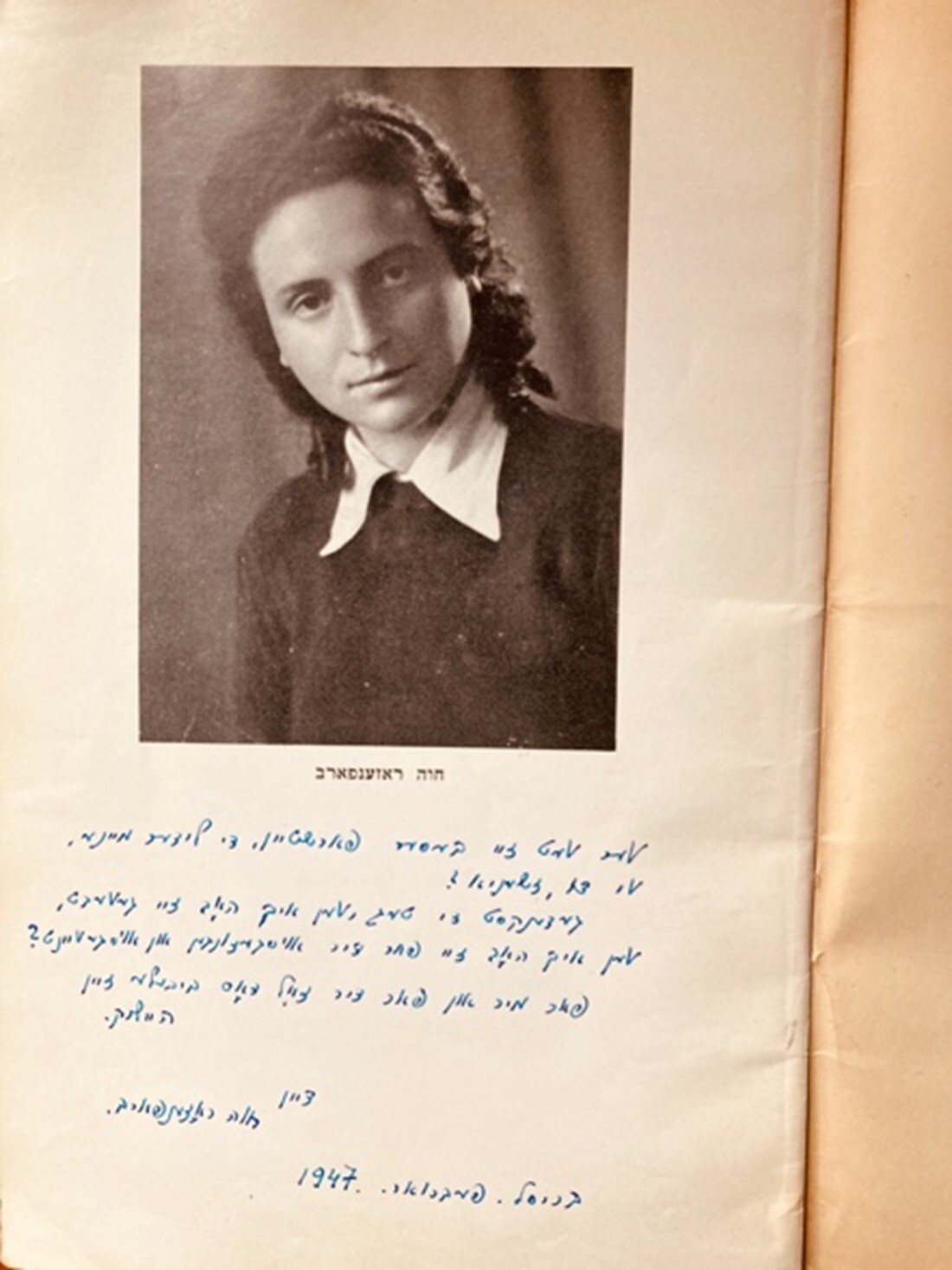
Photo of Chava Rosenfarb in her first poetry collection, Di balade fun nekhtikn vald (The Ballad of Yesterday’s Forest), with a handwritten dedication to Zenia. From Jakub and Hanna Ringart’s Archive, Stockholm.
Institutionally speaking, 1947 marks the emergence of both women as artists: one through admission to an art academy, the other through her first book publication. Yet we know that both of their artistic identities had already been forged much earlier—under conditions of extreme deprivation and violence, within the walls of the ghetto. From the copy of her poetry collection that Chava sent to Zenia, we read:
װער װעט זײ בעסער פֿאַרשטײן, די לידער מײנע, װי דו, זשעניא?
געדענקסט די טעג, װען איך האָב זײ געװעבט, װען איך האָב זײ פֿאַר דיר אויסגעזונגען און אויסגעװיינט?
פֿאַר מיר אין פֿאַר דיר זאָל דאָס ביכעלע זײַן הײליק.
דײַן
חוה ראָזענפֿארב.
בריסל. פֿעברואר. 1947
Who will understand them, these poems of mine, better than you, Zenia?
Do you remember the days when I created them? When I sang them for you and cried?
May this book be sacred for me and for you.
Yours,
Chava Rosenfarb.
Brussels. February. 1947
Chava, called Ewa by Zenia in their letters, was Zenia’s lifelong companion: first in the courtyards of their childhood in Łódź, then through the ghetto and concentration camps, and later as a correspondent with whom Zenia maintained an almost lifelong epistolary relationship. Through their letters, Stockholm and Montreal were connected by irregular yet sustained dialogues spanning more than sixty years, conducted in the only language they shared: Polish. A Swedish artist and writer narrated her life in Polish to a Yiddish writer living in Canada, and their correspondence illuminates their feelings about their lives in the aftermath of destruction and their art, wrestling with living with the burden of trauma and memory. For both of these survivors, creative work became a sacred form of testimony, intimate and personal, but directed outward toward a world. Like the correspondence between these friends, it was a way of reaching through the blinding pain of memory for human connection and self-expression.
Tak samo jak biorę młot i dłuto, i formułuję bezkształtną bryłę kamienia, tak samo moje życie w tworzeniu i rzeźbie, uformowałam na nowo całą moją wewnętrzną strukturę.
(z listu do Chavy Rosenfarb, 27 stycznia 1951)
“Just as I take a hammer and chisel and shape a formless block of stone, so too in my life—through creation and sculpture—I have reshaped my entire inner structure anew.”
(from a letter to Chava Rosenfarb, January 27, 1951)
Although Zenia Marcinkowska Larsson came from a family in which Yiddish was used in everyday life, she was sent to a Polish school, where Polish was both spoken and taught throughout her primary and secondary education. She learned to read Yiddish only later, in the ghetto. Yet her literary work, novels, essays, and short prose were written exclusively in Swedish. Her Swedish husband, Per-Axel (Pelle) Larsson, supported her work closely, assisting with editing, typing, and proofreading. For Larsson, Polish remained a language of intimacy: it was the language of her letters written to Chava Rosenfarb and to a small circle of friends.
In this respect, Zenia Larsson belongs to the broader group of migrant and refugee writers for whom the choice of literary language was neither natural nor inevitable, but shaped by age, biography, and historical rupture.
The choice of creative language, much like the choice of an emotional relationship or a place to stay, was for Zenia neither easy nor self-evident. In her letters to Chava, she repeatedly expressed hesitation about her relationship with a Swedish man, wondering whether mutual understanding across such different life experiences was truly possible. Her collaboration with Pelle on her books may thus be read not only as practical support, but as part of a broader effort to order, clarify, and stabilize her world. In a letter dated January 27, 1951, Zenia articulated this process with striking clarity:
“Oh Eva [. . .], I no longer want to wander or search for a peaceful place for my body. We are children of an unhappy era, and it is difficult to fight against this . . . I gather small, tiny crumbs of happiness and weave them into my life, shaping them so that—like a snail in its shell—my work, Pelle, a few flashes, a few rays of sunlight, a little rain: this is my world. What more does a person need to live and grow? Amid the avalanche that constantly rolls through the world, I want to build for myself a small shelter where I can live. I feel that my roots are gradually growing into the hard and rocky Swedish soil, and I sense that beneath these rocks there is much water, much warmth.”
(from the Polish original, January 27, 1951)
Zenia’s letters reveal that the shaping of stone, language, and life were inseparable processes: all were acts of self-construction after devastation. Her choice of Swedish as a literary language and Sweden as a place to remain was not an erasure of the past, but a deliberate, ethical labor of form, an attempt to build a shelter in which life, memory, and creativity could continue. In this sense, Zenia Marcinkowska Larsson’s work stands as a testament to survival, understood not merely as endurance, but as conscious creation. Her life and writing show that to choose a language and a place is, ultimately, to choose how to live after catastrophe.
----
In August 2024, Centrum Dialogu im. Marka Edelmana (Marek Edelman Dialogue Centre), together with the Galeria Miejska Sztuki w Łodzi (Municipal Art Gallery of Łódź) opened an exhibition of the sculptural work of Zenia Marcinkowska Larsson, for which I served as curator and researcher, responsible for tracing the sculptures and related artifacts. The exhibition was the first ever solo exhibition of Zenia Larsson’s sculptural works, and at the same time the first ever exhibition of her sculptures in Poland.
The exhibition’s narrative focused on the correspondence between the two childhood friends, Chava and Zenia. In 2023, I had discovered in Stockholm the original letters written in Polish by Zenia to Chava. Larsson had published a redacted version of her own side of the correspondence in Swedish translation in 1972, and the recently published Letters from the Afterlife is comprised of English translations of the Swedish versions of Larsson’s correspondence, alongside English translations of the Polish originals of Chava’s correspondence. For the exhibition, I included excerpts from both sides of their correspondence in their original Polish forms, which, as a result, has now made them available to a Polish-reading public. This extraordinary transcontinental correspondence forms an essential backdrop to the exhibition, contextualizing the sculptures, photographs, sketches, and other recovered artifacts. Following the exhibition, these materials will become part of the emerging Zenia Marcinkowska Larsson Archive at the Sveriges museum om Förintelsen.
By exploring Zenia Larsson’s artistic practice, the exhibition made it possible to recover a herstory that had remained unknown in Poland and largely forgotten in Sweden. Visitors encountered a gifted and inspiring sculptor and writer whose work, despite wartime trauma, destruction, and suffering, conveyed a profound sense of hope. This hope was embedded in her sculptures in plaster, stone, and clay—the artist’s preferred materials.
As the exhibition’s artistic consultant, Izabela Maciejewska observed:
Clay is a significant material here, as it is transformed and preserved through fire. In Zenia’s works, one can perceive a combination of traditional techniques with a modern, conceptual approach that reflects nature and its dynamic transformations.
Among the sculptures brought to Łódź from Sweden were works that span Zenia Larsson’s early postwar period through the 1960s, revealing both thematic consistency and formal experimentation. These included Avenger, The Sleepwalker, and Mother of the Ghetto, 5 5 The titles of Zenia’s sculptures are based on Zenia’s letters, as there is no certainty as to their official names. all dated approximately to the early 1950s and held by Judiska Församlingen i Stockholm. Together, these sculptures foreground embodied trauma, vigilance, and maternal suffering, recurring motifs in Larsson’s sculptural language. Also shown were Child’s Head (date unknown) and Head of Hans Rabén (early 1960s), both from the collection of Netta Frister Aaron, which demonstrate Larsson’s sustained interest in portraiture as a means of capturing psychological presence rather than likeness alone. Particularly significant was Head of Eva Grossman (1966), a cast made from an original mold prepared by Zenia Larsson for four editions; the exhibited cast was produced by Izabela Maciejewska and remains in the collection of Eva Grossman. Completing the selection was a bas-relief, Boy, Woman, and Sun (date unknown), owned by Tommy Ringart, which introduces a more symbolic and narrative dimension to Larsson’s work. Taken together, these sculptures attest to a practice rooted in figurative tradition yet shaped by postwar ethical urgency, where sculptural form becomes a medium of memory, testimony, and fragile continuity.
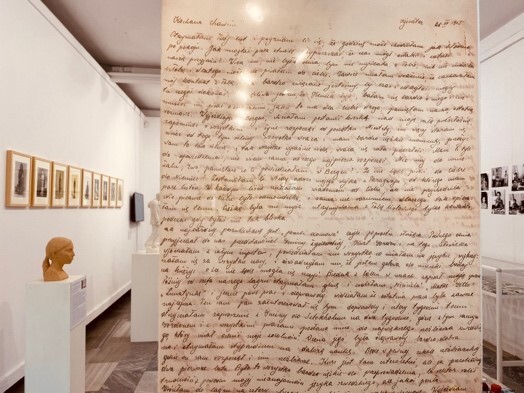
The first letter, dated 26 December 1945, is printed on translucent textile. Łódź 2024.
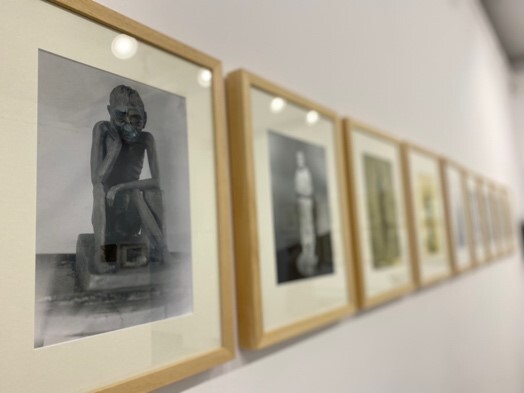
Photograph of an untitled sculpture depicting a seated concentration camp survivor, possibly The Avenger, a title mentioned by Zenia in her letters. Łódź, 2024.
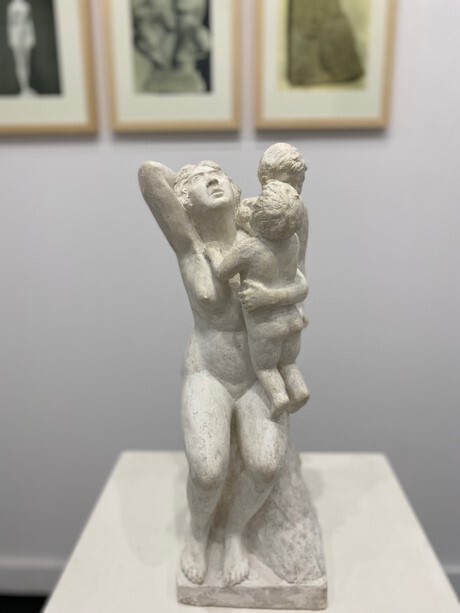
Untitled sculpture, possibly Mother of the Ghetto, referenced by Zenia in her letters. Łódź, 2024.
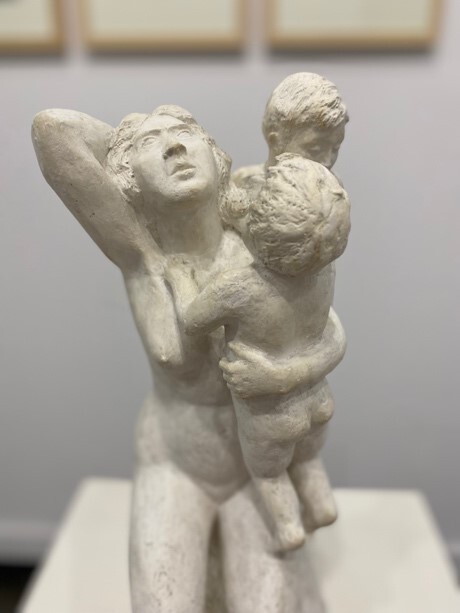
A dramatic composition of a mother with two children, possibly Mother of the Ghetto, exhibited in Łódź, 2024.
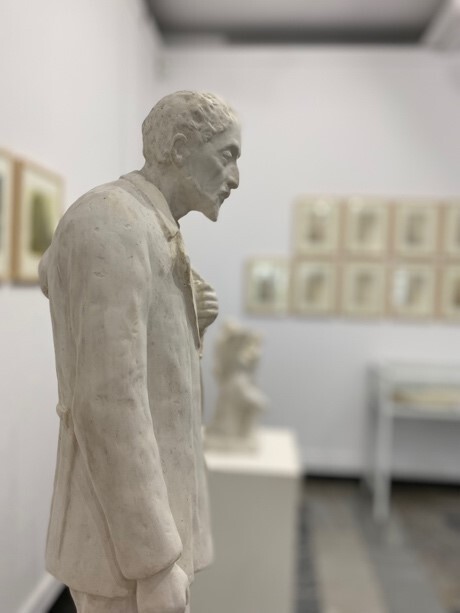
An untitled sculpture, possibly Avenger or The Eternal Wandering Jew, referenced in Zenia’s letters.
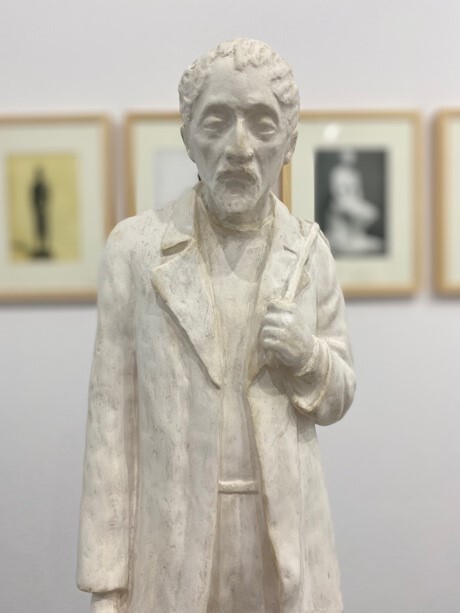
An untitled sculpture, possibly Avenger or The Eternal Wandering Jew.
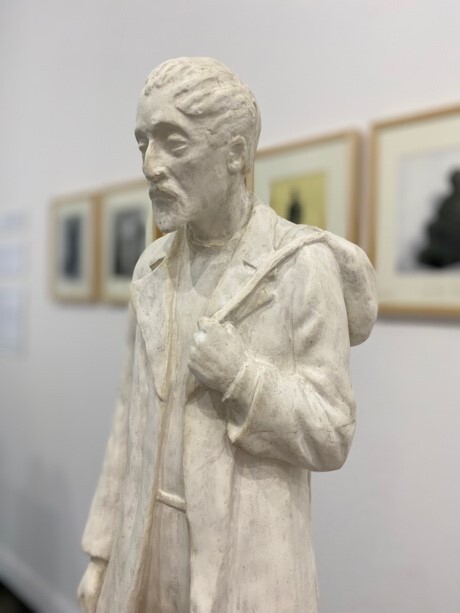
Photos from Zenia Marcinkowska Larsson. Sculptures. Memory. Words, 25 August–24 October 2024, the first exhibition in Poland dedicated to the artist. The exhibition was organized by Centrum Dialogu im. Marka Edelmana and the Miejska Galeria Sztuki in Łódź as part of events marking the eightieth anniversary of the liquidation of the Litzmannstadt Ghetto. Photos by Izabela Maciejewska, 2024.
The conceptual background of the exhibition was grounded in memory and words. Zenia Marcinkowska Larsson’s literary work was deeply focused on memory in the context of the Holocaust, suffering, and emigration. Her debut novel, Skuggorna vid träbron (Shadows by the Wooden Bridge, published in Polish by the Centrum Dialogu Library in 2024), appeared in 1960 and formed the first part of a trilogy tracing the life of a young woman named Paula. The subsequent volumes, Lång är gryningen (The Long Dawn, 1961) and Livet till mötes (Toward Life, 1962), continued this narrative. This largely autofictional trilogy followed Paula through successive stages of life: from the traumatic experience of the ghetto, through the final months in Bergen-Belsen, to the fragile beginnings of a new life in Sweden. Larsson’s later works, including Åter till Babel (Return to Babel) and Mejan (Art School), further developed themes of survival and post-Holocaust adaptation, while also introducing reflections on artistic formation and personal growth in exile. Together, these texts formed a literary archive of memory in which individual experience became a medium for articulating historical trauma, displacement, and the slow, uncertain process of rebuilding a life after catastrophe.
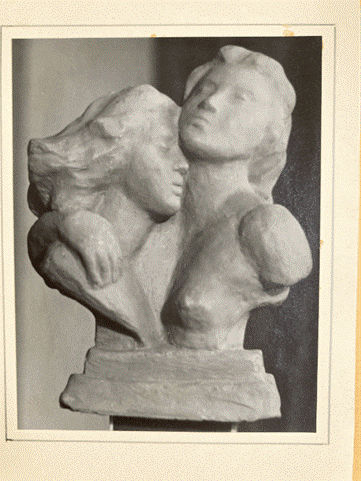
Title unknown. A curator refers to this sculpture as “Friends.” Date unknown, probably from the 1950s. The photograph is from the collection of Hanna and Kuba Ringart, now held in the Zenia Marcinkowska Larsson Archive. The owner of the sculpture is Lena Einhorn.
Zenia Marcinkowska Larsson, who died in 2007, left behind a rich literary and artistic legacy which, now that it has been brought back into view, proves capable of inspiring future generations. Her work documented the experience of a very particular generation whose youth unfolded during the brutality of war. Through both her writing and her sculpture, she consistently emphasized the importance of memory, empathy, and historical understanding as foundations for imagining a more humane future. In this exhibit, and in my teaching, Zenia Marcinkowska Larsson also emerges as a distinctive female voice: a woman, a Jew from Łódź, a friend. Telling her story expands our understanding of postwar Jewish histories, revealing a remarkable dialogue that connected Poland and Sweden.
The exhibition at Galeria Bałucka demonstrates how essential a careful, attentive engagement with the past can be—and how easily art may slip into oblivion. Zenia had no children and thus no direct descendants to safeguard her legacy. Her letters, photographs, and sculptures were dispersed among friends and extended family, kept modestly yet lovingly in private, domestic archives. Fortunately, thanks to the attentiveness and intuition of researchers who gathered surviving documents, correspondence, and information about her works—and by listening closely to the recollections of the children of Zenia’s friends—it became possible to hear again a voice that had nearly been forgotten. Listening to Zenia Marcinkowska Larsson—through her sculptures, her letters, her sketches—became an important lesson and a profound experience.
The exhibition would not have been possible without the support of Centrum Dialogu im. Marka Edelmana and the Miejska Galeria Sztuki w Łodzi, the scholarly guidance of director Joanna Podolska, and the artistic consultation of Izabela Maciejewska. Organizational support was provided by Agnieszka Wilczek (Centrum Dialogu) and Małgorzata Dzięgielewska (MGS). Special thanks are due to the owners of the sculptures, whose generosity—along with access to their private photographic collections—made the exhibition possible: Eva Grossman, daughter of Holocaust survivors Tadeusz Frydman from Łódź and Mina Frydman (née Don) from Vilnius, friends of Zenia Larsson; Netta Frister Aaron, daughter of Bruno Frister (Bronisław Fryszter of Radom) and Gita Frister from Vilnius; and Tommy Ringart, son of Hanna and Kuba Ringart, former prisoners of the Litzmannstadt Ghetto and later friends of Zenia Larsson in Sweden. Thanks were also extended to Yael Fried, curator, and to the Judiska Församlingen i Stockholm, with particular gratitude to Hanna Halpern.
Together, these efforts allowed Zenia Marcinkowska Larsson’s voice, once dispersed and nearly lost, to be heard again.
Life of Zenia Marcinkowska Larsson: A Chronology
(Compiled by Urszula Ulla Chowaniec)
April 2, 1922 – Birth of Szajna Marcinkowska (Zenia) in Łódź.
October 22, 1932 – Death of Zenia’s mother, Perla Wołek.
1937 – Zenia’s father, Mowsza (Moses) Marcinkowski, marries for the second time, to Ewa (Jochewed) Kleczewska.
February 17, 1940 – The Marcinkowski family is forcibly relocated to the Litzmannstadt Ghetto, to 18 Marysińska Street, Apartment 8.
August 24, 1944 – Deportation to the Auschwitz-Birkenau concentration/death camp together with the family of Chava Rosenfarb, followed by transfers to forced labor camps in Sasel and then to Bergen-Belsen.
April 15, 1945 – Liberation of the Bergen-Belsen concentration camp by the British Army. Death of Ewa Kleczewska.
1945 – Departure for Sweden with the assistance of the Swedish Red Cross. Beginning of a long-term correspondence with her childhood friend, the future writer Chava Rosenfarb.
1947 – Admission to the Royal Academy of Fine Arts in Stockholm. Zenia is accepted as the first student who does not speak Swedish.
1950 – Marriage to Per-Axel Larsson.
1952 – Completion of sculpture studies in the studio of Eric Grate. Zenia works in wood, clay, stone, and metal.
1960 – Literary debut of Zenia Larsson: Skuggorna vid träbron (Shadows by the Wooden Bridge), the first book of a trilogy.
1961 – Publication of the novel Lång är gryningen (The Long Dawn), second book in the trilogy.
1962 – Publication of Livet till mötes (Toward Life), third book in the trilogy.
1964 – Publication of the novel Åter till Babel (Return to Babel).
1966 – Publication of Mejan (Art School).
1968 – Publication of Fotfäste (Foothold).
1970 – Publication of Morfars kopparslantar (Grandfather’s Copper Coins).
1972 – Publication of Brev från en ny verklighet (Letters from a New Reality).
1975 – Publication of Vägen hem (The Road Home).
1980 – Publication of Stadens fyrkantiga hjärta (The City’s Square Heart).
1985 – Publication of Mellan gårdagen och nuet (Between Yesterday and the Present).
1994 – Death of Zenia’s husband, Per-Axel Larsson, after a long illness.
September 4, 2007 – Death of Zenia Larsson.
Books, novels, and essays by Zenia Marcinkowska Larsson:
Skuggorna vid träbron (Shadows by the Wooden Bridge), 1960
Lång är gryningen (The Long Dawn), 1961
Livet till mötes (Toward Life),1962
Åter till Babel (Return to Babel), 1964
Mejan (Art School), 1966
Fotfäste (Foothold), 1968
Morfars kopparslantar (Grandfather’s Copper Coins), 1970
Brev från en ny verklighet (Letters from a New Reality), 1972
Vägen hem (The Road Home), 1975
Stadens fyrkantiga hjärta (The City’s Square Heart), 1980
Mellan gårdagen och nuet (Between Yesterday and the Present), 1985
Further reading:
Chowaniec, Urszula Ulla. “Art, Necessary Separation: The Correspondence between Zenia Marcinkowska Larsson and Chava Rosenfarb.” Afn Shvel 404 (2024), Swedish/Scandinavian issue.
Chowaniec, Urszula Ulla. “Zenia Marcinkowska-Larsson: nasza historia odbija się w losie jednostki.” In Zenia Larsson, Cienie przy drewnianym moście (Łódź: Centrum Dialogu, 2024).
Morgentaler, Goldie, ed. Letters from the Afterlife: The Post-Holocaust Correspondence of Chava Rosenfarb and Zenia Larsson (McGill-Queen’s University Press, 2025).
This article and the research that contributed to increased visibility and knowledge about forgotten Jewish artists and writers were supported by The Association of Holocaust Survivors in Sweden (Föreningen Förintelsens Överlevande, FFÖ) through a scholarship awarded in 2025.