Apr 21, 2026
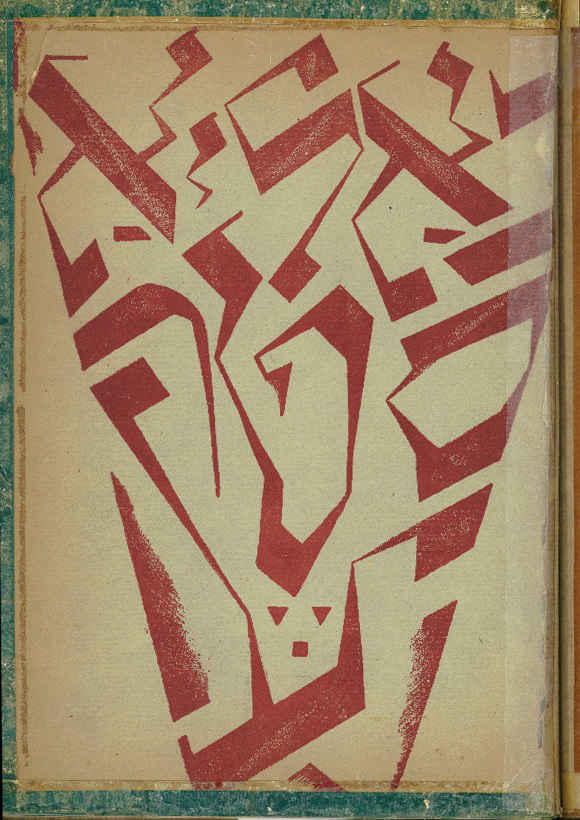
Khalyastre, 1922 publication
INTRODUCTION
Advanced learners of Yiddish often reach a stage at which grammatical competence and basic lexical knowledge no longer suffice for meaningful engagement with modernist literature. At this level, the primary difficulty is no longer syntax or morphology in the standard sense, but the encounter with extreme lexical creativity: dense compounding, expressive affixation, sound-play, semantic overload, and words that appear simultaneously familiar and alien. Few bodies of Yiddish writing confront learners with this challenge as forcefully as the poetry of the Khalyastre group. 1 1 To avoid confusion, it should be noted that the group’s members usually referred to themselves simply as Khalyastre, without a definite article. In later scholarship, the form Di khalyastre appears. Since usage is not uniform, this article follows the poets’ own practice and uses Khalyastre without an article.
Active in Warsaw between 1919 and 1924, Khalyastre (“The Gang,” from the Polish hałastra) pushed Yiddish poetic language to its expressive limits, with texts abounding in compounds, hybrid formations, phonetic inventions, and resemanticizations of ordinary words. While the aesthetic radicalism of Uri Zvi Greenberg, Melech Ravitch, Peretz Markish, and other Khalyastre members has drawn intermittent critical attention, their deliberate contribution to Yiddish vocabulary has not received sustained lexicological analysis:
“As for Yiddish literature—the great product of this revolutionary period—the very language of innovation is almost a closed book.” 2 2 Benjamin Harshav, The Meaning of Yiddish (University of California Press, 1990), 138.
For contemporary readers, practical pedagogical questions arise: Is this a real word? How should it be parsed? Does it follow any recognizable pattern? What kind of meaning is being produced here?
Growing out of long-term teaching practice and classroom experimentation, this article approaches Khalyastre not primarily as an object of literary-historical classification, but as a pedagogical laboratory for advanced Yiddish instruction. Drawing on close reading and classroom experience, it treats lexical innovation as a teaching opportunity rather than a problem to be solved. The focus is not on establishing historical neologism status, but on identifying forms that challenge learners’ expectations and require explicit pedagogical mediation in teaching.
Focusing on learner-opaque forms—words and constructions that disrupt expectations and require explicit pedagogical mediation—this article proposes typological groupings of Khalyastre’s lexical creativity and identifies poems particularly suitable for guided classroom analysis. By reframing modernist radicalism as a teaching resource rather than a barrier, this study also shows how Khalyastre offers students a uniquely powerful opportunity to observe Yiddish morphology, semantic extension, and expressive compression in action and proposes ways of integrating modernist Yiddish poetry into advanced curricula.
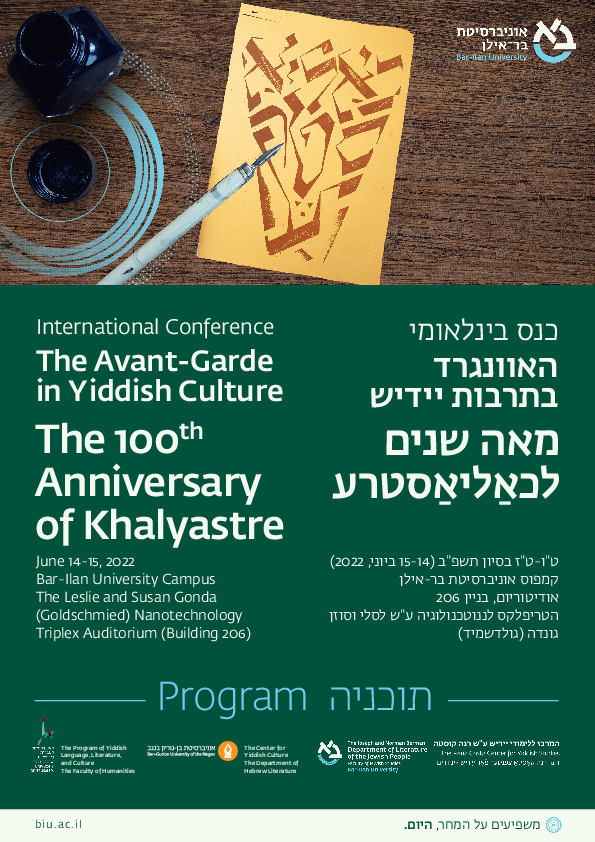
Originally presented at a conference hosted by the Rena Costa Yiddish Center at Bar-Ilan University (2022), and rooted in years of classroom work and linguistic research, this paper identifies key lexical strategies employed by the group. Once familiar with these techniques, students acquire tools not only for understanding avant-garde Yiddish literature, but also for gaining deeper insight into how Yiddish functions and develops as a cultural language.
This study approaches and makes pedagogical use of Khalyastre’s important works, as follows:
* Uri Tsvi Greenberg’s long poem Mefisto (Mephisto) (Lemberg [Lwów]: Dos bukh, 1921), as well as his publications in the magazines Khalyastre (Warsaw, 1922) and Albatros (Warsaw, 1922; Berlin, 1923–24), as anthologized in his Gezamlte verk (Jerusalem: Magnes, 1979).
* Melech Ravitch’s Nakete lider (Naked Poems) (Vienna: Kval, 1921).
* Peretz Markish’s “Veyland” (Pain Land) and selected fragments from “Di kupe” (The Heap; also translated as The Mound, 1920–22), as published in the anthology A shpigl af a shteyn, ed. Khone Shmeruk (Jerusalem: Magnes, 1987), 406–421.
Due to space constraints, this study could not cover hundreds of additional pages authored by Greenberg, Ravitch, and Markish—let alone those of Khalyastre affiliates such as Moshe Broderzon, Israel Joshua Singer, David Hofstein, Itsik Kipnis, Moshe Khashchevatsky, and Oyzer Varshavsky.
The article proceeds as follows: Sections 2–3 outline the principal lexical and morphological strategies characteristic of Khalyastre poetry; section 4 groups these strategies into thematic clusters useful for classroom discussion; section 5 offers guidance on selecting poems for detailed classroom analysis; and the concluding section 6 reflects on the pedagogical value of lexical difficulty itself.
A sample worksheet for conducting a Yiddish lesson based on Ravitch’s poem is provided as an appendix, which is followed by the list of sources. All translations provided by the author of this article unless otherwise indicated.
A pdf of the appendix for an advanced Yiddish lesson can be found here. A pdf of the full article, including the appendix, can be found here.
- Historical Background
Early in the twentieth century, Jewish communities in Eastern Europe were increasingly exposed to modern societal structures, technological advancements, and cultural transformations. A growing number of Jews entered new professional fields and confronted complex realities that required new forms of expression. As noted by Ruth Wisse,
The war had changed the whole course of Jewish history. The revolution in Russia overthrew the hated authority of the tzar, introducing an untried system of government. Britain’s Balfour Declaration . . . galvanized the Zionist movement and . . . demanded a political response of Jews. Poland’s emergence from the war as an independent country and President Wilson’s stated desire to protect national minorities invited Polish Jews . . . to constitute a vocal minority in their native land. 3 3 Ruth Wisse, A Little Love in Big Manhattan (Harvard University Press, 1988), 107. For broader discussion of the situation in Poland, see also pp. 142–143, as well as: Ruth Wisse, The Modern Jewish Canon (The Free Press, 2000), 132–135.
Ashkenazi Jews aspired to shed ghetto clichés and integrate into broader cultural and intellectual currents. Although Yiddish was already a well-developed cultural and literary language, for many intellectuals, especially those affiliated with secular circles, this language was still felt to be lexically inadequate for depicting contemporary political, philosophical, and scientific realities.
Among the intellectuals who took up the challenge of enriching Yiddish vocabulary were avant-garde poets—most notably, the Warsaw-based Khalyastre group, founded in 1919. Their work anticipated the systematic linguistic efforts later undertaken by language planning institutions. 4 4 On YIVO activities, see Cecile Esther Kuznitz, YIVO and the Making of Modern Jewish Culture: Scholarship for the Yiddish Nation (Cambridge University Press, 2014). On Yiddish language planning policy and language engineering in the USSR, see Eli Spivak, Naye vortshafung (Melukhe-farlag fun natsyonale minderhaytn in USSR, 1939); Gennady Estraikh, Soviet Yiddish: language planning and linguistic development (Clarendon Press, 1999). On Yiddish language planning in general, see Joshua A. Fishman, “Language: Yiddish. Planning and Standardization,” in The YIVO Encyclopedia of Jews in Eastern Europe, ed. G.D. Hundert (Yale University Press, 2008), vol. 1, 987–991.
Though the label khalyastre was originally used as an insult by the conservative-minded editor of the influential Warsaw daily Der Moment, Hillel Zeitlin—and an equally negative reaction came from the prominent literary critic Shmuel Charney 5 5 Israel Chaim Biletzky, Otsrot yidish (Papirus, 1989), 156–157. —Khalyastre embraced its name proudly. Its central figures—Uri Zvi Greenberg, Melech Ravitch, and Peretz Markish—were stylistically diverse but ideologically united in their rejection of conventional notions of “beautiful” conventional poetry; they stood at the radical end of the modernist spectrum. Through deliberate distortion of syntax and morphology, at times inventing words, they created a generative and destabilizing poetic language.
In Greenberg’s “Manifesto to the Opponents of the New Poetry,” he declares (p. 425–426):
עס איז אונדז פֿאַרלוירן געגאַנגען דער באַראָמעטער פֿון זעלישער שלווה, דער קאָדעקס פֿון טראַדיציאָנעלע סאַלאָן־געזעצן: "אַזוי רעדן דיכטער אַצילותדיקע . . ." ווי אַזוי אָבער זאָלן רעדן (לויטן אמתן רעדן! אויב דיכטונג איז וואָרהייט) די, וואָס דער שטורעם האָט אויפֿגעריסן אין וועלטישן גייערײַ, אין וועלטישן געדערעם־געשריי? . . . נישט מיר זענען שולדיק, וואָס ס'האָט זיך אויסגעשיילט פֿון אַלע הויטן—דורות—דער טיטאַן: אַלוועלט־אומעט.
We have lost the barometer of mental calmness, the code of traditional salon laws: “This is how aristocratic poets talk . . . ” But how should those speak (in truth! If poetry is reality) whom the storm has condemned to walk the world in universal intestinal pain? . . . It is not our fault that the titan—universal sorrow—has peeled off all the generations’ coverings.
Markish, too, published manifestos calling for the merging of traditional Jewish themes with revolutionary, modern, and avant-garde styles, thereby reflecting the cultural hybridity, upheaval, and “dispersion and confusion” of early twentieth-century Jewish identity through multilingualism and experimental poetry. 6 6 See Karolina Szymaniak, “The Language of Dispersion and Confusion: Perets Markish’s Manifestoes from the Khalyastre Period,” in A Captive of the Dawn: The Life and Work of Peretz Markish (1895–1952), ed. Joseph Sherman, Gennady Estraikh, David Schneer, and Jordan Finkin (Legenda, 2011), 66–87.
In retrospect, the goals of these authors are summarized by Piotr Kieżun and Edyta Zbąska:
Above all, they opposed the existing heritage. In keeping with the avant-garde ethos, they did this primarily through artistic provocation. The images and texts they published depicted reality in a brutal and naturalistic manner. They wrote poems about cannibalism and rape, sometimes iconoclastic invocations of Christianity, and presented traditional themes in entirely new contexts. . . . All were revolutionaries, though not always in a political context. Each of them sought primarily a profound transformation of social life and forms of artistic expression, and only some sought political upheaval. They also sought to express the experience of anti-Jewish violence in both Russia and Poland, which was increasingly prevalent at the time. 7 7 Piotr Kieżun and Edyta Zbąska, “Kiedy Warszawa nadawała ton Berlinowi. O warszawskiej awangardzie jidysz w latach 20. i grupie ‘Hałastra’” (When Warsaw Set the Tone for Berlin: On the Warsaw Yiddish Avant-Garde in the 1920s and the “Khalyastre” Group), Kultura Liberalna, no. 515/47 (2018).
However, Khalyastre turned out to be short-lived. As literary scholar Seth Wolitz points out, apart from a shared adherence to Expressionism and some notions of social justice, there was no common ideological ground among its members. The group fell apart by the end of 1924 when Greenberg, Markish, and Ravitch embraced different political postures (revisionist Zionism, Bolshevism, and cultural autonomy, respectively) and left Warsaw. 8 8 See Seth L. Wolitz, “‘Di Khalyastre,’ the Yiddish modernist movement in Poland: an overview,” Yiddish 4.3 (1981), 5–19.
Khalyastre was not alone in its pursuit. The Inzikhistn (Introspectivist) movement, founded in New York in 1920 by Jacob Glatstein, Aaron Glanz-Leyeles, and others, also explored lexical experimentation. 9 9 On the Inzikhistn and their linguistic modernism, see Sol Liptzin, A History of Yiddish Literature (Jonathan David Publishers, 1971), 311–332; Ruth Wisse, A Little Love in Big Manhattan, 128–130; Harshav, The Meaning of Yiddish, 175–186; Anita Norich, Writing in Tongues: Yiddish Translation in the Twentieth Century (University of Washington Press, 2014), 67. (Direct comparison is hardly possible—especially because Ravitch aligned himself with both movements.)
2. Etymological and Syntactic Diversity of the Khalyastre Creations
Before examining Khalyastre’s strategies of lexical production, it is helpful to outline several features common to its three principal poets.
Rejecting refinement, “the smooth, metrical and symmetrical forms of verse in the neo-Romantic manner developed in Yiddish poetry at the beginning of the twentieth century,” 10 10 Harshav, The Meaning of Yiddish, 140. Greenberg, Ravitch, and Markish adopted directness, shock, and raw emotion—especially in their treatment of subjects like violence, sex, or war. Their aim was not to coin words for their own sake, but to reflect a new Jewish reality. In doing so, they dramatically expanded the expressive capacity of Yiddish. As Benjamin Harshav notes,
The influences of Expressionism in Germany and Futurism and revolutionary poetry in Russia made the new trends after World War I amenable to giving free reign to the spoken language in poetry—including ironies, puns, harsh sounds, wild associations, and conversational gestures—as well as opening the doors of poetry to slang, dialects, and the international vocabulary of urban civilization. 11 11 Harshav, The Meaning of Yiddish, 140.
Greenberg’s poetry exhibits striking multilingual density. He draws from German, Hebrew, Aramaic, Russian, Polish, Latin, Greek, and Serbian, blending them freely to create hybrid compounds and startling juxtapositions. This layering enables a heightened expressiveness and a deliberate shock effect, often achieved by merging registers and cultural associations.
Lexical examples from Greenberg’s Gezamlte verk:
heykhl-shigo’en (temple of madness, p. 399);
hefker-brodyage (tramp abandoned to his own fate, p. 408);
erotishe shniterkes (erotic female reapers, p. 437);
durkhgetrunkene erotishkayt (alcohol-soaked eroticism, p. 440);
brutale hano’e (cruel pleasure, p. 449);
duftiker opyum (fragrant opium, p. 454);
shtern-khevraye (stellar gang, p. 462).
From Markish’s poems, included in A shpigl af a shteyn:
hintish geritshet: leshem yikhed kodsho (growled doggishly: for His holy name’s sake, p. 407), a fragment of the Shakharit prayer being recontextualized grotesquely;
farholet di hemder tsu himlen (pull the shirts up toward the sky, p. 410);
a broyne roshchine fun blut un fun gezegekhts (a brown sourdough of blood and sawdust, p. 414);
onomatopoetic galloping: Hepe, kupe, vildn fiber, iber griber, iber shvel (Ride, the heap, in a wild fever, over pits, over thresholds, p. 415).
Using the pun lokshn-koydesh (noodles language, p. 159) instead of loshn-koydesh (holy tongue), Ravitch mocks poetic pretension and reaffirms his commitment to everyday colloquial “Yiddish!” (that's exactly what the poem is titled).
Most of Greenberg’s and Ravitch’s poems are unrhymed. When rhyme does appear, it typically signals an emotional or thematic climax.
An illustration thereof from Ravitch’s poem “Khalef” (pp. 99–100):
פֿון די עשׂרת־הדיברות איז נישט אָנגערירט קיין אלף! . . .
און מאַנכמאָל דאַרף מען שנײַדן די נשמה מיט אַ חלף.
Not a single letter of the Ten Commandments has been touched! . . .
And at times you must cut the soul with a butcher knife.
Examples from Markish (pp. 414, 420):
דו זוכסט דײַן טאַטע־מאַמע דאָ? דו זוכסט דײַן חבֿר?
זיי זײַנען דאָ! זיי זײַנען דאָ!
נאָר ס'שטינקט פֿון זיי אַן אוויר!
Are you looking for your parents here?
Are you looking for your friend?
They are here! They are here! But they reek of rot!
און לעסטערט די קופּע—אַ קויטיקע כמאַרע:
”און ווער וועט מיך טהרהן?“
And the mound mocks—a stinking (dark) cloud,
“And who will (ritually) purify me?”
Pay attention, too, to this passage from Markish, with its eccentric rhymes and deep irony (p. 416):
אַ וויי און ווינד נאָר וויינט אַ שקיעה, ווי אַ שפּאַרבער,
אויף דאַך אויף בלינדן פֿון אַ בעטלערישער דלאָניע . . .
אָ, עפּל, עפֿן אויף מײַן שטערנדיקן שער־בלאַט,
אַלמעכטיקער פֿון וועלטן, —
הנני העוני . . .
Pain and wind weep at sunset, like a hawk,
on the blind roof of a beggar’s palm . . .
O apple, open my starry cover,
Almighty of the worlds—
here I am, the poor one . . .
These poets demanded from their readers not only polyglotism, but also an ability to navigate shifts in tone, register, and allusion. Their works are crowded with place names, mythological references, and theological imagery.
Yiddish teachers are aware of a recurring classroom challenge: since proper nouns are not capitalized in Yiddish, students are often unsure whether a word is a personal name, a descriptive epithet, or a newly coined form. This difficulty—familiar as well from Hebrew—becomes especially acute in modernist poetry, with its deliberate lexical experimentation. For example, Greenberg’s use of the term “mazl Madim” (the fate of Mars) draws on Hebrew astrological terminology while simultaneously activating broader cultural associations with war and violence, associations that many readers intuitively connect with Mars as an astronomic and mythological figure.
Although lexical borrowing was common in pre-World War I Yiddish literature, Khalyastre employed it more aggressively than other poets, often fusing adopted forms with native roots or endings. The reader is supposed to intuit meanings, associations, and tensions without explicit guidance. These features pose difficulties even for advanced learners. One illustrative case is Greenberg’s use of the word “pushke” in a war narrative (443). Rather than the familiar Yiddish meaning (charity box), here it follows the Russian “пушка” (cannon). The disorientation is intentional, forcing the reader to question even seemingly “known” words. At this point, instructors should alert students to the need for heightened lexical attentiveness.
3. Morphological Strategies of Word Formation
3.1. Lexical Base for Producing Words
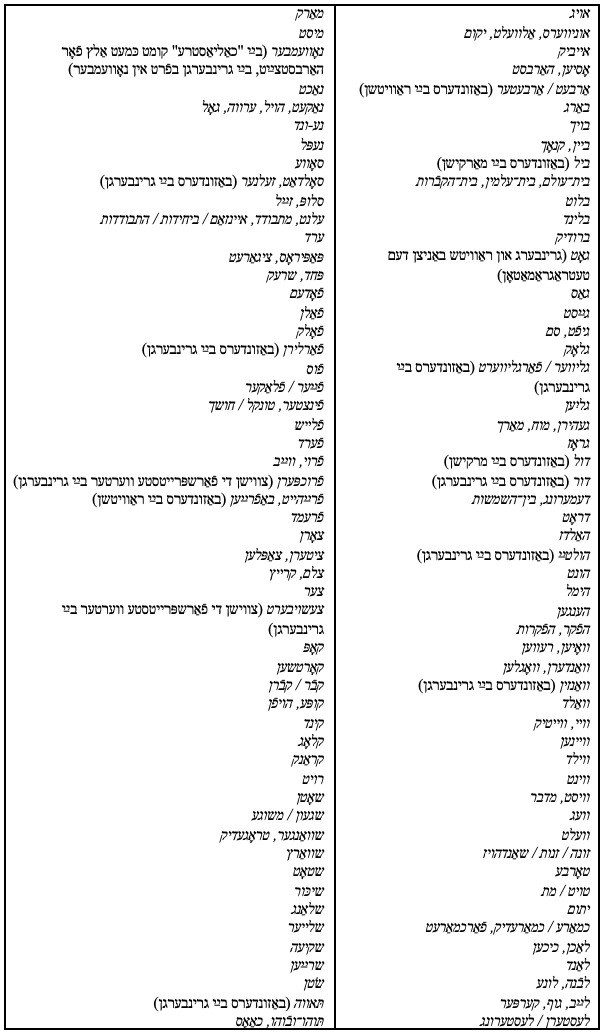
For teachers, the most striking—and challenging—feature of Khalyastre’s poetry is its morphological virtuosity. These poets’ tools include inventive compounding (sometimes combining three or more roots), prolific use of interjections and onomatopoeic syllables, bold affixation (especially suffixes), grammatical conversion (e.g. turning interjections into verbs), and even sentence-level condensation into single lexical units. These are the techniques teachers must carefully and thoughtfully unpack.
Among the “old” Yiddish words, Khalyastre preferred those that enabled them to create distinct poetic atmospheres and engage with non-traditional themes—including militant atheism (where Ravitch seems to precede even Soviet literature) and ecological consciousness.
The following list presents a selection of standard Yiddish lexical items (italicized), along with brief contextual notes (in roman type), that recur with striking prominence in Khalyastre poetry. Not only do they reflect thematic or emotional concerns, they also serve as “raw material” for coining neologisms.
Before embarking on a close reading of Khalyastre works, students are advised to ensure that they are familiar with all of these lemmas. Without this foundation, it becomes difficult to interpret the more complex lexical structures used and/or invented by the poets.
The Yiddish words are presented here in their YIVO-standard orthography, rather than in English transliterated form, in order to foreground their morphological features. 12 12 While transliteration is often helpful for accessibility, original Yiddish orthography is preserved here to highlight morphological structures, affixation patterns, and sound-based wordplay—features that are often obscured in romanization. In all subsequent sections, however, Yiddish words are presented in transliterated form for the reader’s convenience. In groups of synonyms, words are separated by a comma. Lemmas that are close in meaning but not fully synonymous are grouped on a single line and separated by a slash.
3.2. Interjections and Sound-imitation Words
The entire Khalyastre, Greenberg in particular, employed interjections with pedagogically salient frequencies to convey intense psychological or emotional states in compact form. For example, ekh (eh) appears as both an interjection and a dialectal variant of the pronoun ir (you, in plural or polite). This creates a layered irony in the Zionist context: “Berg hobn zey un der Kineres iz dokh—Kineres. Nisht Vaysl—ekh-ekh” (They have mountains, and Kineret is after all Kineret, not the Vistula. Eh-eh) (433).
In his “ecological” chapter (see section 5d), Ravitch “records” the cry of a desperate rooster before slaughter: hi-kri-ko (172)—a Yiddish parallel to “cock-a-doodle-doo” composed of the Yiddish word hi (here), Hebrew kri (call), and Hebrew ko (now). Elsewhere, he renders the lament of a calf separated from its mother as mah-mah-meh (175).
Greenberg’s poetry abounds in sound-imitative verbs. He often introduces onomatopoeia, e.g., “z-z-znus iz der zhum in der luft fun di nekht” (p-p-prostitution is the buzzing in the air of the nights) (407); “Krekh-kh-khtsn vilstu” (You want to g-g-groan and moan) (431). Some interjections and sound-imitation words become nouns or verbs; for instance, vey mir functions as a noun (459).
In the war narrative “Royte epl fun veybeymer” (Red Apples of Pain Trees), Greenberg renders physical and emotional breakdown through phonetically charged outbursts (441):
גע-וויס-סס . . . אין סקוטאַרי פֿיבערט מען . . . און אויף ים אַז מע פֿאָאָרררט ברעכככט מען כּסדר— —מאַ!
He also mimics military and bodily sounds: ts-r-r, k-r-r, vu-u-u (weaponry); h-ha, h-h-h (asthma); vim-m-m, tra-a-ta (trumpets); ts-ts-ts (pen-scratch).
Erotic scenes blend grotesque intimacy and religious mockery. This is how Greenberg renders a lyric persona’s speech during his sexual intercourse with a local Christian woman (443):
מ . . . —ליג! וואָלט וויטמעניש: נעם אויף מײַן זאַמען פֿאַרן קיום־העולם, דו ווײַב! ס'וועט געבוירן ווערן יעזוס. שרעק זיך נישט. יעזוס וועט געבוירן ווערן . . . המ . . . אַככך. . . אַכככך . . . וועגן עטיקע רעדט שוין עמעץ אַַנדערש מיט מײַן ווײַבאין דער היים . . . אַ גלח אַוודאי מיט אַ פּליך אויפֿן קאָפּ (גלחים גייען נישט אין קריג) . . . אַכככך.
M . . . —lie down! As Walt Whitman would say, accept my seed for the existence of the world, woman! Jesus will be born. Don’t fear. Jesus will be born . . . um . . . ah-h-h . . . ah-h-h-h . . . Ethics is already being discussed by someone else with my wife at my home . . . The [Christian] priest, of course, with a bald head (priests don’t go to war) . . . —ah-h-h-h.
3.3. Use of Affixes
Khalyastre poets were masters of morphological manipulation. For instance, Greenberg created the word “brodyagish” (of vagabonds, 425), echoing Russian suffixation. (Markish used this word, too.) To nuance the mild degree of fear, he coined “moyrinke” (slight fear, 441) from “moyre” (fear).
The motif of laughter is expanded not only through sound-imitative words like “khikhen,” but also affixal constructions: “gloknlakh” (bell laughter, 332), “lakhik” (pertaining to laughter, 410).
Markish contributed forms such as opvarfekhts (trash, 406), oysgegorglt (ripped from the throat, 409), mentshikhe-mame (she-human/mom, 410), farneglt (clawed, 410), kopikn (to give alms, from Russian копейка, 411), geritlt (branched, ramified, 412), and tseshtorkhet (shoved around, 419). The following phrase contains two rare words that were not invented by him, but that may pose a challenge even for advanced students: “oys’smoken fun velt dem opgeshkrabetn dem hoyln beyn” (to suck the world's bare, scraped-out bone, 418).
Markish combined affixation with onomatopoeia: “nit-antveynte veyland” (country that has not cried out its pain, 406); “Af dekher kretsik-opgekrokhene myauken kets farkretsikte” (Scratchy cats meow on scratched-shabby roofs, 408).
Ravitch's suffix inventions include: for[e]m-zikherkayt (shape-confidence, 9); oyfgeknipter fayerbund fun hunderttoyznt tsungen (fiery bundle of a hundred thousand tongues, 17); mentshnbafrayung un lebnsbanayung (liberation of people and renewal of life, 34); harbst-zun-zingendik (singing in the autumn sun, 48); zibnfarbnfule shtraln-buntn fun dermonung (ray bunches of memories filled with seven colors, 71).
3.4. Compounds and Hybrids
Compound formation is a natural process in Yiddish, albeit less extensive than in German. Khalyastre poets pushed its boundaries.
Greenberg coined: veltntol and velttol (world valley, 333, 338); blitsnglants (lightning flash, 326); fli-gli-funk (flying sizzling spark, 441); mid-lid (tired poem/song, 441); tsier-farfirer (pickpocket-fraudster, 448). Ravitch constructed: shturem-shtern (storm star, 95); turem-shturemdik (tower-storm-like, 149); valdfrioyfshteyn and valdshlofngeyn (forest rising/sleeping, 26).
Cardinal numbers repeatedly appear as first elements of compounds: Ravitch’s zekskantik (hexagonal, 114), zeksshtok’hoykh (six-storeyed, 115), nayn-un-nayntsik-gradndik (ninety-nine percent [alcohol], 148); Greenberg’s toyznt-gloknklang (thousand bells ringing, 327), milyonen-oderndik (million-veined, 438). In his “Himnus tsu der rusisher shprakh” (Hymn to the Russian Language), Ravitch mentions draygeshpan (troika, 112).
Land regularly serves as the second part. Markish coined veyland (pain land, 406) and groylland (land of horror, 407). Ravitch constructed kinderland (land of children, 172). Greenberg contributed stepnland (land of steppes, 387); morgnland (morning land, meaning the Land of Israel, 385); harbstland (autumn land, of his old homeland,414); Hadsonland (Hudson’s land, of the US, 426); and flakhland (plain land, of Europe, 457).
Greenberg often used lesterung (mocking) as the first ingredient: lesterung-sude (mocking meal, 410); lester-khalyastre (mocking gang, 411); and lesterung-kol (mocking voice, 412). Additional appearances of the word element khalyastre in his writings include feygl-khalyastre (bird gang, 402) and tseylem-khalyastre (crusader gang, 415).
3.5. Word-Phrases and Hypercompounds
Greenberg was unique in creating long lexical chains—multi-word units condensed into single expressions.
Examples include: farloyrn-geyer-velt-tog (day of the world's collapse, 321); farshlofn-zikh-in-gantsn (completely falling asleep, 398); sharey-tume-halb-boygn (half-arch of spiritual/moral decay, 412); s'geyen-zikh-kep-arop-gufim-arunter (walking around with heads up and bodies down, 415); vey-un-vind-geveyn (weeping of pain and sorrow, 417); mit-mi-un-gevalt-oyfgebrokhn (broken by toil and violence, 425); verter-tsum-oysdrukn-felnd (lacking the right words to express, 426); yesoymim-un-velt-farloyrn-bil (cry of the orphans and the lost world, 427); geyn-shlofn-af-gelegers-baynakht (going to sleep on beds at night, 430); likht-fun-a-velt-in-baginen (light of the dawn world, 431); gli-in-di-volkns (heat in the cloud’, 436); glorye-mame-fun-der-velt (Gloria—mom of the world, 436); zayn-vayb-in-di-nekht (his wife at night, 446); un-trogn-nayn-fule-levones-di-mase-in-layb (and carrying the burden for nine full moons, 446); nisht-mentshlekh-nisht-khayish (inhuman and inanimal, 448); tsar-fun-tsesheydn-zikh (bitterness of separation, 452); libshaft-groyse-fun-der-Lilis-gufe (love more powerful than the demoness herself, 453); vayb-fun-ale-vayber (wife of all wives, 453); tayve-fun-ale-tayves (world's strongest [sexual] lust, 453); harts-di-velt-durkh ([with my] heart throughout the world, 457); vund-di-velt-durkh ([with my] wound throughout the world, 457); biz-mayne-shpitsn-finger-faynt-aykh (to the tips of my fingers I hate you, 463); fun-nisht-gezogtn-shvartsn-emes (of the unspoken black truth, 463); tsvey-yortoyznt-zayn-Ahasfer-un-nisht-gleybn-inem-tseylem (two thousand years as Ahasuerus and not believing in the cross, 463); heym-di-velt-durkh ([with my] home throughout the world, 467).
He also innovates branching compounds: gezang- un geveyn-ful (filled with singing and weeping, 384); nisht-tsum-oryent- un nisht-tsu-Eyrope-geherik (not related to either the East or Europe, 425); elekter-, brikn-, hoykhgorndikayt-, kafe’en-, shantan-, shand- un opyum-shtet (cities of electricity, bridges, high-rise buildings, cafés, café-chantants, shame, and opium, 426).
These formations are often syntactically ambiguous—students may ask whether they are metaphors, collages, or surreal grammar. The power lies in force and compression: one image slamming into another in rhythmic bursts, creating kaleidoscopic expressions that are sensory, mythic, sometimes violent.
4. Thematic Clusters in Khalyastre’s Lexical Innovating
This section explores semantic fields that recur throughout Khalyastre’s poetry. These poets’ expressive formations clustered around core preoccupations of the group’s artistic and ideological vision.
Teachers can incorporate these word lists into advanced thematic lessons as guided exercises for working through lexically challenging material.
4.1 Violence, Pain, and Death
Pain is not merely an emotion in Khalyastre’s lexicon—it becomes a vivid, quasi-material substance with its own textures, colors, anatomy, and geography. Many lexical innovations and expressive compounds strive to make pain visible, even sculptural, although in classroom discussion students may read them merely as metaphors.
Greenberg, drawing on his experience as an Austro-Hungarian soldier on the Serbian front in World War I and later as a deserter and witness to a pogrom in Lemberg, constructed a language of trauma from the ground up. His neologisms include: foystkraft (fist power, 378), goyses-yorhundert (century of agony, 414); drotn-batsoymung (wire fence, 415); gaz-ongrif (gas attack, 422); biryoynim-armey (army of bandits, 433); vakhsoldat (soldier on watch, 442); feldvakh (field watch, 444); biksn-treger (gun carrier, squire, 444); harmatn-fayerung (cannon fire, 444); beys-hakvores-reyekh (cemetery smell, 453); farblutung (bloodshed, 462); blut-getsapt (blood drained, 464); gevaldnakht (night of violence, 470).
These words sit alongside a torrent of grotesque compounds: shpinvebsbrik (cobweb bridge, 322); atsvesdik (nervous, 325); blutngroyl (bloody horror, 333); oysterlish-derlebenishn-shver (of strange hard living up, 377); koshmarnkind (child of nightmares, 378); harts-tseraysndik (heartbreaking, 383); blutshrey (bloodcurdling scream, 394); groyl-nakht (night of horror, 398); groyler-toyshev (creepy dweller, 398); veyshtot (town of pain, 400); khoyshekhke-elnt (bleak, dark and lonely, 401); veytants-fiber (pain dancing fever, 405); neshome-shmarts (mental anguish, 405); vundn-kerper (body covered in wounds, 405); koshmarn-shvangerdike (pregnant with nightmares, 405); aroysgetrernt (crying through tears, 405); laydnshaft-shray (cry of anguish, 407); groylduft (scent of horror, 414); shandgang (shame march, 414); giftnakht (poison night, 414); shandroyz (shame rose, 417); giftmilkh (poison milk, 417); troyerkop (mourning head, 418); veyentog (day of pains, 429); veytiknnakht (night of pains, 429); yidish-umglik-geshrey (Jewish cry of misfortune, 431); shakalnklog (jackal howl, 433); veyfeld (pain field, 434); umet-gemit (sad mood, 434); vey-bashefenish (painful creature, 437); pkhodim-shprakh (fear language, 437); blutvey (blood pain, 440); veltshmarts (world grief, 440); hoyttsuk (skin twitching/cramping, 440); opvimen (bleat/whine sufficiently/to the end, 441); vey-tuendik (causing pain, 441); vild-benkendik (wildly longing, 441); mame-veytik (motherly pain, 442); pakhed-geheymnish (terrible secret, 445); veyerd (earth of pain, 447); laydnshaft-veg (path/journey of suffering, 448); shraytog (scream day, 448); veykop (aching head, 457); trernfal (downpour of tears, 457); kloger-foygl (complaining/mourning bird, 457); 14 14 bruderklog (fraternal lament, 457); giftshpay (poison spit, 457); veytikn-fleysh (flesh of pain, 458); veyboym (pain tree, 462); veytikn-heym (home of pains, 465); rakhmim-baderftik (in need of pity, 470); veyen-brumer-fidl (violin of pain and grumbling, 471).
Ravitch, who fought on the same side, added ruinen-groz (ruin grass).
Markish, from Russia, fought inside the opposite coalition. In 1917 he was wounded and demobilized, then witnessed pogroms in Ukraine. His poem “The Heap” has been compared to Ḥayyim Naḥman Bialik’s elegies following the Kishinev pogrom of 1903.
Ravitch and Markish similarly respond to physical and mental trauma with a language of anatomical fragmentation and moral devastation. Markish’s coinages ayngefaln-dar (sunken skinny, 408), meysim-tsug (train of corpses, 408), dul-heym (madhome, 409), kro-shayn (crows shining, 420), and malke-kupe (Heap the Queen, 421) conjure the grotesque logic of modern atrocity. To emphasize the horror, Markish often used numerous anatomical or medical words, such as brustn farbrudikte bilmen (stained breasts peek out like eyesores, 412) and gebrekh af shvartser dikh fun d’r erd (fracture on the Earth’s black thigh, 414).
Ravitch's thematic neologisms include groyzam-lang (terrifyingly long, 112); nervn-shtrik (nerve cord, 116); beys-hakvorim-royz (cemetery rose, 151); umoysgeveynt (unweeped, 153); soldatske yontev-hoyzn (soldier's holiday pants, 154); and folks-kavren (gravedigger of the people, 161).
4.2 Politics, Society, Attitude to Literary Work
Khalyastre emerged the same year that Poland regained its independence. The atmosphere in Warsaw at the time was deeply permeated by politics—one of the key factors behind the explicitly politicized nature of the group’s poetic work. As Wisse notes,
The reemergence of Poland from World War I as an independent republic had a contradictory effect on its more than three million Jews. In no other country of their prolonged exile . . . had Jews grown so numerous or sunk such deep communal and cultural roots. Consequently, when Poland regained its national sovereignty in 1919, . . . many expected the country to become a home for “two nations nursed by the same suffering.” . . . But Polish soldiers returning from the front attacked the Jews with unprecedented brutality, as if proving their prowess against one enemy they knew they could conquer. 15 15 Greenberg called himself “di sove, kluger-foygl, funem veyvand fun Eyrope” (the owl, clever bird, from the European painwall, 457).
Therefore, the theme of politics is often intertwined with those of war and violence, making it difficult at times to determine whether a given word belongs to this section or the previous one.
Greenberg's publications in the first issue of Albatros abound in opaque forms that reflect—directly or metaphorically—the poet's ideological platform in that period.
On page 421: dikhter-yokhid (lone poet); fremd-lenderish (alien, extraterrestrial); yidish-folkishe ekstrateritoryalishkayt (extra-territoriality of the Jewish people); tseshvumenkayt (blurredness); dikhter-af-lehabe (poet for/of the future); galikn (spew bile, snide); goyses-vey (agony pain); mentsh-du-bist-faran-milyonendik (man, there are millions of people like you); milyonen-kep-un-hertserdiker individualizm (individualism of millions of heads and hearts); vundnmentsh (man covered in wounds); remekh-evrimdik (with all human organs, by the entire body); tseleftsnt (open, unfolded, surrounded by lips); araynpulsirndik (throbbing inward); globusvey (global pain); ide’en-knoyl (tangle of ideas); yorhunderts-hisgayles (revelation/discovery of the century); merkhokim-gemit (wandering-state of mind); oysknokhikn fun di eygene atsomes (suck out of one’s own bones); feldzoysdruk (rock expression); arbe-rukhes-oylem (four winds of the world); oyle-reglnik (pilgrim); shvarts-shabes-broyt (black Sabbath bread).
On page 422: moyl-geefnt (open-mouthed); tseylem-veg (way of cross); durkhgroyln (shudder of horror); dikhtung-shalve (poetic serenity); milyonen-kepedik (million-headed); tekhniktsaytn (techological era); amolikayt (bygone times); aroyskishefn (unleash the magic); blut-gerunen (bleeding out); doyres-farblaybung ([inter]generational preservation); oyftishn (serve [food]); farloyrn-geyer-dor (generation of lost people); dikhter-biryen (bully poet).
On page 423: toy[h]evoy[h]edik (thrown into chaos); umruen-dor (troubled/turbulent generation); avoyde-zore-glok (bell of a non-Jewish cult); mentshoysdruk (human expression); introspektivistish (introspectivist [adjective]); shpinvebsbrik (cobweb bridge); mevulbldik (confused, bewildered); mentshferd (man-horse); khilel-hakoydeshdik (sacrilegious, blasphemous); yatkeklots (butchery log); farumvirdikung (dishonoring); mit blut-un-markh (with blood and brain).
On page 424: shund-imitatsye (pulp imitation); shtern-mantl (starry mantle); meyvnes-zoger (speaker with insight); haskolesh-apikorsish (heretical enlightenment-like); voylkenevdikayt (educatedness); blut-oyfkhvalyendik (blood excitement/agitation).
On page 425: sam-groz (poisonous weed); oyfgefliglte nay-klangen-forem (soaring/winged new sound form); fremdvertik (alien-oriented); grafoman-nokhshleper (epigonous graphoman); arvekayt (nudity, shamefulness); “eyn-heym-hobndik kultur-folk” (cultured nation with [only] one home); af-hinerfislekh-shteyendik (chickenfooted); handlen-vandlen (wander-and-trade [verb]); blote-grude (mud pile); mit mi-un-gevalt-oyfgebrokhener feldznkval (by labor and violence uncovered rocky spring); bibl-shprakhik (related to Biblical language); salon-gezets (salon rule [of conduct]); atsilesdik (aristocratic, refined).
On page 426: gederem-geshrey (guts scream); goles-bovl-bandure (bandura of the Babylonian exile); yidns-blutike veybreges (shores/riverbanks of pain stained with Jewish blood); koymen-roykherdik (smoky from chimneys); alvelt-umet (universal yearning); merkhakimdik (long-distance); opshrek-geshpenst (deterrent ghost); pkhodim-kreyts (fear cross); gli-khush (burning sensation); eyntsl-shtern (lone star); arunterraysung (tearing off); doyres-opgehit (kept by/for generations); zol-dikh-dakhtn (let it seem that way to you); odern-gedrey (vein pattern); iberhilekhn (outcry); vanzin-tsezungen (sing-songed in madness).
On page 427: vey-rubin (pain ruby); drotgeflekht (tangle of wires); hungertog (hunger day); kdoyshim-mishpokhe (mortars family); gold-geshribn (written in gold); yerushe-briv (legacy letter); vild-khayoles-geroysh (wild noise of hordes); gusl[y]arn-lid (psalter/guslar song). 16 16 Wisse, The Modern Jewish Canon, 132.
Page 449 contains an almost entirely chained sentence: Vert fintsterer-fintsterer-fintster dayn foter-un-muters royt-royzndik gliblut (your father-and-mother’s rosy-red blood, heated to burning, is getting darker-darker-dark).
4.3 Eroticism and Sexuality
Eroticism in Khalyastre is neither sentimental nor strictly corporeal. It tends toward the surreal, grotesque, or mythic—often violent, often sacred, or both. Greenberg’s coinages from the Hebrew root זנה—zindik-zoynedik (sinful and prostitute-like, 405), zoynesh (pertaining/similar to prostitutes, 407), tsezoynet (corrupted into prostitution, 407)—are striking in their provocation.
Illustrations such as hertser-fanger-nign (heartthrob's tune, 322); hefkeres-vayb (wife left to her own devices, 332); vander-meydele (wandering girl, p. whore, 338); breyshes-shvesterl (primaeval/original sister [possibly associated with the book of Genesis], 338); gasn-libe (street love, 347); bamanung (intercourse with a man, 351); khupe-bet (bridal bed, 367); tayve-yor (lust year, 398); shlofvayb (wife to sleep with, 400); vayb-madone (wife-madonna, 412); fiber-geleger (feverish bed, 412); sho-vayb (wife for an hour, 416); einnakhtik (one-night, 417); bavaybung (sexual intercourse with a woman, 417); tsehulyet (licentious, debauched, 417); vayb-akore (infertile wife, 434); vayblekhkayt-glorye (feminine glory, 436); teylnvayz-gelibte-libshaft (partially beloved love, 453); and libshaft-onzog (confession of love, 453) exemplify the erotic-messianic tension of Greenberg’s poetics.
Markish contributes verb coinages like zikh tseklamern (to disengage from a sexual grip, 408).
4.4 Colors and Their Functionality
Greenberg’s chromatic palette is very characteristic.
Red signifies blood, revolution, and prophecy: baginens-royt (daybreak red, 405); sharlakhik-royt (scarlet, 407); shkarlat-royt (scarlet, 426); tunkl-tif-royt (dark deep red, 444); royt-royzndik (rosy red/pink, 449).
Blue marks femininity and eroticism: blo-oygik (blue-eyed, 416); kheyn-blo (charming blue, 416); blo-blitsndik (sparkling blue, 427); gold-blo (golden blue, 436).
Other colors and hues play minor roles, but also serve the domain of Greenberg’s word creation: durkhgrinen (turn green through, 414); shiml-grin (moldy green, 417); shtolfarb (steel-colored, 442); zilberdikayt (silveringness, 444); shterns-blas (starry pale, 405); tunkl-durkhzikhtik (dark transparent, 444); regn-boygn-farbndik (rainbow-colored, 459).
Ravitch’s use of royt-tseglit (glowing red, 151) and morgnroyt (morning redness, 162) reflects both his revolutionary fervor and his aesthetic sensuality.
4.5 Environmental Protection, Compassion for Animals
In the final section of Nakete lider, titled “Vegetarish evangelyum,” Ravitch anticipates environmental discourse by decades. His poem about the slaughterhouse, “Fleyshfreser” (Meat Devourer, 171–172), published in 1921, may be the earliest Yiddish poem to address environmental and animal-rights issues.
A new topic needed new words such as: otem-vort (breath word); pukhedik (fluffy); angst-kol (frightened voice); shnobl-horn (beak horn); frifuterung (morning feed).
Such lexicon dominates the semantic field of several poems in that section: forshtot-katsev (suburb butcher, 169); shlakhthoyz-brik (slaughterhouse bridge, 169); noyt-shkhite (emergency slaughter, 173); dorfshleger (village slaughterer, 173); ku-kind (cow’s child, 175).
4.6 Religion and the Land of Israel
The Khalyastre poets frequently reworked religious terminology—Jewish and Christian—into novel compounds, ironic formulas, or paradoxical expressions. They referred to Jesus by diverse terms: Yeshu, Krist, Kristke, Yezus, Yoyzl, Yeshu Ben-Yosef, Ben-Yoysef.
Markish mentioned Jesus as “der zun funem almekhtikn” (the son of the Almighty, 409), implying that Jesus himself is not almighty.
Greenberg was particularly versatile in inventing compound words referring to Jesus: Yezus-bokherim (Jesus’s guys, 415); Kristum-prister (Christ-preacher, 417); yudo-Kristus-vey (Jewish-Christian pain, 418); yudo-Kristi-heyliktum (Jewish-Christian shrine, 418); and the sarcastic domen mit fargliverte ben-Yoysefs (cathedrals with Joseph’s frozen sons, 471).
Greenberg's multiple neologisms related to religion, mainly Judaism, include: samet-paroykhes (velvet ark curtain, 408); shvarts-shabes (black Sabbath, 412); flater-tales (fluttering prayer shawl, 416); tfile-baginen (prayer dawn, 416); tfile-farnakht (prayer evening, 416); brudergot (God-brother, 418); zalbungseyl (anointing oil, 431); gebeter-kol (prayer sound,431); t[h]ilimen (recite the Psalms, 433); shakher-gebet (dawn prayer, 436); shabes-shabosn-mentsh (man of the Sabbaths, 440). However, he also created shvarts-khoge (black/horrible non-Jewish festival, 411); shoyder- un shand-evangelyum (gospel of horror and shame, 422); Ala-vanzin-dikhtung (crazy poetry of Allah, 423); kloystershtot (monastic town, 431); and kroyn-tseylem (crown cross, 458).
Some of Greenberg's linguistic terms witness his gradually increasing interest in Zionism: Yam-Hamelekh-otem (Dead Sea breath, 398); palmen-zeysim (palms olives, 431); esroygim-gortn (citron garden, 431); hebre’er-tsar (ancient Jewish king, 433); uryidn-vey (ancient Jews’ pain, 433); kromim-meydl (vineyard girl, 440).
4.7 Science, Technology, Art, and Medicine
Similar to those of German expressionism and Russian futurism, Khalyastre’s aesthetics are full of references to contemporary science and technology. The word usage is mostly symbolic, not factual, serving to convey modern alienation, mechanization, and disintegration. To give just a tiny portion of possible examples from Greenberg: odern-strune (core string), lastvagon (freight wagon).
In his story “Der mentsh shrayt” (The Man Screams, 429), Greenberg compares the functioning of the human body with technical devices and natural phenomena:
לבֿנה־רינגען. גרינע שלאַנגען קומען פֿון די פֿעלדשפּאַלטן, קריכן אַדורך גוזמות מיט שלאַנגען אין שלאָף—ציטערט אויף דאָס נערוון־סיסטעם. נערוון ווערן רעלסן. ס'לויפֿן אָן פֿון אַלע מרחקים לאָקאָמאָטיוון. און די בלוטן לויפֿן אויף פֿון אַלע אָדערן: ווערן טײַכן. זיי—ווערן ימים . . .
Rings of the moon. Green snakes come from between the rocky clefts, creeping, hordes of snakes in dream—the nervous system is shuddering. Nerves become rails. Locomotives run in from all distances. Blood flows together from all the veins—becoming rivers. They become seas . . .
Ravitch was one of the first Yiddish authors to use scientific words borrowed from Latin, Greek, and German in belles-lettres rather than only in non-fiction: batsilum, muskulyar, egotsentriker.
Greenberg’s pool of international terms is even richer: barometer, kosmos, kosmish, planet, atom, lokomotiv, hoybits (howitzer), broyning (Browning [a gun]), futurizm, kubizm, glorye, ikone (icon), dadaistish, ekstaz, nirvana, homunkulus, sugestye, apriori, nyuans, kompozitsye, miniatyur, kontur (contour), ritmus (rhythm), tempo, reflekter, konvuls, konvulsirn, revmatizmus, astmatish, nervn-sistem, sifilis, sifilitiker, somnambulik, alkohol, nikotin, nargile, vampir, opyum, hashish. Phrases like ritmish pulsirndik blut (rhythmically pulsating blood, 386) seem to belong to non-fiction.
In the tekhniktsaytn era, as they called it, the writers of Khalyastre were not satisfied with the existing scientific-technological vocabulary.
Greenberg introduced the following lexical innovations: in “Mefisto,” gliderpayn (pain in organs, 329), reflektor-dimyen (reflective imagination, 362), forsherlempl (researcher’s little lamp, 364), noyge-shtern (star [planet] Venus, 365), and tsikraft (motive force, 377); and in his Albatros publications, glider-gebay (body/organ structure, 404), sifilis-kranker (syphilis sufferer, 410), telegraf-slup (telegraph pole, 412), telegraf-drot (telegraph wire, 414), batramvayet (equipped with tram traffic, 415), dam-hatamtsesdik (like thickened/condensed blood, 416), drotgeflekht (intertwined wires, 442), and beyner-gebay (bone structure, 449).
Ravitch coined pulsshlog (pulsebeat) and koyln-shakht (coal mine). As mentioned above, Greenberg called a mine koylngrub. Nowadays shakht (from the Russian шахта) is more useful in Yiddish.
While coining the word veltnshpin (global web, 328) and the word combination ongenetstiker kholel (networked space, 398), Greenberg most probably was not yet thinking of the Internet . . .
5. Select Lexically Challenging Poems, Recommended for Detailed Classroom Analysis
A good deal of Khalyastre’s texts confront readers with unusual lexical concentration and may cause lexical overload even for advanced students. Therefore, an important task for the teacher is to competently select and allocate materials for classroom and home reading. The most complex and meaningful poems are recommended for detailed study during in-class sessions.
For instance, Ravitch's “Vos is der dikhter” (What is the Poet, 89–92) includes at least thirteen innovations and other pedagogically problematic words across ninety lines: hofnungs-kos (hope-bowl), velt-bagliker (he who brings joy to the world), troym-balast (dream-burdened), veltnlibe (world-love), zaydntsayg (silken tissue), veltn-shoyfet (world judge), blut-trifndik (dripping with blood), baginen-tog (sunrise day), shlangen-kneytsh (wrinkle in the shape of a snake), meshuges-freyd-shoym (foam of mad joy), tsunandgekortshet (crouched and huddled together), blut-gaz (blood gas), unteribererdish (underground and aboveground).
“Di freyd” (The Joy, 93–94) contains mit-zumer-tog (mid-summer day), eynzam-umgliklekh-farlibt (lonely and unhappily in love), lastveg (burdened path).
In “Iber shtolts” (On Pride, 109–111): fayerbarg (fier[y] mountain), natsyonenstolts (nations’ pride), zeyfnvasertaykh (soapy water river), koyln-shakht (coal mine), pulsshlog (pulsebeat), gasn-rin[v]en-shlefer (he who sleeps in street gutters), hartsns-mekadesh (hearts-sanctifying), fayer-tropn (fire drop).
In “Himnus tsu der frantsoyzisher shprakh” (Hymn to the French Language, 114–115): shtroz-lamtern (road lantern), veltbafrayung (world liberation), blankblintsndik (sparkling-glittering), zeksshtok’hoykh (six-story-high), zekskantik (with six cantilevers), shlankfrizirt (shapely cropped[hair]).
In “Gavrilo Printsip” (143–145): folksbager (people’s desire), royshgezang (raucous singing), makreven (sacrifice [instead of the standard makrev zayn]), laydnshaftfarhilt (wrapped in suffering), meydlgelibt (belonging to a beloved girl).
In “Folks-firer” (National Leader, 148–150): velt-batsvinger (global enslaver), gefroyrn-gebrokhn (frozen and broken), din-heldzerik (thin-necked), umderfilt, umoysgelakht, on viderker avek (unnoticed/unfelt, unmocked, unrepentant/unrepentant), turem-shturemdik (as a storm rising like a tower), lang-geshtrekt (stretched out in length), reder-dreyendik (spinning the wheels).
6. Concluding Reflections
In advanced Yiddish classes, students often ask challenging questions about whether the learner-opaque lexical constructions discussed here are “real words.” Such difficulty turns out to be pedagogically productive—and can be addressed in constructive ways. Moreover, it gives the tutor a rare practical opportunity to develop the students’ linguistic insight, to transform confusion into analytical awareness—the indispensable skill for advanced learners.
The environment in which Khalyastre operated was framed by a dual tension: between borrowing and invention, between improvisation and planning. Their poetry bears witness to a world that had come unmoored—morally, politically, and aesthetically. In response, they dismantled and reassembled the Yiddish lexicon into a tool of prophetic and visionary expression. They spoke, and at times howled, in a new Yiddish, a language stretched to the limits of cognition and emotion.
It is true that many of Khalyastre’s lexical inventions did not enter everyday speech and common dictionaries. Some ended up as nonce formations. But in the long arc of language development, avant-garde interventions often serve as catalysts—challenging norms, unsettling habits, and making space for new possibilities. Precisely because many such formations never stabilized into standard usage, they offer advanced learners a uniquely revealing laboratory for observing Yiddish morphology, semantic extension, and expressive compression at work.
A pdf of the appendix for an advanced Yiddish lesson can be found here. A pdf of the full article, including the appendix, can be found here.