Feb 23, 2026
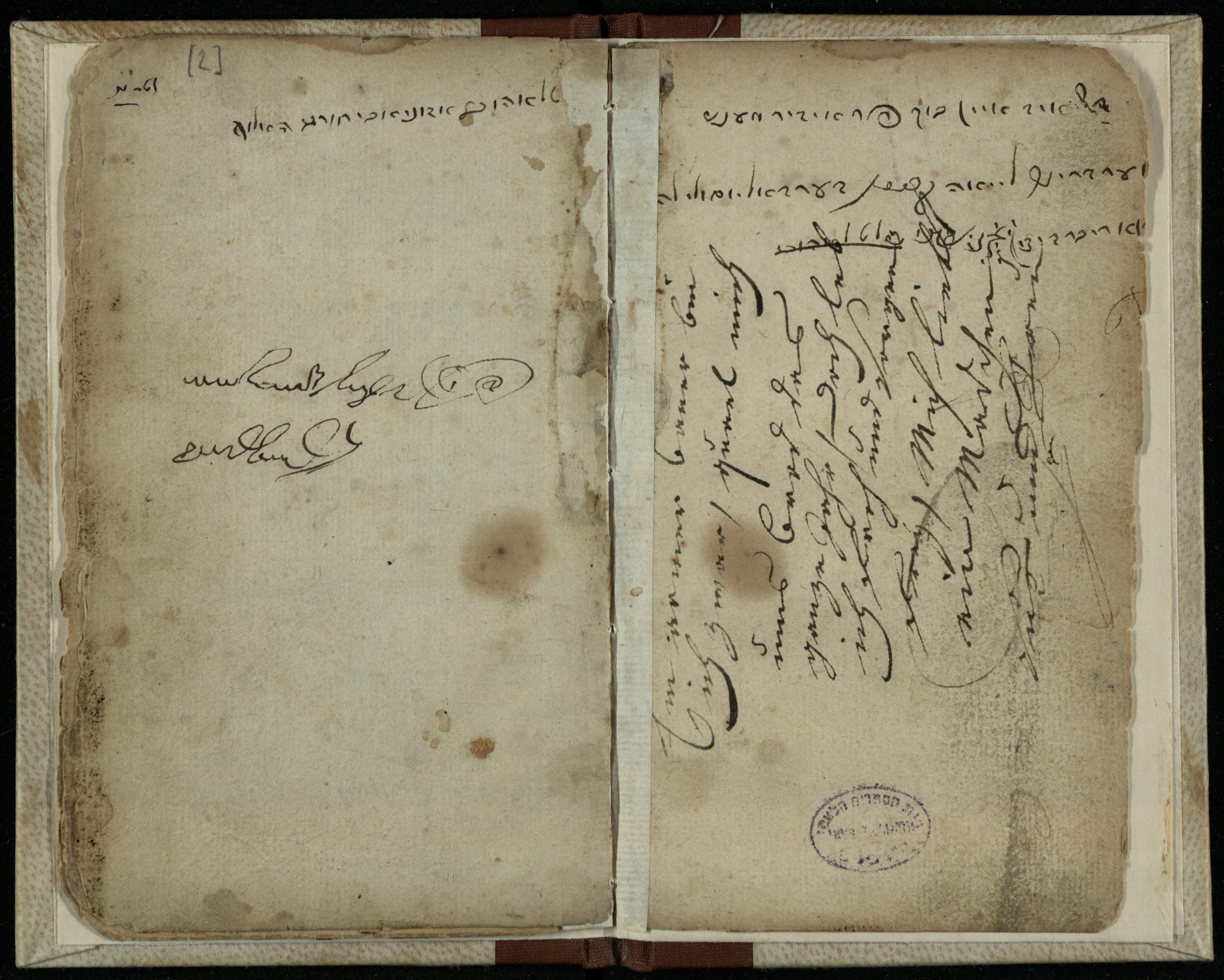
Courtesy of the Jewish Theological Seminary. From Bas Tovim, Sarah. Tehinah Sheloshah She’arim. n.d. BM675.T4 A3 n.d.37.
By all accounts, I wrote my undergraduate senior thesis in entirely the wrong order. After choosing to embark on the biggest project of my academic career, I stumbled backwards into the topic of tkhines and almost accidentally ended up on a yearlong (or really, year-plus) study of Yiddish-language women’s prayers. It was only then, after I’d already submitted the paper and the art piece and the final reflection, that I decided it might be time to actually learn some of the language I’d been studying around for more than twelve months.
Tkhines, literally “supplications,” are a genre of women’s prayers on generally “domestic” topics, dating back at least to the sixteenth century and most often printed as small books or pamphlets so that they can be cheaply made and easily used in the home. Tkhines hold an important place in Jewish feminist history, and my work aims to understand them particularly through the lens of materiality and book studies.
That process, though in retrospect perhaps a bit ridiculous, highlights the belief that brought me to tkhines in the first place: that book culture and material history are uniquely powerful hands-on academic lenses. I believed (and still do) that most contemporary tkhine scholarship focused way too much on the content of the prayers and almost entirely neglected the importance of their physical form and creation. Although my complete inability to read Yiddish at the outset of my project was occasionally frustrating, it also forced me to maintain the object-first perspective that I so badly wanted to contribute to the literature. For me, book studies became not just, more broadly, an entry point into Yiddish studies, but also, once I got there, almost a superpower, a way of looking beyond the content and the language and into the core (or a core) of the culture as it was left to us.
I want to make two important caveats, which are, first, that I was absolutely not the first person to apply a material lens to studies of Jewish texts. My work relies so heavily on the foundations of scholars like Chava Weissler, Emile Schrijver, the whole team behind Columbia University’s Footprints project, and many others. Secondly, and this one is perhaps even more obvious, learning Yiddish really did deepen my engagement with the source material. Even after having completed the project, I was able to return to the source material and gain an even richer relationship with the text, without having to rely entirely on translations and intermediaries. In this way, my book studies training became a perfect jumping-off point for the rest of my engagement with the Yiddish world, inspiring me to go so much further and learn so much more than I initially believed I would.
My initial research process was completely emblematic of this combination of Yiddish illiteracy and focus on materiality. As I sat in the Special Collections reading room at the Jewish Theological Seminary, flipping through nineteenth-century pamphlets way too fast to actually be reading them, even if I had the language ability, I found myself nonetheless surprised by how much I was able to learn just by examining these documents hands-on and in the aggregate.
After getting through a veritable pile of tkhines in this way, I decided to focus in on two particular copies of one particular text: Sarah bas Tovim’s Tkhine shloyshe she’orim, or Tkhine of the Three Gates, which was written at some point in the late seventeenth century but remained in circulation long afterwards. Sarah’s tkhine was written in three parts (the titular three “gates”): one for the three “women’s mitzvot,” one for the Yamim Nora’im, and one for Rosh Hodesh. Her writing is fairly unique in the genre for its personal, even autobiographical voice, and the tkhine’s immense popularity means that there are many copies from many different eras and locations to aptly compare with each other. Comparing and contrasting the two nineteenth-century copies I wrote about (“my” copies, as I came to think of them) helped me understand what was typical of late early modern tkhines, and what that can teach us about the lives of early modern Jewish women.
This research experience—intensely hands-on, non-linguistic, book-historical, and object- rather than text-focused—helped me develop a sort of how-to guide for “reading” a material document, including what sort of features to look for and what information they might be able to reveal, without needing or even being able to read the content within it. Though I adopted this approach somewhat out of necessity, it taught me so much more about tkhines (indeed, everything I know!)—and, even more than that, also helped me to understand the important contributions that book studies and other materiality-centered disciplines can bring to contemporary Yiddish scholarship.
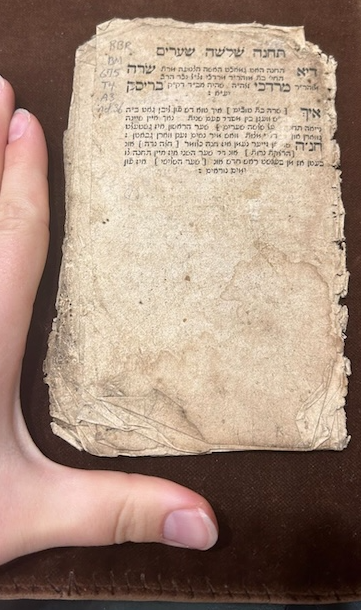
Courtesy of the Jewish Theological Seminary. From Bas Tovim, Sarah. Tehinah Sheloshah She’arim. n.d. BM675.T4 A3 n.d.37.
The first thing you may notice, when trying to understand a textual document while ignoring all of its text, is the size and relative “sturdiness” of the object. Tkhines are universally small, rarely any larger than six by eight inches, and can be anything from a few flimsy pages in a sewn pamphlet to a full collection of prayers bound in hard covers. Chava Weissler, the preeminent tkhines scholar, analyzes how these traits map onto particular eras and locations. Western European tkhines, which were dominant in the seventeenth and eighteenth centuries, were published as longer collections with a wide variety of topics, often as complete books or appendices to Hebrew-language prayer books. By contrast, Eastern European tkhines, which were popular from the 1700s through the early 1900s, were “much shorter, published in little booklets addressing one or two topics, usually on inexpensive paper with small, difficult-to-read type.” 1 1 Chava Weissler, Voices of the Matriarchs: Listening to the Prayers of Early Modern Jewish Women (Beacon Press, 1998), 6–7. And American tkhines, which were published mostly in New York after the turn of the twentieth century, were highly commercialized and came as small, decorative books containing many short tkhines for all sorts of different occasions.
The two copies of Shloyshe she’orim that I studied perfectly match up with Weissler’s description of Eastern European tkhines as slim, cramped pamphlets that cover a relatively limited subject area. The provenance of each of these specific copies was unknown, both to me and to the librarians at the Jewish Theological Seminary in New York, but it was the combination of these particular features that helped me generally trace them back to early-nineteenth century Eastern Europe.
Identifying even these basic types of physical features about the book you’re looking at can be a useful way of understanding where it fits within larger historical, literary, and religious contexts, and can also start to reveal important trends about intended use and audience. Even with so much variety in tkhines format and binding style, they are still absolutely always the size of a modern paperback or smaller, which made them both cheap and portable. This has two main implications: first, especially in the late early modern period, the printers (often, but not always, synonymous with the publishers) that made them did not necessarily see them as valuable stock. At the same time, tkhines’ small size made them much easier for women to integrate into their daily lives; or maybe tkhines were small so that they could be easily slipped in a pocket and carried around from place to place? In contrast to men’s prayers, which were more often intended for communal recitation in synagogue and were therefore often kept in larger, heavier volumes, tkhines cover all sorts of different occasions and can be easily brought to each of them. Their physical size and format simultaneously reveal their marginalized status as feminized texts and their importance, via repeated daily use, to the women who read and prayed from them.
A second important factor is much more tactile than even just the size of the book, and revolves around the question of what the tkhine is actually printed on. As far as I’ve been able to tell, tkhines were never written on the expensive parchment that dominated early European bookmaking and has always been used for holy objects like Torah scrolls or mezuzot. They are also rarely printed on paper of any real quality at all, with nineteenth-century European exemplars often using supple but unevenly textured rag paper, and early twentieth-century American ones using wood pulp paper, now brittle and yellowing. Again, this is an economic indicator: Publishers across time and geography were trying to cut costs as much as possible, perhaps to make tkhines accessible to a wider public, but also because they simply did not see female readerships as being on the whole worthy of nicely produced books.
The third tool to try to understand a document like this is a sort of bibliographic grab-bag of features that may or may not be present, the cumulative presence or absence of which may then be used to make inferences about the documents’ origins and intended use. Many of these features are really quite niche and perhaps only interesting to librarians, cataloguers, or very serious book nerds: things like catchwords, foliation, and running titles, for example, all of which were designed to help printers and readers more easily navigate the text. On an individual level, none of these paratextual features are necessarily all that revealing, but when seen in the context of larger trends in book history, they can start to tell a story of readership and use changing over time, and can even help date particular documents that might not have other clearly time-bound features.
Included in this bibliographic grab-bag is the incredibly broad category of typography. The quality and style of the text can reveal incredible amounts of the origins of the document: where and when it was printed, by whom, and for what sort of occasion. In the case of books and pamphlets printed in oysyes (Hebrew letters), where there is much less variety between typefaces than in Latin-alphabet books, there is still a lot to be learned if one looks closely. I recommend Herbert Zafren’s “Variety in the Typography of Yiddish” 2 2 Herbert C. Zafren, “Variety in the Typography of Yiddish: 1535-1635,” Hebrew Union College Annual 53 (1982): 137–63. on this subject, for a dense but incredibly detailed summary of the differences in Hebrew-alphabet type across Europe.
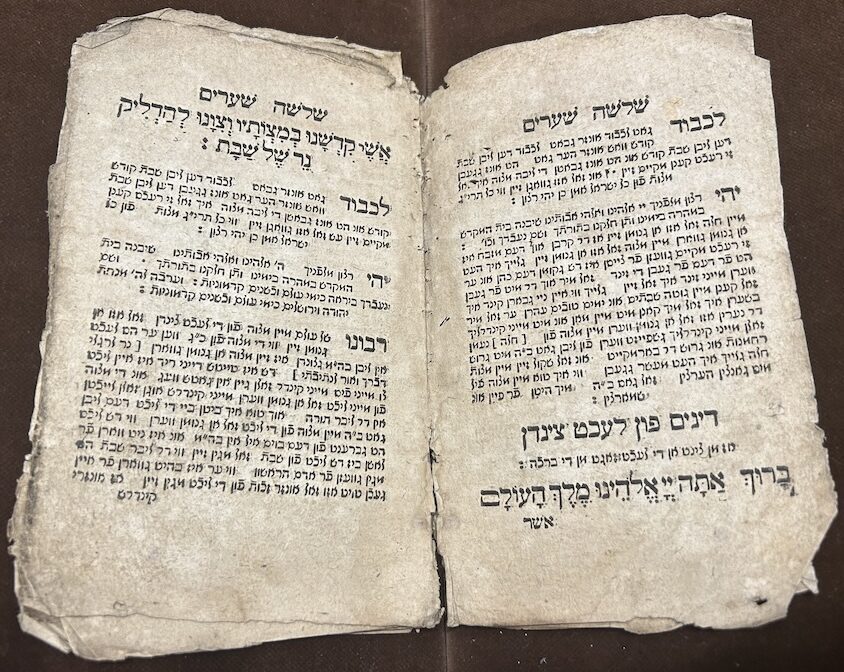
But in the case of tkhines there is often an even more obvious yes-or-no typography-related question, which is whether or not the text was typeset in vaybertaytsh, literally “women’s speak.” Most tkhines printed before the mid-nineteenth century use this particular typeface, which is narrower and more squiggly than standard Hebrew block letters. Vaybertaytsh was reserved almost exclusively for women’s literature (and sometimes other low-class vernacular texts), and fell out of fashion by the mid-1800s, again likely for economic reasons: it eventually stopped making sense for printers to keep around so much extra type, which is bulky and expensive, for only a small portion of their output.
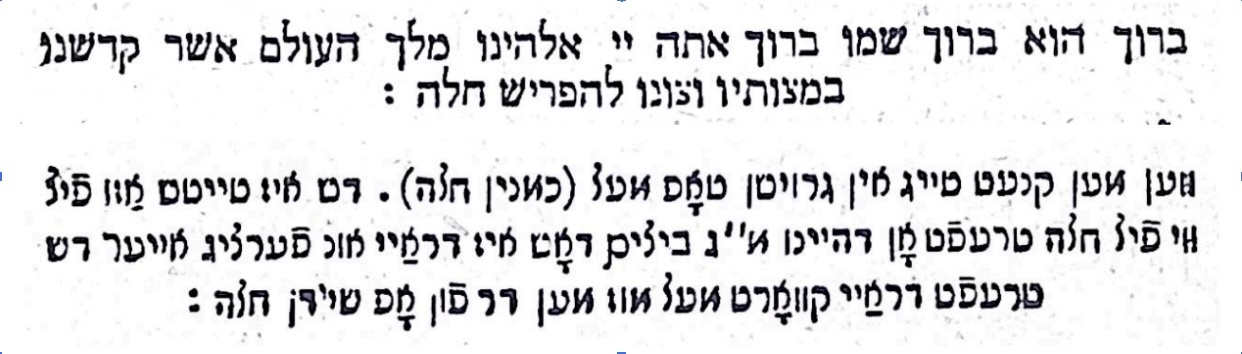
Comparison of block letters or square type (above) with vaybertaytsh (below). From Bas Tovim, Sarah. Teḥinah Sheloshah Sheʻarim. n.d. Courtesy of the Jewish Theological Seminary, BM675.T4 A3 n.d.37.
But when it was around, vaybertaytsh was not an incidental or insignificant choice in tkhines publishing. The typeface was considered much more common, even lowly, than its block-letter counterpart, and was a tangible way that tkhines were rendered sharply distinct from more respected and masculine forms of prayer. It also reveals more of the gendered implications behind the use of Yiddish in women’s literature in general. In addition to the fact that women were much more likely to read Yiddish than Hebrew (thus essentially requiring tkhines to be in Yiddish if they were to be accessible to their main audience), the choice of language and typeface often served to reinforce these gendered boundaries within the religious community.
Many nineteenth-century tkhines actually use a mix of vaybertaytsh and block letters, with vaybertatysh for the main body text and block letters for the headings and short loshn-koydesh (Hebrew-Aramaic) prayers that appear within the larger tkhine. This even further separates vaybertaytsh—and thus tkhines—from the preexisting canon of Hebrew-language religious texts, and also perhaps creates a unique space for women readers within the larger Jewish tradition. I have still not decided whether or not I find vaybertaytsh “empowering” (and perhaps even that framework is too anachronistic to be useful). Is it a symbol of women’s relegation to the sidelines within traditional publishing, or a powerful marker of a religious and literary niche carved out by the matriarchs of my tradition? I’m excited to learn more as the scholarship advances, and, either way, am deeply moved by the ways it makes women’s lived experiences tangible in the archive.
I’ve come a long way since I first started studying tkhines. For one thing, I can now actually read and speak a fair amount of Yiddish. When I returned to Shloyshe she’orim this past summer with a brief question about the text (I’d forgotten the order of the chapters), I didn’t realize until I was closing the tab that I had gone to check the scanned PDF of the nineteenth-century printing, rather than the side-by-side English/Yiddish translation. And to my even greater surprise, it didn’t matter! I could find all the information I needed by consulting the original document. This created a certain amount of retrospective frustration, realizing exactly how much easier my project would have been if I could have read like that the whole time, but it also highlighted the particularities of my relationship with these pamphlets. Before, I felt like a researcher, a code-cracker, an outsider trying to work her way into something. But now, I feel so much more connected to the long line of women who originally wrote, made, and read from these prayers: I can read the same words that they did, without struggle or intermediaries, and it is then that much easier to place myself in their religious and spiritual shoes. It was an unexpected and completely moving realization.
Still, even with this increased linguistic access to the texts, I remain devoted to the importance of a hands-on, material-focused research strategy. My interest in tkhines and the vast majority of knowledge I gained about them came long before I started learning Yiddish, and were indeed the main drivers of my linguistic journey. “The archive” of the Yiddish world is not a metaphor, and there are many different ways to contribute to its appreciation and scholarship. The more that we can learn about these physical objects, with any amount of linguistic capacity, the more we will understand about the Yiddish world as a whole.