Feb 20, 2023
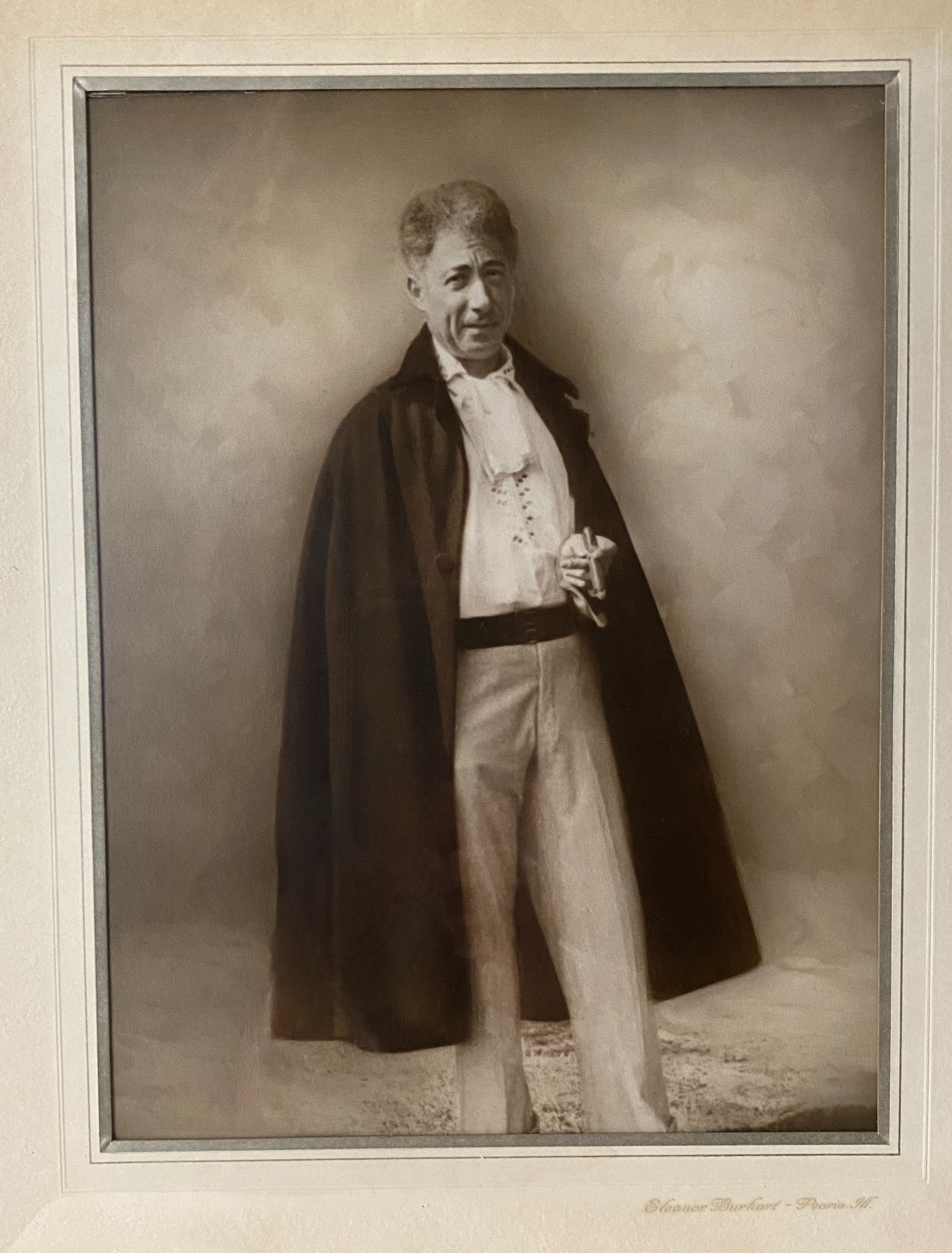
Max Edlin’s portrait of Moishe Nadir. Courtesy of Carole Glauber.
INTRODUCTION
"Even though we are not personally acquainted, in reality we are quite close friends because you hypnotized me during all those years that you, dear Nadir, wrote for the Morgn-frayhayt with your humorous-melancholy explanations of the world."
In my childhood home in Portland, Oregon, a black and white photograph of a smartly-dressed man wearing a cape and cravat hung on the wall of my mother’s office. She told me that it was a photo of Moishe Nadir, her zeyde Max Edlin’s favorite Yiddish writer, and that it once hung on the wall of her grandparents’ home in Peoria, Illinois. My great-grandfather, I learned as a child, was such an admirer of Nadir that he once wrote him a letter asking him for his portrait, a request to which Nadir graciously acquiesced.
While conducting research several months ago at the National Library of Israel, I came across a finding aid for the Moishe Nadir archive. Since Nadir resided in Woodstock, New York, at the time of his death in 1943, it had not previously occurred to me to look for Nadir’s papers in Jerusalem. (Nadir’s widow, Genia, subsequently married the legendary Yiddish bard Itzik Manger and the two immigrated to Israel in 1966. Following Manger’s death in 1969, Genia deposited both of her late husbands’ papers at the NLI.) Remembering the story I heard as a child about my great-grandfather’s letter to Moishe Nadir, I looked up “Edlin” in the list of Nadir's correspondents and was delighted to find a folder containing a single undated letter from “Meks Edlin” – the letter from my mother’s zeyde!
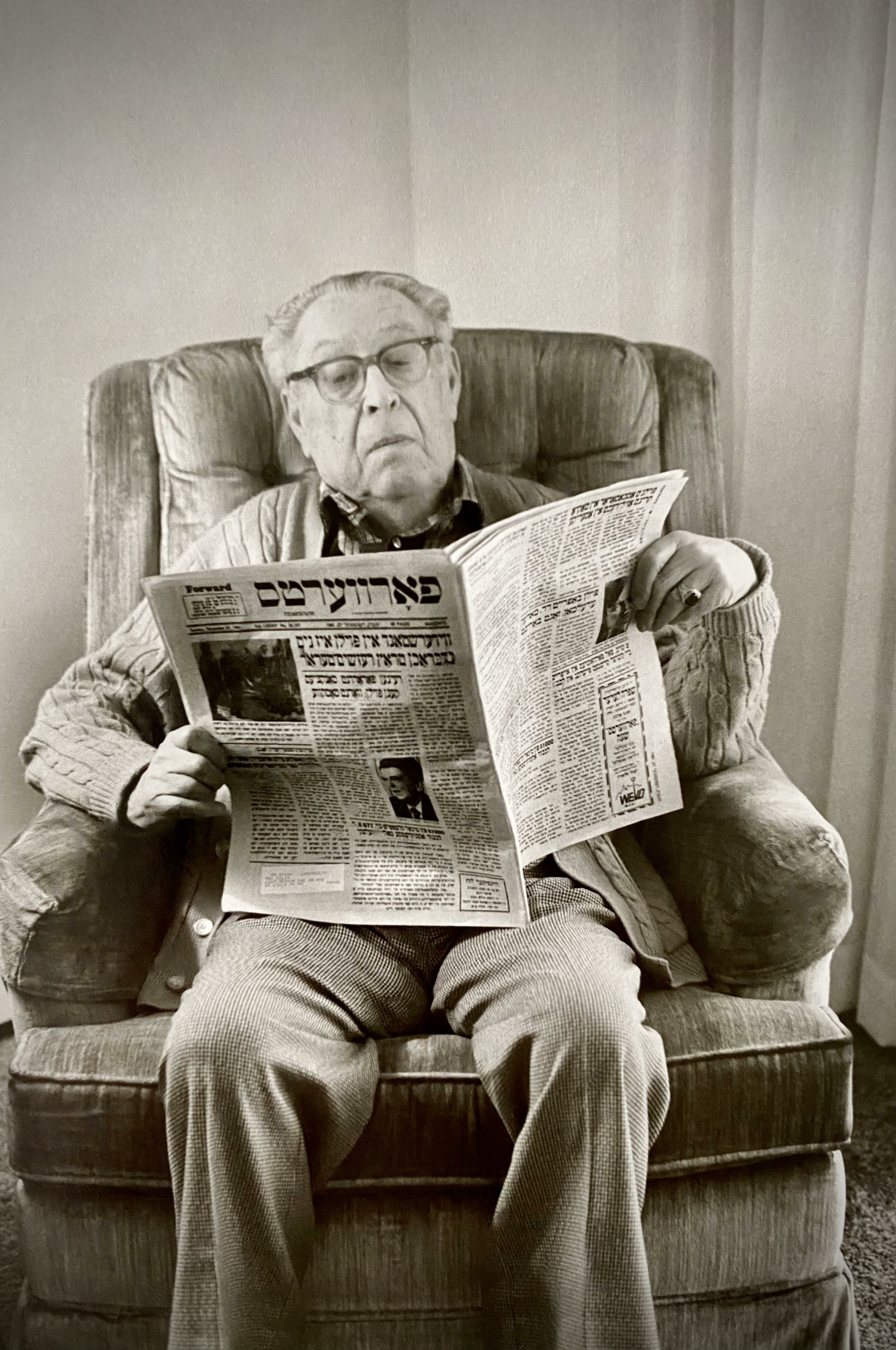
Max Edlin, late 1970s. Courtesy of Carole Glauber.
Holding my great-grandfather’s letter in my hands, I got to work on deciphering his handwriting. What I discovered with each sentence that I parsed were the personal struggles and ideological misgivings of a disillusioned Communist, dilemmas he shared with a man he had never met yet felt to be a close friend and fellow traveler. Max Edlin, I learned, was a devoted reader of Nadir’s column in the Morgn-frayhayt, the New York Yiddish daily staunchly aligned with the Soviet Union. Nadir had controversially remained with the paper following the 1929 Arab riots in Mandatory Palestine, even as many of his fellow writers broke with the Party—and the Frayhayt—over the former’s outright support for the Arab rioters. Nadir broke with the Party in late 1939 following news of the Molotov–Ribbentrop Pact, a process of return to the mainstream Jewish community he detailed in a two-part retrospective article, “Moyde-ani”—the title was later translated by Genia Nadir as “Confession”—published in the liberal Yiddish daily Der tog in April 1940. (This tumultuous period in Nadir’s career has recently been treated by Amelia Glaser in her monograph on Yiddish internationalist poetry.) 1 1 Amelia Glaser, Songs in Dark Times: Yiddish Poetry of Struggle from Scottsboro to Palestine (Cambridge: Harvard University Press, 2020), 211–41. Edlin confessed to Nadir that he had shared the same internationalist hopes for the Soviet Union, of solidarity between all peoples, hopes that disappeared with the realization that Jews across Europe were caught in a deadly vise with vanishingly few friends willing to help them.
Archival research frequently entails getting up to our elbows in old letters and documents. But rarely, as researchers, does the material we work with intersect with our own personal histories. Max Edlin’s ideological journey, my mother tells me, eventually led him to Zionism and, ultimately, a daily subscription to the Forverts. My archival encounter with my great-grandfather’s long-lost letter to Moishe Nadir takes me back to an earlier caesura in his life, when he gave up the Morgn-frayhayt for Der tog and the wounds from his disillusionment with the Communist Party were still raw. The portrait of Moishe Nadir still hangs to this day in my mother’s office (the letter, incidentally, does not include a request for a photograph), a material link to my great-grandfather and his “spiritual love” for the Yiddish writer whose humorous-melancholy writing he so admired.
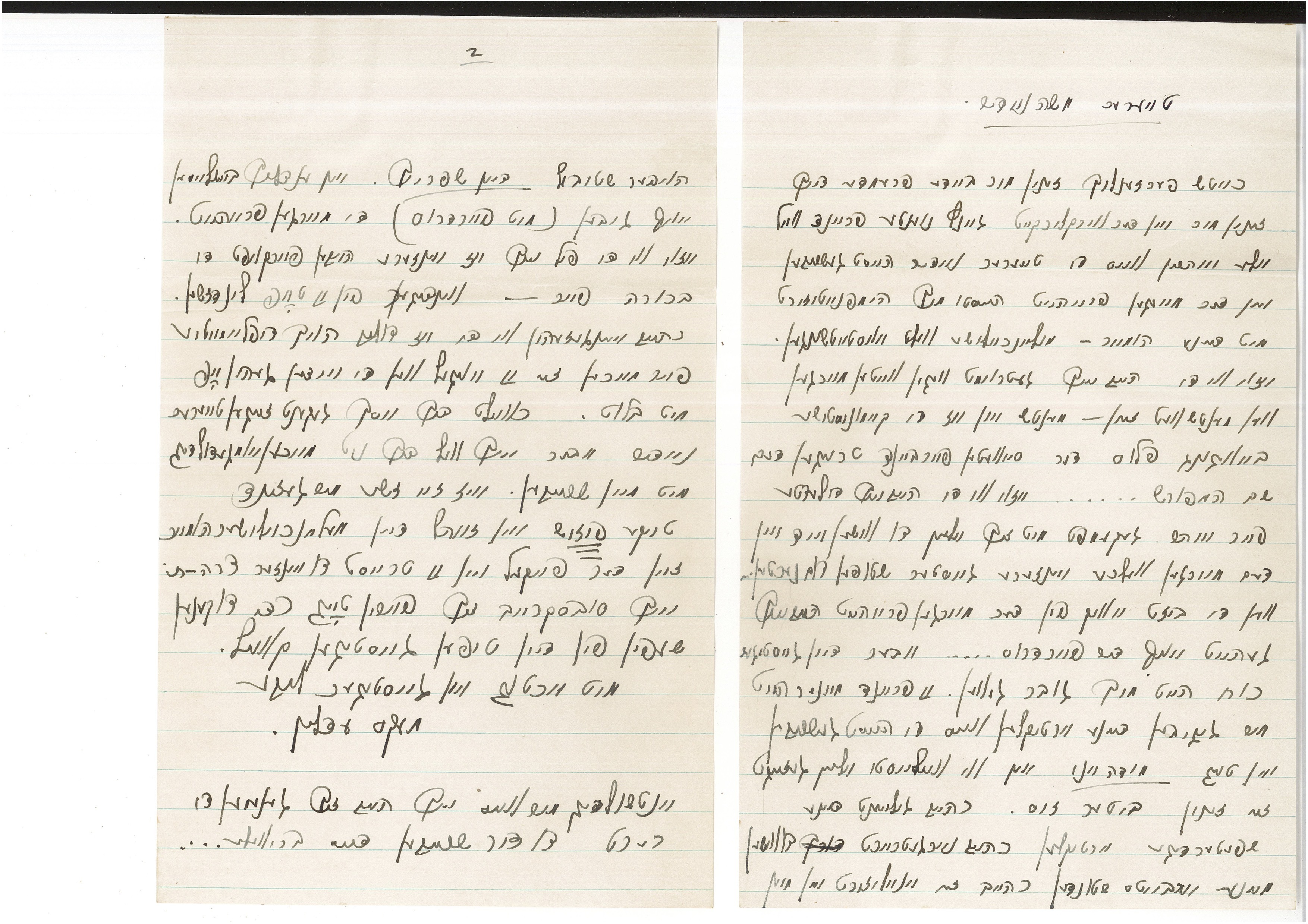
Letter from Max Edlin to Moishe Nadir. Moishe Nadir Archive, National Library of Israel, 4º 1523, Series 2, Folder 165.
Sandra Chiritescu’s English translation of the letter follows:
Dear Moyshe Nadir,
Even though we are not personally acquainted, in reality we are quite close friends because you hypnotized me during all those years that you, dear Nadir, wrote for the Morgn-frayhayt with your humorous-melancholy explanations of the world. Just like you, I dreamed of a distant future when people will be people and when the Communist movement and the Soviet Union will bear the ineffable name of God … just like you I have experienced an inner struggle these last few years between the Jew and the “tomorrow,” which our souls are pushing toward the “yesterday.” When you left the Morgn-frayhayt I was also upset, but your spiritual strength won me over. A friend of mine gave me the articles “Moyde-ani” that you wrote in the Tog. And as you yourself would say they are bitter-sweet. I read your subsequent articles, I thought about them during my work hours, I analyzed them in my mind, their language. And I decided to give up the Morgn-frayhayt (with resentment). Just like you, I feel that we sold our birthright for less than a pot of lentils. I understood just like you that due to higher diplomacy they were turning a blind eye to the bloody deaths of Jews. I could tell you a lot, my dear Nadir, but I do not want to make you impatient with my letter. So be well, especially physically, and your melancholy humor shall be a beacon and solace to our troubles. I am subscribing to the Tog in order to be able to draw from your deep spiritual well.
With regard and spiritual love
Max Edlin
Excuse me for taking the liberty of writing you this letter…