Mar 24, 2026
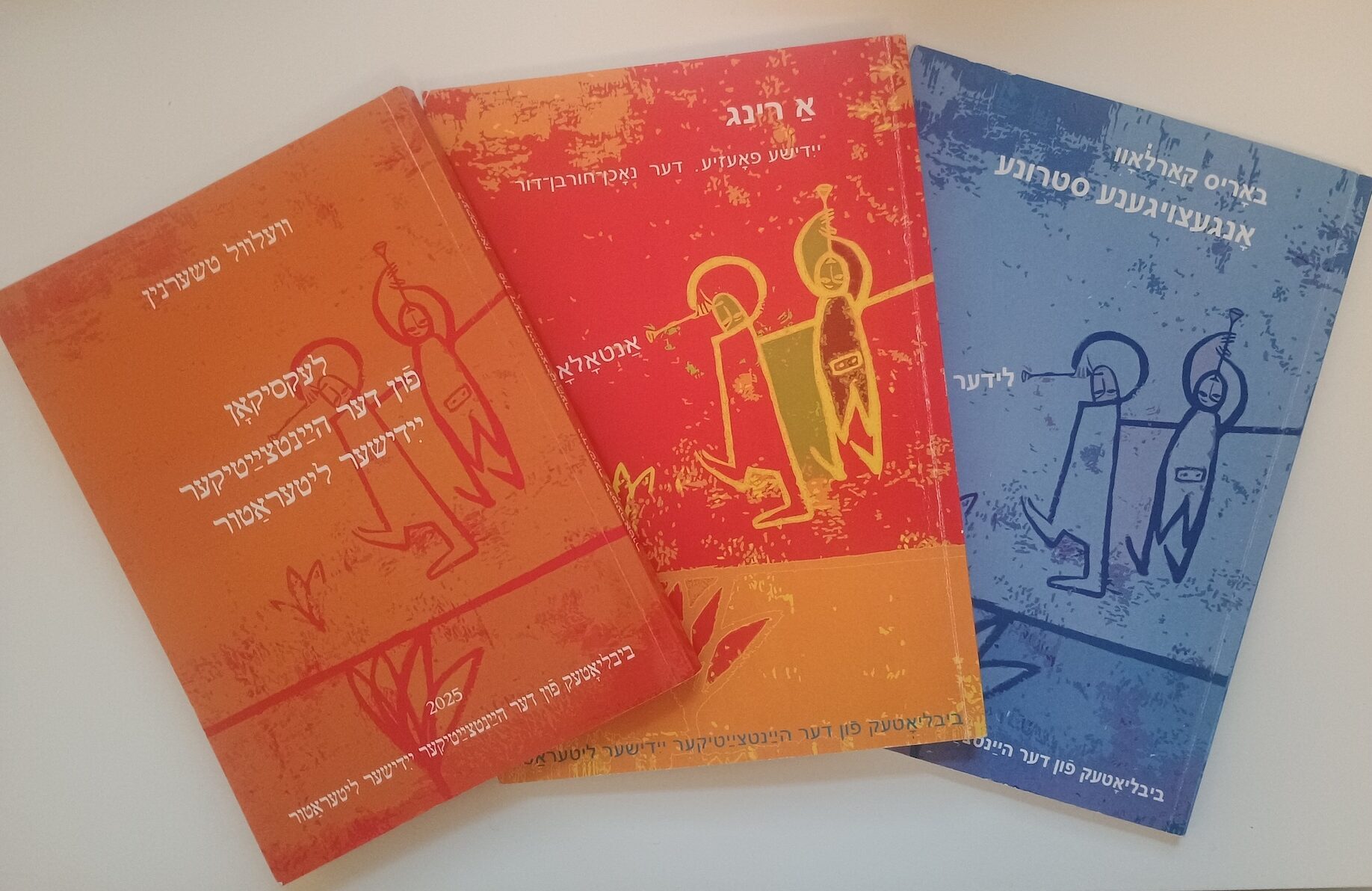
Books from the Bibliotek fun der haynttsaytiker yidisher literatur
INTRODUCTION
The year 2025 brought, alongside several new volumes of Yiddish poetry and prose, an especially important and much-needed publication about contemporary Yiddish literature: Leksikon fun der haynttsaytiker yidisher literatur (Lexicon of Contemporary Yiddish Literature). The book is part of the series Di bibliotek fun der haynttsaytiker yidisher literatur (The Library of Contemporary Yiddish Literature), published in Tel Aviv.
The lexicon includes 123 entries devoted to writers, poets, journalists, and scholars who have written—and continue to write—in Yiddish in the twenty-first century. The central bio-bibliographical section is followed by extensive indexes of digital and printed Yiddish journals and newspapers, anthologies of contemporary Yiddish literature, as well as reviews and critical articles devoted to it.
Almost all of the individuals included in the lexicon are still alive, many of them in their twenties or thirties. The volume also includes Yiddish poets and writers who have already passed away, among them Avrom Sutzkever, Yenta Mash, and Rivka Basman Ben-Hayim. What unites all these figures is the fact that they were writing in Yiddish in the twenty-first century and can therefore be considered part of contemporary Yiddish literature.
The compiler and editor of the volume is Velvl Chernin (b. 1958), a Yiddish prose writer, poet, and editor of the literary almanac Yidishland, who has been actively promoting contemporary Yiddish literature for decades. Born in Moscow, Chernin published his first Yiddish poems in Sovetish heymland in 1983. In 1990, he moved to Israel, where he later earned a PhD in Yiddish literature. Between 1997 and 2024, he published eleven volumes of poetry, as well as numerous essays and short stories in Yiddish. He has also served as editor and translator for anthologies of contemporary Yiddish literature published in Russian, Ukrainian, and Hebrew.
My first encounter with the lexicon project took place in 2023, when Velvl asked me to submit my own biography for inclusion in the lexicon. At the time, I was a beginning Yiddish poet who had published several poems in Yidishland, and the prospect of being included in such a volume was both surprising and deeply flattering. In some sense, it changed the way I saw myself within Yiddish poetry: what I had previously regarded as a personal or even marginal creative pursuit began to appear as part of a broader literary scene. The invitation to contribute my biography marked a shift—from seeing my writing as a hobby to recognizing it as meaningful participation in contemporary Yiddish literature.
Later, I helped Chernin to gather and verify information about other Yiddish poets from Berlin, members of our local poetry group: Jake Schneider, Yael Merlini, and Jordan Lee Schnee. It was a significant gesture of acknowledgment, situating our small local circle within the wider landscape of Yiddish literary culture. Berlin has emerged as one of the important centers of Yiddish creativity today, and the presence of four Berlin-based poets in the volume is another marker of this development.
Below is my conversation with Velvl Chernin about the origins of the project and the process of working on the lexicon. This conversation was conducted in English and edited for clarity and length.
Katerina Kuznetsova: How did the idea for this publication come about? How long did you work on the book, and what did the working process look like?
Velvl Chernin: Yiddish literature is alive. It is an important part of the literature of the Jewish people. This has been my principled position since my youth, and I have tried with all my might to preserve and develop it.
Until the end of the twentieth century, cultural and literary projects in Yiddish were, more or less, led by writers of previous generations—those born before the Holocaust. Their names appeared in earlier lexicons of Yiddish writers; the most recent of these was published in the United States in 1986 by Berl Kagan.
Since the beginning of the 2000s, for natural reasons, the time has come for those born after the Holocaust—for younger generations of Yiddish writers, among whom I also count myself. In the early 1990s, I was still able to publish my poems in Avrom Sutzkever’s famous journal Di goldene keyt, that ceased publication in 1995.
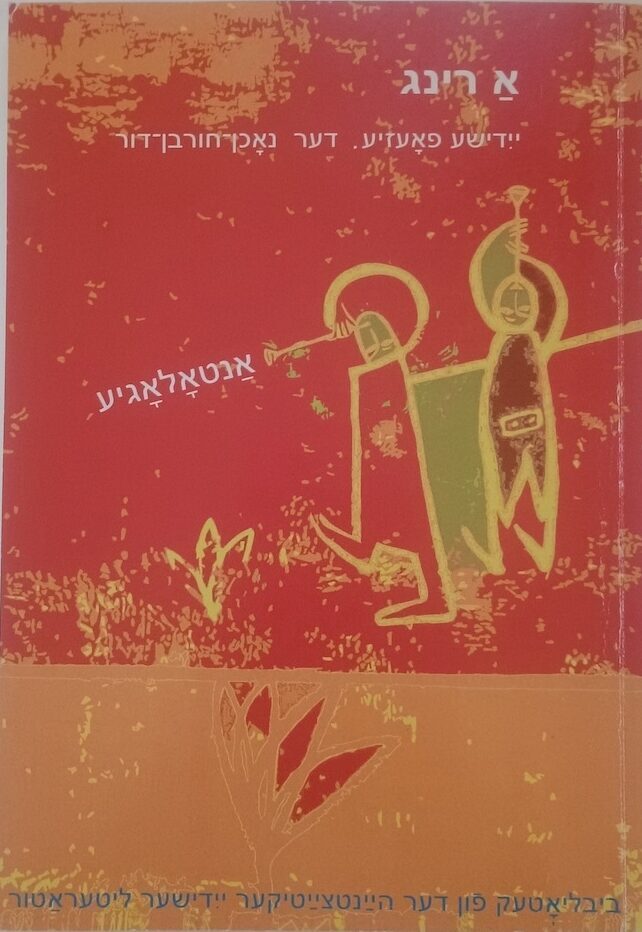
In 2015, together with my friend, Yiddish writer and poet Michael Felsenbaum, I founded the series Bibliotek fun der haynttsaytiker yidisher literatur (Library of Contemporary Yiddish Literature). In 2017, the series published A ring (A Circle), an anthology of Yiddish poets born after the Holocaust. In a way, it was a declaration of independence by the new generation. I had been preparing that anthology for several years, including a bio-bibliographical section about the poets. This work, in fact, preceded my work on the lexicon, which was published in the same series in 2025.
The real beginning of the lexicon project was in 2021, when Michael Felsenbaum and I began publishing a regular section in the journal Yidishland titled Materialn tsum leksikon fun der yidisher literatur inem 21tn yorhundert (Materials for the Lexicon of Yiddish Literature in the Twenty-First Century). Not everything that appeared in the journal was eventually included in the lexicon, but this section contributed greatly to its formation. The work on the book itself lasted a little more than six months.
KK: Within the series, two volumes of Leksikon fun der haynttsaytiker yidisher literatur in Erets-Yisroel (Lexicon of Contemporary Yiddish literature in Israel) were also published, in 2021 and 2023. Can you say a few words about this project?
VCh: This project was initiated by Michael Felsenbaum, and I worked on the lexicon together with him. It includes biographies and bibliographies of the poets and writers who wrote in Yiddish and who, at least for some period of time, lived and worked in Israel.
KK: How do you see the new lexicon in the context of the previously existing lexicons of Yiddish literature? You mention Zalman Reyzen’s lexicon (1914) in the very first sentence of the preface. Did you take any of the earlier lexicons as a model?
VCh: I see my lexicon as a continuation of the work begun by earlier lexicographers, although I consciously avoided taking any of the previous lexicons as a direct model. Now, however, in response to your question, I realize that I was probably influenced subconsciously by the column “Materials for the Lexicon of Soviet Yiddish Literature,” which was established and edited in the journal Sovetish Heymland by the late Khayim Beider.
What distinguishes my lexicon from earlier ones is, first of all, the range of names it includes. These are young Yiddish writers and poets whose work and biographies cannot be found in any of the earlier volumes. In addition, it contains extensive appendices with information on Yiddish magazines and newspapers (at least those published partially in Yiddish), anthologies of contemporary Yiddish literature in the original language and in translation, as well as a bibliography of articles and essays about contemporary Yiddish writers.
KK: Your lexicon includes not only writers and poets, but also Yiddish educators, journalists, folklorists, literary scholars, and musicians. What criteria did you use to decide whom to include?
VCh: The principle was simple: anyone who published texts in Yiddish. In other words, if a scholar had articles published in Yiddish, they were included in the lexicon. If someone wrote about the Yiddish language and literature only in other languages—English, Hebrew, Russian, and so on—they were not included.
In “Materials for the Lexicon of Yiddish Literature in the Twenty-First Century,” in Yidishland, there is no such restriction. There I published—and continue to publish—information about all scholars of Yiddish language and literature, regardless of the language in which they write. In addition, that section also includes information about translators from Yiddish into other languages.
KK: The publication clearly demonstrates that Yiddish literature is very much alive in the twenty-first century. There are many very young Yiddish poets and writers—the youngest of them born in 2002. How do you see the future of Yiddish literature? And how can we support those who would like to write in Yiddish?
VCh: I am quite optimistic about the future of Yiddish literature. Already in the early 1980s, when I was very young and published my first poems in Sovetish heymland, people were saying that Yiddish literature was disappearing. More than four decades have passed since then, and literature has not disappeared. New people have arrived—and continue to arrive—for a variety of reasons.
I believe it is essential that literary platforms in Yiddish exist, so that the goldene keyt—the golden chain—is not broken and young authors have a chance to enter the literary field. This was one of the reasons I, together with other writers, founded the journal Yidishland. Thank God, there are other platforms as well: a website Yiddish Branzhe, and, more recently Di Goldene Pawe (The Golden Peacock, a literary almanac in Yiddish and Dutch, published in Amsterdam since 2024). Literary works are also published in Afn Shvel (On the Threshold, a Yiddish magazine published by the League for Yiddish). Another very important enterprise contributing to the development of Yiddish literature is the publishing house Olniansky Tekst, which operates from Sweden but addresses a global readership.
I am always happy to support young authors. I have been especially impressed by the Yiddish literary environment that young writers have created in Germany in recent years.
I am convinced that there is still much to be done. In this sense, the very fact that the editors of In geveb have taken an interest in contemporary Yiddish literature—and not only in its rich past—is deeply encouraging.
*
Leksikon fun der haynttsaytiker yidisher literatur is more than a reference work—it is a living portrait of contemporary Yiddish literature. By documenting writers, poets, scholars, and cultural figures across generations and geographies, Velvl Chernin demonstrates that Yiddish is a vibrant literary language. The lexicon also highlights the infrastructures—journals, publishing houses, and literary networks—that sustain Yiddish creativity today, reminding us that the future of this literature depends not only on the writers themselves, but on the communities and platforms that nurture them. In this sense, the volume is both a scholarly resource and a celebration: of continuity, innovation, and the enduring vitality of Yiddish literature in the twenty-first century.