Jun 05, 2025
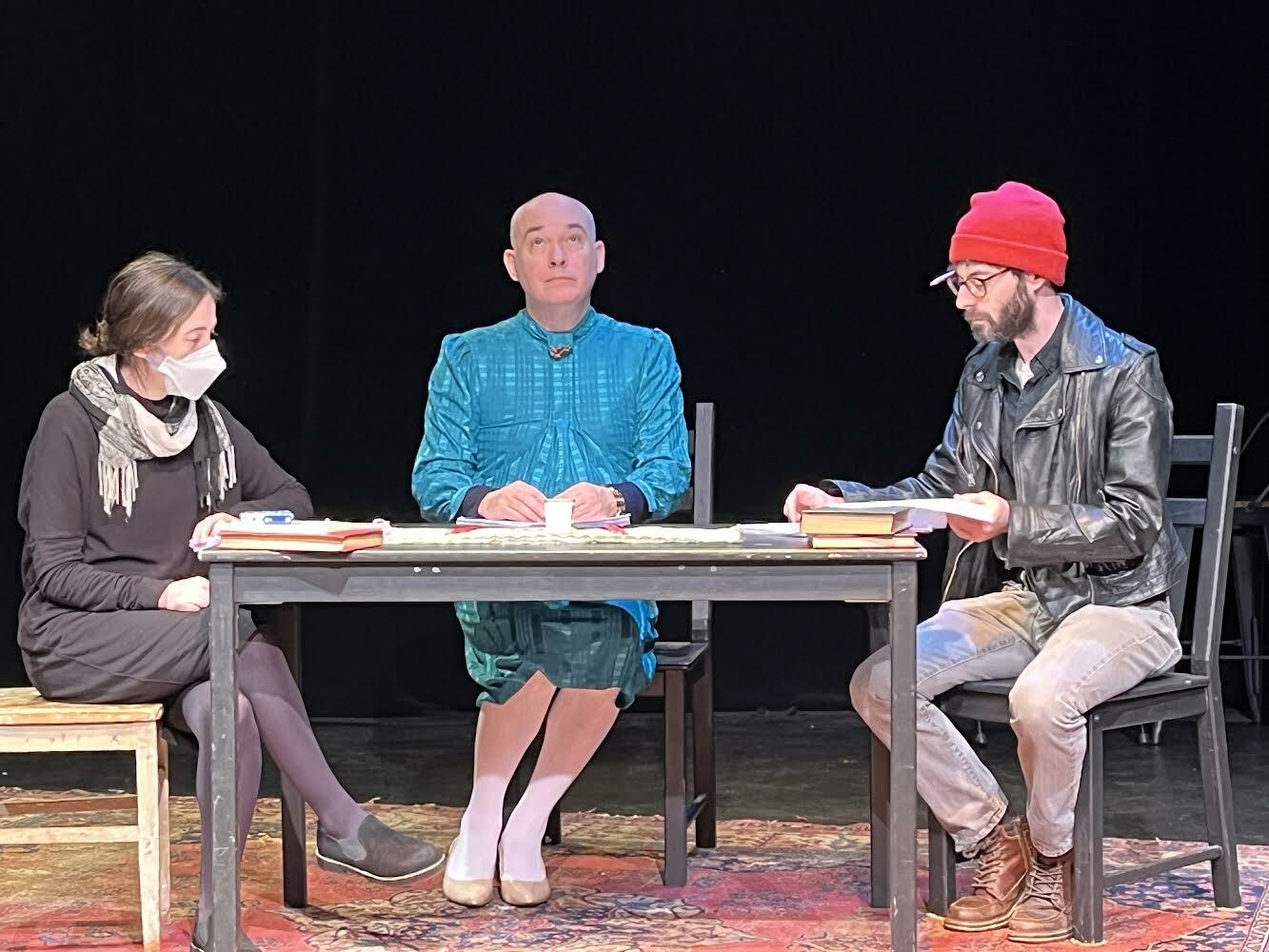
Rehearsal for Shtumer Shabes, December 2024. Left to right, Alona Bach, Shane Baker, Noah J. Mitchel.
INTRODUCTION
Rokhl Kafrissen is a journalist, cultural critic, and playwright whose work deals with Jewish and new Yiddish life. In 2019 she began writing Shtumer Shabes, a new play about the complications and contradictions in the last century of Yiddish theatre and Jewish life. Kafrissen’s play, incubated and developed by a LABA fellowship, the Chutzpah! Festival, and the Congress for Jewish Culture (CJC), has been seen in both online and live readings.
Shtumer Shabes (be forewarned, spoilers ahead) centers on Jess Berman, a grad student in New York City’s Lower East Side. Gareth Jones, a British gentile from her cohort in Yiddish studies, stumbles upon a box of books recently discarded by Sonja Szajnfeld, an erstwhile Yiddish theatre diva now in her nineties. After a local university offered to preserve and archive her books and papers, for which they would charge her an enormous sum, Sonja decided to trash her whole collection. Jess’s research suggests that Sonja acted in a 1938 production of the eponymous, provocative, feminist (and fictional) Shtumer Shabes—a play in which two murderous, lesbian widows sit down for a silent ritual meal with the ghosts of their husbands on the winter solstice—which had only one performance in Warsaw before a riot shut it down, à la The Rite of Spring. Jess, thrilled at the prospect of a firsthand account of a lost Yiddish play, is determined to get Sonja to sign her school’s institutional review board (IRB) form and to be her ethnographic informant for a major piece of research. In flashbacks, we see interstitial scenes from Shtumer Shabes starring a much younger Sonja and Max Vaynberg, a playwright and director of the theatre troupe to which she belonged. Sonja finally reveals to Jess that she, not Vaynberg, wrote Shtumer Shabes, but history credits him with it and it is too painful to revisit those memories and set the record straight. After the war, Vaynberg was exiled from the actors’ union for collaborating with the Nazis and trading goods with them to keep himself and Sonja alive. And Gareth confesses that one of his grandfathers in Germany joined the Nazi party to keep his job as a linguistics professor and researcher. Faced with a history of ethically complicated people, Jess reenacts the ritual shtumer Shabes with Gareth and Sonja, seeking to silently commune with the complicated, painful past.
In mid-February, about a month after a public reading of the play at CJC, Kafrissen sat down with Jonathan L. Green, a dramaturg and Director of New Play Development at Steppenwolf Theatre, at a café in Hell’s Kitchen for bagels and conversation. The following has been edited for length and clarity.
JONATHAN L. GREEN:
I'm sure a lot of people start conversations with you asking you to talk about your connections with Yiddish culture. But I'm more interested in how you came to the theatre.
ROKHL KAFRISSEN:
It was happenstance and sort of reflects the way that things can happen in this very small Yiddish world, that you can have opportunities that you most likely would not have in other kinds of spaces. There's a small Yiddish theatre scene here in New York, and in order to have that, you have to have simultaneous translation [in the form of] supertitles. You have to have a live operator, and it's an art and a science doing supertitle operating. So, I started doing that as a way to pick up a little bit of money. And you do enough performances of a show, even a non-theatre person such as myself, you start to get to know a show, you know the bones, you know it inside and out. And you start thinking about theatre in a different way when you really get inside of a production like that. I did a number of shows over the years, and I started thinking about Yiddish theatre today. There are a couple of categories of productions that are done: obviously, classics like Sholem Asch, and then there are [new works] —one of my first jobs out of college was at the Folksbiene just as Zalmen [Mlotek] and Eleanor [Reissa] were taking over as artistic directors. They had one of Eleanor's plays translated into Yiddish and performed. And I started to think, well, what if I wrote a play? I have no training, no background, not an actor.
[Laughs]
So, I started thinking about it, but it was quite a few years until I actually had an idea for a play, my first play, called A Brokhe/A Blessing. I never set out to write something completely in Yiddish because it didn't reflect who I am. I wanted it to be bilingual, which was a niche that that was not being filled. If people are speaking English some of the time and Yiddish some of the time, what setting should it be? I decided to set it in Brooklyn in 1950; many, many survivors who came to New York resettled in the Brownsville section of Brooklyn, or east New York, which also happened to be the historic home of the Jewish Mafia. So, I thought, oh, well, that's interesting. What if there were an encounter between the two… that sounds like to set up for a play! So, I did that, but that play is a shaggy one. I read one book about how to write a play. Well, it wasn't even a book about how to write a play. It was really a book about how to direct: it's David Ball’s Backwards and Forwards. And it's the kind of book you read and you're like, “Well, good. Now I know something. Right.”
JLG
It’s a very structured, non-emotional way to get into a text. I love a practice that forces you to deal with a text letter by letter, word by word… which is like supertitle operation! It is so technical. It forces you to think with a bit more of your left brain.
RK
I think I am, to a fault, right-brained. And I'm always trying to do things to force myself to be different.
JLG
As I was reading Shtumer Shabes, I was thinking that in a production of the play, you’d see an actor playing a character who is an actor who is suddenly playing a younger version of herself. There is an enforced way of reembodying or revivifying. And sure, I guess that is a part of any play about theatre people; but it lives in interesting context with America's relationship to Yiddish. So often the narrative is about trying to “save” the language or to rescue it from the past. So much of the work being done in translation right now is about finding pieces from the past and translating them into another language in order for them to live in a contemporary world. And so, I feel like that function in your story fits not only the characters but also our own relationship to the language and the culture. This ritual within the play within the play, the actual shtumer Shabes, is in a sense about possession. Maybe not as much as The Dybbuk, where a character is literally possessing someone else, but still, to live in not only emotional but also physical proximity to the past, to the ones who've come before… there are layers of meaning in that that I think sit really beautifully on stage and in your writing.
RK
At the very beginning of this project I knew that I wanted Shane Baker to play the role of Sonja. So much of where he is today is because of the deep, deep relationships he had with his mentors, these elderly Yiddish actresses and activists. I'm intrigued by the idea of representing that through this kind of possession. A few years before I started writing this, Shane developed a drag character called Mitzi Manna, which was a first step in developing a performance practice around his relationship with those women. Now, Mitzi Manna is quite different from his mentors, very, very different—
JLG
Well, a drag persona has to have an exclamation point, right? An exaggeration.
RK
It’s funny, the word “drag” actually became a little bit problematic, because I used it very loosely. When I was in the early stages of working with Lynn [Thomson, my dramaturg and director], our sessions were mostly about the text, but occasionally casting would come up, and she knew that I wanted Shane in the role. And she didn't quite see it at first, or she didn't understand what was behind that choice. And I realized that I had been using the word "drag” in a very casual way that, in fact, was not really appropriate. [Shane] was just to be an actor who was playing this role. He was not in drag. And I don't know if there's a word for that exactly.
JLG
Like there's an extra semi-transparent layer between the performer and the character, so it’s someone playing someone playing someone, right?
RK
Yeah. And I love that. I mean, I wanted Shane in that role because that role was him. There was an essence there of his relationship with these women, and only he could embody them. But also, I loved having him play the role because it makes it more transparent. Our understanding of ‘this is an actor on stage’ is heightened. And Shane is so good, he is such an incredible actor, I mean, he really is. And it's so funny because in real life, you know, we all know these women, they're about four feet tall and adorable and they come up to here. Shane is relatively tall and the young woman [Alona Bach] who he was acting with in the play is relatively short. So, you had a strange reversal where he was towering over her, which did shatter the illusion a bit. But his performance as a woman was not exaggerated, there was no drag element; it was very natural. And part of what I think the play is about is the transmission of culture from one generation to another—as a historical phenomenon, but also as a process. It's something that fascinates me because I didn't really grow up with grandparents. I grew up hearing a couple of Yiddish words here and there, but I didn't really grow up with that older generation in my life. And I didn’t have those kind of mentor relationships that, for example, Shane had. In the Yiddish world, those kinds of friendships or working relationships are incredibly important, because that's your yikhes. “Oh, I studied Yiddish with so-and-so who was born Lodz, and I learned this or that.” I didn't have those things. But also, I didn't have the skills. And in the play, you know, Gareth is able to connect with people so easily. And that's something I envied in Shane.
JLG
In your character descriptions, it says that Sonja could be played by a man [but not that she has to be]. Before I read your play, I googled it and saw images of Shane in a Zoom reading, and I read about your friendship with him. So, when I started reading it, I wondered if this casting note is a way to encourage us to think about gender and representation more generally, or if it’s about this very specific body of work that Shane has as Mitzi Manna. The play does certainly talk about gender in the Yiddish theatre, so it felt like there was the potential to make meaning there… but it also felt like that note could simply be for this specific actor and what his body of work represents. The opportunity to see the practice of intergenerational transmission of culture as we're watching a play about the intergenerational transmission of culture.
RK
I actually rewrote that note very late, after a lot of discussions. Previously it had said something that closed off possibilities, and I wanted to make it much more expansive. Yeah, this iteration is very much about what Shane brings to the role… I wrote it for him. But I don't want to foreclose other possibilities.
JLG
I want to talk a little bit about the IRB [institutional review board] forms.
RK
[Laughs]
JLG
Because as a person whose job deals with research and ethnographic information, but as someone who is not a scholar, I think about this a lot! It’s interesting to me that these forms are both a device in the play and also a sort of motif in the play. The characters don't really talk that much about the importance of these forms to them personally. They’re more of an institutional thing—
RK
It’s an obstacle, yeah.
JLG
In your own life and research, what's your proximity to the ethics of ethnographic research?
RK
The idea of having the form was inspired by a friend of mine who was very close with his grandmother. She and her sister, his great aunt, were from Lodz, they were Yiddish speakers, they were Auschwitz survivors, really incredible women. His great aunt was a very well-known Yiddish writer in Canada after the war. And at some point, I guess, a researcher was writing about his great aunt and was interviewing his grandmother, and he said they had to sign all these consent forms just to be interviewed, and I was like, “Hmm… tell me more.” And I began to think about the stakes of it, this activity that, in my world, in the Yiddish world, we don't talk about. We don't talk about the relationship between the subject and the collector. Or maybe people are talking about it and I'm not part of that conversation. But I started to think about what harm could come from that… what is the experience of the person being collected?
I was at a panel—this was right before the pandemic, I think—at Yiddish New York where they were talking about a Yiddish song-collecting project that the NEA had sponsored in the ‘70s. And someone on the panel was talking about this one woman who said she had all these songs, and when the collectors would come to her house, she would say, “Oh, no, you know what, you should come back on Monday.” It was kind of a manipulation; she really just wanted the attention, and it was this kind of psychodrama unfurling. And I thought that was interesting: these people aren't mannequins waiting for you to bring them to life by asking a question. These are real people with real stakes. Their stories and their songs, these things that make up who they are, are living parts of them. And when you're collecting that, that is a thing to consider.
So, what is my proximity to IRB? Nothing. I mean, I'm not a grad student, I've never been a grad student. I've never had to go through the process, and I also can't attest that the way it’s depicted in the play is 100 percent accurate, but it reflects a certain truth. As a modern person who tries to be sensitive to issues of power discrepancies, who exists in the Yiddish world, which is so much about those relationships and the act of collecting, I think it's something that should be talked about.
JLG
We see, in a couple of different ways, the characters in your play forced to deal with the assigning of value to things that exist within either Sonja’s memory or her apartment. We hear about the folks from the library at the university assigning value not only to her materials but also to the act of preserving them. And though the play does not suggest that Jess might become wealthy because of her research on Yiddish theatre…
RK
[Laughs]
JLG
…there is still a social and professional value for her. For Yiddishists and other folks who are dealing with languages and cultures that either are becoming obsolescent or are changing very, very rapidly to try to live in a contemporary context, the value we place on the past is something that rules the field. And if we don't talk about it, if we ignore the act of assigning value, I think we do ourselves a disservice, right?
RK
I agree. A very common experience a lot of Yiddishists have had is getting an email from somebody who… And this just happened to me maybe two or three months ago. I have a friend who is an academic, and he works in Jewish studies, but in the Czech language. He doesn't speak any Yiddish, so he hired me to translate for him, and he said, “Oh, there's an elderly gentleman in my neighborhood, and he's giving away his Yiddish books and I want to know if there's anything valuable. So, I said, “Take a picture and send it to me.” And it was, you know, the collected works of Sholem Aleichem—
JLG
And, I’m guessing, not a first edition?
RK
Maybe it's a first edition, it doesn't matter. Unless it was literally signed by him and there was a photo of him in it, this was worthless. And it feels crass or ugly to say, and I understand people wanting their collection to have some kind of value. And I get them wanting to be able to make some money off it rather than just tossing it in the garbage, of course. But it happens all the time, people want to know if there's value, and what is value? What happens with Sonja was inspired by real events. Oftentimes, if you donate [a collection], you do have to pay for it, because it costs a lot of money to process it. Archives and libraries do not have unlimited funds. So, you'll find that in the Yiddish world: somebody’s papers have ended up in some weird, random place and you're like, “Why is this in Wyoming?” Well, it's because they had money, they wanted it, and nobody else did. I have a subconscious—or maybe conscious—attraction to themes that are… I don't want to say taboo, that seems so melodramatic, but… uncomfortable places that we don't talk about. To me, that's what's crying out to be explored dramatically.
JLG
And that specific issue has to do with collection, possession, reinterpretation, so I think the theatre is a natural place to try to tell that story, to try to wrestle with it. I love that the play begins with the line “But who played the Nazis?” [Jess and Gareth are talking about a Tisha B’Av reenactment at Jess’s childhood Jewish summer camp.] In considering a story about—and a medium, theatre, that requires—a kind of possession or representation, right from the beginning you're asking us to think not only about who will be playing the protagonists—who will be playing us—in the future, but also why or how we invite our greatest tormentors into our own bodies. It’s such a rich topic for Jews, and for theatre, and for Jewish theatre. So, Jess’s snarky response, “There was a drama camp for Nazis down the road,” is a shot across the bow for theatre-makers in general, right?
RK
Can you unpack that? Say more.
JLG
I felt that you were asking us to investigate why we try to represent not only the bodies of our heroes, the people we’re supposed to pay attention to, but also the bodies of our enemies. Those who use power to inflict harm. In theatre right now, including theatre criticism, I feel like there is a disagreement: [in contemporary theatre,] should we represent our villains as fallible people, which gives them depth and forces us to see them as human and not monsters; or are our enemies monsters, which denies them humanity? There are compelling arguments for both sides. Some writers and directors and actors, at this point, are saying, “I actually don't want to be told to find the softness and humanity in someone who refuses to treat anyone as soft and human.” There are very progressive theatre-makers who are at that point now because they've been told over and over and over by cultural gatekeepers, “Let us see ourselves in this ‘bad guy’ so that we understand why they're doing bad.” In a way it centers the psychology of the oppressor, not the oppressed. And the other side of the argument, of course, is that we're all human, right? If we are not allowed to see ourselves as a part of a culture that commits the worst acts a human can do to another human, then we are othering ourselves from that culture. But, in truth, we're in it, we're a part of it, right? That’s a very long response to one jokey line in the play, I guess.
[Laughs]
RK
But that is something important to the play that I wanted to explore. The story of World War II and Nazis, for better or worse, is still so present and relevant to Jewish culture. And as an adult I now have German friends, and when you make jokes, when you do the ‘Angry German Nazi voice’ for example, they can get offended. German culture is a lot more than just Nazis. I don't necessarily need to see the humanity in a villain like Hitler, but it's interesting that the roots of Yiddish theatre are in the Purim spiel. Homen is a Hitler-like villain, so it tracks well. We have that tradition of playing our greatest villain. And understanding Homen’s humanity—that strikes one as so inane, right? That's not the point of the Purim spiel. But we're not living in medieval times, we're not living in a Purim shpiel. We're living today. The thrust of the play is me poking at American Jews, saying, “Be better, do better, learn something. Don't reduce everything to a joke.” There are people who have to live with the legacy of their Nazi grandparents. I'm sure there are plenty of Germans who don't give a shit about their Nazi grandparents, but there are also quite a few Germans and other folks who do struggle with those legacies and are doing amazing work. And listen, Germany is a very problematic place today for many reasons. But they have grappled with these things in really profound ways. And we would do well to look to them and learn from that.
JLG
I read in another interview that your idea of the ritual shtumer Shabes came from the tradition of a Celtic dumb supper, the idea that, on the longest night of the year, we are silent and present with the dead, that it's possible to live in a liminal space [between life and death]. Which made me think of The Dead Man, Der Toyter Mensch—a world that seems to be always in darkness, torpid, where the living and the dead not only are side by side, but may also be the same thing. I think about Sonja’s play, and when she would have been writing it, and the world in which she would have been writing it. It fits into an historical context where everyone was haunted by the past so much that it became a physical and metaphysical part of the present. In your play, Sonja is literally living in both the past and the present [as we see her onstage in her 30s and in her 90s]. Jess is living fully in the present, aware of time slipping away, trying to preserve an element of the past. Gareth is living in the present haunted by his past, trying to create a future that is better than the past that his grandfather poisoned. So, the idea that the play is both facing history and facing the future, and that all of these characters are forced to do the same, is theatrically interesting.
RK
I think that is part of the play’s meaning: incomplete mourning, being unable to fully talk about what was lost, means that you're perpetually haunted. Because the dead need to be recognized fully and our grief needs to be expressed in order for the dead to move on. In Sonja’s play, written in 1937, [the ritual shtumer Shabes] is not meant to be metaphor; it's meant to be literal. It's based on folklore. But you can then take these things and make them have more meaning, you can take them as metaphor, or you can take ritual and shape it for your own life. The tragedy of Sonia is that, because of who Vaynberg was and how difficult it is to talk about him, she is unable to mourn him properly. And thus, her own life has been kind of truncated. How tragic that is! She's punished herself for decades. And I think that's the lesson that Gareth also has to learn, the importance of being able to mourn, to have a ritual, to be able to speak a person’s name, or silently invite them into their life, to make a place for them. It’s a theme I think about a lot: what role the dead play in our lives; what we're supposed to do with that. I'm constantly confronted with the fact of how different they were, how different their values were. I always tell my students, “We have to meet them where they are.” You can't re-make them into social justice heroes; they're not. Or even if they were social justice heroes for their time, you're probably going to be disappointed how fucking sexist and…
JLG
A contemporary rubric doesn't really work.
RK
Yeah. Vaynberg is based on a real person who really did write these social issue plays and was a brilliant director and a leader of the actors’ union, for good; and yet, ultimately, he has this very difficult legacy because of his somewhat cloudy relationship with Nazi control. And this is my big picture feeling: that for American Jews there still hasn't been a proper mourning of the destruction of European Jewry. And as a result, we are all—American Jews and Israeli Jews, frankly—suffering from some kind of incomplete psychological grasp of the past, and we’re kind of messed up in the head about that. Because we cannot grapple with what was lost.
JLG
And if we can't grapple with it, then others can see that incompletion and manipulate us with it, right?
RK
That's sort of like five thought-steps past the play, but that's what lives in in my head. An incomplete mourning that I don't know if we'll ever move on from. I guess maybe that's why I'm so drawn to these kinds of rituals connecting with the dead and speaking to the dead and allowing them in. But, at the same time, the problem is American Jews only want to know about dead Jews. I mean, despite what Dara Horn says, Jews love dead Jews, too, they do. They don't want to know about how they lived. They don't want to know about complicated characters...
JLG
Right. And to be crass, the benefit of studying the dead is that you understand the totality of their lives. They’ve finished doing. And the complication of honoring the living, and I think this is a pretty contemporary fear, is… what if they do something wrong in the future, after I've honored them?
RK
I feel that all the time, which is why you have to always remind yourself that these are human beings. All human beings are flawed. I just read something by a Yiddish folklorist who went by the name Elzet—his name was Yehuda-Leyb Zlotnik. So, my last name, Kafrissen, means ‘Cyprus.’ Yayin Kafrissen, wine of Cyprus, was one of the elements of the incense that was burned in the temple, called the ketores. There’s a list of the ingredients [that make up ketores in the Torah], some of them are very expensive and smell good and some smell bad. I was online, reading one of these books by Elzet, looking for something. And I read this passage where he says that Rashi teaches us that the ketores reflects human nature because it's not all good. There is nothing that is not a mixture of good and bad. And I swear I wasn’t googling my name, but it said Kafrissen came to mean, in Yiddish, something that is excellent. Kafrissendik means something superior or excellent. But this other ingredient, galbanum, it smells like crap. And in Yiddish folk sayings it came to mean something that's bad. And the point is that even the incense that was commanded by God, burned in the Temple, in the Holy of Holies, is a mixture of good and bad. The stinky and the wonderful, and that's the way life is.
JLG
The most expensive perfumes are a mix of, like, beautiful scents and civet musk, right? A certain kind of cat’s—
RK
Ass glands! So, then I was googling galbanum because I didn't know much about it. And somebody on a Reddit forum said, “in this such-and-such perfume, the death note in it is galbanum.” And I was like, oh, yeah. Death note. I love that.

In geveb is turning t(s)en! If we want In geveb to continue to grow and thrive and remain a central address for the study of all things Yiddish online, we need your help to launch our second decade. Our goal is to raise $20,000 by our official tenth birthday: August 15, 2025. We invite you to donate to support In geveb and to honor everyone who has got us this far.