May 19, 2026
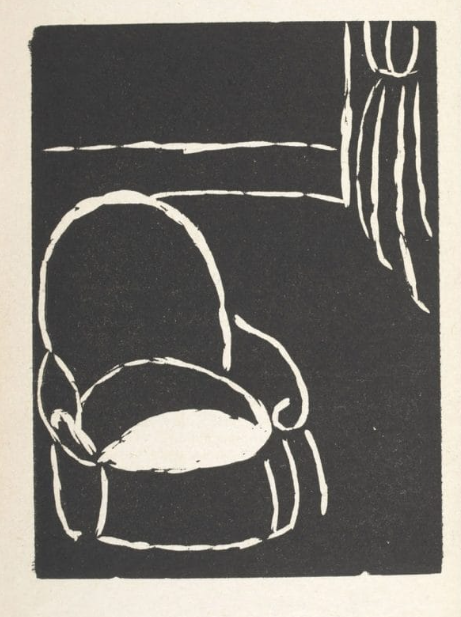
Vanessa Bell, woodcut for Virginia Woolf, Monday or Tuesday (Hogarth Press, 1921).
INTRODUCTION
This piece is part of a series of reflections celebrating the 10th anniversary of In geveb’s publication. Biz hundert un tsvantsik, In geveb!
When In geveb was founded ten years ago, I was living in Regensburg, Germany, and had just started to learn Yiddish in support of my PhD research focusing on Odesa in 1905. Two of the three classical Yiddish writers of the time lived and created in Odesa: Mendele Moykher-Sforim and Sholem Aleichem. I was surprised to discover that Yiddish was the second most commonly spoken language in the city, after Russian, the official language imposed by the Russian Empire, and followed by Ukrainian. The first intensive Yiddish class I participated in was at the Vilnius Yiddish Institute in 2015. The following year I went to New York to attend the YIVO Summer Program and in 2017 to Tel Aviv to attend the Naomi Prawer Kadar International Yiddish Summer program. My goal was to learn to read Yiddish so I could work with texts for my literary research. At that time I didn’t plan on teaching the language.
I first started to read In geveb because of friends and colleagues whose cultural and literary reviews had been published in the journal. The first blog piece I read was by Katerina Kuznetsova, whom I had met in 2017 as a fellow student at the International Yiddish Summer program. Now Katerina is a Yiddish poet living in Berlin, teaching Yiddish and organizing Yiddish cultural events there, and the mother of two; she’s come a long way.
In 2017, the Paris Yiddish Center—Medem Library, in cooperation with the Institute for East European Studies at the Free University of Berlin, initiated a Yiddish Summer school in Berlin for the first time. Katerina had a chance to participate. She wrote an article, “Yiddish in Berlin/Berlin in Yiddish,” about how Yiddish had returned to Berlin almost a century after the city had been a home for Yiddish intellectuals of the 1920s. In reading her blog piece, I learned about Berlin’s interwar Yiddish scene: Between 1922 and 1924, a Yiddish cultural magazine called Milgroym was published in Berlin. The magazine provided space for contemporary Yiddish poets like Dovid Bergelson, Dovid Hofshteyn, Leyb Kvitko, Der Nister, and others. Before moving to Berlin these writers had been members of the Kyïver Kultur Lige (Kyiv Culture League)-—a Yiddish cultural and social organization founded in the newly independent Ukrainian People’s Republic in 1918. In 1925, Kvitko and Der Nister returned to Ukraine and contributed to a newly created Yiddish literary journal, Die royte velt (The Red World), in Kharkiv. Kharkiv, like Kyiv, had been a vibrant center of Yiddish culture at the beginning of the twentieth century. Learning this about my native city increased my desire to learn more about the literary life of Kharkiv of that period and influenced the direction for my postdoctoral independent research: I began to study Kharkiv as a center for Ukrainian and Yiddish literature in the 1920s–1930s.
The second In geveb article that broadened my horizons about literary and cultural Yiddish life in Ukraine in the 1920s–1930s was a book review written by Anastasia Lyubas in 2018. I had met Anastasia two years earlier during the YIVO Summer Program. She subsequently edited and translated two collections of Deborah Vogel’s works—Білі слова. Есеї, листування, рецензії та полеміки (White Words: Essays, Letters, Reviews and Polemics), published in Ukrainian in Kyiv by Dukh i Litera in 2019 and Blooming Spaces: The Collected Poetry, Prose, Critical Writing and Letters, published in English by Academic Studies Press in 2020 as well as the mother of two (more on motherhood later—I promise it’s relevant). Anastasia’s 2018 review discussed Die Geometrie des Verzichts (The geometry of renunciation), the German collection of Vogel’s works translated and compiled by Anna Maja Misiak. Debora Vogel was a writer and an intellectual who lived and worked in Lviv, then in Poland, now Ukraine. Together with Rokhl Auerbach, she was a co-editor of the Tsushtayer (Contribution), a Galician Yiddish literary journal published from 1929 until 1933 in Lviv. In that journal, Vogel contributed an essay on Marc Chagall, who collaborated on illustrations for the publications of the Kyïver Kultur Lige—a fact I found particularly interesting because of my growing interest and research in Yiddish cultural networks in Ukraine.
Through a 2018 In geveb blog post by Yevgeniy Fiks, I encountered Kalman Zingman’s Yiddish-language utopian novella In der tsukunft-shtot edenia (In Edenia, a city of the future), published in Kharkiv, Ukraine, in 1918. Fiks’s post described how, in the summer of 2017, he and Larissa Babij had organized the exhibition Edenia: In the City of the Future in Kharkiv’s Yermilov Center. They had invited an international group of contemporary artists to contribute artworks that reconstructed novella’s imaginary space from different perspectives, which Fiks showed in his post. I was very excited to find the English-Yiddish bilingual edition of Edenia translated by Jordan Finkin in In geveb in 2017 and I used it later in my Leyenkrayz (reading circle) class on Utopia for Yiddishland California.
In 2018, my husband, our newborn daughter Lada, and I moved from Mülheim an der Ruhr in Germany to San Diego, California. I became an affiliate doctorate student of the Jewish Studies Program at the University of California San Diego. In 2019, I started to collaborate with the local non-profit Yiddish organization Yiddish Arts and Academics Association of North America (YAAANA) there. The pandemic brought changes and we launched our very first online courses in 2020. This was also the year I started to frequent online laboratories of feminine writing and I decided to write for In geveb. I submitted a pitch and then spent six months writing my very first blog post, “Diary of a Yiddish Teacher during the Pandemic.” This post was a cry from the heart after being isolated twice over: first, from my usual social life due to maternity and moving to another country; second, due to the pandemic like everyone else.
I was lucky to collaborate with editors Sandra Chiritescu and Jessica Kirzane, who were very patient and kind. I felt supported and understood as a woman and paid as an author. This was my very first paid article. In putting together this blog post, writing became my therapy and In geveb became my safe space, a room of my own, to do it. Perhaps writing for In geveb might at first blush seem to have little to do with Virginia Woolf’s A Room of One’s Own, but for me they were very connected. As Virginia Woolf argued in her essay, a woman must have money and a room of her own if she is to write fiction. I add, a woman must have money and a room of her own if she is to do research. The relationship between women and writing remains, even a century later, an unsolved problem. Today, in many parts of the world, women take part in all the activities and exertions that were once denied them. But getting paid and bearing children is still sometimes incompatible. There are nine months before the baby is born when not every woman can work. Then the baby is born. Then there are at least six months (according to World Health Organization recommendations) spent nursing the baby. Even after the baby is weaned, in the early childhood years, in many families a mother’s care is considered crucial to building secure attachment and reducing potential behavior issues. And if a woman has a second child, as I did, and follows the parenting norms I outlined above, she may not be able to return to full time employment for at least six years, and possibly even longer if health issues arise that may lengthen this period. In no way do I mean to criticize anyone who returns to work, placing their child in childcare or with other arrangements. These are hard and intensely personal choices. My point here is to indicate what being paid by In geveb as a writer did for me as someone who took a career break because of maternity. Even among working mothers, motherhood can slow down career progression—how much the more so with a career break—so being taken seriously mattered to me.
After moving from San Diego to Morbegno in Italy and bearing two children, I don’t have any academic affiliation but I still do my independent research about the cultural life of Kharkiv in the 1920s–1930s in Ukrainian and Yiddish literature and continue teaching Yiddish online. I can do my research and have different part-time jobs. I work as a pharmacy administrator and a yoga teacher during the day and as a Yiddish and Ukrainian teacher during the night (based on the Eastern Time of my students). Writing articles for In geveb is not a job for me, but I have written for the journal several times, each in diary fashion (like this very blog essay!) using it as a public forum to think through the relationship between my personal life and my teaching and research. In geveb has become my diary of a Yiddish teacher during challenging periods in my life. After my first piece about teaching during the pandemic, I followed up with two more pieces about being a Yiddishist from Ukraine during the full scale war in my home country. What did it mean, I asked, to continue academic activities, far away from my home city, while it was under daily missile attacks?
Throughout my years-long engagement with In geveb as a reader and a writer, I did not always have a room with a window looking across people’s hats and vans and motorcars to other windows, as Virginia Woolf describes in her essay. But I always had a table with a laptop on it. Sometimes it was in a hotel or a motel room. At first, it was enough to have an internet connection to read a new article or a translation on In geveb. Later, writing for In geveb became a lifesaver for me. It is my escape from washing up the dishes, putting the children to bed, and reading news from the frontline in Ukraine. Through the journal, I developed the courage to write exactly what I think.