Jun 02, 2026
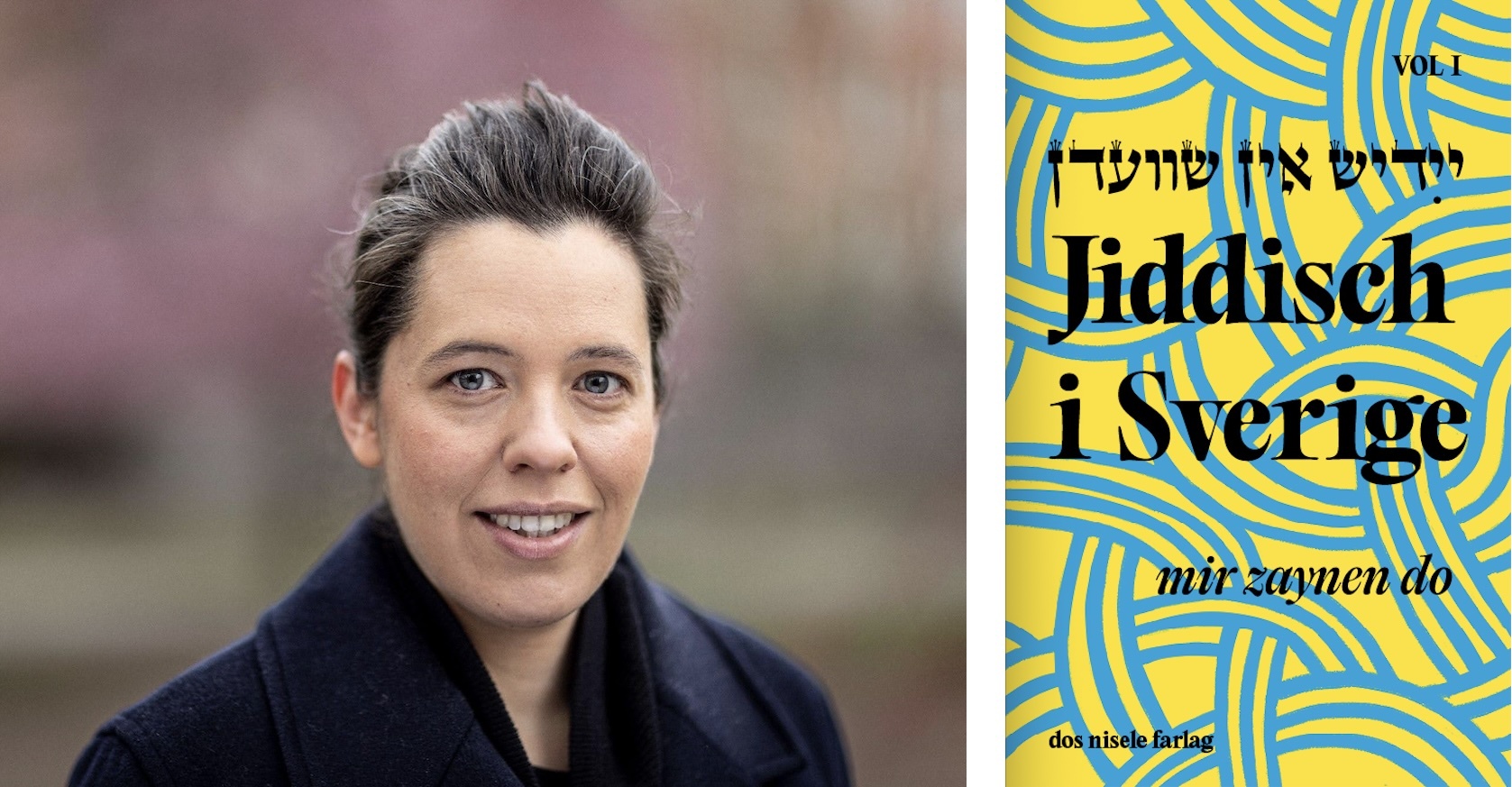
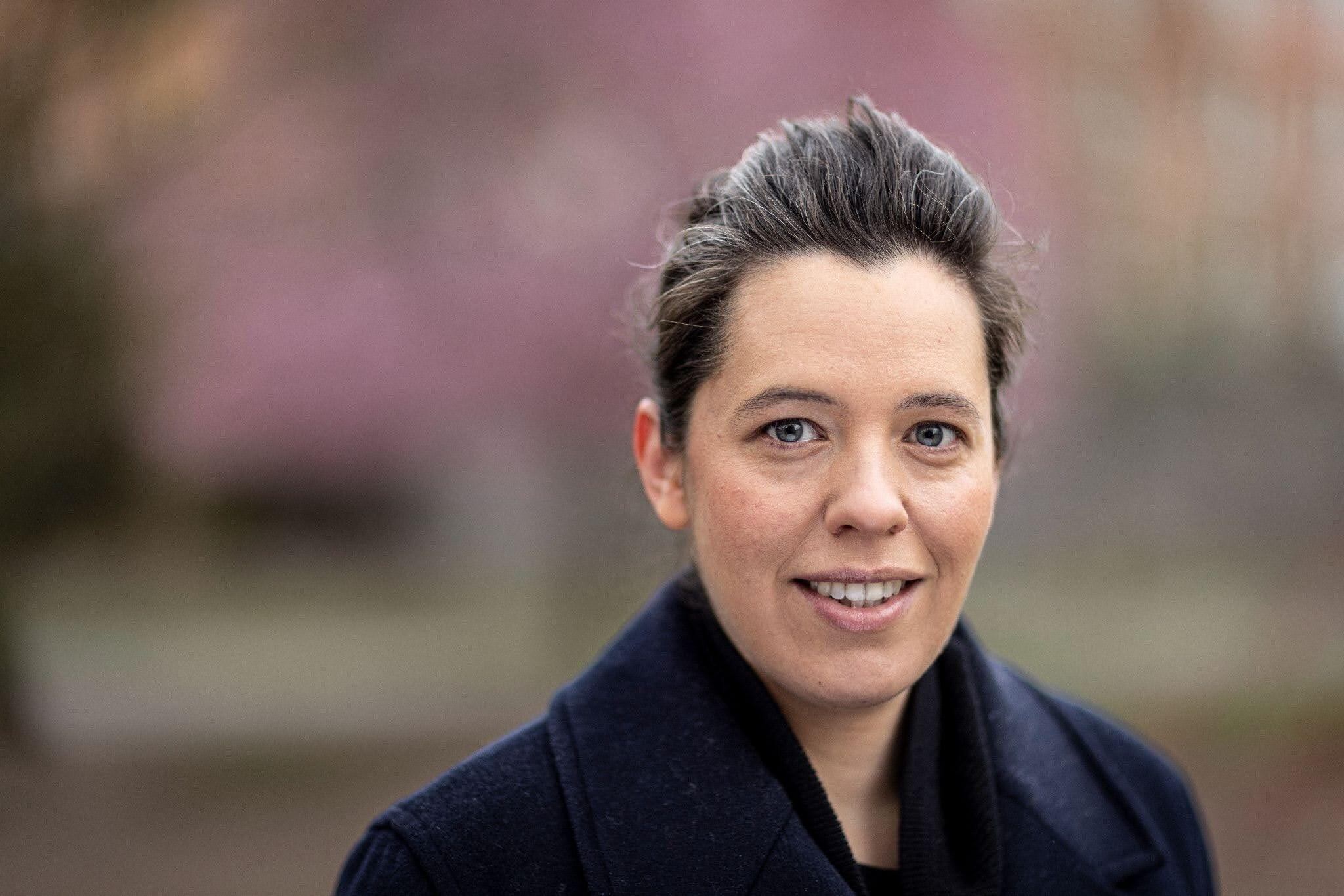
On left, Sarah Schulman, photo by André Prtic.
Jacqueline Nekhe Krass: First, could you tell me about the new book you’ve edited, Jiddisch i Sverige: mir zaynen do (Yiddish in Sweden: We Are Here), which was published last year by your press, Dos Nisele Farlag? How did this volume come to be, what are its orienting goals, and how was the process of putting it together? Who is this book for?
Sarah Schulman: A few years ago, another anthology appeared in Sweden bearing the bold and direct title Jude i Sverige (Jew in Sweden). Many of its essays touched on Yiddish in passing, but none of the contributors explored Yiddish as a concept or as an identity in any sustained way. I found myself wondering what an anthology that placed Yiddish stories at its very center might look like. I wanted to create a patchwork—to weave together many different voices so as to reveal both the breadth and depth of the Yiddish world in Sweden. It is no accident, after all, that Yiddish holds official status as a national minority language in this country.
I reached out to storytellers across Sweden I thought might have something to contribute: well-known and lesser-known writers, artists, musicians, actors, rabbis, scholars, and Yiddish speakers. I imagined I might receive perhaps twenty texts. Nearly sixty arrived. There was, it turned out, a profound and long-unmet need to tell these stories.
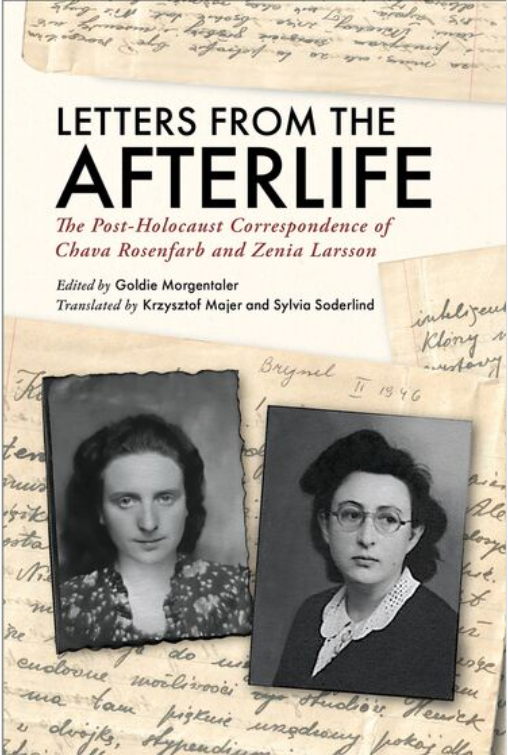
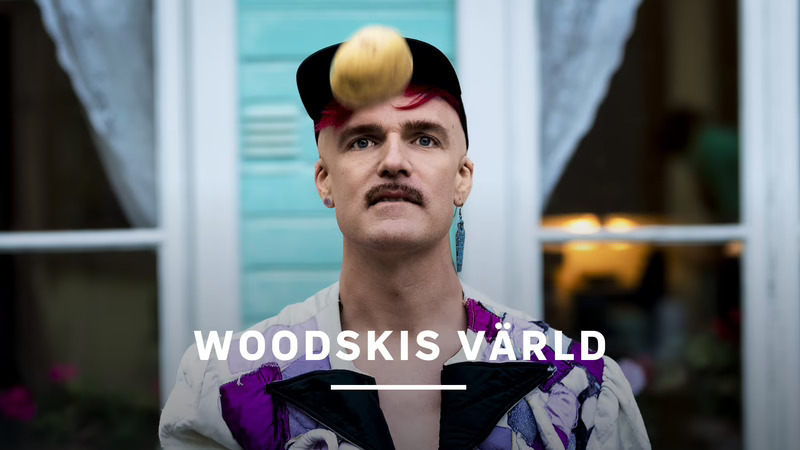
Jiddisch i Sverige: mir zaynen do is the first of two planned volumes. It contains twenty-five texts, one for each year that Yiddish has been a recognized national minority language in Sweden. Deeply personal narratives sit alongside academic essays on artists such as Zenia Larsson and Willy Gordon, the poet Irena Klepfisz, and the history of the socialist Bund in Sweden. The cover, designed by textile artist and Yiddish personality Tomas Woodski, combines the Swedish flag’s blue and yellow with a braided challah pattern, suggesting a deeply intertwined history.
The book speaks to several audiences at once. For many of the Yiddish speakers, the very act of writing—and the fact of the finished book—has become a significant part of the ongoing work of strengthening their own Yiddish identity. Many of those I approached were initially uncertain whether they had anything to contribute, but through our often lengthy conversations it became clear that the writing process had reconnected them to Yiddish in ways they had not anticipated. In the many author conversations we have organized since publication, I have been struck, as an editor, by how profoundly transformative this process has been for the writers themselves. The conversations about Yiddish that are happening now are altogether different from those I encountered when I first began gathering these stories two years ago.
The anthology also includes rigorous academic contributions, among them an essay by linguists Tommaso M. Milani of Penn State University and Kenneth Hyltenstam of Stockholm University, who reflect on Yiddish as a Swedish minority language and on the long struggle that speakers themselves have waged against the state in defense of their language rights.
The book has received a warm and enthusiastic reception in the Swedish press and has been celebrated in several of the country's largest newspapers. For most critics, these stories are entirely new—and so the book contributes to an important rewriting of the history of Yiddish in Sweden while at the same time cementing Yiddish's place as a living national minority language. My hope is also to see the book translated into English. I am convinced that these texts will find a wider international readership—and this very conversation in In geveb is, hopefully, proof of that.
JNK: What is your own relationship to Yiddish and Yiddish publishing?
SS: I grew up in a very vibrant Yiddish family in Sweden. My grandparents came from Poland, arriving in Sweden after the Holocaust on the White Boats. [Ed. note: this rescue operation by the Swedish Red Cross was also responsible for bringing Zenia Marcinkowska Larsson to Sweden.] Yiddish is my father's mame-loshn, and I grew up surrounded by Yiddish music, language, and literature. The stories of Itzik Manger and Isaac Bashevis Singer held an equal place in my literary imagination alongside those of Nordic writers like Tove Jansson and Astrid Lindgren. But when I enrolled in the Jewish school in Stockholm in 1990, I was disappointed to find that the vibrant Yiddish culture I had brought with me from home was given little space on the curriculum.
When I later interviewed Yiddish speakers in Stockholm who had attended the same school, I learned that the majority of children in the 1950s came from Yiddish-speaking homes—yet were discouraged from speaking Yiddish on school grounds. This reflects a complex chapter in the history of Jewish life in Europe, shaped by postwar pressures of assimilation and shifting cultural and political priorities, including the emergence of the State of Israel, the rising status of Hebrew, and the profound rupture caused by the destruction of much of the Yiddish-speaking world during the Holocaust—after which Yiddish often was associated with a past many sought to move beyond. To me, this also reflects a broader shift toward a homogenization of Jewish education, in which a longstanding tradition of multilingual learning, diasporic culture, and folklore was set aside.
When Yiddish was recognized as a national minority language in Sweden in the year 2000, new possibilities opened for us. Eva Mannelid, then chair of the Yiddish Society, was deeply committed to nurturing a new generation of Yiddish speakers, and she encouraged me to attend YIVO's summer program in New York. I felt immediately at home there—for the first time, my own Yiddish culture found a genuine echo. The courses of Jeffrey Shandler, Rivke Margolis, and Avrom Lichtenbaum were particularly formative for me.
Today my father, Abbe Schulman, chairs the Yiddish Society of Stockholm, Sweden's largest Yiddish organization, which has a remarkably impressive program of activities. He was the driving force behind bringing director Moshe Yassur's Yiddish-language production of Samuel Beckett's Waiting for Godot (as Vartn af Godot) to the Royal Dramatic Theater in Stockholm in 2021, in collaboration with the organization Jewish Culture in Sweden. He also writes a beautiful chapter in the anthology about his own Yiddish journey.
Our symbol for the Yiddish Club (Jiddischklubben). All kids get a membership card and lots of stickers when they join.
When I speak about Yiddish language revitalization in Sweden, I consistently highlight the critical role of strong, forward-thinking leadership and organizations like the Yiddish Society—whose ability to build meaningful, lasting relationships across both Jewish and non-Jewish institutions makes them a driving force in the field. State support matters, but the future of Yiddish rests where it always has: in the hands of Yiddishists and the grassroots communities themselves.
I think a great deal about how to build ecosystems, and I oversee the children's and youth programs run by the Yiddish Society. In 2025, together with the Yiddishist Katka Mazurczak, I founded the Yiddish Club, a Sunday club for the whole family, with a strong focus on literature, music, and Yiddish culture. All instruction takes place entirely in Yiddish. As a publisher of children's literature, the club is an ideal space in which to test and develop new material together with a creative and curious audience. You can follow us on Instagram: @Jiddischklubben. [Ed. note: You can find Katka’s 2026 Farbindungen presentation on the Yiddish Club here].
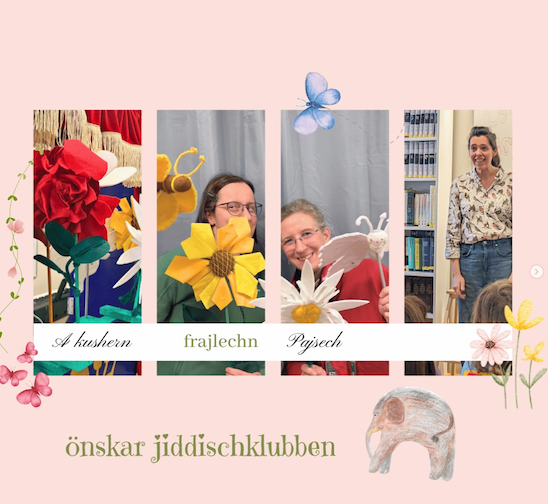
Pesach greeting from Jiddischklubben.
JNK: Can you tell me about Dos Nisele Farlag and its approach to contemporary Yiddish publishing? How did the press come to be, and why? What is its mission?
SS: In our anthology, Erik Joas writes about the publisher Mordechai Forlerer, who devoted the better part of his far-too-brief life to translating, disseminating, and publishing Scandinavian literature for Yiddish-speaking readers in interwar Europe. Also in the anthology, publisher Dorotea Bromberg recounts how she and her father, by securing the rights to Isaac Bashevis Singer's work, accomplished what very few publishers manage: bringing a Nobel laureate to press. To be a Yiddish publisher is to take one's place in a tradition that stretches back generations, a tradition of stubborn and passionate devotion to a literature and culture with deep European-Jewish roots. Today it is Dos Nisele Farlag and Olniansky Tekst in Lund—the latter famous in many parts of Yiddishland for publishing the first two books of Harry Potter in Yiddish—that carry the banner in Sweden, though many other Swedish publishers also bring out books about Yiddish culture, including a significant body of translated poetry.
For us at Dos Nisele Farlag, it really began when I went looking for children's books in Yiddish for my nieces, and finding none that felt sufficiently contemporary, I wrote Nöten / Dos Nisele (The Little Nut) (2015), together with the illustrator Karl Kjäll. It was a pioneering work—the first book to be printed in both Yiddish and Swedish in modern times. I received moving letters from readers across Sweden describing how the book had reintroduced Yiddish words and expressions into their daily lives.
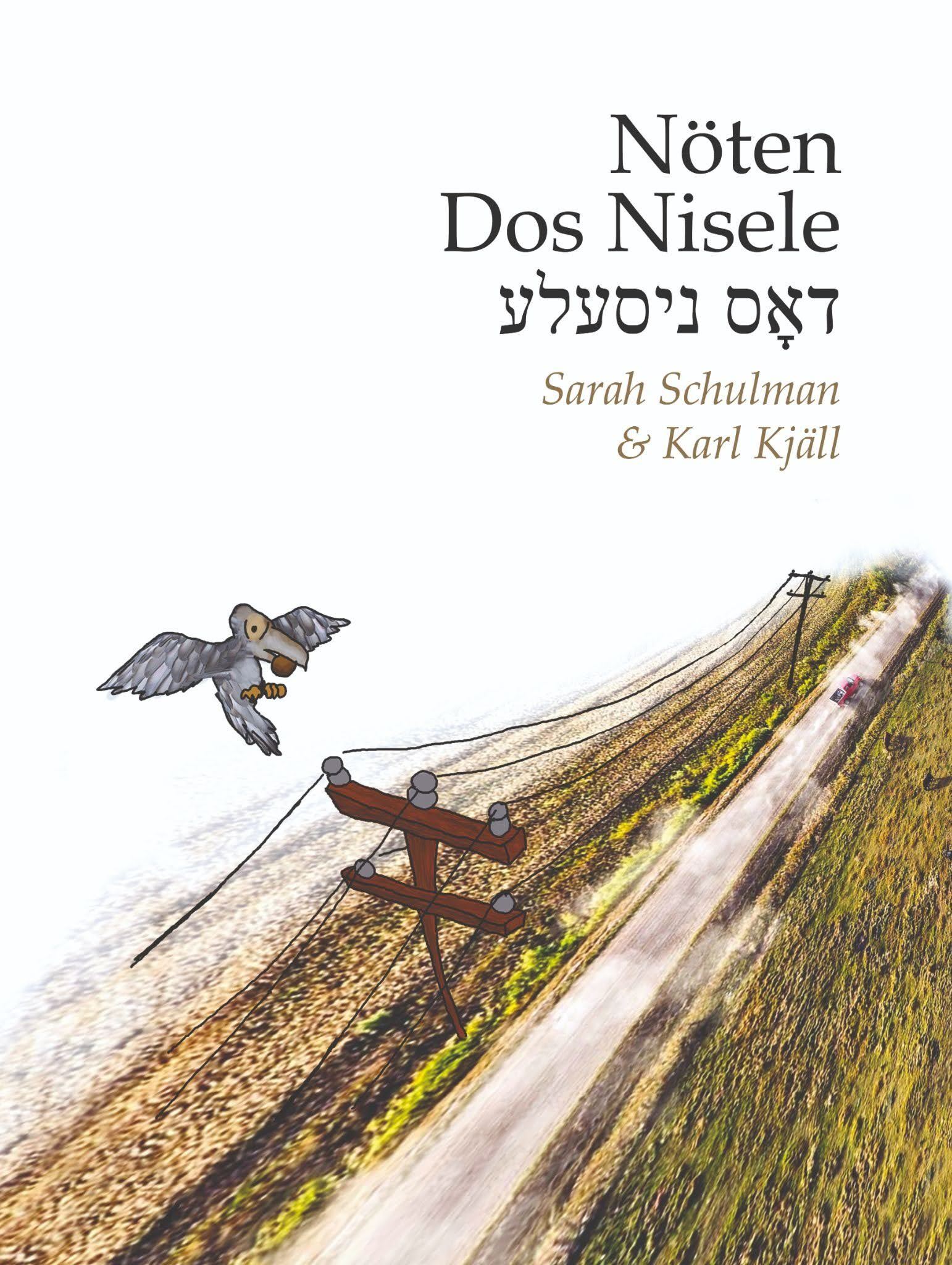
Nöten / Dos Nisele (The Little Nut) (2015)
When our publisher at the time declined to print further books, despite a strong demand, I decided to start my own press. Farvus nisht? My head was full of ideas and projects I wanted to bring to life.
Shortly afterward I was contacted by Georg Riedel, one of Sweden's most celebrated composers and jazz musicians, the man behind generations of beloved Swedish children's songs. Riedel, himself a Jewish refugee who had fled Nazi persecution in Czechoslovakia as a child and subsequently made his way to Sweden, had come across our book Dos Nisele. “"I have never composed for Yiddish before,” he wrote, “but I would very much like to.”
I had grown up with Riedel's music and loved jazz deeply. I saw an enormous creative potential in building a bridge between the most quintessentially Swedish thing imaginable—Riedel's songs—and the Yiddish world. I immediately connected Riedel with Salomon Schulman (no relation), a wonderful Yiddish poet from southern Sweden. Riedel brought in his own daughter, Channa Riedel, herself a poet, and together they began composing a corpus of entirely new Yiddish songs that became Georg Riedels Jiddischland (see here for an article about a live performance of the songs). Riedel called the project a “musical circus.” The Yiddish musician Sofia Berg-Böhm also joined the project, and recorded several of Riedel’s classic and new songs, accompanied by Sweden’s leading jazz musicians. The result was a magnificent songbook with illustrations by the artist Hannah Arnesen, two music albums, a theatrical production for children, and several films. The book won the Silver Medal of the Swedish Publishing Prize, and the music was nominated for Album of the Year at the Manifest Awards.
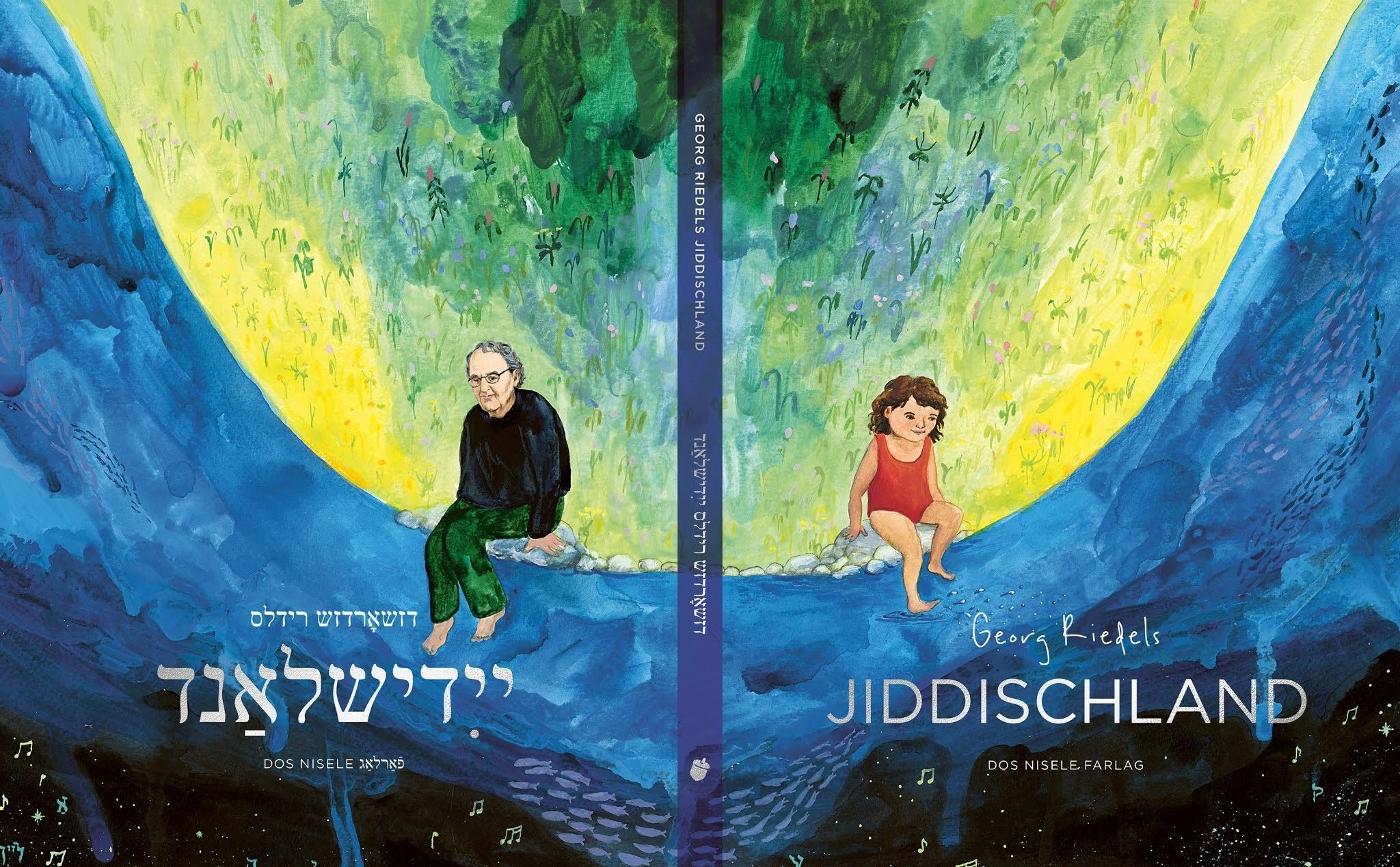
You can listen to the music here: Georg Riedels Yiddishland / Jiddischland, Vol. 1—Klasishe lider / Classic songs / Klassiska Visor; Vol. II—Naye lider / New Songs / Nya Visor.
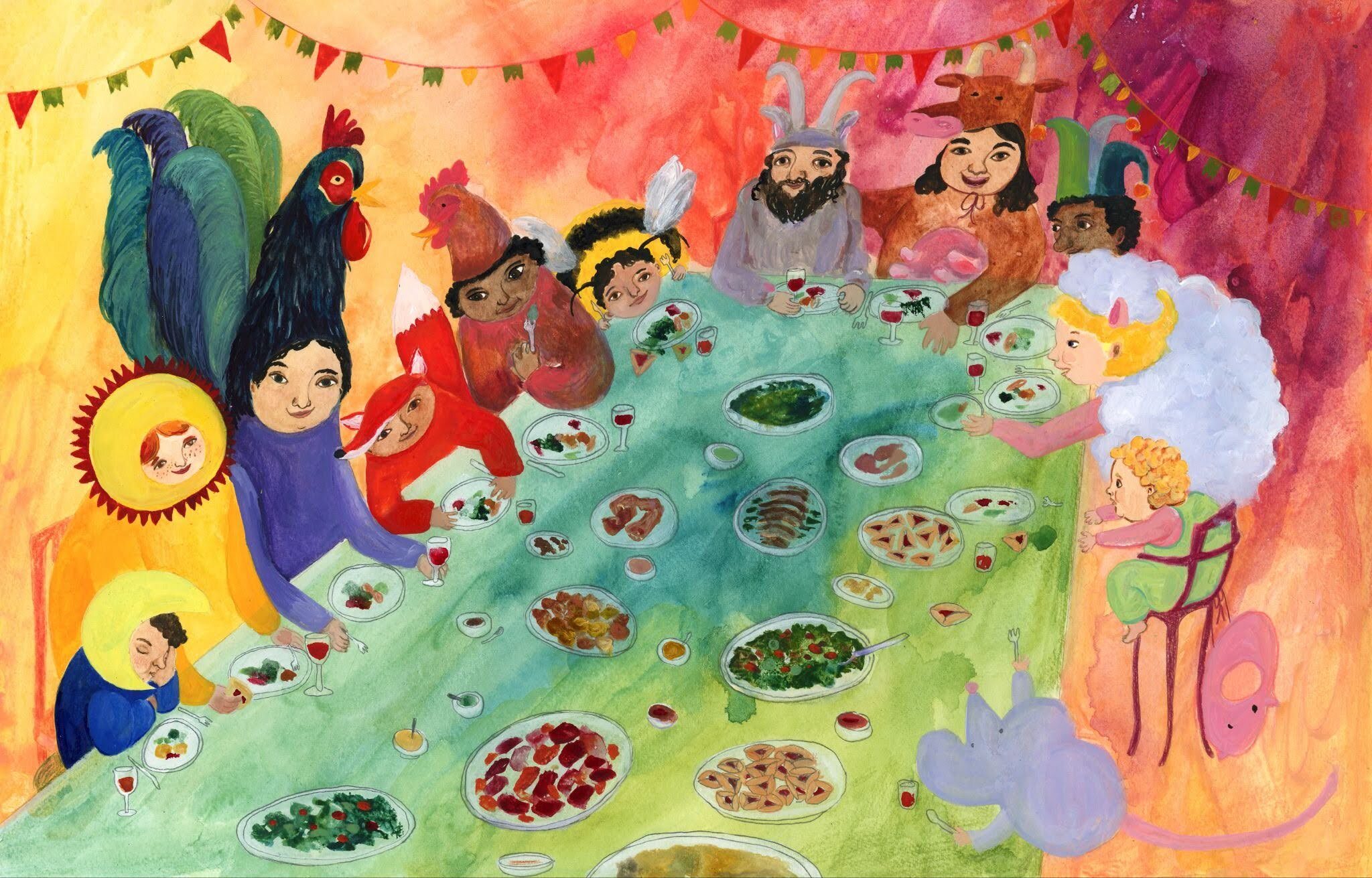
An illustration by Hannah Arnesen from Georg Riedels Jiddischland.
Since then we have continued along the path of multimodal cultural production. Last year we translated the popular book Five Little Gefiltes by the New York-based illustrator Dave Horowitz into Swedish (as Fem små gefiltes). The book has now been nominated for the Peter Pan Prize, one of Sweden's major children's book awards. We also decided to animate it, and in March we premiered the film Gefiltlekh finf. This year we are publishing several wonderful new children's books, including a brand-new title with the celebrated illustrator Joanna Rubin Dranger.
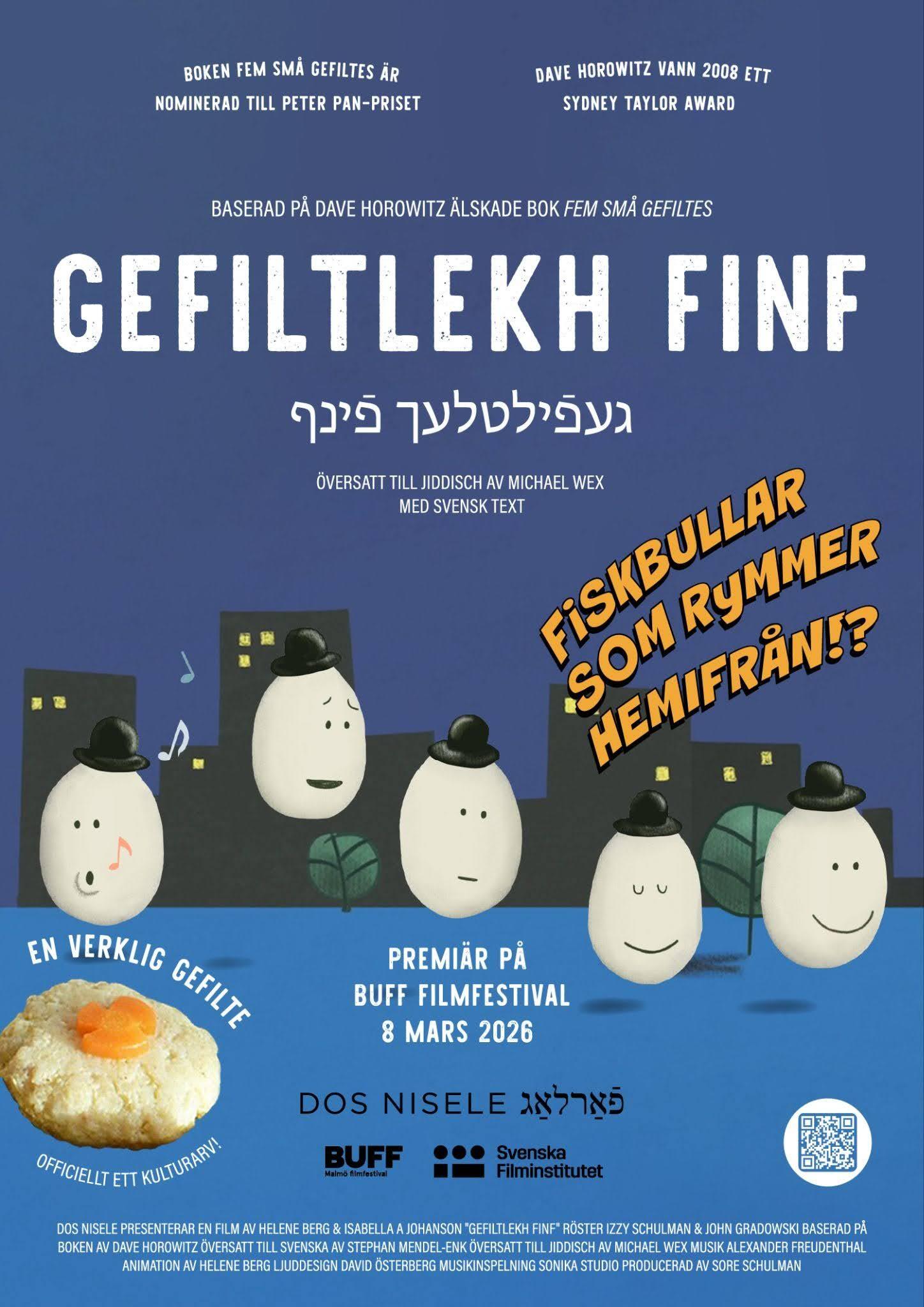
Movie poster: Gefiltlekh finf, premier at BUFF Film Festival in Malmö, Sweden, March 8, 2026.
I believe our strength as a press lies in how we perceive the potential in the fusion created between Yiddish, Jewish culture, and the majority culture. That fusion creates broad public interest for our work while simultaneously drawing a new generation of Yiddish speakers into the Yiddish world. We are always open to new ideas and collaborations.
The anthology Jiddisch i Sverige is our first major foray into publishing for adult readers, and both the interest it has generated and the reviews have exceeded our expectations. It is the most important project I and the press have undertaken. One of the texts, “Havet är fullt av jiddisch” (The Sea is Full of Yiddish) by Ronn Elfors Lipsker, is to be staged as a theatrical piece at the Jewish Museum in Stockholm this autumn. I believe the book will go on living in many different forms and constellations. There is so much material contained between the pages. I think we have only just begun to unravel the Yiddish world in Sweden.
JNK: In the last several years, it seems to me, there’s been increasing awareness (at least among my own circles of primarily American Yiddishists!) of the exciting work being done with Yiddish in Sweden. For many people, however, it may still come as a shock to hear that Yiddish exists in Sweden at all. What should Yiddishists (and anyone with an interest in Yiddish!) outside of Sweden know about the Swedish Yiddish scene? Are there misconceptions you often encounter? Are there special advantages or possibilities you see inherent in this svive, these circles?
SS: The history of Yiddish in Sweden is a remarkable and, in many respects, still untold one. Sweden and Albania are the only countries in Europe with a Jewish population that actually grew after the Second World War. In the years immediately following the Holocaust, a significant portion of the Yiddish literary world's most distinguished survivors gathered in Stockholm. Rachel Korn, Rachmil Bryks, and Rokhl Auerbakh all spent time in the city and published work during their time here—as the researcher Simo Muir documents in our anthology. The poet Irena Klepfisz spent several years in Sweden as a child before migrating to the United States, and her experiences in Sweden, as scholar Ulla Chowaniec writes in her chapter in the anthology, were formative; Klepfisz even referred to Sweden as “Eden.” 1 1 Ulla Chowaniec, “Zenia Larsson och Irena Klepfisz i ett Sverige som ‘Eden,’” in vol. 1, Jiddisch i Sverige: mir zaynen do (Dos Nisele Farlag, 2025), 141.
Several Yiddish newspapers were printed in Stockholm. The greatest actors of the global Yiddish theater visited Sweden continuously over the course of several decades. The children of Holocaust survivors grew up in a comparatively rich Yiddish environment. The YIVO archives hold an extraordinarily large collection of materials from Sweden—it is, in fact, rather puzzling that more scholars have not turned their attention here.
When Yiddish was eventually recognized as a national minority language in the year 2000—after an intense campaign led by the Yiddishist and linguist Susanne Sznajderman-Rytz—it gave rise to a number of important initiatives, not least the annual Yiddish seminar that has brought leading Yiddishists from around the world to Sweden for more than twenty years.
The Yiddish Theater of Stockholm (Stockholms Jiddische Teateramatoren) continues to produce new plays and stagings—most recently Dario Fo's Me batsolt nisht, an adaptation into Yiddish of the original Italian, Non si paga! Non si paga! The Yiddish theater in Sweden has a long and distinguished history. Founded in the early twentieth century, it was the first theater in Sweden to stage Anton Chekhov.
We are well connected with Yiddishists around the world—Eliezer Niborski heads the Yiddish faculty at Lund University—and yet one question remains: why have we not become a natural node for Yiddishists globally? This absence became particularly visible at the inauguration of Yiddish: A Global Culture at the Yiddish Book Center, where Sweden was not represented. Only after a dialogue with the curatorial team was a brief mention of Swedish Yiddish included in the exhibition and its accompanying catalog.
Sweden is home to leading Yiddish publishers. Here one can watch the world's only Yiddish-language television talk show and listen to Yiddish radio programs; here students have the legal right to receive Yiddish classes wherever they attend schools. In a sense, that is our strongest message—the one carried in the very title of the book: Yiddish in Sweden: mir zaynen do. We are here.
You can learn more about Dos Nisele Farlag at: