Apr 07, 2026
Sven-Erik Rose, Making and Unmaking Literature in the Warsaw, Lodz, and Vilna Ghettos. Brandeis University Press, 2025. 344 pp. $40.00 [paperback].
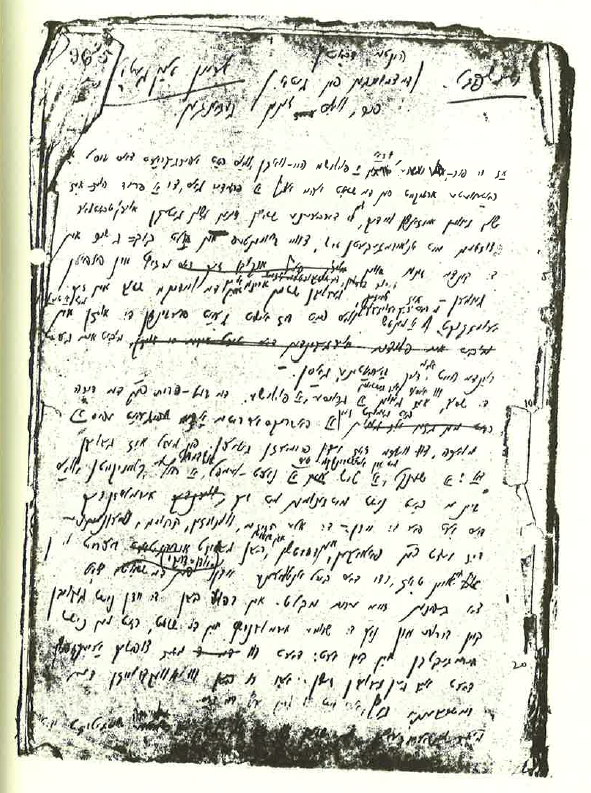
Among the texts that fit under the category of “Holocaust literature,” those composed by Jews while they were interned in the Nazi ghettos hold a special claim on our attention. These texts, most of them written in Yiddish, capture in real time the experiences and imaginative lives of Jews caught up in the Nazi machinery of death. Łódź Ghetto survivor Isaiah (Shaye) Shpigl later underscored the deprivations of this period, saying “[t]he writers in the Łódź Ghetto had short pencils, little time, and hardly any paper—and they were hungry.” 1 1 Szeintuch, Yechiel, and Vera Solomon, eds. Yesha’yahu Shpigel--prozah sipurit mi-geto Lodz’: Shishah-‘asar sipurim mefu’nahim ‘al pi kitve-yad she-nitslu be-tseruf mavo ve-re’ayon ‘im ha-mehaber. [Isaiah Spiegel: Yiddish narrative prose from the Lodz ghetto; 16 stories edited from rescued manuscripts with introductions and a series of oral interviews with their author]. (Jerusalem: Magnes Press, Hebrew University, 1995), 339. Against all odds, significant works of reportage, fiction, poetry, memoir, chronicle, and essayistic reflection have survived from the ghetto period, thanks in large measure to Emanuel Ringelblum and his colleagues at the Oyneg Shabes archive, documents of which were preserved in milk canisters that have themselves become icons of heroism and survival. Whether part of the Ringelblum archives or otherwise, texts written in the ghetto present daunting interpretive challenges. Their extremity of vision, their often fragmentary or unfinished quality, the tattered condition of many of the manuscripts, the radical disjunction between our understanding of the war and their own—all of this has made these writings among the most demanding and ethically fraught texts in the archive of Holocaust literature.
Sven-Erik Rose’s excellent new book Making and Unmaking Literature in the Warsaw, Lodz, and Vilna Ghettos is the first scholarly work to focus exclusively on literary writings from the ghetto corpus and to explore how they work as literature. Significant texts from this period—such as essays by Peretz Opoczynski and Rokhl Oyerbakh and the diaries of Chaim Kaplan and Adam Czerniaków—have long been known, marveled at, and consulted as indispensable sources for reconstructing daily life in the ghetto. But Rose’s primary concern is with texts we might call imaginative, rather than with texts that serve a primarily documentary function. The works he devotes considerable attention to include poems by Shmuel Marvil, Itzhak Katzenelson, and Yoysef Kirman; a novel written by Zelman Skalov; and short prose by Leyb Goldin, Yehoshua Perle, Gustawa Jarecka, Herman Kruk, Oskar Rosenfeld, and Shaye Shpigl. This list of names alone, many of which will be unfamiliar even to readers well-versed in Holocaust literature, suggests the originality of Rose’s book and the painstaking research and work of recovery it reflects.
Rose doesn’t so much argue for a specific thesis as demonstrate a method. His method typically involves a two-step process. First, a given text is closely analyzed with an eye towards its formal qualities, the generic conventions it evokes, and the literary precursors it engages with. Next, the same text is shown to question or somehow defy the assumptions undergirding more conventional examples of its genre. This two-step process is neatly summarized by the book’s title. Literary texts are made in the ghetto, even as the literary frameworks they ostensibly participate in are unmade. Time and again, the formal rules and conventions governing literary genres prove to be radically incommensurate with the horrors of ghetto life. Rose’s insistence that we consider the broader cultural lenses through which Holocaust writers viewed their experiences makes for a compelling extension of the work of others, most notably David Roskies, who exemplifies what Alan Mintz has dubbed the “constructivist” as opposed to the “exceptionalist” model of Holocaust representation. However, where Roskies emphasizes primarily how Holocaust writers engaged with and repurposed archetypes from the religious traditions of Judaism, Rose looks to their engagement with the genres and literary strategies of modern European literature.
An example of Rose’s approach is his skillful treatment of Skalov’s Di hak on krayts (Ax Without a Cross). This work, the sole novel preserved in the Ringelblum archive, has never been published in complete or accurate form; the version published in Poland in 1954 often strayed from the original, though not always for ideological reasons. Based on a close study of the original typescript, Rose argues that Skalov set out to construct a “symbolically coherent and humanly meaningful” novel set during the first two years of the Nazi occupation of Poland (27). Modeling his work on the social novel as developed by writers such as Honoré de Balzac and Émile Zola, Skalov was ultimately unable to carry out his project; the chaos and desperation of ghetto existence defied the real-world requirements for novelization. Not only was it impossible to salvage an overarching narrative arc to hold the events of the novel together, but, as Rose writes, “the status of human subjectivity itself becomes so threatened that characters begin to fall below the threshold required of novelistic individuals; they enter the anonymous—and oozing—mass of suffering” (47). Under these conditions, it was inevitable that Skalov’s novel would fall apart, though its process of doing so sheds light on the terrifying new reality he inhabited.
Another version of this argument is Rose’s analysis of the poem “Di gas” (The Street) by the Warsaw Yiddish playwright and poet Shmuel Marvil, which brings to light this barely-known figure’s genuinely surprising literary innovations. Stricken with doubt that the poem or any possible reader of it will exist in the near future, Marvil turns toward his poem itself as interlocutor. Using a mode that Rose calls “lyric self-apostrophe,” Marvil’s poem “no longer voices the platitudinous lyric subject but does function as perhaps the only remaining addressee that allows the tormented and imperiled subject to speak at all” (95). Marvil’s use of the apostrophe connects his poem to a long, rich tradition in lyric poetry, but the extreme isolation of the speaker points to a winnowing down of this tradition’s expressive possibilities in the context of the ghetto.
Rose’s method leads to a different conclusion in a chapter on the ways two ghetto writers engaged with the popular genre of detective fiction. The texts in question are a Polish-language report written in the Warsaw Ghetto by Gustawa Jarecka and a Yiddish-language text that Rose calls a “true crime story” written in the Vilna Ghetto by Herman Kruk. Both works evoke the figure of Sherlock Holmes and, by extension, the assumptions underlying the detective genre: that the universe operates according to knowable rules and that crime remains intelligible within conventional legal-moral logic. Daily life in the ghetto thoroughly undermined these assumptions, yet Jarecka and Kruk strained to shoehorn events into the conventions of the detective genre. Rose posits their recourse to this popular literary framework as a consoling, though possibly ironizing, strategy in the face of genocide.
Yet another variation of Rose’s approach comes in his chapter on Shpigl’s turn towards the gothic horror tale as a template for prose narratives written in the ghetto, such as “Shtroy” (Straw) and “Ite bensht iber di kandelyabres” (Ite Makes a Blessing Over the Candelabras). By deploying well-worn tropes such as thunderstorms on a dark night, otherworldliness, ghost-like apparitions, danger and suspense, and rampant morbidity and death, Shpigl’s stories may look like artful stylizations, even invitations to escapism. And yet Rose argues that Shpigl’s gothic tropes function more like a flashlight, illuminating the lived reality of the ghetto. Shpigl’s recourse to a fantastical genre conveys to readers a truer sense of ghetto life than a more straightforwardly mimetic approach would allow.
Some readers may be surprised by Rose’s sustained analysis of literary form when examining a corpus of texts written in extremis. But the effect is bracing. Rose insists that we recall that the act of writing, even in the most abject conditions, always involves grappling with conventions and negotiation with structures inherent to language itself. Moreover, his method is justified by the devotion of so many sectors of the Jewish ghetto community to modern European literature. Rose usefully surveys the role of ghetto libraries, the recourse to long novels, and, in a word, the thoroughgoing literariness of this generation. To be sure, Rose’s focus on secular literature de-emphasizes the religious texts, traditions, and archetypes that Roskies places at the fore of his work. But he makes a compelling case that a primary way in which ghetto writers, as well as their readers (whoever they were), responded to their experience was to “think with literature,” and the literature in question came primarily from nineteenth and early twentieth century European culture.
One might press Rose to some extent on his definition of a “ghetto text.” In this study, a strict distinction is maintained between works composed in the ghetto and those written afterward, even when the latter are claimed by their authors to be reconstructions of texts originally written in the ghetto. In most cases, of course, this distinction is meaningless, since nearly all of the writers in question were murdered before the war ended. In a few cases, however, Rose’s strictly observed “during/after” is relevant—and arguably problematic. Consider Chava Rosenfarb, who by her own account composed hundreds upon hundreds of poems during the four years she spent in the Łódź Ghetto. When she was deported to Auschwitz in August 1944, a knapsack containing her poems was confiscated, but when she was later transferred to a forced labor camp in Sasel, near Hamburg, she reconstructed some of her poems from memory, using a pencil stub to inscribe lines on the ceiling above her bunk. Around ten of these works, which she considered the direct product of her ghetto experience, were published in the collection Di balade fun nekhtikn vald (The Ballad of Yesterday’s Forest, London, 1947). These works were included under the heading Geto lider (Ghetto Poems), which were distinguished from works categorized as Nokh milkhomedike lider (Postwar Poems). She clearly intended her readers to understand that the poems in the first group were composed in the ghetto, even if they were published later. Why else was she so anxious to annotate them with their dates of composition and with a reference to the events that inspired them?
Nevertheless, none of Rosenfarb’s “Ghetto poems” appear in Rose’s study, though they would have provided an instructive counterpoint to the poetry by others he discusses. When Rosenfarb is mentioned, it is chiefly to construct a contrast between her purportedly postwar sensibility and Shmuel Marvil’s wartime one. Thus, when Marvil questions in “Di gas” his poem’s “very status as song,” Rose calls it an expression of “the radically contingent temporality of the ghetto years”—and therefore a self-evidently authentic ghetto document. By contrast, Rose finds in Rosenfarb’s postwar poem “Mimaamakim” (From the Depths) a “sentimentalizing and sacralizing” tone that can only be explained, so he argues, by the fact that it was written from the standpoint of postwar security. But what if the difference between Marvil’s and Rosenfarb’s poems derives less from the precise moment of their compositions than from their inherent difference as poets, their different poetic visions, agendas, and sensibilities? After all, Rosenfarb’s “sacralizing” impulse may very well have infused the poems she wrote in the Łódź ghetto and then lost. One wonders, at the very least, what Rosenfarb herself would have made of Rose’s approach, how she felt that her wartime and postwar poems really differed and whether she felt the poems she reconstructed from memory had indeed lost some essential quality.
Or take Rose’s approach to Shaye Shpigl. Just before being deported to Auschwitz, Shpigl stashed a number of manuscripts in the cellar of the apartment where his parents had lived. When he returned to Łódź after surviving the war, he managed to recover some three hundred pages, which he immediately set to editing and reworking for publication. Eleven stories based on these manuscripts appeared in the 1947 collection Malkhus geto (Ghetto Kingdom). Over the next twenty years, Shpigl published additional prose texts based on ghetto manuscripts. Nevertheless, Rose confines his analysis to the original unedited manuscripts that Shpigl recovered and preserved and that scholars Yechiel Szeintuch and Vera Solomon published in 1995, five years after the author’s death. We can only speculate how Shpigl would have regarded this decision to bypass his postwar edits and revisions. We might also ask about a collection of Shpigl’s poems that were published in 1949 under the title Un gevorn iz likht (And There Was Light). Although these poems were not among the recovered manuscripts, each one bears a year of composition, many of them between 1940 and 1944. As with Rosenfarb and her ghetto poems, Shpigl evidently regarded these as authentic documents from his ghetto experience, though Rose does not include them for consideration. Rose’s decision to limit his objects of study to those whose ghetto provenance can be verified is defensible in theory, but the examples of Shpigl’s and Rosenfarb’s oeuvres reveal the difficulties of upholding this principle in every case. At the very least, there remain open questions about how to categorize works reconstructed from memory and how to regard the testimony of their own authors.
However they are defined, the literary works that have survived the Nazi ghettos are an astonishing record. As Rose argues, writing literature performed various functions for Jews living in extremis, including serving as a coping mechanism amid the nightmare that had become their lives. Like so many proverbial messages in a bottle, these texts seldom had any specific readers in view, beyond, perhaps, a few close friends or relatives. Sven-Erik Rose devotes tremendous care to the texts he studies, situating them in broader currents of modern European literature and zeroing in on the qualities that make them astonishing and worthy of a much wider readership than they have had. His book will undoubtedly be a boon to scholars and readers of all kinds, from experts in the field to those with little knowledge to teachers looking for ways of incorporating powerful, lesser-known Holocaust texts into their classes.