Jul 12, 2024
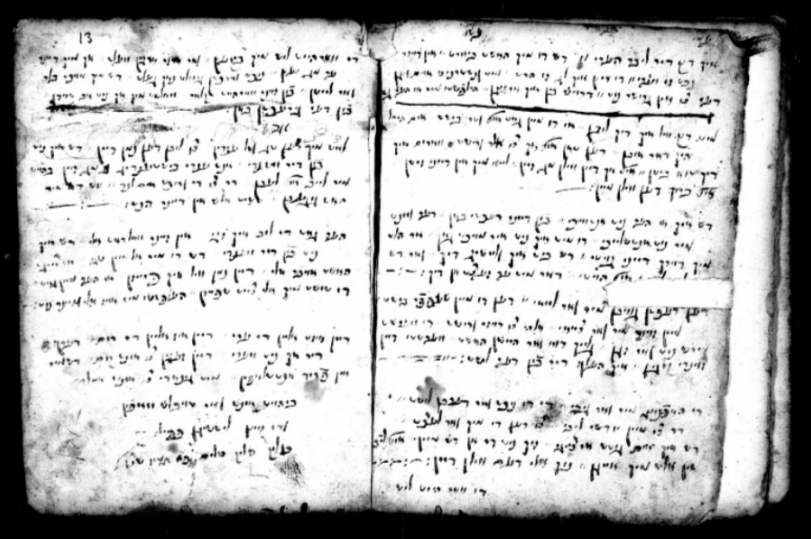
Ms. Heb. 8°7308, 12a–13a.
ABSTRACT
This article adds to the ongoing discussion of interreligious relationships between Jews and Christians in Old Yiddish and early modern European Jewish history by examining a previously unknown source: an anonymous Yiddish translation of Johannes Kolroß’s “Ich dank dir lieber Herre” (I thank you dear Lord). This Protestant morning hymn, written in 1535, was included in Lutheran liturgical anthologies. The translation is found in one seventeenth-century eclectic manuscript containing various Yiddish literary pieces. It is one of the earliest known translations of a Protestant liturgical piece into any Jewish language. This article discusses the translation of “Ich dank dir lieber Herre” for the first time. It uses this hymn and its translation as a case study of the transmission of popular compositions in interreligious contexts. It presents the poem, the basic mechanisms of the translation, and the role of the piece in the general wider context of the manuscript.
Click here to view a pdf version of this article.
In the last few decades, historians and literary scholars of Old Yiddish and early modern European Jewry have been paying more attention to the study of interreligious relationships between Jews and Christians. Questions about the familiarity of one group with the other's texts and cultural expressions are no longer focused only on religious polemics or the activity of converts. Instead, more recent studies emphasize the influence of materials from one culture on another and the common cultural foundations that Christians and Jews in Europe shared, such as popular narratives, literary texts or songs, and medical and scientific knowledge. 1 1 I would like to thank Iris Idelson-Shein, Thom Rofe, Claudia Rosenzweig, and the JEWTACT research team, as well as the reviewers for their important remarks. This project has received funding from the European Research Council (ERC) under the European Union’s Horizon 2020 research and innovation programme (grant agreement no. 801861). For general discussions on exchange of ideas and materials between Christians and Jews in early modern Europe see, for example, Francesca Bregoli and David B. Ruderman, eds., Connecting Histories: Jews and Their Others in Early Modern Europe (Philadelphia: University of Pennsylvania Press, 2019). For discussions about transmissions of songs and literary pieces see Diana Matut, Dichtung und Musik im frühneuzeitlichen Aschkenas: Ms. Opp. Add. 4o 136 der Bodleian Library, Oxford (das so genannte Wallich-Manuscript) und Ms. Hebr. Oct. 219 der Stadt- und Universitätsbibliothek, Frankfurt a. M. (Leiden and Boston: Brill, 2011); Micha J. Perry and Rebekka Voß, “Approaching Shared Heroes: Cultural Transfer and Transnational Jewish History,” Jewish History 30, no. 1 (2016): 1–13; and Jerold C. Frakes, The Emergence of Early Yiddish Literature: Cultural Translation in Ashkenaz (Bloomington: Indiana University Press, 2017). For discussions about medical and scientific knowledge see Marcin Moskalewicz, Ute Caumanns, and Fritz Dross, eds., Jewish Medicine and Healthcare in Central Eastern Europe: Shared Identities, Entangled Histories (Cham, Switzerland: Springer, 2019); Iris Idelson-Shein, “Rabbis of the (Scientific) Revolution: Revealing the Hidden Corpus of Early Modern Translations Produced by Jewish Religious Thinkers,” American Historical Review 126, no. 1 (2021): 54–82; and Magdalena Jánošíková, “United in Scholarship, Divided in Practice: (Re-)Translating Smallpox and Measles for Seventeenth-Century Jews,” Isis 133, no. 2 (2022): 289–309. See also Iris Idelson-Shein, Between the Bridge and the Barricade: Jewish Translation in Early Modern Europe (Philadelphia: University of Pennsylvania Press, 2024).
This article discusses a newly found document that suggests another angle to the shared cultural background between Jews and Christians in southern Germany during the early modern period: a Yiddish translation of the famous Protestant morning hymn “Ich dank dir lieber Herre” (I thank you dear Lord), found in a manuscript copied in 1637. By discussing this translation for the first time, its basic translation techniques and role in the manuscript as a whole, this article reveals an interreligious and intercultural exchange of knowledge regarding religious poetry and music in early modern South Germany.
The Manuscript
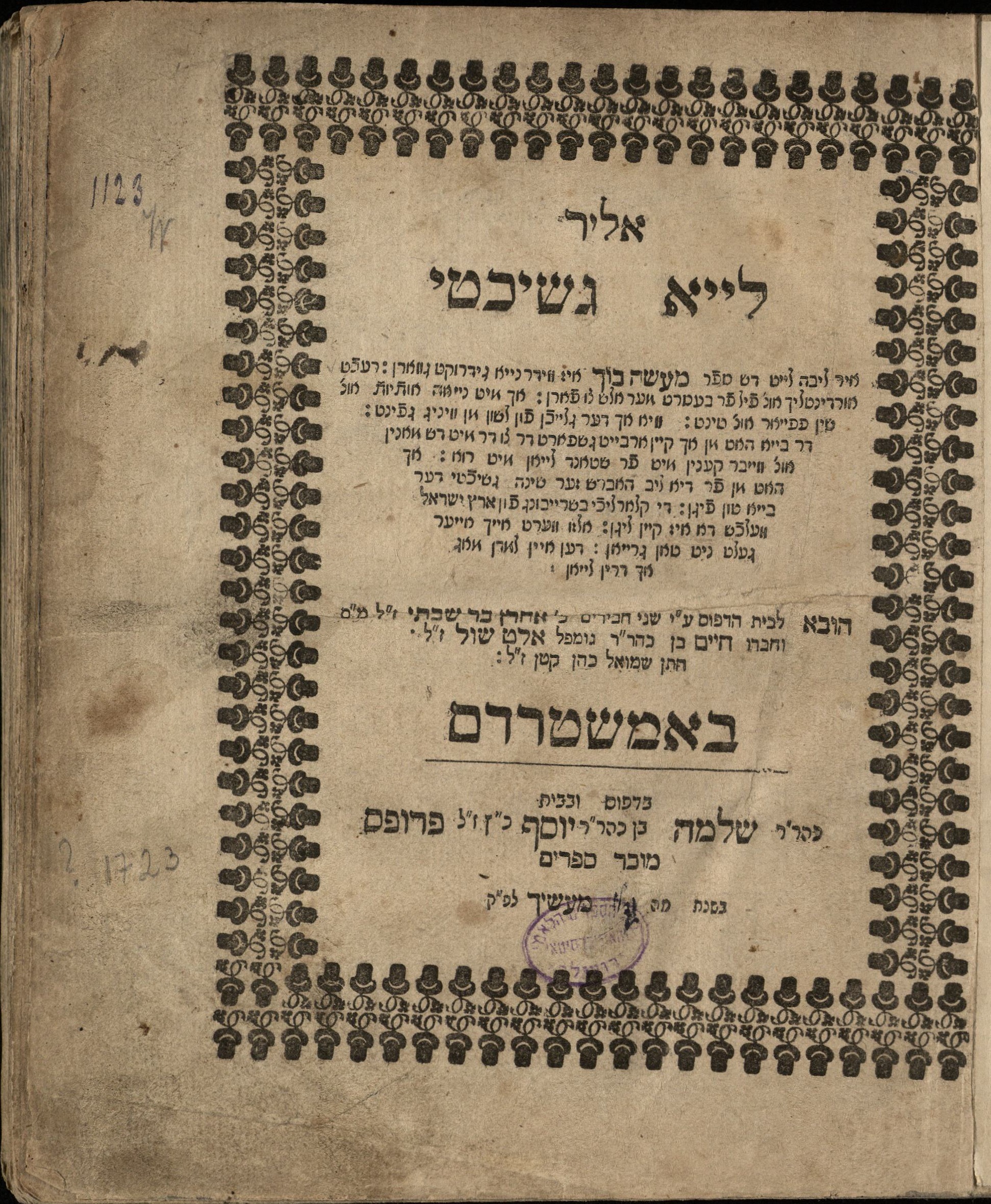
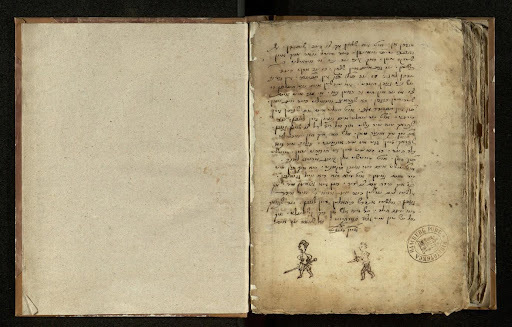
Ms. Heb. 8°73089, from the manuscript collection in the National Library in Jerusalem, is a collection of a few pages added at the beginning of a codex that contains a printed edition of Rabbi Jacob Weil’s popular Sheḥitot u-bedikot, printed in Basel, 1611. 2 2Sefer Sheḥitot u-bedikot was a popular book that contained laws for slaughtering. It was printed in the Ashkenazi world in more than 70 editions. See Yehoshua Horowitz, “Weil, Jacob Ben Judah,” in Encyclopaedia Judaica, eds. Michael Berenbaum and Fred Skolnik (Detroit, MI: Macmillan Reference USA, 2007). For information about other later editions of the book see Sh. Jacobovitz, “Rabbi Jacob Weil’s Book on Slaughtering and Examination of Animals,” Tzfunot: Torah Quarterly 1, no. 4 (1989): 106–14 [in Hebrew]. See also Avriel Bar-Levav, “Solace of the Soul: Printed Prayers, Small Books and the Jewish Ritual Place,” in Way of the Book: A Tribute to Zeev Gries, ed. Avriel Bar-Levav et al. (Jerusalem: Carmel, 2021), 299–314 [in Hebrew]. Because the codex is fragmentary, it likely contained additional pages that have not survived. This eclectic collection of materials is varied not only in genre (religious and secular poetry, stories, amulets) and language (Yiddish, German in Hebrew letters, Hebrew), but also in the number of contributing scribes. Examination of the manuscript easily reveals that it was written by different scribes in different periods. 3 3 For earlier descriptions of the manuscript see the catalogue information in the National Library of Israel. “Ktiv” Project, The National Library of Israel, https://www.nli.org.il/he/disc...; Claudia Rosenzweig, “‘Ayn gevaltiker kenig’: Alessandro il Macedone nella letteratura yiddish antica,” Medioevi 2 (2016): 169–70. The pages include the name of the owner of the printed book (Menaḥem Manes Segal), 4 4 Ms. Heb. 8°7308, [1]b. as well as later owners. 5 5 Ms. Heb. 8°7308, [2]b. However, the scribes who copied the various materials into the manuscript are all anonymous.
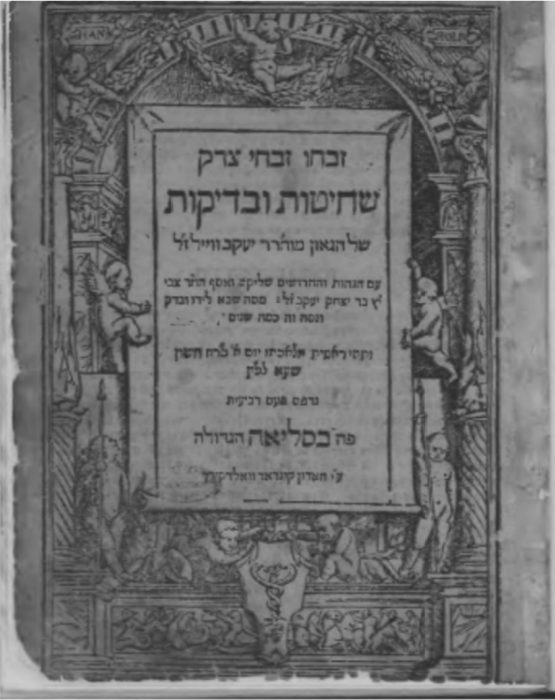
Sheḥitot u-bedikot, printed in Basel, 1611.
The full list of the materials in these pages contains three mayses, which also appear in the famous anthology of Yiddish stories, the Mayse bukh, 6 6 The National Library of Israel, Jerusalem, Israel Ms. Heb. 8°7308, 1b–3a; Rosenzweig, ‘“Ayn gevaltiker kenig,’” 169–70. a religious Yiddish poem written by Moshe Tzart and first printed in Prague in 1602, 7 7 Ms. Heb. 8°7308, 4a–8a; Rosenzweig, ‘“Ayn gevaltiker kenig.’” See also Abraham Meir Habermann, Nashim ‘Ivriyot Betor Madpisot, Mesadderot, Motziot La’or Uvetomkhot Bamehabberim (Berlin: Reuven Mass, 1933), 11. a religious poem, 8 8 Ms. Heb. 8°7308, 8a–b. a version of the German chivalric song “Lämmerweide” (Lamb Field), 9 9 Ms. Heb. 8°7308, 13b–14b; See Rosenzweig, ‘“Ayn gevaltiker kenig,’” 170. Rosenzweig gives credit to Erika Timm for identifying the translation. See also Ludwig Erk and Franz Magnus Böhme, eds., Deutscher Liederhort: Auswahl der vorzüglichern deutschen Volkslieder aus der Vorzeit und der Gegenwart mit ihren Eigenthümlichen Melodien, vol. 2 (Berlin: Enslin, 1893), 39–41; and also Achim von Arnim and Clemens Brentano, eds., Des Knaben Wunderhorn: Alte deutsche Lieder, 3rd ed. (Munich and Leipzig, 1908), 37–8. which portrays a dialogue between a knight and a maiden, translated into German in Hebrew letters, a prayer or a tkhine (a Yiddish prayer of devotion) for health, 10 10 Ms. Heb. 8°7308, 14b. a short parodic poem, 11 11 Ms. Heb. 8°7308, 12a. an amulet against fires, 12 12 Ms. Heb. 8°7308, 12a. and a short text about young kheyder students and their habits, copied by two different scribes and added in the late eighteenth or early nineteenth century. 13 13 Ms. Heb. 8°7308, 9b, 10b. The translation of “Ich dank dir lieber Herre” 14 14 Ms. Heb. 8°7308, 12b–13a. appears next to the translation of “Lämmerweide,” and both were copied by the same hand. At the end of the poem, there is a colophon that states that it was copied in Tammuz in 1637. 15 15 Ms. Heb. 8°7308, 13a.
Ms. Heb. 8°7308, 12a–13a.
The Hymn
“Ich dank dir lieber Herre” is a Protestant morning hymn written by Johann Kolroß, also known as Rhodanthracius (1487–1560), a writer, poet, philologist, and educator. 16 16 Adalbert Elschenbroich, “Kolroß, Johannes,” in Neue Deutsche Biographie (1980), https://www.deutsche-biographi...; Max Schiendorfer, Johannes Kolroß (vor 1490–1544): ‹Fünferlei Betrachtungen, um den Menschen zur Buße zu Bewegen› (Basel: Thomas Wolff 1532). Annotierte Transkription von Max Schiendorfer (Basel: Thomas Wolff, 2018), 4–8. See also Willy Brändly, “Woher stammt Johannes Kolros?” Zwingliana 8, no. 6 (1946): 365–67; on his role in poetry, drama and literature of his time see Newton Arnold, “The Sapphic Ode in Swiss Drama of the Sixteenth Century,” The Germanic Review: Literature, Culture, Theory 16, no. 4 (1941): 250–58. He was best known for his play “Spiel von fünferlei Betrachtnissen” (Play of Five Considerations) (first printed in Basel in 1532). 17 17 Schiendorfer, Johannes Kolroß (vor 1490–1544). See also Idette Noomé, “Embodying Temptation: The Representation of Choice in Medieval and Early Modern Drama,” English Academy Review: A Journal of English Studies 37, no. 1 (2020): 3–22. The morning hymn “Ich dank dir lieber Herre” is considered one of Kolroß's most popular songs. It was written around 1535, and from the sixteenth to the early nineteenth century was extremely popular and was printed in numerous anthologies of Protestant hymns. 18 18 Schiendorfer, Johannes Kolroß (Vor 1490–1544), 8. See also the statistics in Hymnary.com regarding the popularity of the hymn since the second half of the eighteenth century: “Ich Dank’ Dir, Lieber Herre,” Hymnary (website), https://hymnary.org/text/ich_d.... In the nineteenth century, its popularity declined. The hymn was usually sung to the melody of the German song “Entlaubt ist uns der Walde” (The Forest is Defoliated for Us), which could be found in manuscripts since 1580 and gained popularity during the seventeenth century. The melody was probably related earlier to “Entlaubt ist uns der Walde.” 19 19 Carl Ferdinand Becker, Lieder und Weisen Veganger Jahrhunderte: Worte und Töne den Originalen Entlehnt (Leipzig: Kössling, 1853), 9–10. See also Paul E. Kretzmann, Christian Art: In the Place and the Form of Lutheran Worship (St. Louis: Concordia Publishing House, 1921); Hans-Otto Korth, “Die Weise ‘Entlaubet Ist Der Walde’ Als Kirchenlied-Melodie,” Jahrbuch für Liturgik und Hymnologie 50 (2011): 123–49. During the seventeenth century, the hymn was also adapted for a choir by Johann Sebastian Bach. 20 20 William L. Hoffman, “Devotional Hymns: Morning, Evening Songs,” Bach Cantatas Website (blog), December 14, 2017. https://www.bach-cantatas.com/....
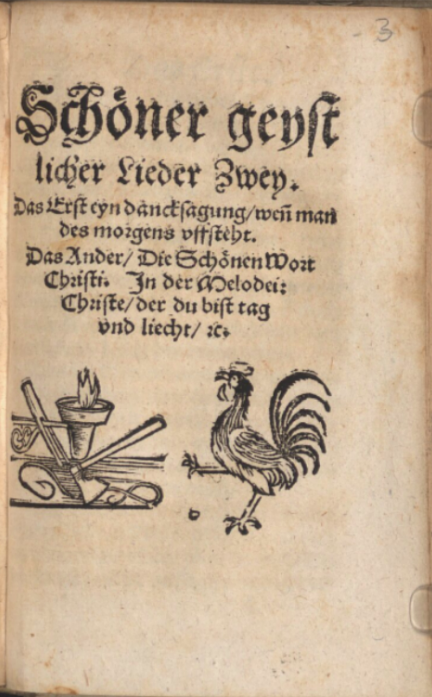
Schöner geystlicher lieder zwey (Marburg, 1555).
“Ich dank dir lieber Herre” is written in the first person. The speaker thanks God immediately upon waking up in the morning. God keeps the speaker safe as they sleep at night and protects them from the devil and other evil forces. The speaker also thanks God for showing them the right path by avoiding dangerous and immoral temptations. Although it is a Protestant hymn of praise for God, many of the lines in the poem are not necessarily restricted to a Christian frame of reference. The hymn discusses concepts such as sin, the right path, or God in a general manner. An exception is the fourth verse, which focuses on accepting Jesus' death for the speaker's sins. In most of its versions, “Ich dank dir lieber Herre” contains nine verses. The Yiddish version of the hymn includes a translation of all of the verses.
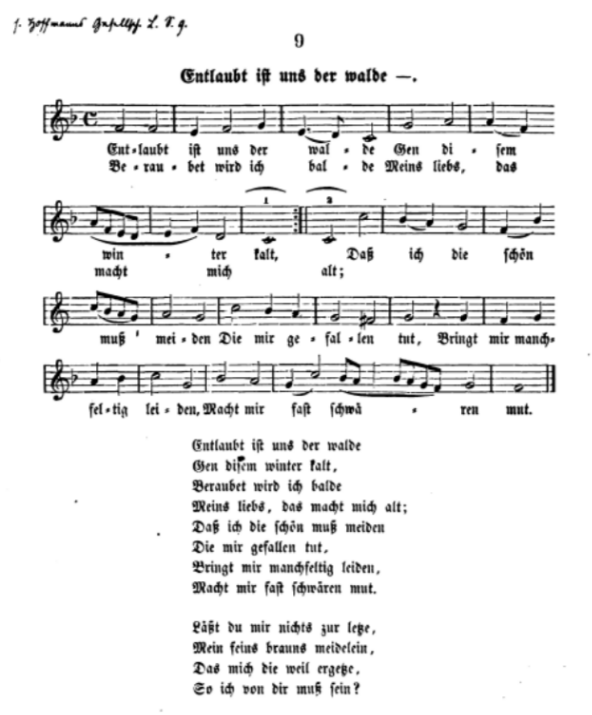
Carl Ferdinand Becker, Lieder und Weisen veganger Jahrhunderte: Worte und Töne den Originalen entlehnt (Leipzig: Kössling, 1853).
The Translation
In the world of written Yiddish in the early modern period, there are different writing styles that vary from one another, mainly regarding their use of the Hebrew-Aramaic component. Marion Aptroot notes six main styles that can be found in early modern Yiddish literature, ranging from a writing style that contains hardly any Hebrew-Aramaic words to a Yiddish that contains many Hebrew words and even grammatical features. 21 21 Marion Aptroot, “Writing ‘Jewish’ Not ‘German’: Functional Writing Styles and the Symbolic Function of Yiddish in Early Modern Ashkenaz,” Leo Baeck Institute Year Book 55 (2010): 122–24. The wide spectrum of Yiddish writing styles is also apparent within the world of Yiddish translations. German texts that were translated into Yiddish differ from one another in their relationship to their source: from close translations that are almost transcriptions of the German source into Hebrew script, to translations that contain many changes, in language and content. 22 22 See Arnold Paucker, “Yiddish Versions of Early German Prose Novels,” Journal of Jewish Studies 10 (1959): 151–67.
The Yiddish version of “Ich dank dir lieber Herre” is an example of a translation of a popular German piece that could, in large measure, be classified as a transcription of the German source. 23 23 See Paucker, “Yiddish Versions of Early German Prose Novels,” and Aptroot, “Writing ‘Jewish’ Not ‘German.’” It does not contain any loshn-koydesh words, meaning, words that are taken from Hebrew and Aramaic. There are also no references to any apparent rabbinic or Midrashic sources. In the German original, “Ich dank dir lieber Herre,” there are not many specific “Protestant” or “Christian” terms, and the general scene of the poem, turning to God upon waking up, can easily be transferred from one religious context to another. Therefore, it is not surprising that the Yiddish version of the poem is extremely close to the German source. Although we do not know the exact wording of “Ich dank dir lieber Herre” that was used in the Yiddish translation, a close comparison between the anonymous Yiddish translation and Korloss’ hymn—at least as it appears in the wording of the first printed versions of the poem—still reveals a few minor yet significant changes.
For example, in the first lines of the fifth verse:
In this verse, the speaker asks God to give hope and the ability to love everyone, even one’s enemies. This special love is described as "Christian love." Unsurprisingly, the translation changes this term into "Jewish love."
Similar minor changes appear in other verses of the hymn whenever clear Christian terminology appears. A relatively major change in the translation appears in the fourth verse, the only verse that mentions Jesus Christ by name:
דען רעכטן גלויבן מיר ואר לייאי
דען דו מיין שעפפֿער בישט
מיין זוינד מיר ואר צייאי
אלהי צו דויזר ורישט
דו ווערשט מירש ניט ואר זגן
גלייך דוא ואר היישן האסט
ווערשטו דיין זוינדי קלגין
איך העלף דיר בֿון דער לשט.
27
27
Ms. Heb. 8°7308, 12b.
Grant me the right faith
Because you are my creator
Forgive my sins
Here in this time.
You will not deny me,
Like you promised
You will repent for your sins
I help (to free) you from the burden.
,Den Glauben mir verleihe
;an dein'n Sohn Jesum Christ
mein Sünd mir auch verzeiehe
.allhier zu diser frist
,Du wirst mir's nicht versagen
,wie du verheißen hast
,Daß er mein Sünd thut tragen
28
28
Korloß, Schöner geystlicher lieder zwey, 3–4.
.und lös mich von der Last
Grant me the faith
In your son Jesus Christ my Lord;
And also forgive my sins
Here in this time.
You will not deny me,
Like you promised
That he will carry my sins
And free me from the burden.
Unsurprisingly, the verse that discusses Jesus and the belief that he died for the speaker's sins is problematic for a Jewish translation of the hymn. Therefore, there are two main changes in the translation that were intended to Judaize the verse. First of all, the speaker’s request that God grant them faith in His son, Jesus Christ (“Den Glauben mir verleihe/ an dein'n Sohn Jesum Christ”) is translated, with a more general reference to a “creator,” as “Den rekhtn gloybn mir var leye/ den du mayn shepfer bist.
An interesting choice of translation can be found in the last two lines: “daß er mein Sünd thut tragen/ und lös mich von der Last” (That he will carry my sins/ And free me from the burden). These lines refer to the belief that Jesus Christ died for the speaker's sins and thus redeemed him. The Yiddish translation replaces this with: “verstu dayn zoyndi klogen/ ikh helf dir fun der last” (You will mourn for your sins/ I help you with the burden). It therefore seems that the translator has turned the last two lines of the hymn into the words of God as addressed to the speaker. God promises that if the speaker will lament their sins, then God will bring them relief.
The changes in the fourth verse of the hymn, and especially the shift of the speaker in the last two lines, are by far the biggest changes in the Yiddish translation of “Ich dank dir lieber Herre.” However, even in the last lines, the tendency to try and stick to the wording and the rhyme patterns of the German source is apparent.
Another relatively large change can be found in the eighth verse of the hymn:
הער גאט די לוב איך זגי
אין זיינר וואל דאש אלי
דש איך ניט בֿון דיר ווענדי
דש דו מיר אל מיין טגי
ארצייגי האשט אויבר אלי
דיין נמן וויל איך פרייזן
או הער מיין גוט
דו טושט מיך אלי צייט שפייזן
העלפשטו מיר אויז אלי מיינר נוט.
29
29
Ms. Heb. 8°7308, 13a.
Dear God, I say praise
In all of his good
That I will not turn from you
That you [showed] for all of my days,
everywhere
I will praise your name
Oh my God
You feed me all the time
And also help me with all my misery.
Herr Christ, dir Lob ich sage
,um deiner Wohlthat all
Die du mir diesen Tage
;erzeygt hast überal
,Dein namen will ich preisen
;der du alleyn bist gut
,mit deinem Leib mich speise
30
30
Korloß, Schöner geystlicher lieder zwey, 4–5.
.trenk mich mit deinem blut
Lord Christ, I say a praise for you
For all your benefaction
That you [did] for these days,
Showed everywhere
I will praise your name;
For you alone are good.
You feed me with your flesh,
And let me drink your blood.
In this verse, the German speaker turns to Christ, thanks him, and at the end of the verse asks to eat Christ’s flesh and drink his blood, a reference to the communion with wafer and wine. These motifs, which are clearly less relevant for a Jewish audience, are changed. The turn to Christ changes into a turn to God. The last two lines, which deal with eating and drinking Christ's flesh and blood, are turned in the Yiddish version into a praise for God's ability to nourish the speaker and help with the speaker's pain and suffering. The need to replace the lines that discuss the sacrament of eating and drinking Christ's flesh and blood made the translator make other changes in order to keep the rhyme pattern of the hymn. Therefore, the line “der du allein bist gut” (for you alone are good) that rhymes with the last line of the verse, “tränk mich mit deinem Blut” (drink your blood) was changed to “O her mayn got” (Oh Lord my God).
These relatively small changes reflect typical techniques of Judaization of non-Jewish materials that were common in translations into Yiddish as well into other Jewish languages. 31 31 On Judaization and changing Christian or Pagan terms in Yiddish translations, see, for example, Paucker, “Yiddish Versions of Early German Prose Novels”; Claudia Rosenzweig’s discussion on the translation methods of Elye Bokher in Bovo d’Antona: Claudia Rosenzweig, “The Widow of Ephesus: Yiddish Rewriting and a Hypothesis on Jewish Clandestine Forms of Reading,” Aschkenaz 1, no. 25 (2015) 98–99; Claudia Rosenzweig, Bovo d’Antona by Elye Bokher: A Yiddish Romance: A Critical Edition with Commentary (Leiden and Boston: Brill, 2015), 176–188. And see also more generally, Iris Idelson-Shein, Between the Bridge and the Barricade, Chapter 3. In the cases of the terms “Jesum Christ” or “christliche Liebe,” the changes seem almost mechanical. In all these cases the rhyme pattern of the hymn stays the same, so that it would also be easy to sing or hum the Yiddish version. However, the translation contains other kinds of changes, terminological in nature, that do not reflect any clear aim of Judaization or carry any polemical tone. For example, the Yiddish translation of the eighth verse contains an additional line, which does not exist in the German source (“Das ikh nit fun dir vendi”, That I will not turn from you). The relationship between this line and the other lines in the poem is unclear, especially when it interrupts the general rhythm and rhyming pattern of the entire hymn. However, this change is not related to any problematic “Christian” content.
Another example of a change that is not necessarily related to religious or theological issues can be found in the first lines of the sixth verse:
The first line in this verse (“Dein Wort laß mich bekennen”) is translated into “di varhayt los mikh bekenen” (Let me confess the truth). In this case too, it is not clear what the reason for this specific change is. Although both the words “word” and “truth” are charged with theological meanings, 34 34 This is not the place to widely discuss the theological meaning of these two words. However, for short, preliminary discussions about the uses of the words in Jewish philosophy see Jacob Klatzkin, “’Emet,” in Thesaurus Philosophicus Linguae Hebraicae et Veteris et Recentioris (Berlin, 1928), 32; Jacob Klatzkin, “Mila,” in Thesaurus Philosophicus Linguae Hebraicae et Veteris et Recentioris (Berlin, 1928), 359–60; and see also Leslie Walker, “Truth,” in The Catholic Encyclopedia (New York: Robert Appleton Company, 1912), 73-77. it is hard to point to a shift in the religious meaning of the verse as a result of the change between the words. It is possible to suggest that this change is rooted in a polemical claim: the Christians may have the “word” but only the Jews hold the “truth.” However, it is also possible that the scribe used the word varhayt simply because it appears in a later line in the same verse ("daß mich bald möcht ableiten/ von deiner Wahrheit klar”). Another possibility is that such differences are related to the textual history of the German “Ich dank dir lieber Herre” and the particular wording of the hymn that was known by the translator.
The Context
At first glance, it may be surprising to find a Protestant morning hymn in a Jewish manuscript. However, there are many other indications that Jews had become familiar with Christian liturgy in the early modern period. As recent studies have revealed, many European Jews were familiar with Lutheran works, especially translations of Biblical texts. The first full Yiddish translations of the Hebrew Bible made by Jekuthiel Blitz (1676–1679) and Joseph Witzenhausen (1679) leaned in many cases on Luther’s translations. 35 35 Marion Aptroot, “Bible Translation as Cultural Reform: The Amsterdam Yiddish Bibles (1678-1679),” (PhD diss., Oxford, University of Oxford, 1989); Marion Aptroot, “‘In galkhes they do not say so, but the taytsh is as it stands here’: Notes on the Amsterdam Yiddish Bible Translations by Blitz and Witzenhausen,” Studia Rosenthaliana 27, no. 1/2 (1993): 136–58; Erika Timm, “Blitz and Witzenhausen,” in Studies in Jewish Culture in Honour of Chone Shmeruk, ed. Israel Bartal, Ezra Mendelsohn, and Chava Turniansky (Jerusalem: Zalman Shazar Center for Jewish History, 1993), 39–66. Moreover, Luther's translations of the Apocrypha, such as Judith 36 36 Ruth von Bernuth and Michael Terry, “Shalom Bar Abraham’s Book of Judith in Yiddish,” in The Sword of Judith: Judith Studies Across the Disciplines, ed. Kevin R. Brine, Elena Ciletti, and Henrike Länemann (Cambridge: Open Book Publishers, 2010), 127–51. See also: Iris Idelson Shein, “Sefer ha-ma’asim (#139), “Judith and Susannah” (#421), and “Judith” (#450), in Iris Idelson-Shein, Ahuvia Goren, Magdalena Janosikova, Tamir Karkason, and Yakov Z. Mayer (eds.), “Jewish Translation in Early Modern Europe: A Bibliographic Database,” https://www.jewtact.com/databa... (accessed August 2023). See also Aaron von Hergershausen’s translation of Proverbs that follows Luther: Rebekka Voß, “Mishlei” (#647), in Iris Idelson-Shein, Ahuvia Goren, Magdalena Janosikova, Tamir Karkason, and Yakov Z. Mayer (eds.), “Jewish Translation in Early Modern Europe: A Bibliographic Database,” https://www.jewtact.com/databa... (accessed August 2023). and Ben Sirah, 37 37 See for example Iris Idelson Shein, “Yehoshua ben Sirak” (#126) and “Bukh der tsukht” (#545) in Iris Idelson-Shein, Ahuvia Goren, Magdalena Janosikova, Tamir Karkason, and Yakov Z. Mayer (eds.), “Jewish Translation in Early Modern Europe: A Bibliographic Database,” https://www.jewtact.com/databa... (accessed August 2023). were translated into Hebrew and Yiddish. Many times, these translations were seen as translations of “Jewish” materials. 38 38 See for example von Bernuth and Terry, “Shalom Bar Abraham’s Book of Judith in Yiddish.” In addition, Luther’s translations of parts of the New Testament were also translated into Yiddish and Hebrew, mainly by missionaries or converts to encourage conversions. 39 39 See for example Magda Teter and Edward Fram, “Fraud, and the Beginnings of Hebrew Printing in Cracow,” AJS Review 30, no. 1 (2006): 31–66; Aya Elyada, A Goy Who Speaks Yiddish: Christians and the Jewish Language in Early Modern Germany (Stanford, CA: Stanford University Press, 2012), 22–38. See also Mellanie Plewa, “Sefer besorah tovah ʿal pi ha-mevaser Lukas” (#518), “Dos noye testiment” (#521), “Aine shene Droshe welche Yeshua ha-Mashiah geholten hat fun der Seligkeit” (#566), “Sifrei ha-Brit ha-hadasha” (#559), in Iris Idelson-Shein, Ahuvia Goren, Magdalena Janosikova, Tamir Karkason, and Yakov Z. Mayer (eds.), “Jewish Translation in Early Modern Europe: A Bibliographic Database,” https://www.jewtact.com/databa... (accessed August 2023). See also Yaacov Deutsch, “Heinrich Christian Immanuel Frommann’s Hebrew Translation and Commentary on the Book of Luke,” in Mission ohne Konversion? Studien zu Arbeit und Unfeld des Institutum Judaicum et Muhammedicum in Halle, ed. Grit Schorch and Brigitte Klosterberg (Halle: Franckeschen Stiftungen Halle, 2019), 125–34; Avraham Siluk, “Zu den Übersetzungen des Alten Testaments im Institutum Judaicum et Muhammedicum in Halle,” Zeitschrift für Religions und Geistesgeschichte 75, no. 2 (2023): 172–88. Although the reception history of Luther’s Biblical translations during the early modern period is not necessarily an indication of Jewish familiarity with early modern Protestant liturgy, it still provides important evidence for the spread of textual materials with Lutheran origins among the Jewish readership of the period.
In addition to translations of Lutheran biblical texts into Jewish languages, there is also evidence of the transmission of additional Protestant materials within Jewish communities, particularly liturgical materials. Debra Kaplan, for example, has already discussed the use of Protestant liturgy in interreligious interactions between Jews and Christians during the sixteenth century. Kaplan points to the use of Protestant liturgy as one of the ways in which Jews were able to know about Protestant theology and to dispute it. 40 40 Debra Kaplan, “Sharing Conversations: A Jewish Polemic against Martin Luther,” Archiv für Reformationsgeschichte 103, no. 1 (2012): 41–63, esp. 53–54.
In the late seventeenth and eighteenth centuries, there are also clear pieces of evidence for the direct influence of Protestant liturgy on Jewish liturgical and para-liturgical texts. Rebekka Voß has discussed Jewish figures who had relationships with Christian pietists – an important strand within the Lutheran church of the time – and who were influenced by Protestant liturgy in their own works. 41 41 Rebekka Voß, “A Jewish-Pietist Network: Dialogues between Protestant Missionaries and Yiddish Writers in Eighteenth-Century Germany,” The Jewish Quarterly Review 112, no. 4 (2022): 731–63. One such example is Elhanan Henle Kirchhan (1666 – 1757), a schoolmaster and author who is mostly known for his famous Yiddish musar book Simḥat ha-Nefesh (The Delight of the Soul). The first volume of the book was printed in 1707 in Frankfurt am Main. Like many other musar books from the period, it contained moral discussions, proverbs, and instructions about different Jewish rituals. The first volume of Simḥat ha-Nefesh gained success and was printed in numerous editions. Kirchhan maintained relationships with Christian pietists from Halle and shared similar views regarding the roles of prayer and ritual for a pious life. In 1726/7 Kirchhan published the second volume of Simḥat ha-Nefesh. Unlike the first volume, which contained a mix of materials typical of Musar literature from the period, this volume contained songs for different dates and holidays in the Jewish calendar, printed with musical notes. While Kirchhan's songs were "original" Jewish songs and referred to rabbinic and biblical materials, the format of the book resembled Christian hymnals. Moreover, some of the melodies Kirchhan included were modeled on non-Jewish songs including Protestant liturgical music. Unlike its first volume, the second volume of Simḥat ha-Nefesh was far from a success and was not reprinted. 42 42 Voß, “A Jewish-Pietist Network,” 739–47.
An example of direct transmission of Protestant liturgical pieces to the Jewish context can be found in Aaron of Hergershausen’s Liblikhe tefile (Lovely Prayer) (1709), a booklet that contains Yiddish prayers and tkhines 43 43 About tkhines literature see for example Devra Kay, Seyder Tkhines: The Forgotten Book of Common Prayer for Jewish Women (Philadelphia: Jewish Publication Society, 2004); Moshe J. Rosman, “A Proto-Feminist Challenge to the Polish Rabbinate in the Eighteenth Century: The Introduction to ‘Tekhino Imohos’ by Sarah Rebecca Rachel Leah Horowitz,” in The Scepter Shall Not Depart from Judah: Leadership, Rabbinate and Community in Jewish History, Studies Presented to Professor Simon Schwarzfuchs, ed. Joseph R. Hacker and Yaron Harel (Jerusalem: The Bialik Institute, 2011), 301–16 [in Hebrew]; and see also Chava Weissler, Voices of the Matriarchs: Listening to the Prayers of Early Modern Jewish Women (Boston: Beacon Press, 1998). for different occasions. Hergershausen is now known for having had friendly relationships with Christian pietist circles in Halle, and especially with August Hermann Francke, a chief agent of Halle pietism. Voß has demonstrated Hergershausen’s extensive use of Christian liturgical materials in his booklet. Many of the tkhines leaned on Johann Habermann’s booklet Christliche Gebet für alle Not und Stende der gantzen Christenheit (Christian Prayers for all Hardship and Estates in all Christendom) (1567). 44 44 Voß, “A Jewish-Pietist Network,” 747–57. As in the case of Kirchhan’s second volume of Simḥat ha-Nefesh, Liblikhe tefile was not at all successful and was not reprinted. 45 45 Voß, “A Jewish-Pietist Network,” 747–57. Besides these case studies, Voß also mentions that hymns and liturgical melodies were used by missionaries to inspire conversion. 46 46 Voß, “A Jewish-Pietist Network,” 746.
The studies of Kaplan and Voß help to contextualize the case of the translation of “Ich dank dir lieber Herre.” On the one hand, this translation is far from being the only evidence of the reception of Protestant liturgy within the Jewish population. However, it also differs from most of the evidence that has been known so far, and therefore suggests another, previously less discussed aspect of the cultural exchange between Jews and Protestants in the early modern period. First, unlike the works of Hergershausen and Kirchhan from the early eighteenth century, the translation of “Ich dank dir lieber Herre” was written down in 1637, almost a century earlier. Therefore, it is the earliest known evidence of a direct transmission of Protestant liturgy to Jewish readers. But a larger and more critical difference is connected to the lack of any self-reflection in the case of the surviving copy of the translation of “Ich dank dir lieber Herre.”
In the cases of both Hergershausen’s Liblikhe tefile and Kirchhan’s Simḥat ha-Nefesh, the choice to use Protestant liturgy was connected to their broader understanding of Jewish religious life. 47 47 Voß, “A Jewish-Pietist Network,” 746. Hergersausen and Kirchhan both couch their use of Protestant materials in explanations about how doing so addresses the problems they have identified in Jewish prayers and rituals. In the case of Hergershausen, Voß attributes his use of Yiddish and Yiddish prayers to his aim of making the meanings of the texts more accessible, and thus encouraging the public to pray eventually in Hebrew as well. 48 48 Voß, “A Jewish-Pietist Network,” 750. Hergershausen and Kirchhan’s translations do not only transmit melodies, structures, or contents, but also worldviews, perceptions, and religious and ritualistic standards. Hergershausen and Kirchhan’s perceptions regarding the Jewish ritualistic texts associated them with the personas from the early Jewish Enlightenment (Haskalah), such as Shlomo Hanau or Isaac Wetzlar. 49 49 Voß, “A Jewish-Pietist Network,” 731–37. See David Sorkin, “The Early Haskalah,” in New Perspectives on the Haskalah, ed. Shmuel Feiner and David Sorkin (Oxford: Oxford University Press, 2004), 9–26.
Unlike these two examples, the translation of “Ich dank dir lieber Herre” does not contain any sort of explanation or introduction to the translated poem. The translation stands alone, in an eclectic collection of texts added by different scribes, without any clear connection or order between them. These texts are there simply because someone, at a moment in time, decided to put them on paper. They survived on a few blank pages that at some point were bound together with a halakhic printed book, again without any clear connection to the codex. Although the translation of “Ich dank dir lieber Herre” differs in certain places from the German hymn, most of the differences are minor, as shown above. The translator alters the few lines that include specifically Christian terms or references, which may be problematic or less relevant for the intended potential audience of the translation; while introducing these changes, the translator nonetheless strives to maintain the rhythmic pattern of the hymn. Some of the changes seem almost mechanical (Yudishe libe instead of Christlische liebe), and none of them suggest a clearly polemical tone, as was sometimes the case in early modern Yiddish adaptations of German-language sources. 50 50 For discussions about more polemic changes see for example Paucker, “Yiddish Versions of Early German Prose Novels,” 155–156.
Although there is no introduction or explanation in the manuscript that elucidates the reasons for translating a hymn like “Ich dank dir lieber Herre,” a comparison between the poem and other materials included the manuscript can give some indication of what made this poem appealing to this specific readership or the copyist. First, the scribe who put on paper the translation of “Ich dank dir lieber Herre” added at least two more texts to the codex: a Yiddish translation of a German chivalric ballad, titled “Lämmerweide” (Lamb Field), which circulated in German-speaking areas in different versions since the sixteenth century, 51 51 Erk and Böhme, Deutscher Liederhort, 140–143. and the fragment of a prayer for good health, which opens with the lines “אין דיינם צארן וואלט מיך ניט שטראפן הערי” (do not punish me in your fury, Lord).
The version of “Lämmerweide” in Ms. Heb. 8°73089 differs from most of the known German versions of the song, which survived in a few versions with a melody. 52 52 Erk and Böhme, Deutscher Liederhort, 140–143; Arnim and Brentano, Des Knaben Wunderhorn. However, the main scene of the song, a dialogue between a maiden and a knight, as well as the structure of the verses and the structure of the refrain, are similar (the last word in every verse is repeated followed by the word ja, or יוא in the “Jewish” version). As in the case of “Ich dank dir lieber Herre,” the translation of “Lämmerweide” does not contain any words in Hebrew or Aramaic, and it is hard to point to any references to rabbinic sources. It seems that the major changes between the known German versions of the song and the version found in Ms. Heb. 8°73089 are due to the fact that the Yiddish translation leaned on a version or variant of this popular song that has been lost, and not due to changes purposely made by the translator in order to Judaize the song.
The prayer, or tkhine for health, which was added by the same scribe, shares similarities with “Lämmerweide” and “Ich dank dir lieber Herre.” Once again, the surviving two verses from the poem do not contain any loshn-koydesh words, a common phenomenon in translations from German into Old Yiddish. 53 53 Aptroot, “Writing ‘Jewish’ Not ‘German,’” 122. The terminology in various lines of the poem, such as its opening line, or lines like "מך מיך בון זוינדן וריי" (free me from sins), appear also in Protestant hymns, prayers, and psalms from the same period. 54 54 See for example: “Ach Liebster Gott und Vatter mein/ im Zorn wöllst mich nicht straffen.” Martin Luther, Geistliche Psalmen Hymnen Lieder und Gebet welche in den Christlichen Kirchen und Versamblungen/ vor und nach Anhörung deß heiligen Göttlichen Worts/ wie auch bey der Außtheilung deß heiligen Abendmals/ und sonsten daheim von jederman mögen gesungen werden (Nuremberg, 1607), 76.
We do not know if the scribe that copied these texts was the author of this prayer, or the translator of “Lämmerweide” and “Ich dank dir lieber Herre,” or was merely writing down already known translations that have not survived in other copies. However, the fact that the same scribe added to the manuscript a translation of a version of “Lämmerweide” along with a translation of “Ich dank dir lieber Herre” and a prayer that contains only German words and no rabbinic references in its two surviving verses points to the scribe’s interest not exclusively in “Jewish” materials, but also in other German texts that were circulating during the fifteenth and the sixteenth centuries. Although “Lämmerweide,” “Ich dank dir lieber Herre,” and “In deynm tsorn volt mikh nit shtrofen” are from completely different genres (a chivalric ballad, a morning hymn, and a prayer), and although each of these texts has a different history and context, they all have the common feature that make them appealing: they are popular texts, and at least two of them (“Lämmerweide” and “Ich dank dir lieber Herre”) have melodies that would have been sung and performed during the period of the scribe.
Interestingly, another relevant literary piece that appears in Ms. Heb. 8°73089 is Moshe Tzart’s religious poem. Tzart’s poem was first printed in a small booklet in 1602 in Prague, financed by a certain Petshl, the daughter of Zanvil. 55 55 See also Habermann, Nashim ‘Ivriyot Betor Madpisot, Mesadderot, Motziot La’or Uvetomkhot Bamehabberim, 11. The long, rhymed poem can be divided into two main parts. The first part retells sections from Genesis and Exodus, from the creation of the world through the lives of Abraham, Isaac, and Yaakov and the exodus. This part ends with God giving Israel the Torah. 56 56 Moshe Tzart, Dos lid shel Moshe Tzart (Prague, 1602), 1–6. The second part of the poem is dedicated to turning to God and asking for future salvation after many years of suffering in the diaspora. 57 57 Tzart, Dos lid shel Moshe Tzart, 6–8.
None of the themes discussed in the poem is particularly unexpected in the context of Yiddish religious poetry, or tkhines literature. Unlike the translation of Korloß’ hymn, or the translation of the chivalric ballad, Moshe Tzart’s poem seems to be a genuine Jewish composition. However, just like “Lämmerweide,” “Ich dank dir lieber Herre” and “In deynm tsorn volt mikh nit shtrofen,” besides the names of the biblical characters that appear in Hebrew script, the poem does not contain any loshn-koydesh words. Moreover, the first line of Tzart’s poem “מיין גוט איך וויל דיך פרייזן” (my God, I want to praise you) is based on Martin Luther's translation of Psalms 118:28 (“Gott ich will dich preisen”). Unsurprisingly, this line is repeated in Protestant hymns from the period, 58 58 See, for example, Georg Matthias Nöller, Neu vielvermehrtes Rigisches Gesangbuch, bestehend aus schönen geistreichen Liedern und Psalmen, nach Ordnung der Jahre Zeiten (Riga, 1695) 276–277. and even appears in the eighth verse of “Ich dank dir lieber Herre” (“Dein'n Namen will ich preisen”), as well as in the Yiddish translation of the hymn. 59 59 Korloß, Schöner geystlicher lieder zwey, 4. The closeness in terminology between Tzart’s religious poem and “Ich dank dir lieber Herre” has already been pointed out in prior discussions of the manuscripts. Although earlier cataloguers did not identify “Ich dank dir lieber Herre” and the fact that it is a translation, they suggested that “Ich dank dir lieber Herre” is a continuation of Tzart’s poem, or another poem written by Tzart, maybe in a later stage of his life. 60 60 See the “Ktiv” Project, The National Library of Israel, https://www.nli.org.il/he/disc....
There is no reason to assume that there is an actual connection between Tzart’s poem and the translation of “Ich dank dir lieber Herre”—in either author or content. However, the fact that there are similarities regarding both texts, as well as the use of similar terminology, may point to preferences for specific textual and stylistic features that made certain texts more appealing or relevant for some of the scribes that were involved with Ms. Heb. 8°73089. Throughout the manuscript, we can see, for example, a recurrent interest in translations of German liturgical poetry and in rhymed poetry written in Yiddish, with little or no use of loshn-koydesh vocabulary.
Conclusion
The lack of any explanation or reflection makes the translation of “Ich dank dir lieber Herre” an intriguing case study. Although the manuscript presents the translation of a somewhat surprising piece of literature, it does so as a matter of course, without fanfare. In doing so, it draws attention to a different, and more casual kind of interreligious transmission of materials, which is still often ignored or pushed to the margins of scholarly discussion. I argue that this transmission leans first and foremost on a shared culture. The melodies of Protestant hymns were known and hummed by a wide public, both in and outside the church. 61 61 On the special place of music, hymns, and especially popular tunes in German Protestant life, see, for example, Rebecca Wagner Oettinger, Music as Propaganda in the German Reformation (London: Routledge, 2001). In the case of “Ich dank dir lieber Herre,” the hymn was known and sung to a popular tune of the time, just like the German ballad “Lämmerweide,” which was also added to the manuscript by the same scribe. There is no reason to assume that Jews who lived in proximity with Christians did not know this tune. 62 62 For further information about the use of German tunes in the Jewish communities in the early modern period, see, for example, Matut, Dichtung und Musik im frühneuzeitlichen Aschkenas. Moreover, the content of the hymn, a praise to the Lord upon waking up in the morning, is general enough to be transmitted, sung, or hummed by Jews with very minor modifications. The general pious content was not perceived as especially problematic for a potential Jewish audience; in fact, it was rather appealing, and could thus be easily adapted and transmitted from one religious culture to another.
The case of the translation of “Ich dank dir lieber Herre” should therefore not be seen only as a story of an interreligious exchange of liturgical material. It is also a transmission of a popular “hit,” of a text that was appealing, in large measure, because it was sung to a known melody. 63 63 On the role of melodies in the transmission of early modern Yiddish pieces see also Chava Turniansky, “The Events in Frankfurt am Main (1612-1616) in ‘Megillas Vints’ and in an Unknown Yiddish ‘Historical’ Song,” in Schöpferische Momente des europäischen Judentums in der frühen Neuzeit, ed. Michael Graetz (Heidelberg: Universitatverlag, 2000), 121–37; Rivka Ulmer, ed., Turmoil, Trauma and Triumph: The Fettmilch Uprising in Frankfurt am Main (1612-1616) according to Megillas Vintz, trans. Elchanan Helen (New York: Peter Lang, 2001); Oren Cohen Roman, “Four Yiddish Songs – One Melody,” Bohemica Litteraria 26, no. 1 (2023): 153–70. More than being a Protestant morning hymn, “Ich dank dir lieber Herre” is primarily a popular song, which was well-known and widely performed during this period and entered Jewish culture through its famous melody, apparently popular with Christians and Jews alike. The fact that the same scribe added to Ms. Heb. 8°73089 not only the translated Lutheran liturgical hymn but also a chivalric ballad, about a maiden and her knight admirer — versions of which, with melodies, were circulated at the time — further emphasizes the possibility that “Ich dank dir lieber Herre” was perceived less as a liturgical piece than as a song with popular appeal. “In deynm tsorn volt mikh nit shtrofen,” which was also added by the same scribe, and at least shares common features with Protestant prayers of the time (even if it is not an actual translation of such a prayer), functions as another example of a rhymed text, with a general enough theme (asking for health), that could easily be transmitted between different religious cultures.
The copying of these different materials by the same scribe encourages us to rethink the usual dichotomy between “secular” and “religious” contents in Old Yiddish literature. The variety between contents included in Ms. Heb. 8°73089, and even between the three works added by the scribe of “Ich dank dir lieber Herre,” suggests that the texts’ aesthetic or stylistic features—and, especially, their relationships to music and melodies—were probably the main vehicle for their transmission between religious cultures. This does not mean that the content of the works did not have any meaning, but it was seemingly not the main consideration in putting these materials on paper one next to another. Ms. Heb. 8°73089 is an example of a private ad hoc anthology, made by amateur or half-amateur scribes for their own use over the decades, and based first and foremost on the scribes’ interests, and even more, their personal taste. In the case of our scribe, it seems that the main parameter he followed in organizing and assembling the materials in the manuscript was the fact that they were popular tunes—be they chivalric ballads or Protestant liturgical pieces that were sung to a beautiful known melody.