May 04, 2026
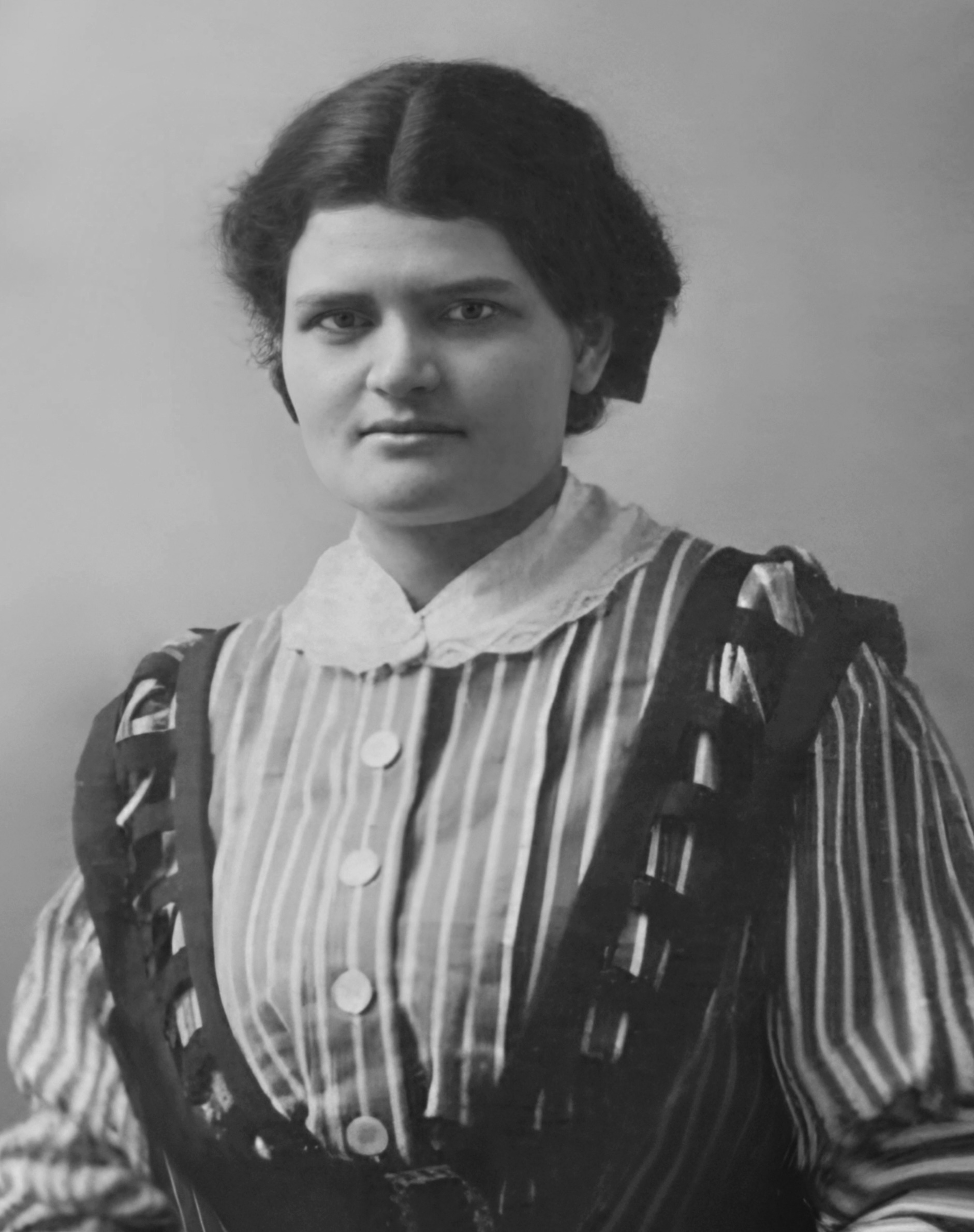
Rokhl Feygenberg, age about twenty-five, ca. 1910. Courtesy of Daphna Levy. Photo digitally restored.
Shvaygn: to be silent, to say nothing. We have no direct counterpart for the word in English, which is perhaps why it feels so poetic to me: it turns the process of being silent into an act, the act of being silent, the act of restraining from speaking. It suggests a purposefulness of silence, rather than an absence of words.
I am interested in the silences, the gaps, the stories that have been left behind. The immigrants in my own family, like so many of the two and a half million Jews who made their way from the old country to the new around the turn of the previous century, did not pass many stories on to their offspring; they had turned their faces forward and were uninterested in holding fast to the exhausting circumstances that had prompted them to leave their longtime homes.
Years ago, long before I started to learn Yiddish, I was shuffling through an ancient box of memorabilia my parents had discovered in a corner of their basement when I came across a short letter, written by my grandfather on notepaper from the Prudential insurance company. I knew that his father, my great-grandfather, had sold insurance door to door to fellow immigrants in New York City, so the notepaper made sense. The letter was dated September 3, 1916, when my grandfather would have been sixteen years old, having been born three weeks after his parents arrived in the United States late in 1899; he was their first surviving child. But what stunned me was that the letter was written in what I could then only assume was Yiddish, the lines carefully constructed with the thick and thin strokes and occasional ink bleed of a fountain pen. I knew my grandfather; he lived into my adult years. But I didn’t have the slightest idea that he had known Yiddish in his youth, and not just a word or two, but enough to write a letter.
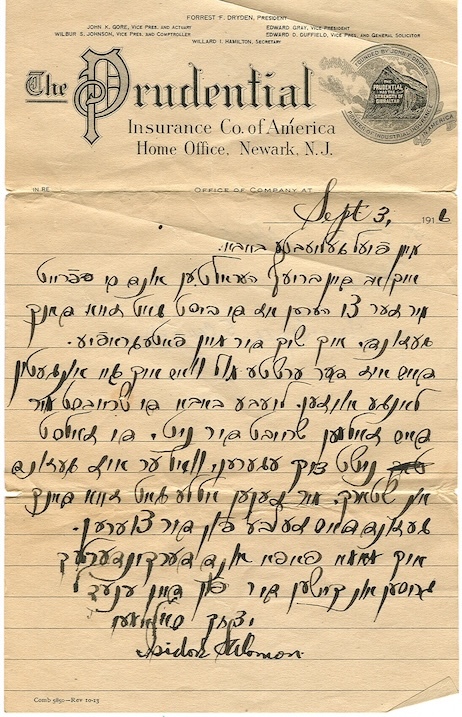
1916 letter written by the translator’s grandfather, Isidore Salomon, to his grandmother in Romania.
It felt like a door had cracked open. Could this letter be a clue to the stories I had been trying to piece together from bits and pieces of family lore and my genealogical research? What if it turned out to be some kind of family Rosetta Stone?
When I had the letter translated (shoutout to Yael Chaver for her generosity, and to the volunteer Genealogical Translations group on Facebook), I found that it was a banal missive my teenage grandfather had written to his grandmother back in Romania. But amid the sending of greetings and the assurances that the family was well, there was a sentence that stayed with me: “I’m sending you my photograph,” my grandfather wrote. “This is my first time wearing long trousers.”
The promotion to long trousers, as much a coming-of-age ritual for this sixteen-year-old boy as his bar mitzvah might have been three years earlier. The poignancy of a letter written from an American grandson to an old-world grandmother he would never meet. The lined notepaper from an insurance company. The Yiddish itself, implying years of study to gain competence in writing, as well as the likelihood of its being his first language, however Americanized he must have seemed to his immigrant parents. Although this was no Rosetta Stone, I began to realize that there were indeed untold stories buried on the page.
###
After I began to learn Yiddish myself—a pandemic whim that quickly and unexpectedly turned into something like an addiction—I came to think of these small inferences as a kind of “umshvaygn,” a fascinating peek into the stories left behind.
Umshvaygn has been a slow unfolding for me, founded in reading and translating Yiddish texts. When I first read Rokhl Feygenberg’s wonderful, lightly fictionalized memoir of her difficult Belarusian childhood in the 1890s, Di kinder-yohren, I felt like I really had found a kind of Rosetta Stone. Di kinder-yohren begins with family history, details her father’s death when she was about five, and takes us through her mother’s three-year illness and demise when Feygenberg was fourteen. Feygenberg (1885–1972), born in the shtetl of Lyuban in the Minsk guberniya, wrote this breakout work when she was still a teenager and went on to become one of the first professional Yiddish women writers, penning stories, novels, plays, essays, and a significant body of pogrom journalism. From 1924 to 1935 she contributed a weekly column to Der Moment newspaper (Warsaw), writing hundreds of articles and feuilletons, and she became one of the most popular writers in the Eastern European Yiddish press during those years.
In Di kinder-yohren, Feygenberg’s deft sketches of characters and scenes from shtetl life are humorous, poignant, and real. Even more tantalizing was my realization that Feygenberg’s tiny childhood shtetl of Lyuban lay only fifty kilometers west of my own great-grandparents’ shtetl of Hlusk. (A different set of great-grandparents from those mentioned earlier!) Her family and mine would have traveled the same road during the same years as they ran their errands and conducted business in the nearby city of Bobruisk.
![<p><i>The Winding Road: My Childhood Years </i>by Rokhl Feygenberg, translated by Tamara T. Helfer. Syracuse University Press, 2026. 280 pp. $29.95 [paperback, ebook]</p>](https://ingeveb.s3.amazonaws.com/images/book-covers/The-Winding-Road-Cover.jpg)
The Winding Road: My Childhood Years by Rokhl Feygenberg, translated by Tamara T. Helfer. Syracuse University Press, 2026. 280 pp. $29.95 [paperback, ebook]
Translating Di kinder-yohren, available in English as The Winding Road: My Childhood Years (Syracuse University Press, April 2026), gave me time to sit with Feygenberg’s text and notice the small details that bring her shtetl to life. Since she too was only about sixteen when she wrote Di kinder-yohren, her descriptions tend to be much more unfiltered than those of an adult, which in itself is a kind of umshvaygn. She describes her grandmother, in my translation, as “truly devout and very charitable, though she gave to charity not because she had compassion for the poor, but because she wanted the mitzvah for doing so” (11). When she describes the master storyteller Mendl Karovitser, an impoverished bookbinder, we realize, umshvaygndik, that his poverty may be at least in part because his profession has grown archaic in his own lifetime. In another minor scene, she calls out to a passing gentile cowherd and promises to give him a bagel if he would braid her a wreath of blue cornflowers from the fields, and we realize she must know this unnamed fellow, that there must be myriad daily interactions between the Jews and gentiles of the region, too seemingly inconsequential to have been developed into the broader narrative. When she devotes a memorable, page-long anecdote to Oreh the melamed’s goat (“People used to complain about her, that she didn’t comport herself well,” 71), we understand that, even if it wasn’t common to have pets as we think of them today, families kept animals and enjoyed enduring emotional bonds with them.
There are two different versions of Di kinder-yohren that are nearly identical to each other, but in comparing their differences, we get a clear example of how the process of shvaygn can unfold. Feygenberg wrote the original version when she was about sixteen, circa 1901, and it was serialized in the monthly journal Dos Leben in 1905. 1 1 Rokhl Feygenberg, “Some Details from My History” (Hebrew), 1955, Rokhl Feygenberg Archives, reference item reference 3873/1, The Gnazim Institute of the Hebrew Writers Association in Israel; and Feygenberg, “Summary Chapters on the Lives of Three Generations of the Family” (Hebrew), undated, Rokhl Feygenberg Archives, reference item 33670, The Gnazim Institute. For the original serialized version of Di kinder-yohren, see Feygenberg, “Di kinder-yohren,” Dos Leben (Saint Petersburg), published in eight monthly installments beginning January 1905, p. 31. This version includes a heartbreaking scene in which she describes in detail the accidental poisoning death of her baby brother Nakhumke. The doctor who subsequently examines the baby’s corpse denounces her mother, “attributing all the problems of the miserable, uncivilized shtetls to their residents, who didn’t understand that they needed a good medic far more urgently than they needed to build a third shul so the fancy homeowners wouldn’t have to pray together with the simple tailors and shoemakers” (The Winding Road, 38). By contrast, in the later book version of 1909 (HaShakar Press, Warsaw), published when Feygenberg was a grown-up twenty-four, the entire existence of baby Nakhumke is written out of the narrative, thereby obviating the necessity of telling the story of his tragic death and the criticism heaped on her mother and the shtetl’s inhabitants. The shvaygn had begun. As I made my way through both versions, it became clear that Feygenberg’s original story was truer to the voice of a teenage girl who had not yet learned to obscure uncomfortable realities, and I decided to base my translation on her original text.
More broadly, it seems all but certain that Feygenberg would not have been able to write about her childhood with such directness as a mature woman, that the painful events of her early life would have blended into the shvaygn of untold stories. After Feygenberg settled permanently in Mandatory Palestine in the 1930s, she made the deliberate decision to write primarily in Hebrew instead of Yiddish, and she eventually translated her own books into Hebrew with the goal of encouraging acculturation and promoting language acquisition for new immigrants. But decades later, explaining why Di kinder-yohren was the only one of her books she never translated into Hebrew, she wrote, “I lacked the emotional strength to relive the suffering I had endured in my childhood, [which] remained infused in my blood my entire life.” 2 2 Feygenberg, “Some Details from My History.”
The shvaygn that was passed down in my own family like a kind of inheritance left me yearning to fill in the silences; there’s so much more I want to know about how and why my ancestors were driven to leave their parents and siblings and the graves of their own dead children. How fortunate, then, that stories like Di kinder-yohren came to be written. Along with the main plot of her narrative, Feygenberg uses her keen eye and vivid, straightforward writing to sketch a rich collection of small anecdotes, side stories, and offhand comments about ordinary people at a time of great upheaval in shtetl life. Her writing amounts to a kind of umshvaygn, which not only gives us the authentic voice of a late nineteenth-century teenage girl, but which also sheds light on the kinds of stories our own ancestors may have left behind.
The Winding Road was made possible with support from the Yiddish Book Center.