Jun 04, 2025
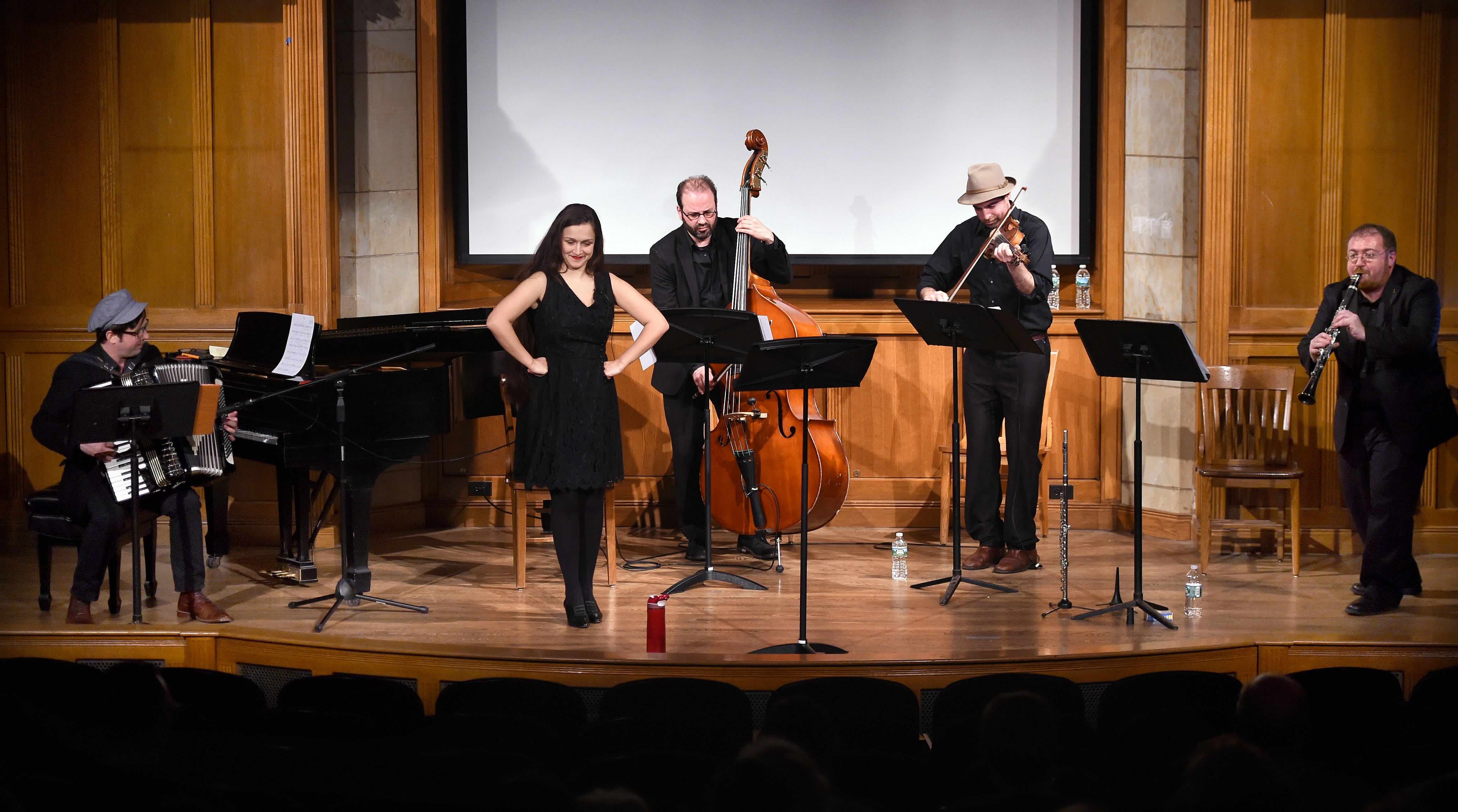
Left to Right: Joshua Camp, Sasha Lurje, Dmitry Ishenko, Craig Judelman, D. Zisl Slepovitch.
Courtesy of Fortunoff Video Archive for Holocaust Testimonies at Yale University.
INTRODUCTION
Released in 2024, Shotns -Shadows: Songs from Testimonies in the Fortunoff Video Archive Volume III is the third in a powerful collection of albums based on songs from Holocaust survivor testimonies held at the Fortunoff Video Archive for Holocaust Testimonies at Yale University. Preceded by Where is Our Homeland: Songs from Testimonies in the Fortunoff Video Archive, Volume I and Shray, hertsele, shray -Cry, My Heart, Cry: Songs from Testimonies in the Fortunoff Video Archive, Volume II, the album is the result of D. Zisl Slepovich carefully combing through the survivor testimonies, conducting research, arranging and composing additional material, and recording the songs with members of his ensemble.
In this interview, Meaghan Guterman speaks with Slepovitch about the challenges of selecting and compiling material, the emotional and intellectual journey of the research process, the impact of recording during the COVID-19 pandemic, and his thoughts on why this music is important both historically and today.
Meaghan Guterman I'm very excited to speak with you about Songs From Testimonies, particularly since volume three came out last year. Can you share how this project started?
Zisl Slepovitch Well, it started with a Fortunoff Archive conference held at Yale University in May 2018. My friend and fellow musician, Annette Ezekiel Kogan, who leads the punk rock klezmer band Golem in New York City, called me and said “They're looking for a composer to work on the archive material. I thought that you would be a better choice for that.” So I said, “Sure I'll connect.”
They asked me to look into one testimony, the testimony of Liubov K. They asked me to transcribe, arrange, and perform the songs. I could bring, given the budgetary constraints, one other person with me. I asked my bandmate from the klezmer band Litvakus, Joshua Camp, to join me. Conference participants met our performance of Liubov’s two songs with great enthusiasm. They [the Fortunoff Archive staff] were so enthralled to hear those songs from the tapes performed live that they asked me, “Can you look at two other songs on that testimony?” [It is possible to find songs on testimony easily because] nearly all of over 4400 testimonies have been identified for whether they contain songs or poetry. When I examined that testimony, I found that the pieces were not songs, but amateur poetry. Liubov had been a prisoner in the Zvenyhorodka ghetto, and then in a labor camp in Ukraine, which she survived. She and other prisoners composed poems and songs to sustain themselves. They used poetry and songs as a vehicle for sharing their feelings and expressing their support for each other. The Fortunoff Archive ultimately wanted me to record those pieces of poetry. I took liberty and composed music in the spirit of the period styles, imagining what could be heard in the Soviet Ukraine around that time. As a trained musicologist and composer, and as someone who actually comes from that neck of woods, it was not a hard guess. I come from Belarus, and I was born in the Soviet Union. So we did the four songs, and as for the rest of the project, I could call it a dayeynu story.
The Fortunoff Archive Project Songs has its own specifications. You can't get too cool or too edgy about a Holocaust project, especially a Holocaust project that is based in an academic institution. There's an advisory board, other people who have different attitudes on what you can or cannot do with the material. The project in and of itself, in a way, is already a kind of transgression in the eyes of many scholars who look at this material with a very preservationist approach; anything that is connected to the Holocaust cannot be remotely hopeful. However the testimonies themselves, as expressly stated by some survivors, are a solid proof that the urge to create music, literature, theatre, even to joke and laugh — amidst suffering and loss of life— had in fact a huge place in surviving the Holocaust (for those few who did), or, for that matter, any genocide.
So that's how it started. It started in May 2018, and we went on to record four songs. Then Stephen Naron, the director of the Fortunoff Video Archive, suggested we record a full album. He assigned me to work as a musician in residence, to look at the database with the testimonies that were marked as having musical poetry in them. I was to comb through, informally speaking, those interviews, and make an assessment of what's worth recording, and what's possible. Around fall of 2018, maybe winter of 2019, I invited my longtime collaborator and friend from my European chapter of life, Sasha Lurje - a versatile vocalist, Yiddish singer, and multiple-language singer, to do it. Together with that band, we recorded three albums.
MG What was your research process like, and were there any unexpected discoveries along the way?
ZS A lot of unexpected discoveries. I mentioned before, most of the songs were composed in ghettos and concentration camps. That, by design, makes those pieces unique and less known. Not a lot of songs from ghettos and concentration camps, and slave labor camps are well known. Most of the Vilna ghetto songs are quite widely researched and performed. But the same cannot be said about the songs of ghetto Łódź and many others. The archive took a holistic approach towards interviewing survivors or witnesses to the Holocaust, which is similar to my own approach as an ethnographer and musicologist during my previous work in Belarus, which played a crucial role in contextualizing each song. To elaborate on that, this approach comes down to asking people to share the stories of their entire lives, not only isolated episodes.This approach allows us to get to know these people because we wanted to learn who these people were. The central point being the history of their lives, rather than the history of death. Death and suffering were obvious, and on the surface. But to see an individual, to see a human being behind it, I think was a key thing to the interviewers who documented these oral histories, and it is a key thing to me as an ethnographer in general.
So yes, the interviews contained a lot of unique material that was original folklore, or some contrafacts — when new lyrics were suited to, say, popular tangos. One of the recurring jokes in the studio was, “So is all the material we're recording marches and tangos?” Because a lot of it is. The march genre was an expression of civilian conscience of the day. You had to sing a march. All the ideologically charged songs on any and every side of the spectrum, from Soviet to Jewish Bundist, or Zionist, or even Nazi German, sounded all pretty much the same. And then tango was also very popular. Since it took the world by storm in the early twentieth century,that's what people heard in city squares, parks, cabaret, and theater, and later on the radio. When the need arrived, they used new lyrics [to these familiar melodies]. These circumstances created and popularized a lot of unique, new, and sometimes unexpected material.
My overall work process was that I would first go through the database. I would listen to the tapes at the timestamps that were marked as having poems or songs, then I would go back and I would listen to the entire testimony. In some cases, that would not be feasible; some testimonies are 10-12 hours long. [In such cases] I would skip through carefully. I would still make it through the entire testimony but not listen to every word. I would then make an assessment as to whether or not there was interesting enough material to record. In other words, if a person said, “When we were children, we would sing Oyfn Pripetshik, Tumbalalaika”, something many people know and sing even today, I would not record that in the studio. However, if I felt the song would portray a community or was associated with a unique event, I would definitely consider that. Then I would make sure to reflect that context in both the liner notes and the musical arrangement.
The second factor was the completeness of songs, because ultimately, music is entertainment, the final product is an album. The bottom line was that I had to create or arrange a sensible, meaningful musical composition that could be presented either on stage or recorded, and then put on a medium, or distributed digitally. If I heard something that was not sufficient for a musical composition, then I would consider combining it with something else. And that something else would oftentimes be context-creating material. For example, if it were an antisemitic song that a survivor would remember from his time of service in the Polish army — we actually recorded a fair share of such antisemitic songs — I would combine it with some song-specific regional folk dances. I would fit local obereks or polkas, or whatever is suitable to musically contextualize it, but also create a sensible musical composition that is listenable.
After the material was selected, the ensemble would convene, we would work on it for a few days, and the musicians would contribute additional details to the arrangement. I welcome such collaborative work because I'm so blessed to work with such creative, versatile, and knowledgeable musicians. Then we would move on to the recording studio, keep fine tuning it, spend another three or four days recording, and another day or two mixing. That route was pretty elaborate, because I also had to make it work for our out-of-town artists. Our violinist and vocalist, Craig Judelman, and Sasha Lurje, came from Berlin, so I had to accommodate that and share material ahead of time. That circumstance created a sense of intensity which I see as a positive thing. We even recorded an album during the time of COVID-19 restrictions and mandatory testing. That kept us on our toes throughout the process, but we managed to do it. That was the third album, Shotns - Shadows. The second album, (Shray, hertsele shray! - Cry, my Heart, Cry!) we tracked in January of 2020, and then lockdown happened in March. Fortunately, we had all the material that needed to be mixed and mastered, and we didn’t need to be in the studio in person for that. It could all be transferred via the internet for me to listen to with my equipment at home, and to make corrections. So we released the second album during the pandemic. That was a very lucky turn of events, indeed.
That was generally my mode of operation on Songs from Testimonies. But then each piece would dictate its own individual route and approach. Some of the survivors were really amazing folk singers, such as Jack M. He was an amazing folk singer with a tremendous memory, and he would sing a lot of songs in many languages. Not just songs, but also Hasidic niggunim and Purimshpils, the folk theatrical plays. He memorized a lot of material, including the Polish antisemitic songs I mentioned earlier. Jack served in the Polish army before the war, became a ghetto prisoner, and survived the Holocaust. After the war, he emigrated to the United States. While not everyone was a folk artist like Jack, other survivor’s songs and stories were just as valuable and worth discovering [even if it was incomplete or the singers were less knowledgeable]. When you have just a few lines here and there, you have to make sense out of them. Sometimes the melody was not quite identifiable, so I had to compose something along the same lines. For one of the pieces, I convinced Stephen Naron [Director of the Fortunoff Archive] to commission our album art artist, Yulia Ruditskaya, a wonderful animation artist, to create an animation, The Waltz, that made rounds of film festivals, based on one such song [I composed for] A. Lutzky’s poetry that was performed in the Łodź ghetto, according to Jean B.’s testimony. The story and creative route for each song is different.
The Waltz (Yiddish song animation), from the Yale/Fortunoff Video Archive for Holocaust Testimonies, created by artist and animator Yulia Ruditskaya based on the song composed by D. Zisl Slepovitch. The film is based on a poem by A.Lutzky, the pen name of the Yiddish poet Aaron Zucker (1894-1957), who was born in Lutsk, Ukraine, and immigrated to New York in the early 20th century. The poem was sung in the Lodz Ghetto during World War Two and was recounted by Jean B.(HVT-701) in her testimony for the Fortunoff Archive. “The Waltz” is included in the album “Cry, My Heart, Cry! – Songs from Testimonies, Volume 2.”
MG Did you notice any thematic or stylistic differences between the folk and popular songs in the testimonies?
ZS Yes, but the line is not always clear. A lot of popular music examples — by popular I mean marches and tangos — were folklorized through the performance, through the multiple chains of transmission of a single source. [Still, there are significant differences between the types of music we encountered.]
The very first testimony I worked with, Liubov’s testimony, was a vivid example of amateur poetry, of folk creativity. It was amateur, imperfect, but so raw in that way
We also worked with some professionally crafted pieces such as popular tangos or very highly elaborate pieces like the song Shotns (Shadows), that hailed from the Vilna ghetto theater. Shotns was written for a revue, Korene Yorn, Veytsene Teg (Rye Years, Wheat Days) for the Vilna ghetto theater. The survivor who recalled it, Sima S., worked directly with the playwright who wrote the lyrics for that song, Leyb Rozental. It's very researchable material, it's just that song was not widely recorded. I only found one archival recording on Yad Vashem’s website, which helped me recover the rest of the lyrics. Sima only remembered a few lines, and I was not able to recover the source of the tango itself but really struck me how masterfully it worked.The tango is full of sunshine, and the poetry contrasts with it. In the poem, people are like shadows yearning for an unattainable light which can only be reached in the afterlife. The contrast between the beautiful, major key tango and such gloomy text is really striking. This is an example of a very masterfully, elaborately written professional piece.
Then you have contrafacts of Latin American tangos that were suited to the modern-day texts, or Polish resistance songs that were retexted with very antisemitic new texts, W Saskim Ogrodzie (In the Saxon Garden). It says that all the Jews must go to Palestine, even this little Moishe in his stroller now knows that he can only walk behind the fence. He cannot cross the fence. Such an openly antisemitic song. The original had zero xenophobia. It was a frivolous love song, W Ogrodzie Saskim, koło fontanny (In the Saxon Garden, Near the Fountain). You can easily find a lot of those songs on YouTube, for example, or any open sources. They continue their life afterwards without the antisemitic text of the contrafact. But those antisemitic texts were performed during the Holocaust.
Sometimes the difference between amateur and professional music is very clear and sometimes the line is blurry. What do you make of a song written as a sort of inexact contrafact to Brother Can You Spare a Dime? set in Yiddish, Efsher hot ir finef sent? (Maybe You Got Five Cent?) sung by a performer in a slave labor camp in Yiddish, which probably hailed from Yiddish theater in Warsaw. Or maybe it was composed by him — it seems to be a professionally composed text, but who knows? There are a lot of mysteries, and there are a lot of questions. And they dictate how you operate, how you address, how you arrange, how you perform the piece.
MG What did you do if you had songs that you weren't able to track down more information on?
ZS Ultimately, I would have to decide. And I made some hard decisions not to record some songs. One of the songs that I'm considering for the fourth volume, should it ever happen, is a song from the Slovak army. It's very specific to a unit, sung by a Jewish soldier who fought in the army and then survived. That song is not to be found anywhere, but the survivor performed an incomplete version. So I'm still looking, I’m talking to specialists in Slovak military history, for example. In every case, I speak to specialists, use search engines, libraries, archives, whatever sources I can access. In some cases, I was very lucky, I really struck gold, but in some cases not so much. It's really a bit like archeology.
MG Can you describe any other challenges you faced while researching songs within the testimonies, and how did you address them?
ZS The first challenge is, again, completeness of material. It’s not just a matter of whether there was enough in terms of quantity, but that a lot of those people were in their seventies and even eighties, and naturally their diction was not as good. Knowing certain languages, including Yiddish, Polish, and some basic Hebrew helped me a lot. But even after having recorded some songs, already having published CDs, I would later discover that I made a mistake. In some cases, I would correct an error with a new run of that CD , or leave it as is and make a note of the errata on the website. Due to the complexity of the material, that's an ongoing process. Some of those unique songs that use slang, camp lingo, ghetto lingo — they're really hard to decipher, and sometimes the meaning changes dramatically [depending on how I interpret them]. So that's one big challenge.
Also, there's a limit to all of that knowledge. Sometimes the material that I find contains elements that are beyond that limit. So sometimes you have almost all elements in place, like [when you have almost solved] a Rubik's cube, but one element is not in its place. You know, it's clearly the white side of the cube, but there's a blue square still in it. What do I do with that? How do I make it all white? That’s when you have to make creative decisions to make up for something that is impossible to understand due to bad diction, even if you listen a thousand times. Sometimes we would have to substitute a word, and maybe make a footnote to explain the choice. We would choose to replace it with something that makes sense, that does not distort the meaning. That's the last resort, of course. That's not ideal, but it ultimately serves the overarching goal of presenting the song. If we miss one word in the whole three or four verse song, that's a compromise we have to make while acknowledging it. That's one challenge. There were multiple other challenges too.
In the very beginning, [I did more experimental work.] There was a Holocaust survivor who's still alive and very active, talking about her experiences at schools, to the United Nations, and so forth. She remembered a poem in English that she wrote while in Terezín. She recited the poem, and I decided to use her audio and write a contemporary minimalist composition that would serve as underscoring. We recorded the piece, but then Stephen [Naron] said, “No, we cannot do that,” because there are limits to the liberties you can take in such projects. The solution for that was to make that track available on Bandcamp but not include it in the physical CD. We also used that music for the opening and closing titles of a video series we recorded during the lockdown. At least it was put to good use. Anybody who's a composer, arranger, etc., we should definitely venture in those risky territories. But there's a limit to that in such projects. There are thin lines between restoration, reconstruction, and creativity. There has to be some creativity, but how much of it [is difficult to assess].
Then there was COVID, the challenge of doing COVID tests and hoping that everyone was well and able to record, and we wouldn’t have to find another large sum of money to convene everyone and arrange new dates with the recording studio [due to an outbreak]. We were very lucky in some instances, but faced many challenges.
MG You talked a little bit about this, but could you describe what criteria guided your selection of songs to arrange and record for the albums?
ZS I would say my first priority for selecting a song would be its meaning in the testimony. Its meaning in the survivor’s or witness’s life. I think the epitome of the importance of context was the French boy scout song, Une fleur au chapeau. So the story was that there were two brothers, originally a Polish Jewish family. They got separated or probably lost their parents, and they were surviving in Paris. Together with other adolescents, they decided to defect from Paris to non-occupied territory. In order to achieve that, they procured forged papers and Petain insignia, the Vichy of France’s insignia, that they affixed on boy scout uniforms. The elder brother pretended to be taking his younger brother to a summer camp. So they went to the train station, and they literally saw Germans who were sorting Jewish families and sending them to concentration camps. While fully understanding what was going on, the elder brother, who was a young teenager, was whistling that song with feigned carelessness to pretend that he was a French boy scout.
MG Ah, so that's why there’s whistling in the beginning of your arrangement.
ZS That’s why the whistling, and that's why I used the piccolo there.
MG That makes sense.
ZS It all has to make sense. It’s all about giving great attention to detail in arranging and selecting and producing, and everything around it. There's no other reason in the world I would otherwise include this French song that first appeared in print in 1936. It's not Jewish music per se, but it had to do with the actual story of these survivors. So that's one example. Sometimes the context is not contained in the song per se, it is the commentary that needs to be given.
MG Yes, wow. I was so glad to be able to access the liner notes. They were so fascinating to read, and I'm really glad you talked about the French piece in this interview, because it stood out to me as well. Another piece that really struck me was the contrafact of Cielito Lindo.
ZS That's what makes this project really valuable, not just to Holocaust specialists or scholars, but to historians of Polish history, or urban history, or Warsaw history – the story of how Cielito Lindo made it to Poland by a South American touring band [illustrates something important about the historical moment]. It was appropriated multiple times. Actually, the version that we recorded was a prewar version, [W pociągu jest tłok (Crowded Train)] a Great Depression version, although sung during World War II. The survivor [whose testimony it came from] was caroling in the courtyards of Warsaw, singing it. But there was also a wartime version of the same song, Teraz jest wojna,kto handluje, ten żyje, (It is war now, those who sell live). And then there was another version pertaining to the Solidarność, the Polish Solidarity Union strikes and demonstrations in the 1980s anti-Jaruzelski movement. That song really has its own page in modern Polish history. It could be valuable and important to people who study other fields of scholarship or just want to know more about this history. Presenting all of this is part of a holistic approach. I would circle back to the fact that the Fortunoff Archive interviewers were asking people to tell their entire life stories [and not just isolated stories of the years of the Holocaust]. That's what makes the testimonies incredibly valuable, and by design, prompts people to speak about many things that they might not even acknowledge themselves, that would speak to all kinds of listeners and readers.
MG How did you balance staying true to the original songs while introducing new arrangements for the band?
ZS I would say that a historically informed approach is the key. Even when I had to compose new music for the project, I would use the genre patterns that would likely have been used, performed, or heard on the radio in that time and place. I think staying true to the historical facts of what could really have been heard and performed is the chief answer to that, the only answer.
I also have to mention that the musicians I work with come from a variety of musical backgrounds, and that contributed really wonderfully to the process. Because everybody brings his or her own background. Our accordionist and keyboardist, Joshua Camp, has done a lot of Appalachian folk music, but also Latin music. He is a founding member of Chicha Libre, which has gained immense popularity in South America, and One Ring Zero, a more experimental band. His idiomatic accordion playing brought a sense of authenticity to the songs, like Cielito Lindo.
Dmitry Ishenko is a bass player who's done work with many big names in jazz. He’s a really sensitive and versatile musician, who can perform anything from classical music to theater music, as well as folk and avante garde jazz. I've employed him in musical theater settings, including Fiddler on the Roof in Yiddish. Recording tangos and early jazz arrangements for Songs from Testimonies, Dmitry was really speaking his language. Craig Judelman, our violinist, is rooted in American folk music, and has become an expert in klezmer fiddle styles — he’s a wonderful klezmer violinist. I'm coming from the classical music world, but I also I ventured into klezmer early in my life, and then into improvised music. I had to carefully find the right woodwind instruments, and the right setup that would actually sound more like early jazz in those tangos. For me, jazz was a later-learned language, while for Dmitry, it was his musical mother tongue.
Sasha Lurje, known primarily as a Yiddish singer and pedagogue, is also deeply steeped in the Slavic and Baltic musical traditions, and is an extremely versatile musician, who has brought so much to the project on many levels. Now Sarah Myerson, a cantor, dancer, and a wonderful singer, is filling in for Sasha when needed, also brings a lot of nuance and detail to the rendition of each piece. They are wonderful, sensitive artists who contribute a lot.
We would have conciliums, discuss the multiple ways we could go, and agree upon the the one that would ultimately make it a good sounding track. That's something we had to consider. It's Holocaust music, though there were some pre- and post-war pieces we worked on, but it had to be a good sounding track, because ultimately, it has to be something people want to listen to and spark their interest.
MG What steps did you take to preserve the emotional weight of the songs from the testimonies in your recordings?
ZS Oh, you have to live through each piece. And that takes a lot of effort to really sing through the Holocaust period songs, telling of terrible suffering and death. I have done Holocaust songs many times in my life, beginning in my adolescence. When I actually performed solo, I remember bursting into tears or barely holding my tears. It's impossible to sing if you actually think about the meaning of the lyrics — the loss of life, loss of health, loss of significant others, family. It's impossible, and it should be so. You have to become a little numb to it, but you do have to live through it as well. You have to actually convey that emotion and stay very true to what survivors wanted to convey. Or what their counterparts, their friends who did not make it, wanted to survive. Some of them actually performed the songs of people, including their friends, who did not make it. Like in the opening song on the second album, In Dinaverke, which was a forced labor factory Latvia. The survivor, Lily M., remembered her friend Tosia, who died from typhus in 1945 somewhere in Germany, at a slave labor facility. Tosia composed that song, and it's important to convey the gravity of those feelings. It's a tricky combination, to be sensitive to each song but numb enough to be able to perform it professionally, and not to sob into the microphone. It’s really hard.
MG What do you believe is the role of music in preserving and conveying Holocaust testimonies?
ZS Music is an organic vehicle of storytelling. In fact, in many testimonies, as people are sharing their stories, they remember a song that accompanied their deportations or death marches, or their story of staying in a concentration camp, or doing theater performances in the ghetto. Songs are part of the stories that they tell. Music is not an added or artificial element. It's not something that can be meaningfully separated from their stories. The other side of this is that the songs can’t be separated from the context of these stories. The stories are necessary context for the songs, [just as the songs are integral to the stories]. We’re really taking part of a testimony and presenting it on an album, highlighting the musical component, but always telling the story of how that piece came to life. Or how it was performed, by whom, when, and where.
MG What do you hope listeners take away from Shotns - Shadows: Songs from Testimonies in the Fortunoff Video Archive, Volume III, and this whole collection?
ZS Music makes things accessible, really speaks on a different level to people. I hope that music will prompt people to get interested in these testimonies, in the stories of people. And maybe have them reconsider their vision of people's survival in the Holocaust. Help them understand that music itself helps people survive, just like storytelling, just like any human or cultural expression. I hope that it will really let people read deeper into the stories themselves and also make them realize that this is about these people's lives. That this is what matters to their lives. On the other hand, I hope it becomes clear from these publications that these were very few people who made it, and most — by magnitudes — did not survive, and did not get to tell their stories. These are important takeaways that I hope people have from all of these albums.
Shotns - Shadows: Songs from Testimonies in the Fortunoff Video Archive, Volume III can be found on Spotify, and on Bandcamp, https://zisl.bandcamp.com/album/shadows-songs-from-testimonies-vol-3, along with the Volumes I and II. Further information about the project and albums can be found on the Fortunoff Video Archive for Holocaust Testimonies website at https://fortunoff.library.yale.edu/education/songs-from-testimonies/.

In geveb is turning t(s)en! If we want In geveb to continue to grow and thrive and remain a central address for the study of all things Yiddish online, we need your help to launch our second decade. Our goal is to raise $20,000 by our official tenth birthday: August 15, 2025. We invite you to donate to support In geveb and to honor everyone who has got us this far.