May 20, 2025
By now, the history of the Anschluss is well known: When German troops entered Austria on March 12, 1938, Germans received enthusiastic support from most of the population, and within a day Austria had been incorporated into Germany. Widespread antisemitic actions and political violence followed, including the forceful application of the anti-Jewish legislation already in place under Nazi rule in Germany. Jews were almost immediately expelled from the country’s economic, social, and cultural life.
Most readers in North America were likely to have encountered this story through news coverage. Through the US Holocaust Memorial Museum’s online resources, you can now read hundreds of newspaper articles from around the United States about the Anschluss, 1 1https://newspapers.ushmm.org/s...[]=5 most of which paint the picture in broad political strokes rather than focusing on the stories of individuals.
How did North American Jewish writers intervene, in the years surrounding the war, to offer a more personal vantage point on these events? How did they address North American audiences and teach them to care, with an air of intimacy, about the shocking suddenness of a moment when Jewish life in Vienna was thoroughly shattered? This essay offers a close look at two novels in which the Anschluss takes center stage.
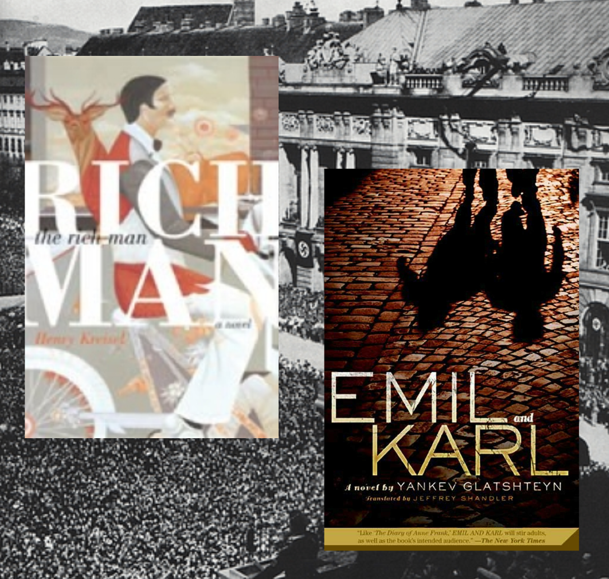
Henry Kreisel’s The Rich Man, written in English in 1945 and published in Toronto in 1948, is a rare example of a Holocaust novel “without an element of retrospective sentiment or irony,” which, as Norman Ravvin explains, “is almost unheard of in English-language literature.” 2 2 Norman Ravvin, Introduction, The Rich Man, by Henry Kreisel, Red Deer Press, 2006, pp. 3-10. (9) Set in 1935, the book centers on Jacob Grossman, a man of 53 who is employed as a presser in a Toronto garment factory. For the first time in 33 years, Jacob returns to his native Vienna, where he witnesses the intensifying oppression of the city’s Jews, senses his family’s desperation, and reckons with his inability to provide the assistance they need.
Kreisel was born in 1922 in Vienna’s Leopoldstadt district to a family of Polish Jewish origin. In July 1938, he managed to escape to England and soon renounced his native German in favor of English. Two years later, when he was still an adolescent, he was sent to Canada as an enemy alien and was interned there until 1941. Kreisel went on to become an accomplished novelist and a professor of English at the University of Alberta in Edmonton.
Forty-five years after he had departed Europe—and three years before he was appointed an Officer of the Order of Canada for producing fiction that “has a universal quality and is a bridge between the worlds of Europe and Canada”—Kreisel wrote an essay entitled “Vienna Remembered” in which he described his first sixteen years. As a child and youth, he recalled in 1985, he lived among “extended family” and knew “security, [and] a feeling of belonging” 3 3 Henry Kreisel, “Vienna Remembered,” Another Country: Writings by and about Henry Kreisel, edited by Shirley Neuman, NeWest Literary Documents Series 7, NeWest Press, 1985, pp. 50-58. (52) in his Jewish enclave. That certainty was crushed in the summer of 1934, when the assassination of Chancellor Dollfuss by the Nazi party brought into Kreisel’s consciousness “the smouldering conflicts that were eventually to tear Austria apart.” 4 4 Kreisel, “Vienna Remembered,” 54. It was then that Vienna became a place where he “encountered the forces of evil in the world and looked into the heart of darkness.” 5 5 Kreisel, “Vienna Remembered,” 58.
Kreisel remembers the shock of the Anschluss that followed four years later. Directly after Germany’s annexation of Austria on March 13, 1938, “schools remained closed for a few days,” 6 6 Kreisel, “Vienna Remembered,” 56. Kreisel wrote. Upon reopening,
everything was changed, changed utterly. Jewish students were immediately segregated, and had to sit in the rear benches of their classrooms. Some of our fellow students still tried to be civil, some even friendly, but most were now openly hostile. There were verbal taunts and then increasing physical violence. Most of the teachers, either out of fear or because they approved of what was going on, turned a blind eye to the increasing violence in the corridors and even in the classrooms. 7 7 Kreisel, “Vienna Remembered,” 56.
As the “school was being taken over by barbarians,” the director “sequestered himself in his office”; one lone instructor, “Father Ullmann, a priest who gave courses in religion for Catholic students,” stood out in his “decency.” 8 8 Kreisel, “Vienna Remembered,” 56. By May, after “a particularly nasty and violent incident,” Kreisel “absolutely refused to go back to school and [had] dropped out.” 9 9 Kreisel, “Vienna Remembered,” 56-57.
Notwithstanding these painful memories, when he first set himself the task of writing a novel based in his early years, Kreisel returned to Vienna, gripped by the imaginative pull of its setting. In The Rich Man he sends his Austrian-born, Yiddish-speaking protagonist “back to Europe.” 10 10 Felix Cherniavsky, “Certain Worldly Experiences: An Interview with Henry Kreisel,” Another Country: Writings by and about Henry Kreisel, edited by Shirley Neuman, NeWest Literary Documents Series 7, NeWest Press, 1985, pp. 170-75. (170) In doing so—in relating “the Canadian experience to the European experience” and presenting this “double view” to his readers—Kreisel correctly observed that he was “one of the first people to bring to modern Canadian literature the experience of the immigrant.” 11 11 Cherniavsky, 170.
The Rich Man was written and published in the immediate aftermath of the war, but its plot centers on several weeks in 1935. The resulting narrative irony, as Rachel Feldhay Brenner notes, “derives from the disparity between the time of the story and the time in which the story was read.” 12 12 Rachel Feldhay Brenner, “Henry Kreisel—European Experience and Canadian Reality: A State of Mind,” Journal of Postcolonial Writing, vol. 28, no. 2, 1988, pp. 269-87. (280) Readers, for example, grasp the risk Jacob takes as he travels by train from France, where his ship docks, to his family home in Vienna. A customs agent boards the train as it crosses the Belgian border into Germany. He is “a tall, heavy-booted officer in the black uniform and the visored cap of the storm-guards, on his left arm, just above the elbow, the deep red band with the black swastika in a white disk.” 13 13 Henry Kreisel, The Rich Man, Red Deer Press, 2006, p. 58. As the official checks passports and then searches under seats for contraband material, Jacob notices “the strange and ominous insignia on his cap—two crossed bones and a leering death’s-head. He had once read newspaper accounts of this, but now that he saw it with his own eyes, the effect was terribly menacing and monstrous.” 14 14 Kreisel, The Rich Man, 58-59. The sight of the skull and cross bones disturbs Jacob’s equilibrium, for it makes real a once distant danger. Later that day, after the evening meal with his family, he finds “himself thinking [again] of the insignia” and begins to “sweat.” 15 15 Kreisel, The Rich Man, 88-89. In fact, neither Jacob nor the reader can forget “that moment” 16 16 Kreisel, The Rich Man, 59. of fear on the train, which looms ominously over narrative events and evokes a terrifying future known only to the audience.
Subsequent scenes in the novel are similarly magnified by sinister foreshadowing. At the cave, Jacob and his young nephews Herman and Bernhardt are tormented by three thuggish boys who seek to claim it for themselves. When the ringleader spits out, “You know what’s in this cave? Two little Jew-boys and an old Jew” and calls Herman a “little Jew-rat.” Then, “Jacob’s eyes grew large … All the air seemed to have been cut off … He felt the pounding of his heart and he was afraid.” 17 17 Kreisel, The Rich Man, 167. Eventually, the intruders retreat, but not without further attack and warning. They throw a stone at Jacob and shout hatefully, “Goddamn Jews. Wait’ll we get you alone. We’ll knock the hell outa you.” 18 18 Kreisel, The Rich Man, 168. Later on, the revelation that Robert Brucknor aka Robert Koch, a gentile ally of his sister and brother-in-law, has been arrested for “printing an underground newspaper” induces in Jacob “a kind of fear he had never known before.” 19 19 Kreisel, The Rich Man, 254, 257.
In these instances, Jacob’s fright once again lasts “a moment” 20 20 Kreisel, The Rich Man, 257. and his dread is fleeting. Immersed in the present and ignorant of the future, he quickly regains composure. But Kreisel’s first readers lack a similar shield. They bear knowledge of the recent past and of a world war that has only just ended. They already know the dire outcome of Koch’s detainment by police. They also understand that the three boys will not be censured for antisemitic tyranny that is societally sanctioned. They hear the Nazi analogy of Jews as vermin in the barb directed at Herman. And they are cognizant that the Jews of Europe will, indeed, meet a hellish demise. For these readers, The Rich Man makes all too plain the generalized suppression of dissidents and Jews in 1935 Vienna.
All the same, as a self-declared “ethnic” writer in Canada, Kreisel refuses to cater to “perceived readerly appetites.” 21 21 Henry Kreisel, “The ‘Ethnic’ Writer in Canada,” Identifications: Ethnicities and the Writer in Canada, edited by Jars Balan, Canadian Institute of Ukrainian Studies, University of Alberta, 1982, pp. 1-13. (11) Attuned to “the dangers of falsifying experience,” he will not “play up the exotic and picturesque aspects of his material and thus … diminish and ultimately … corrupt its value.” 22 22 Kreisel, “The ‘Ethnic’ Writer,” 11. So, rather than rob his subjects “of their dignity” by presenting them as “caricatures, [and] less than human,” 23 23 Kreisel, “The ‘Ethnic’ Writer,” 10. he focuses on the intrinsic tie between individual identity and language. During internment in Canada, Kreisel himself had learned “how closely linked identity is to language, how intertwined are the emotional and psychological centres with the language in which that personality expresses itself.” 24 24 Kreisel, “The ‘Ethnic’ Writer,” 3.
In a novel recognized by Neil Besner as an early “depiction of the immigrant’s New World nostalgic impulse to return, in language as much as in vision, to a European world imagined whole, before its second modern breakup,” 25 25 Neil Besner, “Kreisel’s Broken Globes,” Canadian Literature, no. 107, Winter 1985, pp. 103-11. (104) Kreisel melds English and Yiddish inflection to demonstrate that “the new language could be made to express the old as well as the new,” 26 26 Kreisel, “The ‘Ethnic’ Writer,” 8. a semantic strategy that is announced early in the first chapter. This is especially notable as Yiddish was not Kreisel’s own first language—he was a German speaker writing in English—but he presents Yiddish-inflected speech as a deliberate strategy for characterization of his immigrant protagonist.
Jacob shares his plans with his daughter Rosie, with whom he lives in Toronto, and says, “Vat you t’ink? Ef a person vants to go ‘vay fa six-seven viks, he got to esk the manager, no?” 27 27 Kreisel, The Rich Man, 15. When Rosie dismisses the “foolish notion,” Jacob instantly shifts to Yiddish, which is conveyed through unaccented English. “‘This here is no foolish notion,’ he interrupted her sharply, suddenly switching to Yiddish” 28 28 Kreisel, The Rich Man, 15. the narrator remarks, in an interpretive cue to the reader. Later that morning, Jacob approaches his general manager: “Mistah Donken, I come to ask you for a long holiday because I am goink to the old contry. To Austria, Mistah Donken. In six – seven viks, mit God’s help, I’ll be back.” 29 29 Kreisel, The Rich Man, 24. Here, Kreisel is adapting a convention deployed by Yiddish writers like Kadya Molodovsky. In Fun Lublin biz Nyu-york: Togbukh fun Rivke Zilberg, a novel serialized in 1941 and published in book form in 1942, Molodovsky uses what Anita Norich identifies as “foreignized English” to indicate words that her Yiddish-speaking heroine either “would have heard or misheard.” 30 30 Molodovsky’s novel was translated into English by Norich as A Jewish Refugee in New York: Rivke Zilberg’s Journal, Indiana University Press, 2019. See Norich’s Introduction, pp. vii-xxiii. (xvii)
While Jacob’s flawless English stands in for fluent Yiddish, the faulty English he speaks with gentile figures signifies the dislocation he feels as an immigrant to Canada, a strategy used by other writers such as Henry Roth in Call it Sleep. 31 31 See Henry Roth, Call It Sleep, Robert O. Ballou, 1934. Kreisel, like Roth, supplants Yiddish—a language that “would be illegible and incomprehensible” to the majority of readers—with what Hana Wirth-Nesher classifies as “‘translation’ into the familiar sign of English.” 32 32 Hana Wirth-Nesher, Call It English: The Languages of Jewish American Literature, Princeton University Press, 2006, p. 79. Thus, as Wirth-Nesher goes on to elucidate, Yiddish becomes “the absent source language from which the thoughts and actions in English are experienced.” 33 33 Wirth-Nesher, p. 80. That The Rich Man features so little “foreignized English,” and reads as if it were a “translation” from Yiddish, is intentional and meant to respect rather than demean Jacob—we, his English readers, experience him largely as an articulate narrator of his specific experience (recounted as though in Yiddish), rather than through the lens of the difference, and even potentially the humor, of the representation of his imperfect English.
Kreisel’s willingness to “seek in the memory the strength and vividness of my deepest roots” and his matching determination “to see European experience through Canadian eyes, and Canadian experience through European eyes,” served to widen his fictive lens and introduce readers to his “double perspective.” 34 34 Kreisel, “The ‘Ethnic’ Writer,” 11, 8. While Kreisel’s novel is about a return journey to Vienna, it asserts itself as a Canadian narrative about displacement and memory through the eyes of a character who feels himself both rooted in the past and belonging to the present, though these two poles feel disjoined.
Like The Rich Man, an adult tale written and published soon after the end of the war, Emil un Karl, a children’s novel composed and released during the conflict, transpires as “a developing event of the present.” 35 35 Jeffrey Shandler, “The Holocaust for Beginners: Yankev Glatshteyn’s Emil un Karl and Other Wartime Works for Young American Yiddish Readers,” MELUS: Multi-Ethnic Literature of the US, vol. 37, no. 2, Summer 2012, pp. 109-30. (116) Emil un Karl, set in early spring 1939, concentrates on the friendship of Jewish Emil and Christian Karl—two nine-year-old Viennese boys—who become homeless after the Anschluss. Together, they wander the city and by turns experience chaos and rescue. Written in Yiddish in 1939, the novel was published in New York in 1940. An English translation by Jeffrey Shandler finally appeared in 2006, and my remarks here are in reference to this translation.
Glatshteyn, akin to Kreisel, had Polish roots. He was born in Lublin in 1896 and immigrated to New York in 1914. There, he published poetry and prose, helped establish the Inzikhist literary movement in 1920, and later emerged as a critical figure in American Yiddish literature. A trip to Poland in 1934 to nurse his dying mother brought home the threat of heightened antisemitism that was spreading across Europe.
Vienna, so carefully portrayed by Kreisel in The Rich Man, is elicited by Glatshteyn through the depiction of actual incidents that occurred there in the weeks following the Anschluss. These include the isolation and targeting of Jewish students in public schools, as reported by Kreisel; the widespread humiliation of Jews; and the effort to safeguard children by sending them out of Austria; alongside references to resistance operations and conditions in concentration camps. 36 36 Shandler, 116. As Jeffrey Shandler notes, Emil un Karl was a pathbreaking work. “Among the first” to represent the harassment and anguish of Viennese Jews, it was written “to transport [American] readers not to the remote past but across the Atlantic in present time, inviting them to imagine an unfolding epochal event” 37 37 Shandler, 110, 116. that would become known as the Holocaust.
Shandler continues, Glatshteyn “had no first-hand knowledge of Vienna” when he chose the “modern city” 38 38 Shandler, 117. for his locale. In doing so, the author hoped to engage young readers, most of whom lived in large US cities such as New York, Boston, Philadelphia, Cleveland, and Detroit. 39 39 Shandler, 117. Many of those readers, like Glatshteyn’s young champions, also resided in apartment buildings, attended district schools, roamed nearby streets, and played in neighborhood parks.
The novel opens in Karl’s apartment after “three, big hulking men” 40 40 Yankev Glatshteyn, Emil and Karl, translated by Jeffrey Shandler, Square Fish, 2008, p. 3. burst in, seize his mother, and drag her away. Karl’s mother, like his father who was murdered five years earlier, is a socialist whose views are anathema to the Nazi regime. Once he rallies—Karl himself is punched in the stomach by one of the men—he runs “all the way down the stairs [of his building] in one breath” 41 41 Glatshteyn, 9. and makes his way to his friend Emil’s home. At Emil’s apartment a separate catastrophe has taken place. Emil’s father has been beaten, carried off, and slaughtered—the ashes are returned “in a box” 42 42 Glatshteyn, 24. —and his mother has suffered a resulting breakdown. After Emil’s mother is transferred to hospital, the two boys are dispossessed of family and left to fend for themselves. They avow their deep attachment to one another, return secretly to Karl’s home, and sleep in the cellar of his building. Thus, Glatshteyn deploys the familiarity of an urban setting and boyhood connection—a comforting friendship based on love and understanding that crosses religious boundaries—to ground his story and capture young readers.
An account of the difficulties the two boys confront at school deepens readers’ empathy for Emil and Karl. They are persecuted for playing together. Emil is picked on, beaten, and called “Dirty Jew,” while Karl is threatened, teased, and hit. 43 43 Glatshteyn, 18. Then, for two weeks following the Anschluss, Emil stops coming to school. Initially, Karl “faithfully” visits his friend at home, but Emil’s mother soon asks him “not to come over any more”; she is desperate to avoid “trouble.” 44 44 Glatshteyn, 11. Karl, however, retains a fierce loyalty to Emil, a feeling that is reinforced by his own mother who encourages him to act according to his beliefs. Karl’s decision to remain friends with Emil is bolstered by his teacher who abhors Nazi ideology. Though she feels too “old and broken” to publicly defy the dicta to teach her students “how to hate, [and] to make Jews the scapegoat,” she resists by privately urging Karl to “protect your precious heart … That little bit of decency is our only hope. Be good to Emil, protect him whenever you can.” 45 45 Glatshteyn, 20, 21. In a treacherous world where adults feel impotent and abandon their principles, the two children maintain their integrity and show unusual bravery. Here, Glatshteyn uses the antagonistic school environment to affirm the value and significance of the boys’ alliance.
In other scenes that revive recorded events of spring 1938 readers perceive the ever strengthening bond between Emil and Karl. As they walk the streets of their neighborhood, the boys suddenly notice that Jewish-owned stores selling groceries, shoes, and clothing have smashed windows and looted shelves. They come upon a public square where they are forced to join hundreds of Jews who are on their knees scrubbing the pavement with their bare hands. Uniformed overseers deliver blows, step on hands and heads, and chant “the children of Israel will never escape … the children of Israel will die, die, die!” 46 46 Glatshteyn, 61. At their local park, they watch as Jews are forced to sit in trees and crow and trill like birds, to crawl on the ground and bark like a dog or chew on grass and low like a cow. When one man shoots himself, the overseer declares, “How beautifully they die, these children of Israel! How excellent!” 47 47 Glatshteyn, 93. Each terrifying circumstance brings the boys closer and fortifies their pact to remain united always.
Like Kreisel, Glatshteyn brings gentile dissenters into his narrative. While Jacob’s brother-in-law Albert provides Koch with shelter and protection from the authorities—for three months, Albert hides Koch in a back room of his bookshop—Matilda and Hans offer refuge and care to Emil and Karl. The couple, like Koch, is part of a clandestine organization that seeks to thwart the government. At the park, Matilda rescues Emil and Karl and brings them to the safety of her home on the outskirts of the city. Hans courts peril by distributing “pamphlets and books [and] … recordings of patriotic songs that ended with speeches denouncing the crimes of the current regime”; he does “so that Emil and Karl might be able to live together in peace.” 48 48 Glatshteyn, 137, 180. After Hans is betrayed and then captured by police, Matilda escorts Emil and Karl to the home of her Jewish sister-in-law who is facilitating Kindertransports to England. Aboard a bus to the railway station, as they grapple with their imminent departure from Austria, the boys take solace in the love they were shown by Matilda and Hans, who function as surrogate parents during this unprecedented time of upheaval and volatility. The novel’s emphasis on loyalty, friendship, and succor helps temper its disruptive close at the train depot, where amid the crowds and commotion Emil and Karl are split up and the prospect of a reunion is left uncertain.
As Shandler points out, Emil un Karl was written in Yiddish about “contemporary Jews who, were they actual people, would speak a different language,” 49 49 Shandler, 118. that is, German. Glatshteyn’s use of lucid Yiddish to denote his characters’ native German compares with Kreisel’s explicit use of fluid English to suggest Yiddish. Glatshteyn’s linguistic aims are implicit, however, and tied closely to his didactic purpose, Shandler argues. As a book that was read in US classrooms, the author sought to boost the grasp of Yiddish among English-speaking children attending extramural Jewish schools; 50 50 Shandler, 114. to highlight the cohesion of language and European Jewish culture and to show what might be lost if Yiddish were to disappear; and to demonstrate the vibrancy of Yiddish in the diaspora, where it served as a bridge between new and old worlds. Thus, Yiddish gives expression to the longing and the brooding of the author of Emil un Karl, as a shadow language standing in for a similarly native expression of his characters’ travails in their native German.
While Kreisel and Glatshteyn found sanctuary in North America, they wrote as European exiles whose continental sensibilities and firsthand experience of racism informed their respective portrayals of Vienna. In so doing they educated their North American audiences—in Kreisel’s case English-readers and in Glatshteyn’s case largely English/Yiddish bilingual students in Yiddish supplemental schools—about the sudden upending of Jewish life in Vienna at the start of World War II. By deliberately grounding their narratives in place and time, and by deploying Yiddish—the first language of many of their Jewish readers—through inflection (in the case of Kreisel) and idiom (in the case of Glatshteyn), they provided an immersive rendering of Jewish persecution in 1930s Austria.