Apr 15, 2026

INTRODUCTION
This piece is part of a series of reflections celebrating the 10th anniversary of In geveb’s publication. Biz hundert un tsvantsik, In geveb!
A hartsikn dank, my profound thanks to Lindsey Bodner, the executive director of the Naomi Prawer Kadar Foundation, for locating the relevant emails and digital files going back to 2010, without which this retrospective could not have been written.
In geveb was born at a one-day conference held at Ben-Gurion University on Sunday, June 13, 2010. We were a group of over thirty scholars of Yiddish from all over Israel, crowded into a newly opened Yiddish Room: graduate students, professors, and lay leaders.
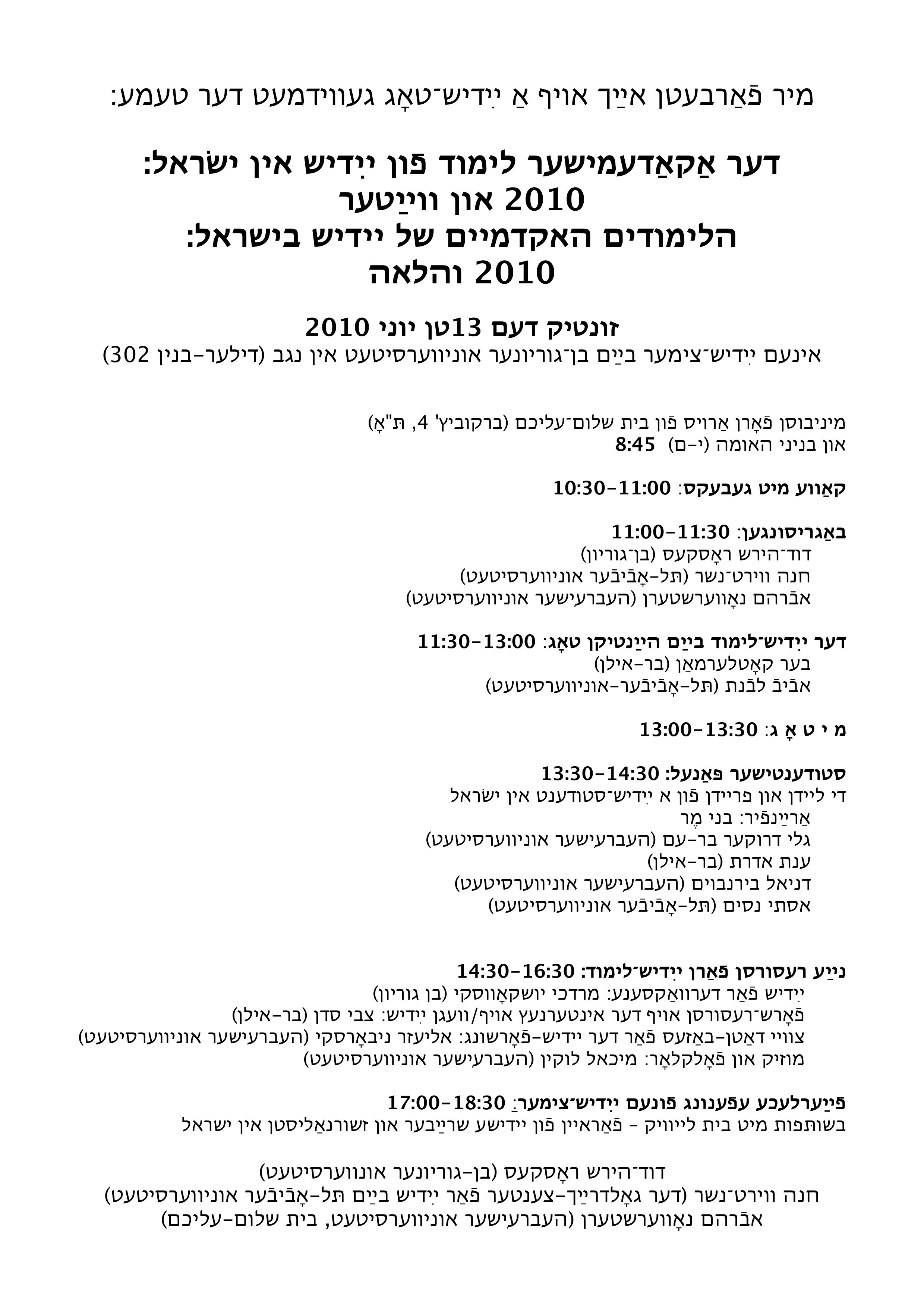
program for the conference held at Ben-Gurion University on Sunday, June 13, 2010.
Located in the heart of the desert, BGU was off the beaten (Yiddish) track, and most of the participants were bused in from Tel Aviv and Jerusalem, courtesy of Beit Shalom Aleichem. The stated purpose of our gathering was to think strategically about the future of Yiddish Studies in Israel. Stephanie Ginensky, at that time the research assistant of Prof. Hana Wirth-Nesher, had prepared two bibliographies, of publications and dissertations in the field of Yiddish from 1995 to 2010, whose multilingual scope was impressive (although English greatly outnumbered other languages) but also deeply disappointing, because they revealed pockets of activity operating without rhyme or reason, with no guiding hand, no consistent standard, no apparent connection between one scholarly project and another. The work was proceeding in a vacuum. Then, instead of breaking for lunch, as scheduled, we ate sandwiches in our seats, to allow more time for what turned out to be the high point of the day: a panel discussion on “The Sorrows and Joys of a Yiddish Student in Israel.” The three students who presented were Gali Drucker Bar-Am, Anat Aderet, and Daniel Birnbaum, the first two native Israelis and the third American-born. Each had a completely different story to tell about the roads that led her or him to study Yiddish, yet when it came time to address the sorrows, each spoke about the crying need for an academic journal dedicated to the study of Yiddish. With the deaths of Shalom Luria and Avrom Sutzkever, the editors of Huliyot (in Hebrew) and Di goldene keyt (in Yiddish), respectively, no such publication existed in any language. Where was a young scholar to publish work-in-progress? Where could one go to learn what was happening in the field?
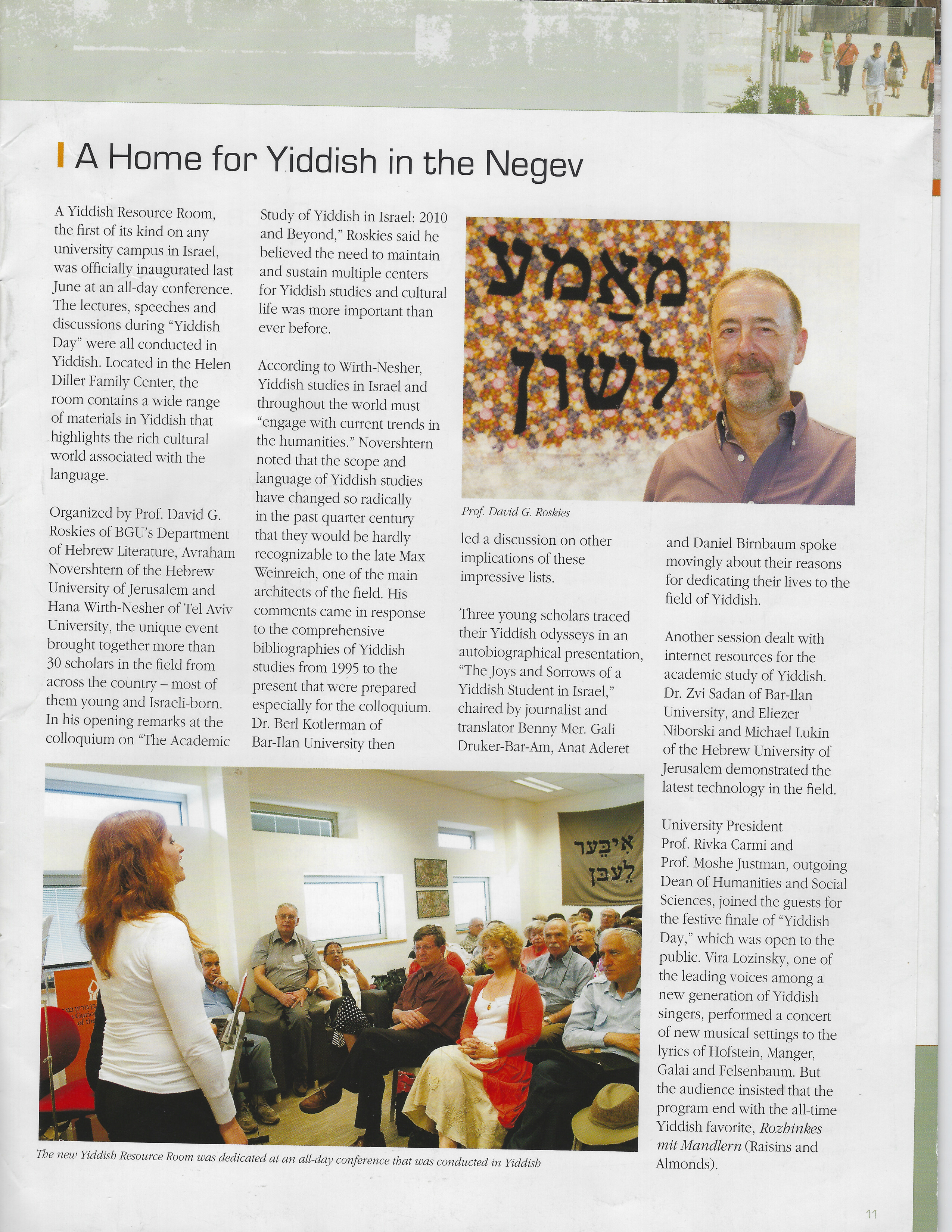
Write-up of the Yiddish resource room, inaugurated at the 2010 conference at BGU
That was my cue, my epiphany. I went over to the built-in bookshelves, which in addition to a basic Yiddish collection of 300 volumes housed a complete set of Prooftexts, and pulled out the first issue, with its regal colors and emblazoned ALEF, and waved it in front of the assembly. “You see this journal?” I asked with rhetorical flourish. “It was created in 1981 by eight recent PhD’s, one of whom [pointing to Hana Wirth-Nesher] is sitting right in front of me, and together we launched the field of Jewish literary history. Now it’s your turn; itst iz gekumen ayer rey.” At that moment, I felt Dr. Max Weinreich shining his countenance down upon me from the Celestial Yeshiva.
The legend of Max Weinreich is well known, 1 1https://www.tabletmag.com/sections/arts-letters/articles/legend-max-weinreich-yiddish especially to the readers of In geveb, who will be familiar with his dedication to cultivating and empowering the next generation of Yiddish scholarship.
“Now it’s your turn,” I said, addressing the members of my audience under thirty. “What is most needed at the present time is a scholarly venue for Yiddish. So, tell me, what should that venue be? In print or online?” thinking I knew the answer. By a show of hands, the overwhelming answer was online—not what I expected.
Our working lunch was followed by a demonstration of the latest computer technology in the field of Yiddish by Zvi Sadan of Bar-Ilan and Eliezer Niborski and Michael Lukin of the Hebrew University. From all sides I was hearing that the new frontier, the new central address for Yiddish Studies was—cyberspace. This is what “our youth” demanded, and if I could make it happen, my job was done.
Thereafter, things moved quickly. If this was my Weinreich Moment, then Yiddish Studies must have a territorial base, namely Israel, and must be conducted entirely in Yiddish. To that end, I recruited two of the most promising graduate students in the room, Gali Drucker Bar-Am and her close friend Ella Florsheim, to launch an online Yiddish journal, and sent them a detailed memo on how to proceed—choose an eight-person editorial board of peers (like Prooftexts!), send a prospectus to Israel’s major university presses, come up with a catchy name—and offered to hook them up with their academic counterparts abroad. By June 20, Gali and Ella had graciously bowed out, until they finished writing their dissertations, but I had hit upon the title, In geveb, named after the two volumes of Yehoash’s modernist verse, “vos hobn gehat a groyse hashpoe af Sutskever; that had a profound influence on Sutzkever.” What better way to domesticate the web than to claim it for Yiddish? What better way to ensure cultural continuity than to gather up all the sparks of Yiddish modernism?
Got shikt tsu di kelt nokh di kleyder, as we say, “God sends the cold after the clothes.” My beloved student Naomi Prawer Kadar had died of cancer on February 23, 2010, and the Naomi Prawer Kadar Foundation established in her memory had just given a major grant to Tel Aviv University to secure the existence and growth of the Yiddish Summer Program, to be renamed after her. Concurrently, the BrainPOP enterprise created by Dr. Avraham Kadar while Naomi was still alive had just launched YiddishPOP, with its inspired triumvirate, Nomi, Moby, and Meyerke. There was now a central address for all utopian Yiddish schemes, and that was the family foundation run by Dr. Kadar.
I submitted the following four-pronged proposal to the Board of the Naomi Foundation on November 22, 2011, and titled it “The Naomi Foundation Virtual Center for Yiddish Studies: A Sovereign Space for Yiddish.” The lynchpin of the operation, strategically placed in the middle, was In geveb.
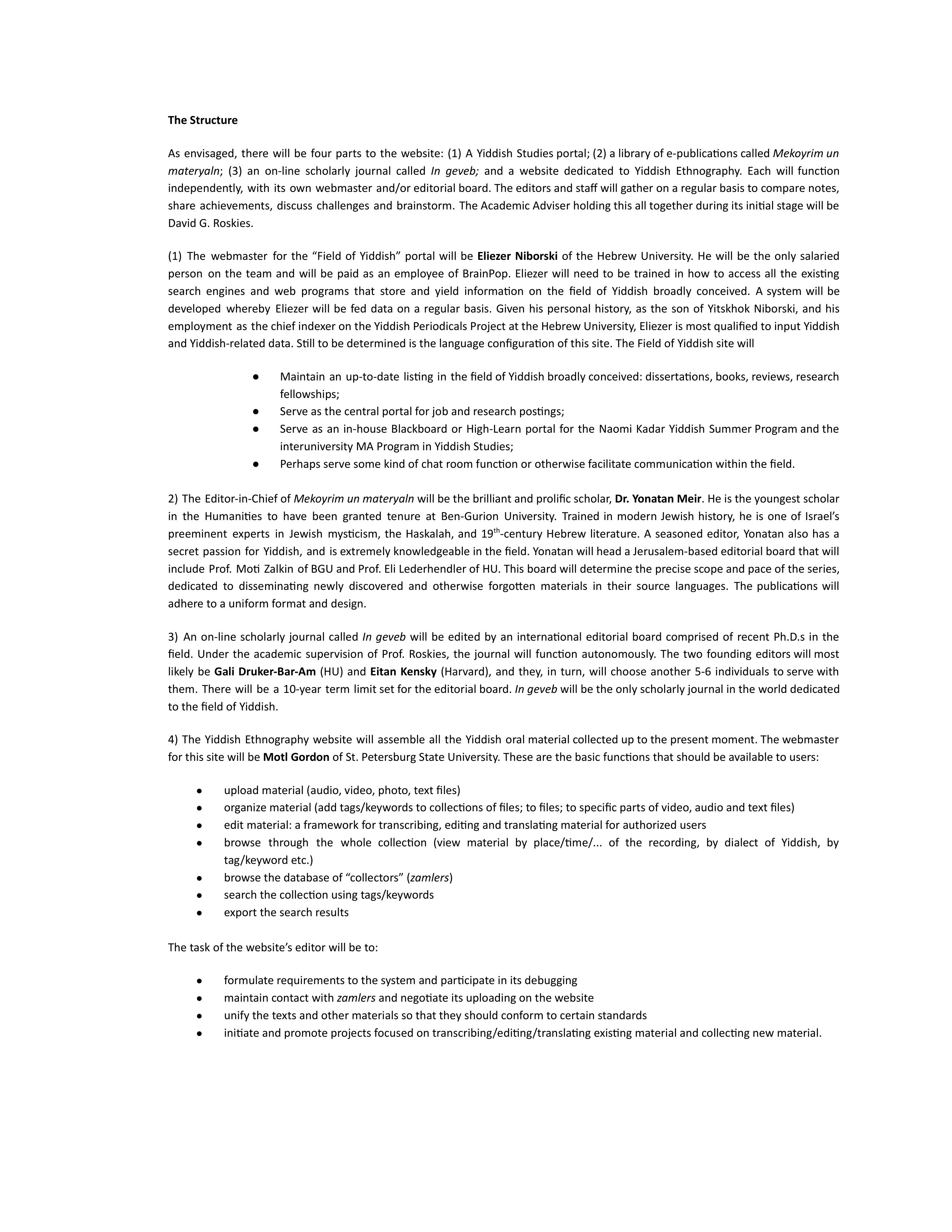
proposal to the Board of the Naomi Foundation, November 22, 2011
Full of technical lingo that someone must have helped me with, this proposal bordered on the messianic. Part one spoke of “search engines, web programs and portals” being harnessed by an all-powerful webmaster sitting in Jerusalem; part two, without mentioning it by name, was a desperate attempt to revive the ambitious series Yidishe literatur produced by the Yiddish Department of the Hebrew University between 1977‒1995, the gold standard of Yiddish academic publishing; part four, the ethnography website run out of St. Petersburg, was no less ambitious, because expeditions to Belarus and Ukraine were still proceeding apace, but the digitized material was wildly scattered, difficult to access, or not yet extant. As for part three, nowhere did the proposal state whose mantle In geveb was meant to inherit. Was it YIVO-bleter, Huliyot, Prooftexts, or all three? The editorial wish list, however, betrayed a subtle but significant shift: I hoped for one editor to be Israel-based and the other in the United States. Altogether, the sales pitch was for the Naomi Foundation to become a Virtual Center for Yiddish Studies.
Impressed by a vision that would further Naomi’s legacy and believing that her doctoral advisor was worth the investment, Dr. Kadar personally oversaw the online interviews of two of the potential webmasters, while other members of the Kadar family watched from afar. This happened on November 14, 2012, in the ultramodern headquarters of BrainPOP at 71 West 23rd Street, on a big screen. When the interviews were over, Dr. Kadar turned to me and said: “This is too unwieldy. It’s not going to work. I suggest that you start over. Choose one person, meshuga la-davar, and let that person choose his own team.” Choose someone with a fire in his belly. Who might that be?
To stand in for Max Weinreich was an extraordinarily tall order. It meant more than coming up with a grandiose scheme, more than sticking with it year after year, and more than even finding institutional support. It came down to passing the torch, entrusting the mission to someone else; the younger, the better. Prooftexts had happened differently, because we were baby boomers who knew that the future belonged to us. Both Alan Mintz and I were veterans, having each of us founded a Jewish student journal, he in English, I in Yiddish. In no time, we had assembled an eight-person editorial board, and only briefly did we toy with the idea of enlisting established scholars as a way of garnering respectability. Over the years, the one unanswered question was: Which of us was Max Weinreich and which was Zelig Kalmanovich, the two editors-in-chief of the YIVO-bleter? Deep down I knew that the towering intellectual was Alan; insofar as Prooftexts was concerned, the Weinreich mantle properly belonged on his shoulders.
After the failed interview process at BrainPOP, it took another nine months for me to realize what part of the master plan was realizable and what wasn’t, and on August 22, 2013, I informed the foundation that I had successfully recruited Eitan Kensky to launch the new online journal, enclosing a copy of his CV. Eitan, I knew from my sister Ruth Wisse at Harvard, aspired to become a public intellectual. As for his Yiddish bona fides, he had gotten his start as my student at JTS. After many emails in all directions, the official meeting of Eitan with the Naomi Prawer Kadar Foundation was set for November 14, 2013. To my shock and amazement, Eitan had already lined up his second-in-command, none other than Saul Zaritt, my current graduate student! “It bears noting,” Lindsey Blank (later Bodner) reported on the meeting to Maya Kadar Kovalsky, “that both Eitan and Saul are proud graduates of the TAU Summer Program [named after Naomi Prawer Kadar]. They are both incredibly smart, capable, and enthusiastic. They really impressed me!” The stars were aligned.
It was a long and momentous day. Eitan and Saul had come prepared with a three-pronged proposal for (1) a Yiddish literary blog, (2) a formal peer-reviewed academic journal, and (3) Yiddish Texts and Translations, which together, to my delight, covered three of the four areas in my utopian proposal, not counting such new features as interviews, top-ten lists, recipes, conference reports, videos, and readers’ comments, which I never even dreamed of. After meeting with Lindsey and taking a break for a robust lunch, they met with BrainPOP’s executive producer, David Grandison Jr., to talk shop. I sat there for two hours and did not understand a word. As Sheyne-Sheyndl complained to her husband Menakhem-Mendl: “Zey hobn geredt af terkish.” For Eitan and Saul, however, this was the moment of truth, because Dr. Kadar had informed them through Lindsey that In geveb would have to stand alone as a financially independent not-for-profit and design its own website from scratch. Whatever remuneration its staff received would be from revenues raised from within. There would be seed money, to be sure, but by a certain cutoff, In geveb had to become completely self-sufficient. Dr. Weinreich would have greatly approved.
My own head was spinning. The new technology rendered most of my experience editing a print journal obsolete, and the radically egalitarian approach of the new generation made the notion of a fixed editorial board (with a 10-year term limit!) unthinkable. The “path to our youth” was full of surprises. A “sovereign space” in cyberspace was not the same as a territorial base. The borders of Yiddishland were changeable and permeable. “Texts and Translations” alliterated as nicely as did Mekoyrim un materyaln, but the former were as outward-focused as the latter were inward-focused. And the changes ushered in by the digital revolution were so radical that even Prooftexts, let alone YIVO-bleter, seemed to belong to the Gutenberg era. Except in one respect.
Eitan took the 7:00 pm Acela back to Boston, and Saul and I headed uptown on the Number 1 subway, speaking mame-loshn. “Eyn zakh vil ikh nokh visn,” I said, as if expecting an answer. “Ver fun aykh iz Alan Mintz, un ver iz Dovid Roskies?”