Apr 15, 2026
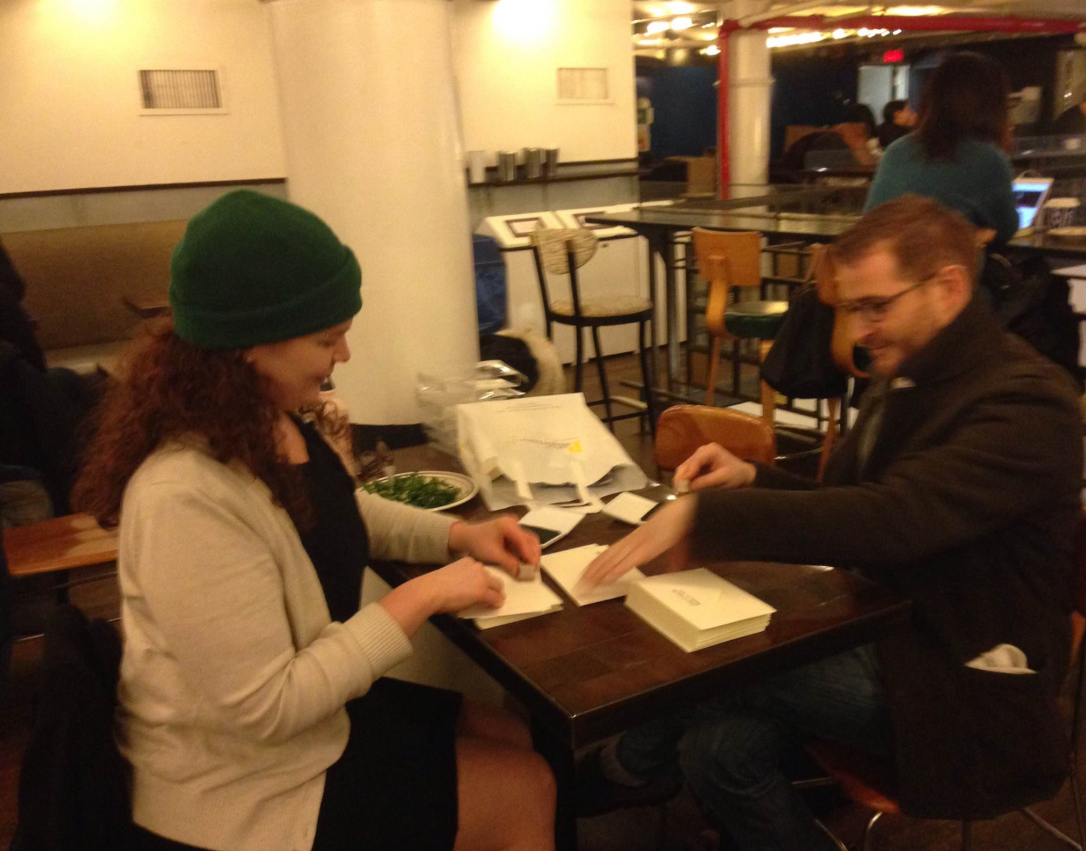
President of the Board Eitan Kensky and Managing Editor Sarah Zarrow, hard at work preparing envelopes for thank-you cards, January 2016.
INTRODUCTION
This piece is part of a series of reflections celebrating the 10th anniversary of In geveb’s publication. Biz hundert un tsvantsik, In geveb!
In preparation for our roundtable at the Association for Jewish Studies conference this past December, titled “Yiddish Studies in the Digital Age: Reflecting on 10 Years of In geveb: A Journal of Yiddish Studies,” I went digging through my inbox to find the first mention of the journal we early editors affectionately called Inga. As far as I can tell, I first learned of this top-secret potential project in mid-November 2013, when Saul Zaritt emailed me. He wrote:
Now, onto the other subject at hand. In geveb, the online journal of Yiddish studies. We're in the planning stages, so it's still hush-hush, but we (Eitan [Kensky] and I) want to gauge your interest in the project. How much would you want to be involved, in what aspects? We need more historians, and not just literature people, involved! The pre-proposal we wrote is attached (not for circulation!). Let me know what you think—or wait until the Thanksgiving car ride and we'll talk the whole thing through.
I smiled, nostalgically remembering our almost-yearly Thanksgiving car rides up to Worcester, Massachusetts. But beyond the trip down memory lane, I also think this short exchange gets at a few things that are worth thinking about as we enter In geveb’s second decade of publishing. These ruminations are by way of taking stock of how the journal came about, what it has become, and what the implications of both of those things might be.
1. In geveb was founded by people who knew each other socially, as well as professionally. Is that a good thing? Bad? Inevitable? This is a question worth thinking seriously about, even though (perhaps because!) In geveb has been highly successful with this start. If a junior scholar came to me today and asked how to start a new organization, I would hesitate to tell them to ask their friends (even their highly qualified friends). That way of operating can lead to “We just dreamed up this new initiative at the [thing you weren’t able to come to because you have caregiving obligations/a disability/a religious obligation you needed to attend to]” cliquishness. On the other hand, working with total unknowns is a huge risk for a not-yet-even-formed organization. How did In geveb begin as an initiative between friends and become a sprawling network that at least aspires to be inclusive well beyond the personal networks of its editors? When has it fallen into the trap of cliquishness, and what has it overlooked as a consequence? I’m not sure I’m able to answer these questions here, but the chumminess of this early email led me to ask them—and I think asking them is an important start in and of itself.
2. In geveb was always about more than Yiddish for Yiddish’s sake. In geveb is by and for people who use, and are interested in, Yiddish-language sources. Saul’s email indicated that more historians were needed in the journal, and it’s true that throughout its history—and even now—the journal struggles to attract submissions outside of literary scholarship. But it does, on principle, pursue such writing. It is a journal of Yiddish Studies, but not a journal (only) for Yiddishists per se. That’s where my role in the journal has been clutch, even after I stepped off the core team at the start of my postdoc in 2016 and moved on to the editorial board. There I reviewed and edited more historically oriented submissions, offering my expertise and disciplinary vantage point as a resource for the journal. Whether I’m a Yiddishist or not—something I like to bring up but other people are probably sick of—is a moot point. The knowledge I have is valuable to the journal. Nevertheless, it’s a question that continues to come up in conversation, and for people outside of Yiddish Studies the label “Yiddishist” can signal a politics and identity that aren’t what I intend when I use the term about myself. I sometimes find myself surprised, even angered, by what people seem to think “Yiddishist” means, and that’s a challenge not just for me personally, but for In geveb as a whole.
3. In geveb offers wide-ranging and nonstandard professionalization opportunities to emerging scholars. Saul and I did talk about In geveb on that car ride. We were excited; founding something from scratch, even with the imprimatur of senior scholars, felt very new and thrilling. For me (but not for Saul!), part of what made the project so important was that I was doing it outside of the input or supervision of my PhD advisor—he had no involvement whatsoever—and that was important for me as an ABD candidate, forging my own way. I wore a lot of hats in those early years of In geveb—not all of them fit so well!—but they were all mine, ours, and not my institution’s or my advisor’s. Having to learn everything from the ground up, seek out mentors, get advice, interact with designers, with lawyers, with banks— that still feels really important. In geveb helped us all learn myriad new skills, to interact beyond our academic walls, to be humanists who work with humans rather than solely with books and our computers. Standard humanities training doesn’t always, or perhaps even often, offer that kind of skill-building.
It was a complete pleasure to be asked to come back on to the Peer Review team last year, and to start working with a new (to me) group of people—first Matthew and Aya, and now Shachar—scholars I didn’t know before. In that sense, it was a reminder that In geveb has become something very different than those beginnings I discussed in the cozy, familiar car of a close friend. But in the ways it gives me an opportunity to make an impact as a historian on the field of Yiddish Studies and to expand that field, and in the ways I continue to learn new skills through hands-on work, and in the ways that I am making friends and having a good time while performing scholarly labor, returning to the editorial staff of In geveb does feel like a real homecoming. We’ve come so far, but perhaps just as importantly, we haven’t strayed from the journal we set out to be.