Feb 02, 2021
INTRODUCTION
Ira Khonen Temple’s album Strange Tongue/ מסתּמא־לשון / Mistame-Loshn, out from Borscht Beat, is a testament to Queer Yiddishkayt. The album is a balm for this moment of rising fascism. It is a reminder that the work of liberation is messy but necessary, and we need to do that work with each other and not alone. Ira manages to create an artifact for our exact moment, meaning that the album feels deeply of our times and engages with different temporalities from our specific vantage point, without calcifying any of the songs, or putting the artifacts behind museum glass. Strange Tongue is a piece of a living, breathing, changing culture. In the album, Ira puts music to previously unaccompanied Yiddish songs, writes new verses and tradaptations of modernist Yiddish poetry, and gives us the queer wedding banger we all need.1 The album is both hopeful and desperate. It is able to hold these tensions because it is an album that exists in, and is all about, the spaces between: between past and future, between movements, between you and other people, between experience and language. Anne Carson talks about translation as “a ditch between two roads or countries,” a “bottomless pit.”2 In translation, Carson says elsewhere, “you come to a place where you’re standing at the edge of the word and you can see across the gap to the other word and you can’t get there, and that space is unlike any other space in language, and something there is learned about human possibility.”3 Strange Tongue/ מסתּמא־לשון / Mistame-Loshn showcases Ira’s ability to play in those spaces. Through both the musicality and the language, Ira’s delivery of original, Yiddish, and tradapted lyrics feels like standing at the edge of a word and looking across the gap to another word. Ira moves deftly between Yiddish and English, giving the listener a chance to feel what it is like to move between sides of the bottomless pit.
The album opens with “change my shoes,” the only wholly original and wholly English song on the album. The journey continues with “vikhtik / what’s important,” where Ira introduces Yiddish lyrics by Reb Efroyim Vaksman. Vaksman’s lyrics are set to a Modzhitz Hasidic high holiday nign, and explore what is important/sweet/beautiful in a halachic context. In Ira’s original English verses, the song takes on new contemporary, subversive, and explicitly queer dimensions, creating a new list of things that are important, as if claiming and creating a new halokhe. In ending the new English verses with the old Yiddish refrain, “vos iz vikhtik un vos iz nisht?” Ira stresses the importance of language, of Yiddish itself, and of being able to claim these songs. The album continues to explore, introduce, distort, and play with a rich history of Yiddish folksong, Moishe Broderzon’s modernist poetry, songs for the streets and songs for the heart.
Ira and I first met years ago after a Tsibele concert in Baltimore. Years have passed, and now, as a part of our friendship, between comrades and people who share in the work of world building and cultural labor, I helped out a bit with the production of the album and we made a music video together! After all that, I was excited to get pieces of our sprawling conversations down in the paper of record. I sat down with Ira to see if we could, asymptotically, fill in some of the in between. The following is only a piece of our conversation, and I wanted to keep a list of all of the people and teachers Ira mentioned as a way to trace relationships and lineage, a project Ira and I have a shared investment in. So even if they are not captured in this version of the conversation, we mentioned: Ethel Raim, Lorin Sklamberg, Jenny Romaine, Chana Mlotek, Yoel Kohn, Jacob Gorelik, Itzik Gottesman, Paula Vogel, Sore Kessler.
YAEL EMRAV HOROWITZ: What are you feeling really excited about for your album?
IRA KHONEN TEMPLE: I think it represents and is an offering from our generation of Yiddish revival. And our generation is queer in the way that we're queer and we're a mix of religious and secular in a specific way and we have our own way of relating to the archives and the way that we've received them. We weren't the generation who found everything on 78s, a lot of stuff was easier for us to receive. I think our generation is finding our voice about how we relate to Yiddish culture. And it's really connected to my teachers and mentors who are older than me. I can already see it connecting to people who are younger than me, who are holding on to it as a rung as they pull themselves into the culture.
YEH: That's a really beautiful image. Could you situate this album for us more personally within your Yiddish journey, life, generation?
IKT: Yeah, you know, the album is a little bit all over the place in terms of where it comes from in Yiddishland, and I think that's something unique about it. It's sort of hard to describe in a simple way, but it reflects how I started singing in Yiddish in Satmar Williamsburg, when I had a job there, working with Satmar elders who were my grandmother's age. And in that way, it reflects, I think, singing from, like a women's perspective, even though I no longer reflect that [perspective] in my outward appearance and my Yiddishland existence and voice. It also comes from secular and less gendered spaces, like teaching for 10 years at the Worker’s Circle Shule in Manhattan, where Yiddish was a way to have embodied culture and to have culture altogether, and to have a relationship to ancestry and to have a relationship to Jewishness. My job was as social justice director of the Shule, so I was always asking, how can we connect holidays to organizing campaigns? And I think that that impulse is really present in the album. And I've done some work in Yiddish theater, and that impulse towards storytelling and character building is on the album.
The album is a continuation of the work that I did in the band Tsibele, including some songs that we were singing as a band when we were active but didn't get to record. It reflects my study with Ethel Raim as a major culture bearer, and Lorin Sklamberg was my vocal producer, which also means that he was checking my YIVO transliteration standards and holding that beautiful institutional way of knowing and cataloging what exists and our relationship to the known culture as a whole.
You know, it's a very New York album in that it's like, in New York, we have all of these manifestations of Jewish culture, and they're all in the same city. Sometimes they touch, sometimes they brush up against each other, sometimes they really overlap, sometimes they rankle. But there's just so much here.
YEH: People throw around all of these different terms, translation, tradaptation, interpretation, and your album is in Yiddish and English and Hebrew. I'm curious about how you thought about language and lyrics and the relationship between these languages and your relationship to the languages for the album.
IKT: Well, one of the reasons the album is called Strange Tongue is because I think Yiddish has been really useful for me to denaturalize the world as I understand it. Both me and my parents grew up in North America, and English feels natural to me, but that’s true for so few generations [in my family]. I remember starting to learn Yiddish, and at the time, I had been to Germany a few times, and I was like, “Oh, it would be really nice to learn Yiddish enough that when I spoke German, my German was kind of wrong. That Yiddish was the new standard.” It’s similar to understanding klezmer as a musical genre before understanding jazz, for example. There's something about setting yourself up well enough (even though we're all playing catch up with this music and there's been so much cultural loss) that it feels like a default, and that we feel comfortable in it. And that is a kind of embodied belonging. A huge goal of mine for Yiddish is to make Yiddish feel like a place of comfort on the album.
YEH: I'm wondering if you can talk more specifically about how denaturalizing the world around you — but creating a lot of comfort in Yiddish — informed some of your writing and translation on the album.
IKT: The impetus of the album was to bring forward all these Yiddish songs. But there's so much English on it. There's almost nothing on this album that gets said in Yiddish that doesn't also get said out loud in English. That’s a development of my Yiddish singing persona. But the purpose of the album was to bring forward these archival Yiddish songs. It turned out that I reluctantly brought them into English out of a deep desire for them to be accessible. And, you know, it's like, as they say in Italian, traddutore, tratiatore, the translator is a traitor. I feel that very deeply. Of course, as soon as you move into English, you also lose the original.
[When it comes to lost originals I think about] “umet/ sadness,” which is a song that we only have a record of as an unaccompanied song; [Ruth Rubin] recorded Sore Kessler singing that.4 Tens of thousands of women must have sung that song [but we only have Sore’s version]. And I cry thinking about that. How did it sound different for each of them, and what did they think about when they sang it, and what did it sound like when her mom sung it, and her mom's friends, and how many people knew and sung that song? And now we have just this one recording.
So that song just felt so accessible and immediate to me. I put it into an English that felt very modern, and when I play that song for people and I tell them that it is a translation of an old Yiddish song, they're often very surprised, because it's not what they think of when they think of Yiddish song.
YEH: Right, and that's what reading different kinds of translations will also do. Anne Carson talks about loss in translation, but also what is gained by translating. And I'm wondering, what did you gain from translating these songs?
IKT: I really felt on this album, there's something in between the English and the Yiddish, and that's the living part. For example the title of the album, people have been asking me, “Oh mistame-loshn, does it mean strange tongue?” And, with apologies, I've been like, oh, well, it does…It sort of does…but it also doesn't…It actually doesn't mean strange tongue at all. [The word-for-word translation would be “maybe-language,” and transliterating it as mistame-loshn plays with the reference to mame-loshn.] It's so funny. They want it to be a translation. And they're like, oh, which part of this means tongue?
Both of these phrases, strange tongue and mistame-loshn, reference alienation from language, they reference alienation from speaking. They both came out of the same brainstorm, which was, how can we queer the expression of both mother tongue and mame-loshn.
YEH: Let's switch a little bit to talk about how you put together the visual language of the album, the cover, the zine, the music video: What were some of your sources of inspiration? How would you describe the visual language of the album?
IKT: Visual language isn't my forte, and you helped me a lot and now I would also say visual language is one of the most fun things to me about making an album. Because how wild to work with artists and say, “Hey, we work in totally different media, what if we each made something that pointed towards the same thing?” Our expression is an approximation. So what if we both try to explain what the thing is in different ways? It's so cool.
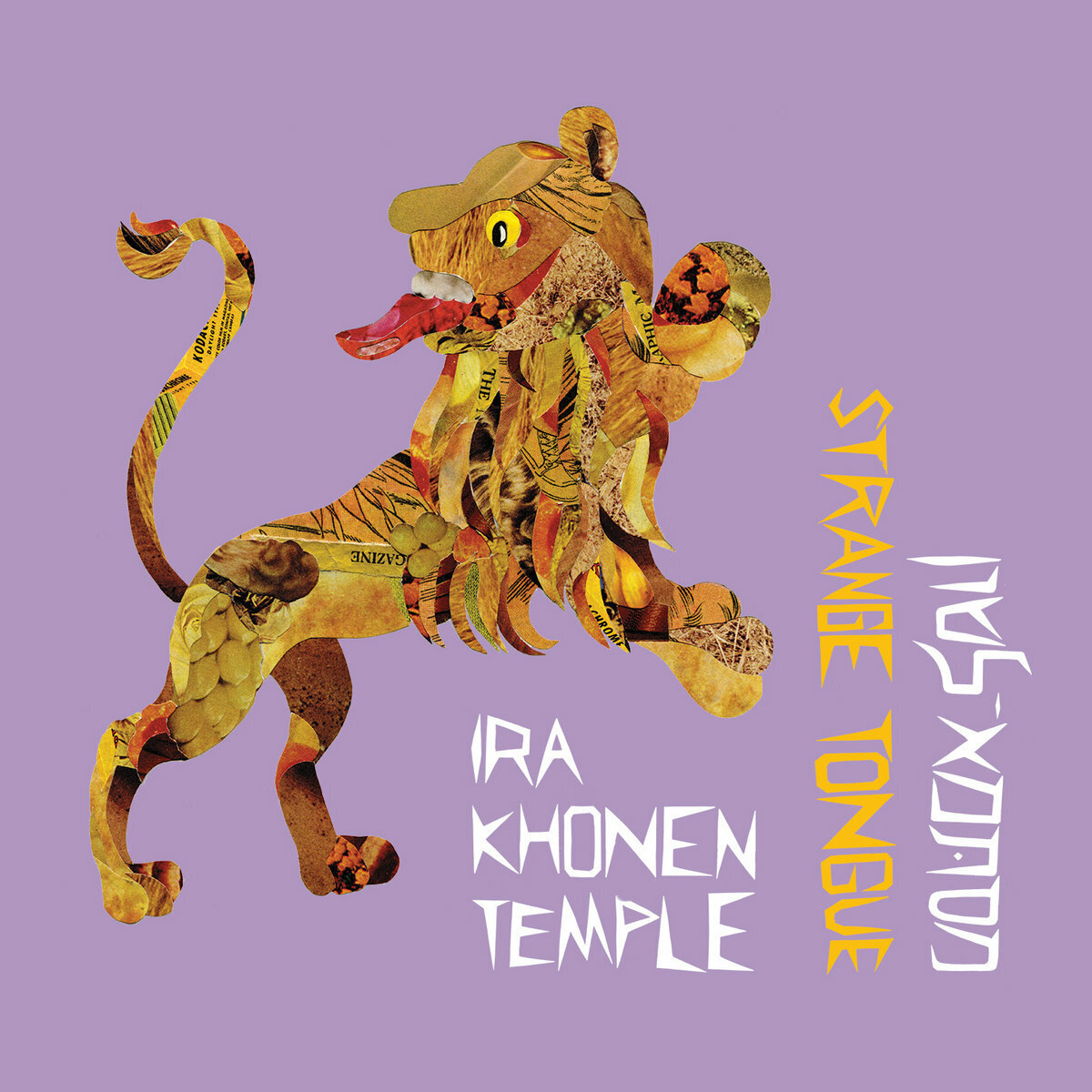
I was very, like, stubbornly convinced about this album that I needed to be represented by this specific lion. Because while I was creating it, I was doing a lot of reading in the bath for inspiration. And my friend Alana had given me this book, The Jewish Museum of Budapest [edited by Ilona Benoschofsky and Alexander Scheiber], and I was finding all of these cool things that were super different from each other. First, because the album is such a collage, I wanted the cover to be like a Bundist flag, with a religious icon, with like..I wanted it to be super, super visually complex, and to represent, visually, everything that the album represents. But I also just got super obsessed with this lion that comes from Hungary, where I have a lot of family…
Part of the album for me and part of the visual culture of the album is going to Europe, going to the cemeteries, and being like, “Hey everybody!” Just being like, “What's up, my guy, Hey, everybody's fucking here.” And the images on the gravestones. But I think that the lion definitely comes from this feeling of, “I want to eat this juicy Hungarian Jewish culture” and I want to integrate it.… And when I went to Sol Brager with the lion for the album cover they had been doing all this collage paper work stuff, very Jewish, and they incorporated the collage back into the lion.
YEH: I like that you use the word collage because I was thinking about this with the music video. Why was the montage the part that we were both like, “Yes, absolutely! Put the chain next to the steak, hell yeah!” Is that just random? Is that just our shared aesthetic sensibility? But I wonder if the diasporic, multi-rooted nature of what we do and how it's really relational actually lends itself to assemblage and collage as an aesthetic standard.
IKT: Love that.
YEH: Okay, I have some words that I feel connect to the album to do some rapid association with. First, ornamentation.
IKT: A commandment, you know, to beautify the mitzvah, like that's how we get tam [meaning taste, charm, appeal]. That's how we get our Jewish taste, is by understanding how to ornament. And that's the kind of, like, micro-improvisation that makes our music what it is. Like maqam [a melodic mode and improvisational technique that includes scales, patterns, and musical phrases] in Arabic and Persian music. It’s the texture, it’s the carpet, it’s the taste.
YEH: Reverence.
IKT: I mean, speaking of in between, this album is very, very balanced on a reverent-irreverent spectrum. I would say it has major oldest child energy, it’s really reverent of teachers, like it's really reverent of the chain of transmission, of masoyre. And it’s irreverent of stupid rules.
YEH: Crisis.
IKT: Why did you put that word on this list?
YEH: I think that this album is of our moment. I think this album is time specific, like we talked about all of the specific geographies, and we talked about the generational specificity. But I really feel like this album is of our shared time, or co-temporality, as our friend, Ozzy Irving Gold-Shapiro likes to say. And I would characterize our current shared moment as a moment of crisis. And so in that way, there is some relationship between that and what this album is doing.
IKT: Yeah, I hesitate to claim that, because I feel like I'm doing such a bad job. We are in crisis. So it is responsive. But I feel like I want to meet crisis by being like, “guys, let's go meet the crisis.” And this album still feels to me so much digging into the sources of our tradition and loneliness. But in order to meet the crisis, we have to have community, and we have to know who we are, and it feels like a contribution in that way… I want my music to be a home for people who are preparing for crisis. I want it to be a place for them to feel. I want it to be for people who need their Jewish community to reflect their values and not reflect the desire for (or acceptance of) genocide, and also not reflect the feeling that we have to assimilate immediately away from anything Jewish if we want to have ethics. I want this to be a place for you so that you can ground and then you can keep doing the work that you need to do in the world.