May 11, 2026
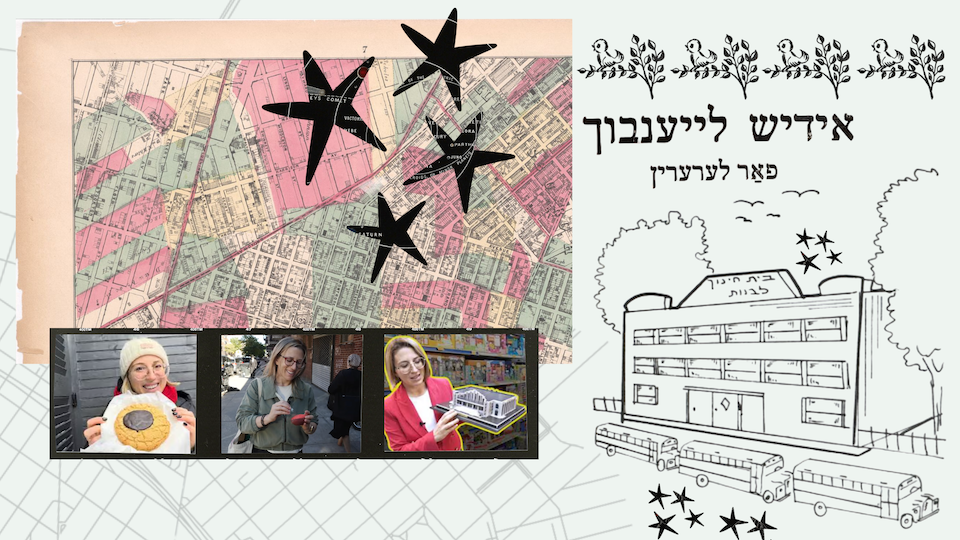
Graphic by Judy Goldstein
INTRODUCTION
I first encountered Frieda Vizel in the summer of 2024 through a YIVO program, on a walking tour of Williamsburg, Brooklyn. I went again in spring 2025 with my Columbia University Yiddish class—this time entirely in Yiddish. In both languages, Frieda’s tour was unlike any other I have experienced. It was part insider testimony, part ethnographic walk, and part food tour.
Vizel is a YouTuber, tour guide, and former member of the Hasidic community of Kiryas Joel in New York State. She grew up in a large family and left the community in her mid-twenties. Her work now centers on documenting Hasidic life in Brooklyn through walking tours and digital storytelling, with an emphasis on resisting flattened portrayals.
This conversation took place in that spirit—moving between representation and translation, and circling the question of what it means to teach about a place and a community that is still very much living and changing.
Judy Goldstein: I'd love to start off with you introducing yourself for readers who haven't found your content yet.
Frieda Vizel: My name is Frieda. My Yiddish name is Freyde. I was raised in Kiryas Joel, the Hasidic village, in a large family. I’m one of fifteen children, and I think what would help someone who doesn't know my work to understand it is that I spent the formative years of my life in the Hasidic community, very, very deeply embedded in that world. I come from a very pious family, so we didn't have a lot of opportunities for exposure to the outside world; we were very sheltered.
I left the community when I was twenty-five after having gotten married and having a child. So, I was very impacted by my experiences in Kiryas Joel, in a good way, and in some respects more difficult, challenging way. And after I left, I felt this tremendous urge, which I continue to feel throughout my life, to document and tell the stories of everyday people and their everyday lives, especially people who are often represented otherwise as very flat and very black and white.
One of the reasons I want to do this is that when I was Hasidic, I could often experience secular people looking at me with judgment that I felt was flattening and dehumanizing and I sensed they didn't see me as a person, and yet I couldn't I couldn't explain that there was more to our lives and that we were more alike than people assumed. And so that's a part of what motivates my work.
My work is multifaceted. I am a YouTuber. I am a tour guide. Sometimes I write, but also I have a social observer personality. I love to just walk in the city. I can walk for a long time and always find interesting things, see interesting things, interact with people, and I find that really interesting. I find the world fascinating, especially humans—human nature, how we behave, how we think, how we make sense of the world. And so my work is really about that, but heavily focused on telling the stories of Hasidic Jews who often are so much misrepresented in the media, because those who tell their stories are often outsiders and don't really understand that world.
JG: I hear you speak about how you see yourself as filling a lot of different roles—you're a storyteller, social observer, maybe an anthropologist. Are there any other ways that you see yourself, maybe as a researcher or a scholar?
FV: Well, there are a couple of things I often saw myself as being in life, and sometimes those things didn't work out exactly as expected, but I think I still ended up, in some ways, being on that path. I'll give you an example. My mother would always say when I was young, “You'd be a great teacher. You're great with explaining stuff.” And I was very flattered by that. I really liked that she said that, that was a very big compliment.
But when it came to assigning teaching positions, I was totally not a candidate because teaching positions were given to the students who were well behaved and had earned a reputation as the trustworthy, responsible students. And I can't say I begrudge the Hasidic school administration for not giving me a position! I bet I was a nightmare student. I was a tomboy. I was a heck of a pain in the neck, but it felt like something that was a bit of a dream that didn’t come true. And my mother would often say, when I became a secretary for a Hasidic company, “Well, you're still going to be a teacher one day.” And I'm now forty-one and I'm still not a teacher. I've never been a teacher in a classroom, but at the same time, I am a teacher, and I feel grateful for that title. Sometimes people will say, “I watch your videos. You've taught me so much.” Or people will come on my tours and they'll say, “I learned so much.” Sometimes people even say, “Well, this was information overload,” which means I was a bad teacher, but I was still a teacher trying my best, and I’m very sentimental about the role of teacher — what teachers do, the role of teachers, and my desire to be one of them.
I think when I was Hasidic, we were taught, I'm not sure if I remember it correctly, but it was something like, anyone who teaches you anything, you're indebted to them. Like there was a reverence towards someone who had given you the gift of learning. I do think that's how I feel towards people who teach me. And I love the role of teacher.
JG: I was also thinking about teaching while watching your recent video series on the Yiddish reader of moral fables [ed. note: see below]. I’m currently training to be a teacher myself, and what struck me is that the book was intended for female teachers teaching female students. For people who haven’t seen the series, can you tell us what this Yiddish reader is and how you first came across it?
FV: Oh my God, I'm so happy you brought that up. That is one of my favorite projects! So there is a guy I've exchanged emails with on and off for a while, he's absolutely brilliant. And he has been sending me little finds that he finds occasionally. His name is Samuel Marks. He grew up secular, and he got very interested in the Hasidic community, and he goes to dusty bookstores and look for unique finds. And if he thinks it's interesting to me, he might send it to me or tell me about it, which is just like—talk about teachers, talk about teaching with so much generosity! I feel so much gratitude to Sam. So recently, Sam sent me an email that he found a 1977 Yiddish workbook for teachers that he thought I would find interesting, and he sent me a few screenshots. I said, “Could you send me the whole thing?” And he spent hours into the night at the extremely expensive law school scanner, scanning the whole thing, because he feels like it needs to be preserved for posterity. And he sent it to me! And I thought, it would be in the spirit of his generosity for me to share it with others by going through this book in a video format bit by bit, reading stories and translating them and offering my own commentary.
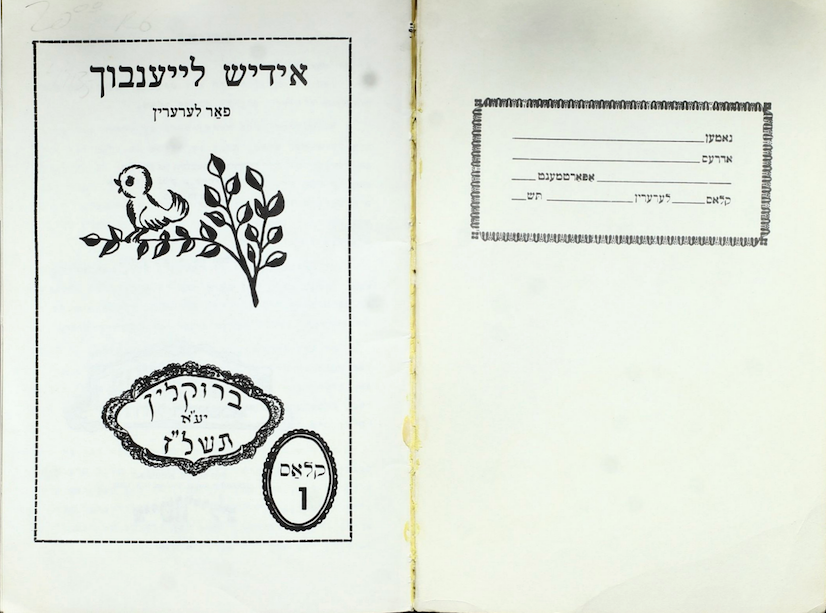
Idish leyenbukh far lererin: klas 1 (Yiddish Workbook for Teachers: Class 1)
And there's so much cultural context that you can gain by reading these stories. You really get to see a moment from the past of the Hasidic community. You see its value system, how women were trained, how women were raised. It's very calm, it's very loving. It's also very, very old-school, almost Victorian, where women are, for lack of a better word, repressed. And you can see that their socialization is about keeping your emotions down.
And for me, as someone who experienced that, and also experienced the shift into a modern sensibility of womanhood, it's really interesting, because I can see how my own sense of womanhood was shaped towards being demure, towards being agreeable, towards getting along, for better and for worse. There are a lot of benefits to the way I was raised. There are a lot of challenges. But I think that book is so telling for how women are socialized, and it's so valuable that one of my most enjoyable projects has been to just open it when I'm already sitting at the computer and just reading the story and translating it from the Yiddish to English bit by bit, and offering my thoughts as I go along.
The issue with doing something like this is it's extremely niche. And the challenge with that is that if you put out videos for very niche audiences on a big channel, then the algorithm is going to start suppressing your other videos. So it leaves me in a really big conundrum where it's like, do I continue publishing something so niche when the audience is minuscule and it can harm my other videos? Or do I just not publish it and do it for myself? And it makes me really sad to have this dilemma, because it feels like this is valuable. If you are not interested in it, don't look at it. There are people who are interested in old Yiddish texts and it's so worth putting out there. So I have put out three installments, and I'm hoping to put out more.
JG: I love the illustrations. I feel like you see that style in old Yiddish texts, and not so much today.
FV: One hundred percent. It has amazing, nostalgic illustrations. I can see the ruler and how the lines are being drawn to create the room and the bed for the girl's bedroom or the kitchen. There are no people, but also, you can see the hand of the artist.
JG : Another element that brought me to that video series is that I am in between an advanced and an intermediate Yiddish student, and I feel like the level of these books is so perfect for me, both in the sense that it's good for me to hear Yiddish in a new accent that I'm not hearing so much in a classroom context, and also because the book is intended for students so the vocabulary isn’t too crazy.
And as a Yiddish student, I have been fortunate enough to go on one of your tours in English, with YIVO, and another one in Yiddish, with my Columbia Yiddish class. They were both wonderful! But I feel like I got something different out of both tours. I'm wondering if the language had anything to do with that. Do you feel like your tours are different when they're in Yiddish versus when they're in English? Or does it feel similar to you?
FV: No, it doesn't feel similar. I do give a different tour to every group. I'm really not good at consistency. But the language definitely produces a different tour out of me, especially when I speak Yiddish to speakers who are not Hasidic Yiddish speakers, it feels like a very weird juggling act. On the one hand, it feels very heimish, like I'm talking in insider lingo, and yet, at the same time, I'm very cognizant that a lot of things don't translate, and so it isn't quite heimish. So there's a sense of balancing the very intimate against the estrangement in language that happens when I give a tour in Yiddish, and that doesn't play out in English. In English, I just feel like my secular self. The end. But also I really just talk about whatever I'm interested in that day when I’m giving a tour. So that also changes things.
JG: So is there a lot of preparation and research for your tours? Or at this point, can you trust yourself to figure it out a little bit as you go?
FV: At this point, the preparation for my tours is mostly about logistics. I think of it as a lot of hospitality work. If the weather is bad, I’ll walk around beforehand and see if there’s scaffolding along the route so we can walk in that direction and be protected from the rain, or find a place where we can stop and I can take questions. I’ll go through the shops along the route and see what the situation is—who’s there, what’s going on. Usually I come by bike and just walk around to scout everything in advance and make sure it will be pleasant.
You’d think it would be super easy by now, since I’ve been doing tours for twelve years. But the irony is that it’s actually gotten a lot harder, which is very counterintuitive. In the first eight years I was giving tours, people came with the expectation that they would get an introduction to a neighborhood. They didn’t know who the tour guide would be. It was never about me. People came with an interest in architecture or food, and my price was much lower, so the pressure on me was extremely light. I felt like I could just show you around a little bit—be your Brooklyn tour guide for this particular neighborhood, give you some information, and we’d all have a great time.
Now it’s very different. I walk through the streets and I’m no longer a fly on the wall. If I stop to take a picture, people notice, because they recognize me. So I’ve lost that place of just walking around and observing. My tour participants also come with a totally different set of expectations now. I charge a lot more money, partly because it costs me a lot to make videos, and my YouTube channel is supported by the tours. That means the pressure on the tours has gone up a lot. Something that used to feel extremely enjoyable —like, let’s see what’s in the neighborhood today, are there new street posters, is there new construction, is someone interesting out on the street—is now more like: I need to make this worth people’s time. I need to live up to their expectations. I’ll show up to a tour and someone might say, “Oh, you’re much shorter than I thought,” and that’s the first thing they say.
It’s not that I take offense—it’s just that the spotlight has shifted onto me in a lot of scenarios. And that’s not really the joy of it for me. I never wanted to be a performer. I never had an interest in performance. I’ve done videos with Riki Rose, and she says that when the spotlight comes on her she lights up. I don’t have that feeling at all. I’ll do it if that’s what it takes to teach—if that’s what it takes to share passion and knowledge. I’ve gotten used to seeing my face on camera, and I’ve gotten used to the attention, but it was an adjustment.
“We returned to our former religious sect”: Frieda Vizel and Riki Rose in Williamsburg
Ultimately it’s all just a vehicle for what I actually enjoy, which is being a nerd—nerding out on human-interest stories, on life, on complexities. Even since you were on one of my tours, things have changed a lot. Because the spotlight has shifted onto me and the community now recognizes me, the tours have actually become harder, even though in theory they should require less preparation.
JG: You mentioned the joys of walking through the city and how much you can learn just by observing. Over the years you’ve been giving tours, you must have seen Williamsburg change quite a bit. What changes have stood out to you, and what has remained the same? What have those shifts meant for the community there?
FV: Williamsburg has undergone a tremendous change. When I was a child, all four of my grandparents lived in Williamsburg, and we would go to Williamsburg when I was really young, every Motzei Shabbos, every Saturday night, to visit them. And I remember the smells. It was really metally and polluted and humid in the summer, it was gross. Whereas we lived in Kiryas Joel, where, when you got out of the car, even if it was summertime and it was humid, it smelled of greenery and hot, gorgeous summer nights. So I always had a very negative association with Williamsburg in that way. It was very unappealing. It was also a place where my mother would tell a lot of stories of how high crime was when she lived there in the late ’70s and early ’80s. Her memories were of a really, really unsafe neighborhood. It was a place where you would get attacked and stuff would be stolen from you all the time.
And then slowly, Williamsburg started to change. I remember I was a teenager when Yiddish newspapers were up in arms about the hipsters moving in. They called them the artistn, and they were like, the artistn are walking around their apartments naked without window shades. It was terrible. I remember thinking, why would anyone do that? Like it was unimaginable to me, why anyone would want to make themselves so uncomfortable as to walk around their apartment half naked? I didn't understand they were probably in their underwear, in clothing that they didn't feel uncomfortable in.
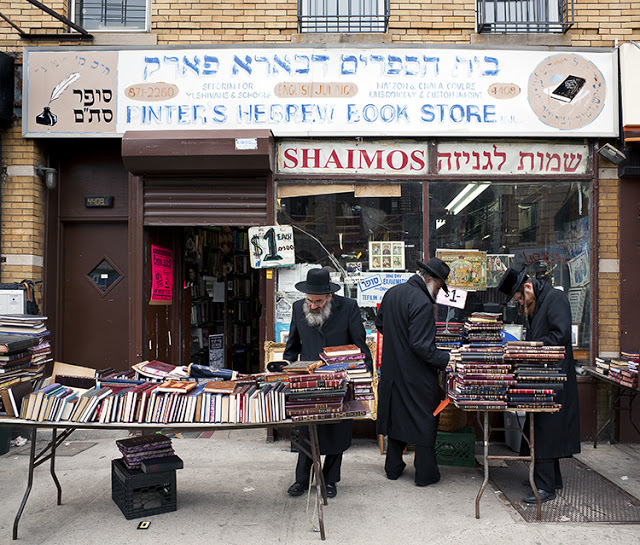
Anyway, slowly Williamsburg completely became uppity and a very desirable neighborhood, and the north side is totally unrecognizable, even the Hasidic side. Like the projects are under private management and they have security, and the public spaces are extremely cleaned up with these tiny benches so no one can sleep on them. So it has so much of a different feel, and it no longer feels like that grimy Williamsburg of my youth, and a lot of the shops, especially in the newer areas, are getting very trendy. But not to fear, the streets still have a lot of personality, especially the parts where I walk with my tourists. There's still a lot of complaints from my tourists about the trash! There's still a lot of children living there, and so there's still a lot of that kind of old-school vibe, but it feels like some of the old school, the so-called charm or old-school quirks, is disappearing.
JG: I’d love to end with a lighter question. Many people may discover your work through collaborations—are there any partnerships you’d like to explore in the future, or any dream projects you’d love to put out into the world?
FV: I actually did a video with my son Seth that we already finished. That was an incredibly interesting experience, because I've done videos with him before, but this was something where we ended up talking about all sorts of things. We ended up discussing some pretty intense stuff, like intermarriage. It was not what we expected when we went out to film it.
You know what would be really nice, and I don't think would ever happen—if either of my parents would ever be willing to partake in any way . . . that would be very meaningful just to tell their oral history. I think it would mean a lot to my former self who never got to be a teacher. Especially my father. My father does have more of an interest in preserving his memories, and he would often talk about them, and I think he has a lot of stories to tell, and I would love that. That would be incredibly interesting for me. It would be emotionally impactful to talk to my parents. But I don't think it's ever going to happen.
JG: Well, maybe there’s still a version of that. I don’t know if this is what you meant, but maybe it could just be something you record for yourselves—for you and for Seth. And I also have to say, it says a lot that you answered the question that way. When I wrote it, I was imagining something like a big collaboration with a Yiddish or Hasidic celebrity—some kind of out-of-this-world project. But I really love that your answer was your family. I think that speaks so much to who you are.
FV: I appreciate that. I feel like that question triggered something in me which is very revealing of how personal this whole project is.
JG: And lastly, is there one video you'd like to recommend as a starting place for readers who might want to explore your work?
FV: My suggestion is that viewers start with “The Get” and my series with Pearl.
JG: Why should people start there?
FV: “The Get” reflects my complicated, loving relationship to the Hasidic world and my inevitable need to depart it. The Pearl videos reflect the wonderful quirks of this world through the eyes of two women: Pearl, a woman who lived it, and me, a woman who left it. I think together we present a very vivid human portrait.
You can learn more about Frieda and her work by visiting her YouTube channel. To get you started, here are some of my favorite videos of hers: [ I went to the all-girl's Satmar Hasidic school. This is what I learned] [ How Hasidic teens learn about sex]