Jun 30, 2025

Alyssa Quint and Amanda Miryem-Khaye Siegel, eds. Women on the Yiddish Stage. The Modern Humanities Research Association, 2023. 348 pp. $120.00.
From the Margins to the Center
Years ago, at the beginning of my journey into Yiddish studies, I enrolled in “Introduction to Yiddish Culture,” a course taught for decades by a prominent professor. On the first day, we reviewed the ambitious syllabus: from Old Yiddish texts and the Haskalah to modernist literature, Soviet Yiddish culture, and its American counterpart. Tacked on at the very end was a session on Yiddish theatre. “Don’t worry,” the professor said with a grin, “we probably won’t get to it. We never do.” With an avek mit der hant —a casual flick of the hand—he signaled to us newcomers the lowly status of Yiddish theatre within the established hierarchy of Yiddish culture. He was right. We never reached that final session—not in that course, nor in any of my subsequent B.A., M.A., or Ph.D. coursework.
Yiddish culture is often perceived as marginal—at least from outside the shifting borders of “Yiddishland.” Within this already marginal field, Yiddish theatre occupies an even more peripheral space: the margins of the marginal. What happens, then, when we introduce a gendered lens, and examine women’s roles—and their historical silencing—within the Yiddish theatre? Does this add a third level of marginalization? Put simply: would the world care about Women on the Yiddish Stage—the book, or the subject more broadly? Among scholars and enthusiasts—such as those affiliated with the Digital Yiddish Theatre Project—there is no lack of passion for recovering the lives and careers of forgotten actresses. Yet one suspects that the broader academic world remains largely indifferent.
Then again, perhaps the opposite is true. In the twenty-first century, could these intersecting forms of marginality—Yiddish, lowbrow or popular theatre, women—become a source of scholarly vitality rather than a liability? The continuous prominence of feminist and gender studies in contemporary academic discourse may provide fertile ground for revisiting and reimagining Yiddish theatre. Rather than embracing “the margins of the margins” as a niche pursuit, we might respond to the call to “center the periphery,” as the title of a recent volume on Eastern European Jewish culture beyond Warsaw suggests. Recentering the margins would entail more than recovering forgotten performers or ephemeral productions—it would demand critical engagement with broader theoretical questions, such as the politics of cross-dressing and gender performance, the lived experiences of women on and off stage, the sexualized or de-sexualized personas of actresses, or the intersections of misogyny and popular culture. At this confluence—where feminism, performance, and a minoritized, fractured tradition meet—new forms of critical inquiry can emerge, linking Yiddish culture and Yiddish theatre to broader scholarly conversations.
So, what path does this volume take? Does it dwell affectionately in its marginal position, or does it strive to reposition female Yiddish performers and cultural producers within contemporary discourse? With these questions in mind, I approached this dense and wide-ranging collection, which traverses not only the expected contexts of the United States and Poland but also less-studied locales—Argentina, Lithuania, South Africa, Romania—adding, potentially, a fourth layer of marginality.
A quick glance at the table of contents already suggests that Women on the Yiddish Stage takes both directions. Of the thirteen essays, the majority focus on individual figures—seven on a single actress, two on a pair. Only four—Vivi Lachs on London’s Yiddish music halls, Tova Markenson on Argentine Yiddish theatre, Nina Warnke on self-representation in memoirs of Yiddish prima donnas, and Alyssa Quint’s intriguing introduction—seek primarily to offer a broader conceptual or cultural frame.
The volume, then, moves between recovery and recontextualization, with individual essays emphasizing different aspects of this dual task. Among the articles that focus on a single actress, some situate her within broader theoretical frameworks—especially feminist ones—for example shedding light on enduring double standards surrounding the actress’s sexuality and public presence. Others lean more toward recovery work, mining rare archival materials—both institutional and personal—to reconstruct lost narratives. Some essays attempt to piece together specific performances, such as Ida Kaminska’s postwar Mother Courage in Giulia Randone’s study; others bring lesser-known figures to light, such as Sarah Sylvia (in Veronica Beiling’s article) or Sofia Erdu and Rachel Berger (in Ina Pukelyte’s). Still others revisit better-known performers to explore overlooked dimensions of their careers: Ronald Robboy’s close reading of Molly Picon as a lyricist, Caraid O’Brien’s examination of Miriam Kressyn’s radio work, and Sonia Gollance’s focus on Judith Berg’s interwar choreography beyond her iconic “Dance of Death” in the film The Dybbuk (1937).
Given the scholarly framework outlined above, I was particularly drawn to the essays that adopt broader cultural and theoretical perspectives. That said, even the more narrowly focused contributions reveal recurring themes, insights, and tensions that merit attention. I will highlight just a few of these in what follows, as they gesture toward larger questions that could inform future research. Any subsequent volume would do well to build on the strong foundation established by Women on the Yiddish Stage, edited by Alyssa Quint and Amanda Miryem-Khaye Seigel —whether through continued archival exploration or expanded theoretical engagement.
The Birth of a Field
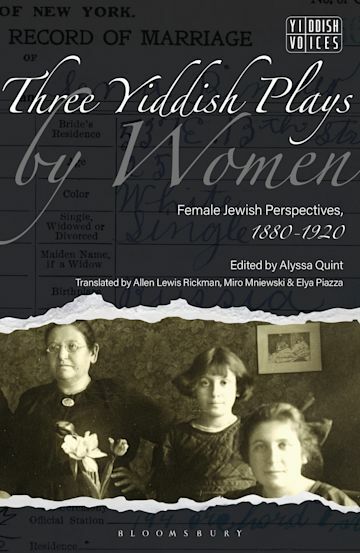
In her introduction, co-editor Alyssa Quint declares, “A Field is Born”—not to suggest the redefinition of existing disciplines, but to mark the emergence of a previously neglected area of scholarly inquiry. Reflecting on the 2016 conference that gave rise to this volume, Quint recalls, “I could not fill the slots of even a brief one-day conference.” Since then, however, both Quint and Miryem-Khaye Seigel have played a central role in the field’s development, extending their efforts far beyond that initial event and this volume. Together, they co-edited a companion publication, Women on the Yiddish Stage: Primary Sources (University of Wisconsin Press, 2021), a collection of translated memoirs and writings by Yiddish actresses. Quint also collaborated with Elissa Bemporad to edit Three Yiddish Plays by Women: Female Jewish Perspectives, 1880–1920 (Bloomsbury Academic, 2023). Moreover, the field has steadily expanded since 2016. Notable contributions include Shelly Zer-Zion’s “Ester Rokhl Kaminska and the Legitimization of Yiddish Theatre” (Journal of Modern Jewish Studies, 2017); Sonia Gollance's “The Shomer Sisters and the Gender Politics of Shund Theatre” (In Geveb, 2018); and numerous articles published by the Digital Yiddish Theatre Project (DYTP), such as Seigel’s “‘A Day That Tortured My Body and Tormented My Soul’: Bertha Kalich’s Kol Nidre in Bucharest” (DYTP, 2016); Tova Markenson’s “Perla Rozenblum: A Porteño Life in Yiddish Theatre” (DYTP, 2017); and Sonia Gollance’s “Tea Arciszewska: Remembering the Modernist Playwright on Her Sixtieth Yortsayt” (DYTP, 2022).
That said, Quint is undoubtedly right to identify the significant gap this volume seeks to fill—and to draw attention to the surprising persistence of that gap, given the field’s evident scholarly potential. She presents Yiddish theatre as a particularly fruitful site for examining the role of women in Yiddish culture, in sharp contrast to the broader Yiddish literary sphere, which she describes as overwhelmingly male-dominated and characterized by “an absence of women in positions of security or authority.” Within this context, the theatre stands out as a rare space of female agency and visibility. Tracing the emergence of Yiddish theatre, Quint notes that “the social status of the female actor rose,” and that “From the theatre’s first days, women assumed positions of authority, security, and visibility.” (Quint, 4) This argument resonates across the volume—for instance, in Debra Caplan’s assertion that Yiddish theatre was “a tradition where women were often the biggest stars” (Caplan, 196).
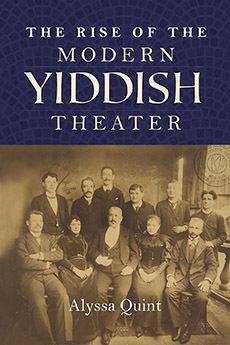
A leading scholar of early Yiddish theatre, particularly through her 2019 monograph The Rise of the Modern Yiddish Theater, which centers on Avrom Goldfadn’s pioneering troupe, Quint underscores that the emergence of modern Yiddish theatre coincided with the entry of women into public Jewish performance. While she stops short of framing women’s involvement as a necessary or sufficient condition for the formation of the modern Yiddish stage, she nonetheless asserts that “the participation of women was a crucial ingredient” in its development.
Given these insights into the distinctive role and historical significance of women in Yiddish theatre, one might expect a robust body of scholarship on the subject. Yet the contributions of female performers have remained largely marginalized within Yiddish theatre historiography. It is worth noting that many of the canonized works of the Yiddish stage are named after their central female characters—from Solomon Ettinger’s Serkele, to Goldfadn’s Shulamis and Di Kishefmakherin, to Jacob Gordin’s Mirele Efros. Other unforgettable figures populate the repertoire as well, such as Leye in Der Dibuk and Rivkele in Got fun Nekome. While there is a growing body of scholarship on the representation of women in Yiddish drama—by scholars such as Seth Wolitz, Joel Berkowitz, Barbara Henry, and Naomi Seidman, as Quint notes (5)—far less attention has been paid to the women who embodied these roles on stage.
This neglect stems, in part, from the tendency to view women in the field primarily as performers—ephemeral figures whose impact was limited to their onstage presence. Few women wrote plays or memoirs, and even fewer held directorial or leadership positions. This marginalization recurs throughout the essays in the volume. The paradox is perhaps most vividly embodied in the figure of Sonia Alomis, the subject of Debra Caplan’s article, aptly titled “Documenting a Voiceless Celebrity Actress.” Alomis left behind no written legacy—no plays, memoirs, or personal letters—yet hundreds of photographs remain, primarily promotional stills (204).
Whether through recovery-driven case studies or broader theoretical interventions, this volume resists the reductive portrayals of Yiddish actresses common in both the contemporary press and later historiography. It refuses to confine these women to the role of beautiful face, body, or voice—mere objects of admiration under the public gaze. Instead, its contributors work to restore their agency, perspectives, and cultural labor. As Quint provocatively asks: “How may we consider women on the Yiddish stage as cultural producers?” Embedded in this question is a larger challenge: can we recognize these women as models of female empowerment and financial autonomy—figures who carved out platforms for authority, creativity, and cultural production?
Behind the Curtain: Patterns of Erasure and Empowerment
This ambitious project contends with several recurring challenges, reflected across multiple essays in the volume. One is the scarcity of first-person sources, exemplified by the case of Sonia Alomis. Another is the persistent preoccupation with the actress’s sexuality—her love life, appearance, and public persona—which, while often contributing to her public appeal, also tended to overshadow her artistic achievements. The enduring stigma of the actress as morally suspect—historically linked to prostitution, promiscuity, or social transgression—casts a long shadow over many of the discussions in the volume. At one end of the spectrum is Tova Markenson’s compelling analysis of the Argentinian Yiddish stage and its alleged ties to human trafficking. Building on the work of theatre scholars such as Donna Guy, who cautioned against accepting reports of strong connections between theatre and prostitution at face value, Markenson challenges the persistent myth that equates Buenos Aires’s Yiddish theatre with the sex trade. Though she ends on a note of incertitude—“we do not know for certain if Jewish prostitutes attended the Yiddish theatre in Buenos Aires”—she persuasively argues that such associations stem less from fact than from “dominant cultural assumptions about antitheatricality, femininity, and class” (Markenson, 222).
At the other end is Warnke’s study of the memoirs of three iconic Yiddish prima donnas—Bertha Kalich, Sarah Adler, and Bessie Tomashevsky—who, as she demonstrates, carefully navigated “between adhering to and subverting social expectations” (Warnke, 11). For all three women, “discussion of their courtship, their affairs, and their marital lives becomes a significant cornerstone in the creation of their offstage personas and provides a powerful counter-narrative to the chronicles of Yiddish theatre historians who had a vested interest in suppressing sexual matters.” (Warnke, 22). Their efforts, however, unfold within clear boundaries. Even Adler, who repeatedly foregrounds her love life, is “careful not to sexualize her extra-marital affairs” and all three take pains to avoid the unforgivable female transgression of destroying their own marriages—or those of others (Warnke, 31).
Alongside these recurring challenges, other themes repeatedly surface throughout the volume, offering insight into how both contemporary and earlier generations of scholars and critics have framed discussions of actresses. One such theme is the inherently relational status of women on the Yiddish stage—arguably true of women in theatre more broadly—who, even as “stars,” are often situated in relation to others, far more so than their male counterparts. This is particularly evident in the frequent framing of actresses through their marital relationships. Many—indeed, most—of the women featured in this volume married in the theater. For example, Molly Picon, discussed in Robboy’s article, was married to Jacob Kalich; Diana Blumenfeld, the focus of Anna Rozenfeld’s article on performances in the Warsaw Ghetto, was married to Jonas Turkow; while Ida Kaminska, central to Giulia Randone’s chapter, was married to his brother, Zygmunt Turkow, and the list goes on. Critics have consistently drawn comparisons between these actresses and their husbands, often constructing narratives of rivalry or dependency, repeatedly asking: who stood in whose shadow? This dynamic is echoed within the volume itself, which often reveals that, regardless of the power dynamics during their lifetimes, it is the husbands who tend to prevail in historical memory.
A striking example is the case of Sonia Alomis and her husband, Alexander Asro. As Debra Caplan notes: “In life, they had performed together side by side and Alomis received more attention than her husband. In death, however, Alomis […] became a historical footnote to her husband’s illustrious theatrical career” (Caplan, 208). The case of Molly Picon and Jacob Kalich is, indeed, more complex. Throughout her career, Kalich acted as her “manager, coach, and agent,” and has written much of her plays or playlets. As Picon herself once remarked, “He did the talking for me—I was always doing the listening” (Robboy, 95). This dynamic contributed to the widespread assumption that Picon was primarily a performer, not a writer. Yet, as Robboy notes, “I was a little surprised, when, in the course of this research, I did not encounter any concrete evidence that he played any significant role in any of her writing” (Robboy, 95). The attribution of authorship to Kalich, it seems, has long obscured Picon’s own creative contributions, particularly as a lyricist.
More promising, however, from the perspective of the Yiddish actress, is the mother–daughter relationship. Esther Rokhl and Ida Kaminska are perhaps the most iconic example—though mentioned only in passing in Giulia Randone’s article, notably to question the notion of an inherited legacy of realist performance. Corina L. Petrescu’s contribution sheds light on a lesser-known couple: Dina and Lya Koenig. “The mother-daughter pair,” she writes, “demonstrates a model that was replicated many times over during the history of Yiddish theatre: women, who made Yiddish theatre into a family matter, who operated with financial independence, who aspired to do art but were pragmatic enough to be flexible when their life depended on it” (Petrescu, 293). At least within the scope of this volume, husband–wife relationships—however loving—are often framed through the lens of rivalry or historical erasure, whereas mother–daughter relationships emerge as a powerful model of female solidarity: matriarchy rather than matrimony.
Rethinking the Popular Stage
Finally, two articles in the volume compellingly demonstrate the value of bringing gender studies into dialogue with the growing body of research on popular culture. Both take popular performance—and its texts—seriously, rejecting the apologetic tone so often adopted by earlier generations of theatre critics, historians, and reformist playwrights such as Jacob Gordin, who lamented the so-called low status of Yiddish theatre and its association with shund, and always strived to elevate it. As Warnke’s seminal essay, “The Child Who Wouldn’t Grow Up” (2008), insightfully shows, this patronizing attitude often stemmed from a desire to excuse Yiddish theatre’s perceived belatedness or lack of refinement. By contrast, the two articles discussed here treat popular performance as a rich repository of cultural and social insight, rather than as a source of embarrassment.
The first is Robboy’s article, which challenges the narrow ways in which Molly Picon’s contributions have been remembered. Though she has been “justly celebrated as an actress, singer, dancer, comedienne, and scintillating personality,” she has been “all but overlooked as a lyricist” (Robboy, 86). While much of the article is devoted to a meticulous analysis of her songs, it also points to broader conclusions. Examining Picon alongside two contemporaries—Jennie Goldstein and Nellie Casman—Robboy observes: “Productive as these women were, none of them are customarily thought of as having written the words to the songs they were singing” (91). Once again, we encounter the persistent gap between the actress as a fleeting, embodied presence and her deeper, often unacknowledged role as a cultural producer and writer.
The second article that engages with the challenges of popular culture and the genre of entertainment song is Vivi Lachs’s study of women in London’s Yiddish music halls at the turn of the twentieth century. Her contribution brings to the fore a crucial theme that no volume on women in Yiddish theatre—or indeed in theatre more broadly—can afford to overlook: cross-dressing. Theatre, after all, is a realm of transformation, masks, and costume. Can male dress function as a vehicle for female empowerment on stage? In the twenty-first century, the answer seems evident—consider, for example, the casting of 88-year-old Lia Koenig as King Lear in Habima’s 2018 production, a moment briefly mentioned in Petrescu’s article. But what about earlier Yiddish theatre?
This question is taken up most directly in Lachs’s aptly titled essay, “Who’s Wearing the Trousers?” At first glance, her method seems conventional: analyzing female representation in theatrical texts—specifically, music hall songs saturated with gender stereotypes like the nagging wife, the unfaithful wife, or the seductress. What sets her study apart, however, is her serious engagement with this often-dismissed material and her insistence that “who is singing is crucial to understanding the power play of a particular song” (Lachs, 62). Lachs structures her chapter around three performative scenarios: songs performed by male actors playing male protagonists, by female actors playing male protagonists, and by female actors playing female protagonists. Though grounded in textual analysis, the essay ultimately re-centers performance, showing how the presence and embodied choices of performers can dramatically reshape meaning on stage. A particularly striking example is the song “A moytse im gevashn”—a bawdy tale alluding to illicit sex. Its humor, Lachs contends, stems from “the female singer, dressed as a Hasid, telling this tale.” In Rosa Klug’s cross-dressed performance—deliberately not attempting full male impersonation—the text is reframed to deliver “a political statement about male behaviour in treating women as objects of sex that can be discarded.” (Lachs, 75) Thus, Lachs suggests that such popular songs may allow a double reading, subverting their misogynistic meaning through the actress’s embodied performance.
Reflecting on the “Introduction to Yiddish Culture” course I recalled in my opening anecdote, I would like to imagine that today such classes no longer sideline women’s contributions—and that they now engage more fully with the vivid, often overlooked world of Yiddish theatre, a space that also offered women real avenues of empowerment. As Women on the Yiddish Stage makes clear, women were not peripheral figures but central players in the making of Yiddish cultural life. Their stories, whether told through archival fragments, recovered memoirs, or close readings of performance, call for a more inclusive and accurate understanding—one in which actresses are not merely remembered for their presence onstage, but recognized for their lasting cultural impact.

In geveb is turning t(s)en! If we want In geveb to continue to grow and thrive and remain a central address for the study of all things Yiddish online, we need your help to launch our second decade. Our goal is to raise $20,000 by our official tenth birthday: August 15, 2025. We invite you to donate to support In geveb and to honor everyone who has got us this far.