May 31, 2026
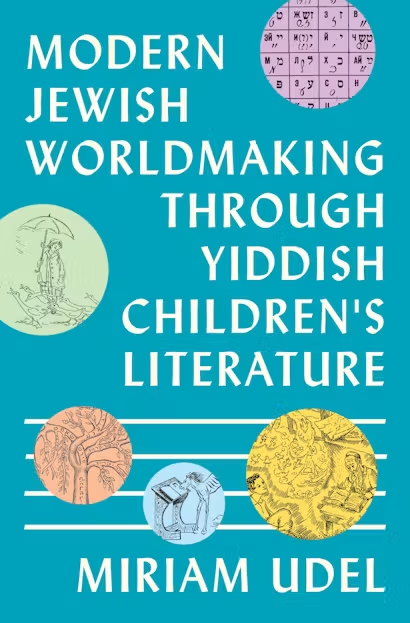
Miriam Udel. Modern Jewish Worldmaking Through Yiddish Children’s Literature. Princeton University Press, 2025. 384 pp. $19.98.
Miriam Udel’s Modern Jewish Worldmaking Through Yiddish Children’s Literature asks a question as complicated to answer as it is easy to pose: what did children read in Yiddish? A simple solution might be that one ought to read a cross section of historical Yiddish children’s literature and discern a few common motifs, trends, and perhaps ideological frameworks. One might call this literary history in the indicative mood: an examination of the corpus as it is. Yet as Udel demonstrates, building out from Reuven Brainin’s foundational 1900 declamation—“What Should Our Children Read”—the history of Yiddish children’s literature is a history shot through with the subjunctive mood (39, 295n72, et passim). It is as much a history of reading and writing as it is a history of political aspirations, of worlds built, lost, rebuilt, torn down, of what would have been and what might yet be. 1 1 Here I am somewhat inverting Udel’s sharp insight into the nature of our work as scholars of Yiddish literature, both personal and professional, drawn as she reflects on “an incandescent burst of the indicative,” her son’s palpable excitement at and desire for more tales of Labzik the proletarian puppy, which “breaks through the softening scrim of the subjunctive,” the what would or might have been, familiar to any Yiddishist’s daydreams. (See Udel, Modern Jewish Worldmaking, 21-22.) This is no small task, and it is one Udel accomplishes deftly.
Udel’s book is split into three sections, comprising the three significant eras, as it were, of Yiddish children’s literature. In each section Udel claims for that era a certain spirit of the times and illustrates this spirit with a number of close readings—of which I highlight some standout examples below. In part one, “Claiming a Usable Past,” the ambivalent—often dark and stuffy yet warm and inviting—and highly gendered childhood spaces of the shtub and the kheyder are set in the context of enlightening maskilic discourses surrounding them. Here, in chapter 3, “A Sabbath for Socialists,” she presents her excellent discussion of folklore, “fauxklore,” and the dialectic-as-aesthetic-practice—between religious tradition and secular progressivism—in socialist Sabbatarian literature (64-82). In part two, “Contesting the Jewish Future,” Udel shows how these enlightenment discourses are transfigured into the flames of leftist projects for national and economic betterment that sought to remake the Jewish people by means of their juvenile reading materials. Chapter 5, “The Storm Within,” contains the revelatory discussion of psychological agency and interiority, the hotly debated invention of childhood, and temper tantrums in Moyshe Kulbak’s Der vint, vos iz geven in kas (The Wind That Got Angry) (115-120). In part three, “Cataclysm and Creativity,” she sensitively analyzes the response of Yiddish pedagogues and children’s writers to the khurbn and the complex legacies of survivorhood, witnessing, and rebuilding. In chapter 10, “Should I Be Pope Someday?,” she engages in a thought-provoking analysis of the reinscription of Jewish history and myth to tackle the questions of assimilation, (de-)recialization, and the post-war push to choose Yiddish in Yudl Marks’s middle-grade novella Der yidisher poyps (The Jewish Pope) (240-247, 256).
In a word, Yiddish children’s literature, per Udel, has a long history, a series of stormy futures past, and a fraught yet fruitful and ongoing aftermath. Throughout the book, Udel maintains the necessary critical distance without losing sight of the vitality present in printed matter for children, the institutions pursuing this work, to say the least of the debates surrounding this highly contested work which suffused each epoch.
Udel’s book draws on a variety of theoretical threads in order to present the various texts, authors, and institutions under consideration. Beginning with the title, Udel reads the project(s) of modern Yiddish children’s literature through a framework borrowed from political science, that of worldmaking. Though first introduced with a distinctly Yiddish flair as a term that “entails the erection of a portable homeland, no matter how flimsy or jury-rigged” (xiv), Udel’s use of the term is better understood through a gloss she cites from the work of anthropologist Dorinne Kondo: worldmaking signifies “political action animated by political hope” (2). While this framework is seldom revisited explicitly beyond the introduction, it is the core principle underlying Udel’s project. Far from the stingy realm of realpolitik, Udel reads the lofty political aspirations of the largely leftist organizations leading the charge for Yiddish children’s literature generously, with a sympathetic yet discerning eye for the material impacts they made on generations of Ashkenazi Jewish children by means of paper, ink, and the Yiddish word (see, e.g., Udel’s discussion of the Medem Sanitorium, 120-136).
Udel’s deployment of Michel Foucault’s notion of heterotopia, a theoretical framework she does revisit throughout the text on several occasions, is less effective. Situating it in the context of the spatial turn that dominated the critical tradition in the middle of the twentieth century, Udel emphasizes Foucault’s insight that heterotopias—neither utopic nor dystopic, but heteros, other—mark tensions with and inversions of the usual topoi of our daily lives, literary and geographic: “a cemetery, for example, abuts the city of the living and reflects some of its hierarchies and other modes of social organization, but it’s home to the dead” (11-12). Thus, Yiddish children’s literature relates to and reflects the genres and concerns of adult literature in Yiddish, but it does so “aslant” (12). Sometimes this insight has its uses, as when the Medem Sanitorium becomes for Udel a heterotopic inversion of the city and the home, as seen through the representations of children’s autonomy and authority in books produced by and for the Sanitorium (120-121), or when Udel reads Yiddish fairy tales as reflecting “otherwise inaccessible truths” about the shifting economic and social realities of turn-of-the-century Eastern Europe (167). Other times, this insight is largely lost, as when the kheyder is figured as a heterotopia because it gathers together children of varying economic backgrounds (87). Here, the presence of difference does not necessarily rise to the level of heterotopia. It is not that Udel expands the concept too widely—Foucault’s heterotopias, like most Foucauldian concepts, are capacious to a fault. Rather, it is that the incisive power of the conclusions Udel draws about the juvenile inversions of adult expectations, and the hectic, crowded, clamoring spaces packed full with tension, difference, and contradiction which dominate in the Yiddish children’s literary imagination often feel displaced by the theoretical energy of the Foucauldian citation rather than left to stand on their own. Udel may have found exemplary heterotopias in the corpus of Yiddish children’s literature, but the theory’s explanatory power is not always sufficient to warrant its repeated presence in her book.
Without a doubt the greatest success of Udel’s book is her expert close reading of the corpus of Yiddish children’s literature. Here, as I am sure she herself would be the first to admit, her book is far from complete. Nor should it be, given the size and depth of the corpus under examination and her position as the first to thoroughly consider as “worthy of critical exegesis a set of texts too long dismissed as slight” (xvi).
A few of these close readings are referenced above. However, I will pause here to focus on one more exegesis Udel provides. Her book is, at its core, a feminist work, and necessarily so, given the heightened gender politics of childhood and the simultaneous dismissal of children’s literature as a secondary, feminized domain even as the field was occasionally dominated by men. It is, moreover, an explicitly feminist work, as Udel emphasizes at various points (16). Yet she does not read feminist history where it is absent. In chapter 6, “Without: The New Girl and the Power of Getting Lost,” Udel presents a twinned reading of two Yiddish “girl stories” that upset the typical European mode of reading the literary body of the girl as a metonym for the vulnerability of the nation: “the uniformly happy endings of Yiddish girl stories bespeaks both a shift in the meaning of girlhood in general and the insistently utopian worldmaking tendencies of this particular corpus” (139). Specifically, she reads Shloyme Davidman’s story “Norma iz gevorn a rednerin” (Norma Becomes an Orator) together with Dovid Rodin’s novella A modne meydl fun bruklin (An Unusual Girl From Brooklyn), taking them as inversions of the narrative of the wayward girl into the wandering girl. While the two stories differ in tone and political weight—the former an explicitly political tale of worker’s rights and cross-cultural solidarity, the latter a more meta-literary reflection on the power, perhaps at times unwieldy, of reading—Udel reads them (both, notably, written by men) as navigating the tightrope between the tendency of Yiddish culture of the time towards avek (away) and “adventure, agency, independence, and novelty,” and the patriarchal narrative of needing to lead wandering girls aheym (homewards) (158). Thus, in an exemplary moment of generous yet critical close reading, while Udel rightly admits that neither story can be read as thoroughly feminist by our standards, her feminist analysis recognizes them as “well on their way” towards the open political horizon of feminist possibility (159, emphasis in the original).
Udel’s book is not simply about what Yiddish-speaking Ashkenazi Jewish children were reading, once upon a time. It is, ultimately, a book about Yiddish child readers themselves, about the power and empowering nature of this reading material and the worlds these books tore down, built up, and shaped. Udel says this much in the introduction: “Books for children reinforce the habits of literacy itself—a politically freighted enterprise bound up in the transfer of power, for saber es poder—and often takes as their implicit theme the development of the child reader” (14). I found myself, therefore, disappointed in her concluding move towards a certain sense of ahistoricity when considering the most foundational of children’s literature in Yiddish, the abecedary, or alef-beys book: “While [the] trajectory [of Yiddish children’s literature] was shaped by historical forces, I want to conclude by considering how Yiddish children’s authors sought to transcend linear time and re-embed young readers in the Jewish eternal, a discursive space-time safely beyond history” (257). Udel’s reading in her conclusion is at odds with the corpus of readers and writers she has presented, who she so effectively shows to be engaged not in seeking safety in the pages of the book, but in seeking rather to use the book as a tool to actively and historically shape the world around them. The Jewish eternal dematerializes the presence of the Yiddish word in history, a presence made all the more powerful when it is wielded by and for young readers.
Ultimately, my political and theoretical reservations are kleynikaytn in the face of an admirable work of scholarship. Miriam Udel’s Modern Jewish Worldmaking Through Yiddish Children’s Literature is a model of engaged analysis, combining the personal and the political. As it wends its way through the varied corpus of Yiddish children’s literature, reading critically (yet more importantly, generously), it uncovers a usable past of political commitment, hope, and above all, as Udel reminds us both in her afterword and throughout her book, dignity over shame (281). She successfully champions this corpus, “the best of [which],” she writes, “lodge in the psyche of both adult and child as poetry—or prayer” (15). I would only add, in the spirit of the sabbatarian dialectic, that thanks to Udel’s work, Yiddish children’s literature today, as much as it did a century ago, stands as both poetry and prayer for a “shenere un besere velt” (133).