Mar 09, 2026
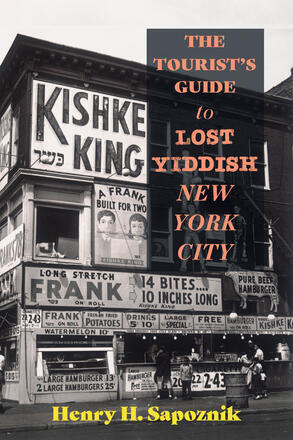
Henry Sapoznik. The Tourist’s Guide to Lost Yiddish New York City. SUNY Press, 2025. 385 pp. $29.95 [paperback].
Locals and tourists walking New York City’s High Line hear a cacophony of voices in languages that mirror the immigrant population of the city: English accents from all parts of the former British empire; Irish brogues, and various Scandinavian languages alongside visitors speaking German, Italian, Mandarin, Spanish, Portuguese, etc. Other than from an occasional ultra-Orthodox family, the one language from the rich US immigrant history not heard is Yiddish.
A hundred years ago, a tourist walking what became known as the Lower East Side (and rebranded in the 1970s by realtors with the more savory moniker East Village) would have heard Yiddish everywhere. As Irving Howe lovingly details in his Pulitzer Prize-winning book, World of Our Fathers (Harcourt Brace, New York, 1976), Jews expressed Yiddish culture on “the Jewish street” and in the institutions, in the words of Howe’s subtitle, “they Found and Made.” But the subtitle opens questions at the center of Jewish memory work: What are the material and geographic parameters of Jewish life, and who “made” the history? Who is included (and not)? Where are the boundaries of Jewish New York neighborhoods? In the tumultuous and contested world of Jewish work and labor, of trade unionists, bosses and entrepreneurs, of performers and audiences, who made that “lost” world?
Henry Sapoznik, the award-winning producer and performer of Yiddish song and music, most notable for his National Public Radio (NPR) series The Yiddish Radio Project, recovers large swaths of their “lost” world in his richly detailed The Tourist’s Guide to Lost Yiddish New York City. It is a lively account that will appeal to a general audience. Drawing on his own passion, his background as chronicler of Yiddish song, and his deep research in thousands of newspapers, biographical materials, and many little-known images of disappeared sites and buildings, Sapoznik documents the continuing legacy of Yiddish culture in the American present. But in moving from the 1880s to the end of the twentieth century, his story is of shops and streets in which little if any Yiddish is heard. The postwar story is of Yiddishland, a memory landscape with sites and artifacts packaged for a commodified present experienced often by nostalgic Jewish tourists noshing on the past. The organization of the book into four thematic sections—restaurants and food culture, architecture, music, and theater—does not offer a principle of inclusion and exclusion. To be fair, not everything can be included and the book does cut a broad swath, but readers will miss the New York Jewish history of Passover staples like matzah (Aron Streit’s factory) and Manischewitz wine. Still, readers will relish stories of many familiar characters, institutions, and foodstuffs from Yiddish New York, from stories of knishes and bagels, to icons such as George Jessel and Al Jolson, to the history of the families who built and sustained, for example, the Forverts (Forward) building, New York’s Jewish theaters and hotels, and the Jarmulowsky Beaux Arts building and banking empire. Rich accounts of women cantors (khazntes), African American synagogues and Black cantors, and the early history of Jews and jazz, speak to the fullness of Sapoznik’s range and research.
More importantly, the thematic organization buries the geographic and chronological history of Yiddish-speaking Jews and its segue into Yiddishland. But Sapoznik recovers multi-generational family histories that do illuminate changes over time. Second- and third- generation members reshape family enterprise to appeal to young generations of consumers in inventive ways that might surprise their forebears. Told in delicious, albeit sometimes wearisome detail, readers can piece together the rise and remaking of Yiddishland, but one misses a sustained discussion of this process and of what Sapoznik recognizes is the commodification of the past in an inventive present. (For me, a resonant example is the blueberry bagel.)
The book also contributes, more broadly, to a robust literature in tourist studies and public history. Recovering the Yiddish past raises questions that complicate all museologists’ and memorialists’ work: Who is to be included, whose stories get told and by whom, and what in the “remembering” is forgotten or ignored? Much of the book focuses on wealthy builders and entrepreneurs and, as noted, on their families. Long accounts provide much detail about Jewish daily life in foodstuffs—and the cafeterias and delicatessens that served it—and of entertainment venues. But on the whole, this is a top-down celebratory history that draws on Jewish nostalgia for a romanticized past. What about the cacophony of the Jewish street on which anarchists, socialists, communists, and anti-communists fiercely debated justice and injustice? That is, what about the people who worked in the Yiddish-speaking institutions chronicled in the book and argued amongst themselves about their working conditions and daily life? For ultimately, the literature asks chroniclers and readers to think about who made the Jewish world.
Amidst the wide-ranging vibrant example of Yiddish life Sapoznik provides in this book, the thematic organization also leads to some significant conceptual and geographic gaps. Although Sapoznik opens with a short chapter on New York’s 1902 kosher meat riot by Jewish women, such political activism is generally underrepresented in the book. Many of these same women—often informed by Jewish Bundism—become the backbone of the extraordinary story of Jewish garment worker unionism in the prewar era, department store unions in the 1920s and 1930s, and rent strikes in Brooklyn, Bronx, and Manhattan. They make for a different “bottom up” narrative of Yiddish New York. The sites of their struggles, from the Triangle factory fire to “the Coops,” spoken often in a multitude of diverging socialist and communist voices, allow for compelling tourist mapping. But other than an occasional sidenote on workers’ unions, the 1902 riot stands alone in this text.
In addition, Sapoznik’s focus on Manhattan in his history of Yiddish New York City obscures and delimits other possibilities. To be sure, the identification of New York City with Manhattan is familiar; teaching New York City history I struggled to get students and the history into the outer boroughs. Sapoznik does bring his story to Newark briefly and refers to the Catskills’ Borscht Belt. But readers will not find a sustained story of Brooklyn’s Borough Park and Brownsville or of the South Bronx and Grand Concourse Yiddish communities. Moreover, Yiddish-speaking Jewish activists traveled throughout what was then understood as the New York Metropolitan area. For instance, Yiddish-speaking trade unionists traveled to organize and support the 1926 Passaic strike and Paterson’s important textile strikes. Similarly, the Paterson strikers, many themselves Jewish Yiddishists, traveled with comrades to the 1913 Paterson Pageant at Madison Square Garden in support of that city’s textile workers’ strike. And in support of the working class, the Paterson Jewish Folk Chorus (like others in other local area Jewish communities) sang in Yiddish. This, too, is a story that broadens the popular scope of the Yiddish New York musical scene beyond that of its icons.
Finally, while Sapoznik ties upstate New York’s Borscht Belt to the Second Avenue Jewish Rialto, albeit in passing, he does not make similar connections to philanthropic social institutions that contributed to the rich immigrant Jewish culture. Jewish Yiddish-speaking activists and German-speaking reformers established institutions important to the history of Jewish youth. The Federation of Jewish Philanthropies established the Hawthorne School for “delinquent” boys in 1906 and Cedar Knolls for girls in 1911, institutions that document contested histories of Jewish youth. In lower Manhattan, the Henry Street and Greenwich House settlements similarly open a window on Jewish youth play and development. In such ways, an enhanced geographic field for Yiddish New York places a complex, contested set of experiences at the center of Yiddish New York history.
These arenas for extended inquiry do not diminish Sapoznik’s achievement. Rather, while they put forth what I think can be a more class-dynamic conceptual framework for thinking about what is remembered and what could have been introduced into his story, they are meant to suggest how other scholars might build on his work. And in that regard, one final especially dramatic event—theatrically dramatic and politically so—illustrates the profound set of class and ethnic relationships that riddle Yiddish New York.
The example is a play familiar to many In geveb readers: the well-known controversy surrounding the production of the play “God of Vengeance” (Got fun Nekome), written by Sholem Asch, originally produced in Yiddish. In 1923, the entire cast and production of an English-language version was closed by New York authorities as “obscene.” Yiddishland had signifiers that continued beyond the expression of language. Indeed, the cast included the famous Jewish immigrant actor Rudolph Schildkraut, who surprisingly does not appear in the Tourist’s Guide.The play also speaks to the complexities of Jewish voices of owners, workers, women, and men. At its center is the story of a Jewish brothel owner who seeks respectability by bargaining with a local rabbi to provide a Torah scroll for his synagogue in exchange for the rabbi matching his daughter with a yeshiva student. The daughter, however, is in love with one of the brothel’s sex workers, with whom she has what is putatively the first lesbian kiss on Broadway! The chief witness against the production was the rabbi of uptown Temple Emanu-El, Rabbi Joseph Silverman, who declared in an interview with the Forverts: “This play libels the Jewish religion. Even the greatest anti-semite could not have written such a thing.” So were the lives of German-speaking and more elite uptown Jews intertwined with downtown Yiddish-speaking working-class Jews.
Two final thoughts. First, while the back cover notes that there is an interactive Google Map linked to sites discussed, the text does not take readers to the Google site. A Kindle version easily could, but I would urge the publisher to prominently insert a URL link to the Google Map in the next iteration of the book. [Editor's note: : There is an online interactive map associated with this book which can be accessed at https://www.henrysapoznik.com/lost-yiddish-nyc] But in any case, the volume could benefit from maps and a suggested walking tour (or two, or three). Secondly, the volume has fifty images, many not well known to readers. In black and white, many are quite grainy, but I think there would be an audience for a collection of enhanced images presented in a coffee-table book.
None of this diminishes Sapoznik’s achievement. Yiddish New York City is a story demanding context, complexity, and struggles of Jews, together and apart. Sidebars hint of some of that history; a sequel could well elaborate those complexities. Meanwhile, readers will find much to enjoy in stories that celebrate significant players in the Yiddish New York past.