Oct 27, 2025
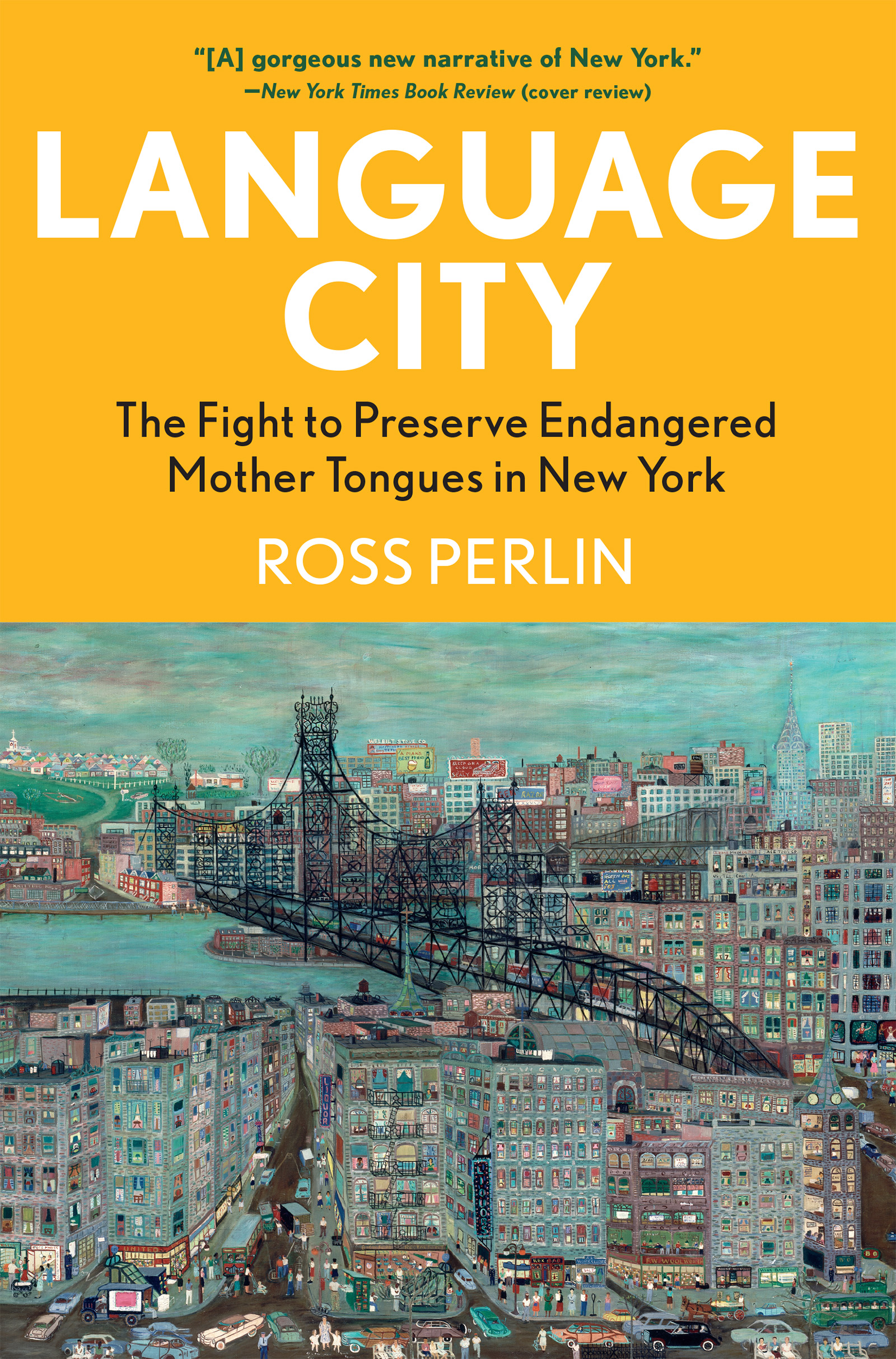
To get a sense of the seven-hundred-plus languages spoken in New York, you can visit languagemap.nyc, a map-based portal chock-full of information and recordings from Ross Perlin’s Endangered Language Alliance. But to learn in depth about many of those languages, the enterprises of linguistics and language documentation, and the past and present of various immigrant and indigenous groups, check out Perlin’s excellent book Language City: The Fight to Preserve Endangered Mother Tongues in New York (Atlantic Monthly Press, 2024).
I could imagine a similar book that focuses only on words, phonemes, syntax, and other technical aspects of language. But language is a human phenomenon, and Perlin humanizes his linguistic analyses. We learn about the immigrants who speak various languages in New York, their relatives who still live in the homeland, and the activists who are documenting and revitalizing endangered languages. It’s linguistics, but it’s also ethnography. That makes this book great reading not only for linguaphiles but also for anyone who loves a good story.
The initial chapters introduce the book, the work of the Endangered Language Alliance, and the field of linguistics in a concise, relatively comprehensive way. I have assigned one of these chapters—“A Brief Guide to Radical Linguistics”—in multiple classes that deal with language, and the students find it informative and enriching.
Part 2 gives a history of groups and languages in the city, including survivors of various wars and genocides and stories like that of Minik, an Inuktun speaker from Greenland brought to the US at age seven in the late 19th century by explorers, as well as the emergence of a new “superlanguage,” Caribbean English Creole, which brings together features from several islands.
The gem of Language City is Part 3. Each chapter showcases an individual involved in language documentation and/or revitalization: Rasmina (from Nepal, Seke speaker), Husniya (from Tajikistan, Wakhi speaker), Boris (from Bessarabia and Moldova, Yiddish speaker), Ibrahima (from Guinea, promoter of the N’ko writing system for Manding languages), Irwin (from Mexico, Nahuatl speaker), and Karen (from Ontario, Lenape speaker). The profiles use these individuals’ personal stories as launching pads for broader discussions of the languages, their histories, and their current communities. The ethnographic details are so rich that readers feel like they’ve read six separate books about particular cultures.
Language City mentions several Jewish languages, such as “those spoken along Ocean Parkway, arguably the most diversely Jewish street in the world”: “Juhuri, Bukhori, Ladino, Judeo-Shirazi, and various forms of Judeo-Arabic, though most are shifting fast to English, Hebrew, Russian, or Persian” (52). But the part that is most directly relevant to Yiddishists is the chapter profiling Boris Sandler, who became the Forverts editor after he immigrated to the US in the 1990s.
We learn about Boris’s Yiddish-speaking childhood in Belz, Moldova; his education in Yiddish literature as an adult and his subsequent unlearning of Soviet orthography; his work with Sovetish heymland; his leadership in Yiddish culture in Kishinev and New York; and the Yiddish musical for children he wrote with pianist Evgeny Kissin, which premiered in Birobidzhan shortly before the COVID-19 pandemic. We read an excerpt from Boris’s Lamed-vovnikes fun mayn zikorn, transliterated and translated by Perlin.
This chapter offers an example sentence demonstrating the Germanic, Slavic, Romance, and Semitic components of Yiddish:
דער זיידע האָט געבענטשט גומל
Der zeyde hot gebentsht goyml
Grandpa said the prayer (i.e., was grateful) for having made it out of danger (132)
(The book gives all language excerpts in the original orthography [if available], in transliteration, and in an italicized English translation, subverting the norm of italicizing non-English words.)
Perlin characterizes the New York Yiddish scene as made up of “Yiddishist descendants, self-taught ideologues, straight-up oddballs, grad students, retirees, and international types passing through” (303). We learn about Mordkhe Schaechter’s lexicographic notecards and the thousand-plus Yiddish songs recorded by Ben Stonehill. Perlin talks about “the irony of the secular klal ‘standard’ being based on the now highly endangered Northeastern (a.k.a. Lithuanian) variety,” in contrast to the vibrant Hasidic Yiddish.
He offers some disparaging words about Hasidim, quoting Boris Sandler calling them “cultural amoratsim” (280) and later saying that Hasidism is “troublingly tied up with separatism and superiority” (308). But with admiration, he appropriately characterizes the continued use of Yiddish among Hasidim as an intentional revitalization: “This is no archaic sliver of shtetl just off the J train, but the conscious attempt of Holocaust survivors with meshugene koyekh, crazy force of will” (304). And he highlights the “back and forth between frum and fray” (306), including increased readership any time the Forverts has published articles about Hasidic Jews.
We often think about Yiddish independently or within a Jewish studies context, but Perlin’s book contextualizes it in the broader phenomena of world languages and contemporary language shift due to historical colonialism, war, and migration. For example: “Both in Moldova and across the collapsing Soviet Union, suppressed ethnolinguistic impulses and buried histories were now returning with a vengeance” (132). He compares Hasidic Yiddish revitalization to “the extraordinary and much larger-scale survival and growth of African American English across the US since the Great Migration.” He discusses the Forverts in the context of three-hundred-fifty-plus non-English media outlets, including in Czech, Arabic, and Rusyn. He compares the Fishman, Schaechter, and Gottesman Yiddish enclave on Bainbridge Avenue to an Irish-language enclave in Northern Ireland that began a few years later. (We also learn that the Bronx families “called their experiment Bainbridgivke, a play on Sholem Aleichem’s idealized fictional shtetl Kasrilevke” [300].)
Of course, Joshua (Shikl) Fishman made those connections decades ago, with his Yiddishist activism and applied research on reversing language shift. This book also highlights Fishman’s work: “He was so venerated among language activists worldwide that Māori dancers came to New York to honor him with a thundering haka just before his death in 2015, which was the last time I saw him” (302). Clearly Perlin was influenced not only by Fishman’s language revitalization work but also by his Yiddishism. After learning his grandfather’s language as a young adult, Perlin served as a Yiddish correspondent for the Forverts while living in China and beyond. Fishman’s sociolinguistics library now lives at the ELA.
Readers learn concepts relevant to Yiddish studies even in sections not directly focusing on Yiddish. We learn about other cases of sacred texts’ writing systems used to represent unrelated languages. An example is Ajami, the system of rendering West African languages with Arabic letters, such as Kanuri glosses in a 17th-century Quran in Chad. We read about language activists avoiding influences from other languages, including in neologisms. In a chapter on Wakhi, an endangered language from Tajikistan, we learn about the controversies involved in writing a Wakhi children’s book: “People will be sensitive about everything: the dialect, the spelling, the speakers, the morals, the age level” (253). Sound familiar? In the chapter on Seke, a Sino-Tibetan language, we learn how much work goes into eliciting language, determining whether a particular morpheme is used in a particular context, transcribing and translating the language, and making it accessible to the public. This explains why even over a century after scholars started seriously documenting Yiddish, there is still much work to do.
In the 1960s, a linguist worked with Lenape speakers in Moraviantown, Ontario, whose ancestors had been expelled from New York, to document their language, including significant variation. This was the same time that linguists Uriel Weinreich and Marvin (Mikhl) Herzog and their team at Columbia University were documenting Yiddish variation from immigrants and refugees in New York. We also meet language activists who learned the languages their ancestors rejected—in the wake of colonialism, restrictive language policies, and socioeconomic pressures.
The conclusion brings together the book’s languages in creative ways, just as immigrants are doing. It emphasizes hybridity, from the Yemeni ocks (“guys,” from Arabic) who run delis (a clipping of “delicatessen,” from Yiddish, with roots in German and French) and bodegas (Caribbean Spanish, originally from Greek “apotheke,” cognate to “boutique” and “apothecary”) to the translanguaging that is the norm in bilingual families. This chapter also applies the findings about language, immigrant communities, and urban space to immigration and health policy. For example, when the COVID-19 pandemic hit, “speakers of less common languages were suddenly at a life-or-death disadvantage” (453). Perlin calls for “a linguistic infrastructure, a real right to language that ensures information, interpretation, and education in every mother tongue” (459).
Ultimately, readers should be left with a sense of the importance of immigration and linguistic and other cultural diversity in New York and beyond—and a desire to support immigrants and their language needs and to help document endangered languages before it is too late. And, especially if they read the hundreds of footnotes, they will come away with fun facts to share with anyone interested in language.
For those who live in or can visit New York or immigrant enclaves elsewhere, I recommend reading the book while experiencing that linguistic diversity—on subways, buses, and street corners, in markets and restaurants where you can hear multiple languages. And I recommend purchasing the book because you may want to go back to it again and again to re-experience its encyclopedic breadth and richness.