Apr 27, 2026
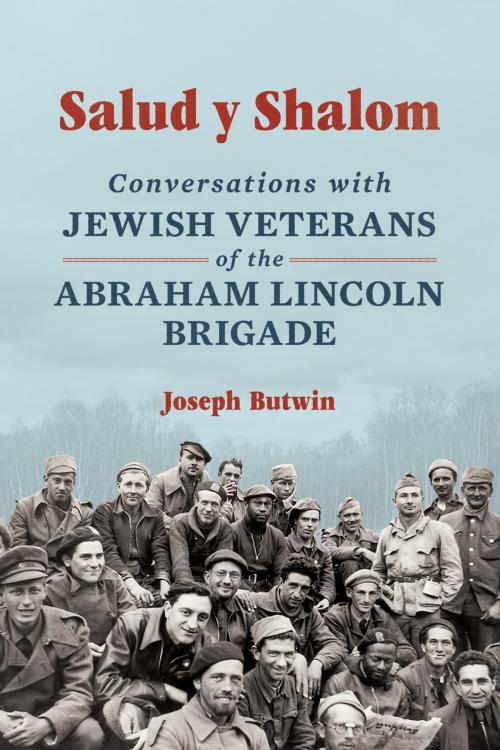
Joseph Butwin, with editorial assistance from Edward Baker and Anthony L. Geist. Salud y Shalom: Conversations with Jewish Veterans of the Abraham Lincoln Brigade. University of Illinois Press, 2025. 260pp. $28.00 [paperback].
Joseph Butwin’s Salud y Shalom is a long-awaited exploration of the motivations that brought hundreds of Jewish American volunteers to Spain in the late 1930s to fight in the country’s nominally civil war. Through detailed conversations with ten veterans, Butwin elicits fascinating reflections on their experiences and era. The last living American veteran of the Spanish Civil War, Delmer Berg, died at 100 in 2016, so the opportunity to read these first-hand accounts now, a decade later, is an unexpected gift.
The Spanish Civil War (1936-1939) drew around 35,000 international volunteers from fifty-three countries to the fledgling Spanish Republic to join the ultimately futile struggle against Franco and his fascist and Nazi allies. In Jewish Volunteers, the International Brigades, and the Spanish Civil War, Gerben Zaagsma estimates that between 3,500 to 4,000 of all the foreign volunteers were Jewish. 1 1 Gerben Zaagsma, Jewish Volunteers, the International Brigades and the Spanish Civil War (Bloomsbury Academic, 2017). Three thousand Americans traveled to Spain to support the Republic, three-quarters of them Communists, and nearly one-third of them Jewish. These numbers are, however, all estimates: many volunteers adopted anglicized names and pseudonyms, and used counterfeit passports, which complicates any calculation of Jewish participation. Still, even these rough numbers indicate something striking: a disproportionate number of Jewish people among the so-called premature antifascists.
Salud y Shalom’s first-person narratives join historically-focused studies of Jewish participation, including Zaagsma’s vital study of the international Jewish presence in the war, Derek Penslar’s Jews and the Military: A History, and Alain Brossat and Sylvia Klingberg’s Revolutionary Yiddishland: A History of Jewish Radicalism, as well as Raanan Rein’s extensive study of Spanish Civil War support and volunteerism amongst Palestinian and Argentinian Jews in “Tikkun Olam and Transnational Solidarity: Jewish Volunteers in the Spanish Civil War,” “Jewish Women Fighting for Social Justice on Both Sides of the Mediterranean,” and other works. 2 2 Zaagsma, Jewish Volunteers; Derek Penslar, Jews and the Military: A History (Princeton University Press, 2013); Alain Brossat and Sylvia Klingberg. Revolutionary Yiddishland: A History of Jewish Radicalism, trans. David Fernbach (Verso, 2016); Raanan Rein, “Jewish Women Fighting for Social Justice on Both Sides of the Mediterranean,” in Untold Stories of the Spanish Civil War, ed. Raanan Rein and Susanne Zepp-Zwirner (Routledge, 2023), 41-60; Raanan Rein, “Tikkun Olam and Transnational Solidarity: Jewish Volunteers in the Spanish Civil War,” Politics and Religion X, no. 2 (Autumn 2016): 207-230. Salud y Shalom also joins many efforts to preserve American volunteers’ experiences, including the expansive work of the Abraham Lincoln Brigade Archives and the Veterans of the Abraham Lincoln Brigade. The book is, to my knowledge, the first effort to discuss Jewish American volunteers’ lives as Jewish volunteers, and their insights and anecdotes form a valuable chorus of voices articulating diverse motivations and experiences.
What accounts for the preponderance of Jewish volunteers? The question of their motivations has long been a fraught one: while, perhaps most obviously, fighting Franco was the most direct way possible to counteract spreading European fascism, most international volunteers served with the Communist International Brigades and many proclaimed—at least publicly—that their political beliefs and especially their internationalism, not their religious or ethnic identities, inspired their antifascist commitment. The 1937 establishment of the Yiddish-speaking Naftali Botwin Company within the International Brigades—which included Jewish volunteers from across Europe, England, and Mandatory Palestine—demonstrates the significance of one facet of Jewish identity, at least for some volunteers. Yet, as many scholars, including Butwin, recount, volunteers often dismissed the relevance of their Jewishness to their antifascist activism. As he explains, “In the late 1930s Jewish American leadership played down the threat to Jews posed by the rise of Fascism in Europe; so did the Jewish Left. Established Jews didn’t want to call attention to the plight of Jews anywhere” (11). As Butwin’s perceptive, moving conversations demonstrate, with the benefit of time and age, and with Butwin’s own conversational encouragement, many veterans were ready to reflect on the foundational role of Jewish upbringings and yiddishkayt in their paths to Spain: to, as former volunteer George Watt memorably terms it, “come out of the closet with our Jewishness” (11). Many, but not all: another former volunteer, as Butwin recounts, refused his request, believing the Jewish dimension of volunteering to be irrelevant.
Butwin’s dialogues with ten American volunteers—two women, both nurses, and eight men, all soldiers—showcase participants’ varied inspirations, experiences, and politics. The ten volunteers, as Butwin describes, “had grown up with the revolution of 1917. Some, in their childhood, had witnessed the revolution firsthand; most were the children of immigrants from czarist Russia, and many were raised in a tradition of Jewish—and Yiddish-speaking—Socialism before they joined the Communist Party in the early 1930s” (x). They attended Yiddish secular schools, and later became members of the Young Communist League, learning about Spain, the Scottsboro boys, the Harlan County strikes, and Hitler’s rise in the pages of the Daily Worker and the New Masses. In Spain, where Yiddish was often the lingua franca, they served with the American Abraham Lincoln Brigade and the Canadian Mackenzie-Papineau Battalion (in this way, the book’s title is a slight misnomer), and with the American Medical Bureau to Aid Spanish Democracy. The women arrived with extensive medical training; the men with no military training. After the Spanish Civil War, many served in World War II—where some experienced antisemitism from fellow American soldiers. Later, they were targeted as “Reds” during the Cold War. Most had left the Party by the time they spoke with Butwin.
Butwin’s introduction is insightful, a helpful frame within which to reflect on the dialogues themselves. Butwin’s dialogues with the veterans are composed of excerpts of letters—in fact, the book’s title, Salud y Shalom, comes from one veteran’s usual closing—and transcriptions of their conversations. (A digital archive also includes selected interviews: https://jewishstudies.washington.edu/american-jews-spanish-civil-war/. The complete recordings are housed in the University of Washington Libraries’ Special Collections.) He is quick to stipulate that these are not necessarily oral histories or interviews, but conversations: the motivation to conduct this work came from the veterans themselves, and Butwin, in his words, “knew very little about the principles and practice of oral history” (xi). The resulting conversations are oral history “to the degree that oral history is also the history of orality, of speech and memory” (xi). Butwin conducted the meetings in person in the early 1990s, traveling across the country to visit veterans who were by then in or nearing their eighties, and motivated to share their experiences: “This was the time for broad reckoning and reflection” (x).
The veterans share details of their upbringings, their parents—sometimes their grandparents too—their educations, and early political involvements. They recount their time in Spain and its aftermath, and their evolving relationships to national and international identity, politics, and religion. In their individual decisions to travel to Spain, there is frequently a fascinating sense of inevitability. Watt describes how he was motivated because “I was afraid that history was going to pass me by” (45). Abe Osheroff reflects that although he at first hesitated—"They [the Spanish] barbecued my people not too many hundreds of years ago!” (195)—as a longtime activist, he soon recognized that his political beliefs compelled him to volunteer: “if I didn’t go, I’d have some very big difficulties with my conscience” (196). Bill Susman explains, “I was born to go to Spain because with this background [his family’s politics] there was nothing else in my future but to do precisely that” (105). Celia Seborer was the first American woman to volunteer in Spain, initially working with the Canadian doctor Norman Bethune’s trailblazing blood transfusion unit. A rarity among the volunteers, she had visited Spain before the war, accompanying her husband when he reported on the Asturian miners’ strike in 1934, and then across Europe. As a result, she had seen Nazi antisemitism first-hand and so about volunteering, “I never had any question” (63).
The accounts include gripping stories of wartime danger and kindness. Sana Goldblatt recounts how she was imprisoned and nearly murdered as an accused spy, all because she was trying to transport Nazi propaganda to share with the Daily Worker so that the newspaper could report on Nazi involvement in Spain. While she recounts the situation with humor—“I was an international spy by then! But I didn’t know it” (94)—she acknowledges the grave danger she faced. Osheroff concludes that Spain was “[w]ithout exception, for everyone … the, or one of the, peak experiences of their lives … nine-tenths of us did experience—the incredible love and generosity of the Spanish people whom we came into contact with … for most guys this was something new: to walk down the street of a town and be recognized as a volunteer, and people fight for the privilege of taking you to a bar for a drink and being upset if you don’t go with them. There were ordinary guys in the brigade who never got any recognition like this again, and this might be the only time in their lives when they experienced group love, affection” (205; italics original). The contribution to which this respect and affection testify have been, for Watt, effaced in most histories of Jewish antifascism: “the fact is that Jews did fight against Hitler long before it was generally accepted, even before the general threat of Hitlerism was understood and at a time when the Jewish establishment had a hush-hush policy” (36).
Butwin’s conversations with Irving Weissman begins with their discussion of the influence of James Joyce’s A Portrait of the Artist as a Young Man on the veteran. Many of the other veterans, too, refer to the integral role of Yiddish and English literature in their upbringings. For these veterans, their time in the war was a personal and political watershed moment, their coming of age. Some later depicted their experiences through art, too, including Abe Osheroff’s film Dreams and Nightmares, and George Watt’s memoir The Comet Connection. All sustained their political activism, nationally and internationally, including in the American South, Nicaragua, Israel, and Spain. “Next year in Madrid!” was the concluding rallying cry of the 1957 meeting of the Abraham Lincoln Brigade veterans, a call to action that, like the book’s title, suggests the inextricable tie between their Jewish and political identities. Butwin sees this cry as evidence of the veterans’ “read[iness] to recuperate” their yiddishkayt (222). Madrid—in 1957, under fascist rule, but still the hoped-for capital of the democratic Spanish Republic—is figured as a new Jerusalem. The Madrid-Jerusalem connection resonates differently for each of these ten volunteers, so many decades later. Their diverse perspectives on antifascist activism, Jewish identity, and internationalism remain critically relevant. The title Salud y Shalom draws from a valediction, but the conversations the book contains hail new insights into Jewish political engagement then and now.