May 06, 2026
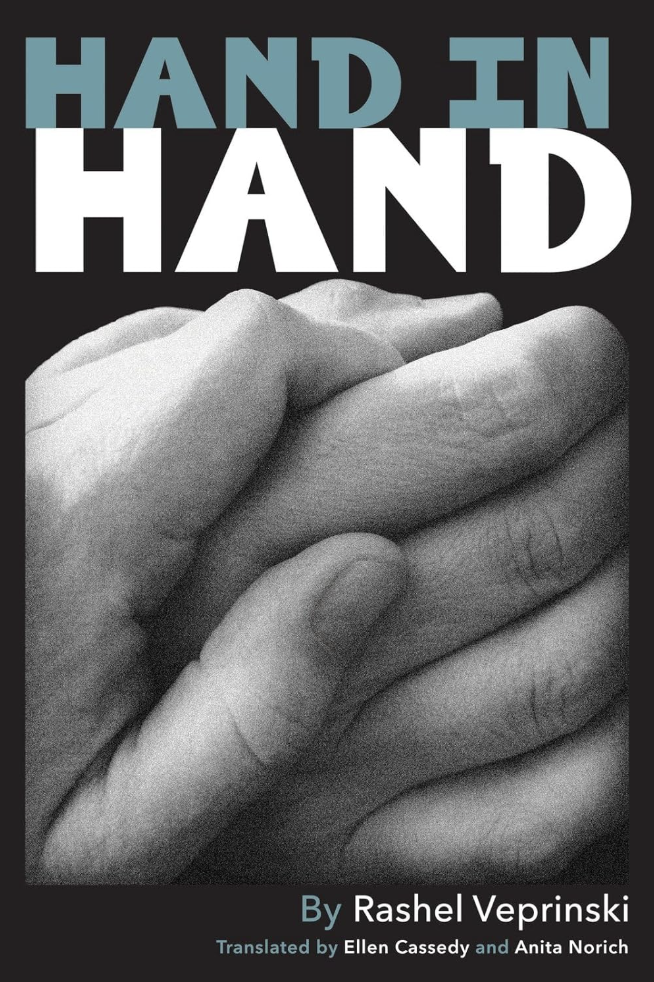
Rashel Veprinski, Hand in Hand: An Autobiographical Novel, translated by Ellen Cassedy and Anita Norich. White Goat Press, 2025. 194pp. $18.95 [paperback].
Rashel Veprinski's Hand in Hand, translated by Anita Norich and Ellen Cassedy (White Goat Press, 2025), is a translation from the original Yiddish, which was published in 1971 in Tel Aviv as Dos kreytsn fun di hent: oytobyografisher roman [Crossing of the hands: an autobiographical novel]. The excellent English translation by Anita Norich and Ellen Cassedy, published in 2026, takes its title from a poem within the novel (152-153).
In this roman à clef, a novel based on real life people and events, Veprinski paints a vivid portrait of young love and literary life in New York. Drawing on material from her life fifty years earlier, the novel centers on the affair between Miriam and Nyezhnier, characters based on Rashel Veprinski and Mani Leyb, who were life companions for nearly three decades. From the grittiness of the city to secret rendezvous in the Catskills, the narrative reveals the emotional world of the couple and the Yiddish literary circle Di Yunge (the young ones) that surrounds them. Their infatuations, despair, jealousy, arguments, breakups, commitments, and dreams make this novel feel as though it was written yesterday.
The novel’s brilliance lies in its illumination of gender and desire, especially the shifting expectations for Jewish women moving from eastern European shtetl life to factory work in New York and into the modern American Yiddish world. Refracted through the main character Miriam and grounded in the veracity of Veprinski’s real life, the reader experiences firsthand how work, love, and artistic freedom get reconfigured.
—
The novel begins in 1918. Miriam and Nyezhiner meet for the first time walking across the Williamsburg Bridge. Miriam Eidelberg, an immigrant, a mother, and a wife, knows all of Nyezhiner’s poems by heart.
Nyezhiner is an up-and-coming poet and a working-class artist, jumping between furnished rooms and jobs, single, yet the father of five, all while pioneering a newly formed Yiddish literary group.
Miriam is besotted. No more than a child herself, she tells him of her parenting struggles, her devotion to her daughter Dinaleh, and her decision not to have any more children with her husband David—a dependable yet emotionally vacant pharmacist—hinting at her festering marital discontent. Despite Miriam’s attempt to friendzone Nyezhiner, the two nevertheless grow close. As Miriam observes, “his every gesture felt oddly familiar, like a scribbled line she’d read before, without remembering where or when” (8). Their romance quickly intensifies and the early chapters reveal the hastiness of this passionate affair. Miriam admits her desire for Nyezhiner and swiftly separates from her husband. Miriam's family disapproves, insisting on stability and security over the fulfillment of her longing.
While consoling her daughter after the implosion of Miriam’s marriage, Chaye Sore recounts an anecdote about her own mother—Miriam’s namesake—and concludes, “You see? A woman should never depend on a man. Or maybe that’s just true in our family” (40). The desire for freedom is a family inheritance.
Chaye Sore’s mother Miriam had also fled her unreliable husband in the old country. He was a furrier; “his hands were as hard as leather when he touched her, making her blood run cold” (40). Despite a rabbi’s order to return, the elder Miriam packed her bags and left. She later married a widower with five children and, with infants at her breast, began selling goods in the marketplace alongside Jewish and non‑Jewish women. While Miriam worked, her second husband studied Talmud; Chaye Sore notes his “delicate, lovely hands that inscribed the letters of the Bible onto parchment and earned next to nothing” (40). Seeing the parallels between her daughter’s situation and her mother’s, Chaye Sore falls silent and murmurs, “maybe what is happening to Miriam is meant to be” (41).
Though Chaye Sore stops short of fully exhausting the parallels between the two Miriams, her anecdote gestures at the common gender expectations in shtetl life. Soft, pale hands signified idealized masculinity; demonstrating a life of the mind, spent indoors studying Torah. Women, on the other hand, were the breadwinners: outgoing, entrepreneurial, and assertive with strong hands.
Hand in Hand underscores how shifting gender expectations in America have reshaped Jewish women’s roles, opening up exciting, if complicated possibilities. Early in the novel, Miriam’s husband David reflects on this change: “Here in America, it fell to men to make a living. Women, especially those of the middle class, had a lot of free time. It was no accident that America had so many female writers” (11). This was true of Miriam, who largely wrote in secret while married to David, and is further echoed in the character Ada, “the leading lady of Yiddish literature” (1), who was based on the influential Yiddish poet Anna Margolin. Miriam credits Ada with introducing her to the poetry of Di Yunge, bringing Miriam the papers and journals that published the group’s poetry. Ada is known in the novel for her talent; the men around her assert that they are not jealous. Ada dates fellow poet Yankev Shor (based on the founding poet of Di Yunge, Reuben Iceland), who deep inside, was “embarrassed because Ada, with her handful of published poems, had more of an impression than he had been able to with a whole book of poetry” (67). In addition to her literary flare, Ada is an emotional force to be reckoned with throughout the novel.
Ultimately, it is Miriam’s shift in class position that reshapes both her aesthetic sensibility and her romance with Nyezhiner. Now separated from her husband and working long factory days, she experiences a physical tiredness that dulls the poems that once moved her. Fearful of her newfound tiredness preventing her from enjoying the art that previously made her feel so alive, she admits that after “a day’s work in the factory, her fingers pricked by the needle and her weary shoulders bowed—now the poems whispered didn’t touch her the way they had in the days when she wasn’t so tired” (49).
Nyezhiner, she notices, does not share in this dulled sensibility; he continues to show her how beautiful life can be. In her newfangled independence, Miriam must navigate how work and love now shape her world, often intersecting.
—
Miriam and Nyezhiner closely mirror the lives of Rashel Veprinski and Mani Leyb. Born in Ukraine in 1896, Veprinski’s family came to New York in 1907 following the death of her father. At age thirteen she started work in a sweatshop. In 1918, Veprinski began publishing her poems and began her love affair with Leyb. Leyb, who later became Veprinski’s lebns-bagleyterin (life-companion), was born in Russia in 1883 to a poor family. 1 1 Sheva Zucker is quoted as using the term lebns-bagleytern to describe their relationship in David Mazower’s post “Sunday in the Park with Bertha,” for the Bronx Bohemians blog of the Yiddish Book Center. A teenage revolutionary, he was arrested twice for political activity, a detail echoed in Nyezhiner’s character. After coming to New York in 1905, Leyb became a shoemaker by day and a popular, lyrical, rootless, and ailing modernist poet by night, playing an integral role in Di Yunge.
Di Yunge was a Yiddish literary group founded in 1907 by Reuben Iceland, Mani Leyb, Moyshe Leyb Halpern, Zishe Landau, I.J. Schwartz, and David Ignatoff. Formed in the wake of the 1903 Kishinev pogrom and the 1905 Russian Revolution, these poets, disillusioned by political and religious upheaval, embraced modernist aesthetics while remaining committed to Yiddish. Seeking to create art for art’s sake, their poetry was lyrical and pioneering. Cafes on the Lower East Side served as the group’s meeting place for their lively literary debates.
Di Yunge was known not only for its quarrelsome meetings and tortured love affairs, but also for its fiery devotion to Yiddish. In chapter four of Veprinski’s novel, for instance, Di Yunge gathers in the living room of Hersch Berman, who brings together both seasoned and emerging poets to plan a publication. At the meeting, Nyezhiner narrates a push-pull dynamic between himself and another poet Itche Lichtenstein: the two are “drawn to each other’s talents, but those talents were so different that sometimes they couldn't stand each other” (31). Nyezhiner reflects on Itchele’s deliberateness as one of his greatest strengths, observing how “he caressed every word,” and “loved the Yiddish language so much it pained him” (31). To the artists of Di Yunge, creating in Yiddish took on a sense of urgency—an almost imperative force, reflecting their desire to modernize Yiddish poetry. In this way, their artistic relationships mirror their relationship to Yiddish itself, marked by devotion, intensity, and tension.
—
Beautifully translated, Hand in Hand captures the exuberance of a pivotal moment in Yiddish history: a milieu of self-definition, exploration, beauty, and art for art’s sake. With its scandals, rumors, legends, and origin stories inextricably embedded, the novel transports the reader into a world that still feels alive and pulsing. Grounded in real life, it deepens our understanding of Di Yunge’s orbit while inviting readers and scholars to probe the aspirations and desires of young Jewish women and men navigating love, family, class, and Jewishness.
I first learned of Rashel Veprinski and Mani Leyb as separate from one another, star Yiddish poets. It was only when I was working at the Yiddish Book Center in 2022 that I learned of their relationship, solely from shelving books and coming across the slim, white bikhl (little book) titled Briv—1918-1953: Mani Leyb tsu Rashel Veprinski (Letters—1918-1953: Mani Leyb to Rashel Veprinski). Following Leyb's death, Veprinski compiled the correspondence between the two of them, which was published in Tel Aviv in 1980. This is the first I heard of this relationship and I was struck by its salaciousness. To a young Yiddishist like me, Veprinski and Leyb felt like celebrities—and now they were figures who had left spouses and children to be together. I had never encountered such a literary scandal, a quintessential New York Yiddish romance. How was no one in the Yiddish community talking about this? Why wasn’t it better known? I was able to verify this gossip in the Yiddish Book Center’s Bronx Bohemians blog post “Sunday in the Park with Bertha.” This discovery then led me directly to Dos kreytsn fun di hent for more clues.
The translation itself is sharp and modern. At many points, I forgot the novel was set in the 1920s, perhaps a reflection of Veprinski writing in the 1970s as well as the strength of the translation. The narrative is interspersed with short, interrupting dialogue, an element that contributes to the characters’ energy and nervousness. The translation of this dialogue further enhances the contemporary feel, particularly in Nyzehiner’s romantic and often anxious pleas to Miriam, which read as if they were texted between lovers today.
Additionally, the translation largely steers clear of incorporating Yiddish, though a few instances are peppered throughout, reminding the reader not to grow too comfortable with the characters’ level of assimilation. This is evident in Nyzehiner’s character, whose dialogue occasionally includes a Russian word. In one letter to Miriam he writes, “write longer letters. Prashu. Please. Pleez!” (130). It also appears when Miriam’s ex-husband David, in a moment of comic relief, tells his daughter Dinaleh, “why are you crying, child?...I came to show you a gud taym” (122), playfully mocking the Yiddish-inflected pronunciation of the English phrase.
Thanks to the work of inimitable scholars and translators Anita Norich and Ellen Cassedy—known for reshaping the Yiddish literary canon in English through their translations of works by women—future generations of Yiddishists won’t be as bereft as I was. Now that Hand in Hand is available in English, readers can finally encounter the real lives behind the legends, ensuring that the passions, conflicts, and creative urgency of this Yiddish world come into view.