Jan 29, 2026
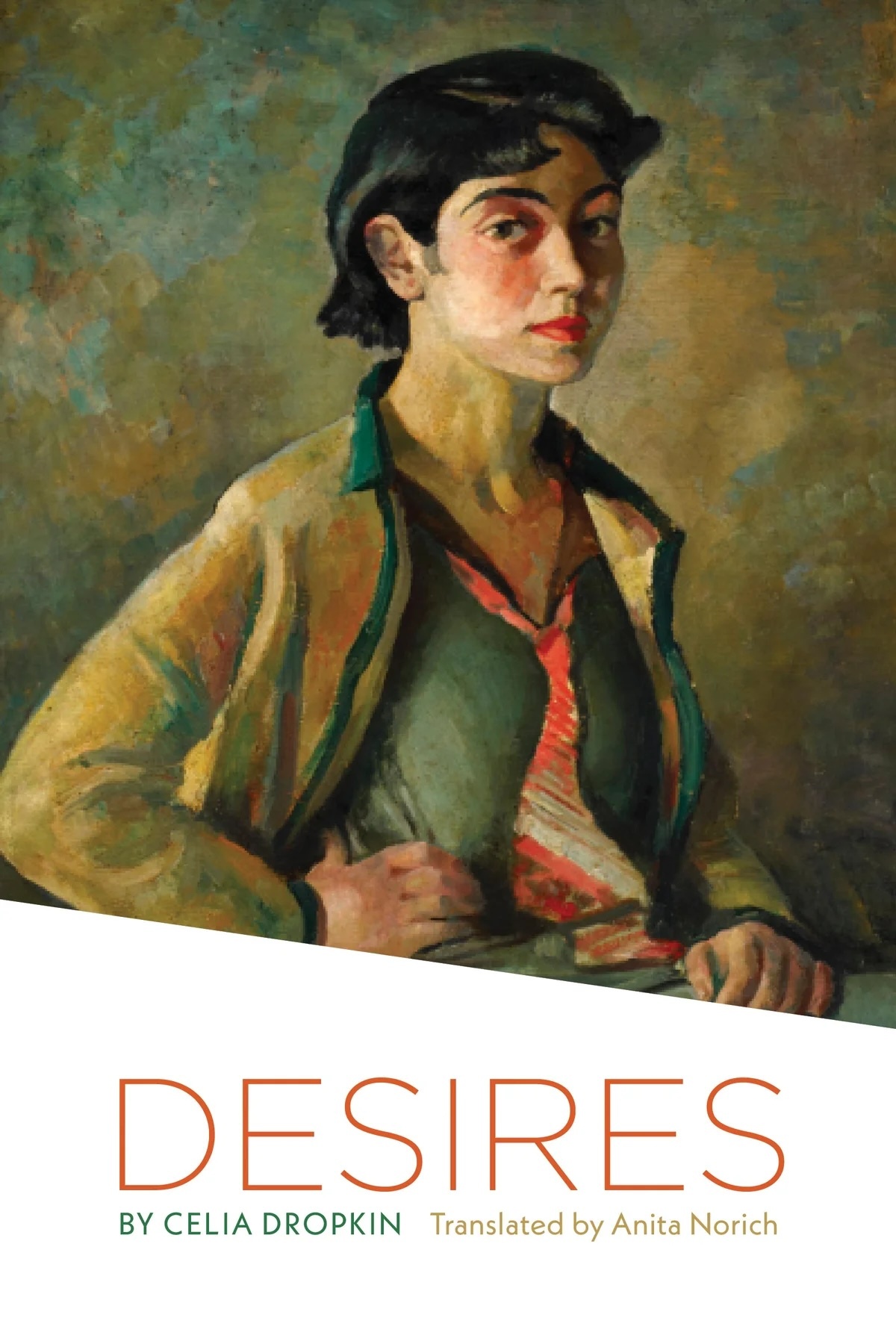
Celia Dropkin. Desires, transl. Anita Norich. White Goat Press, 2024. 273 pp. $18.95 [paperback].
It’s 1934. The depths of the Great Depression and two young Jewish-American authors have published earth-shattering novels: Tess Slesinger’s The Unpossessed and Henry Roth’s Call It Sleep. Celia Dropkin, a well-regarded avant-garde Russian- and Yiddish-language poet, whose writing probes female erotic longing, is busy churning out bits of a novel serialized over sixty-eight consecutive days from March 31 to June 6 in the Forverts. Like her poetry, this pulpy novel exposes the treacheries, obsessions and pleasures of illicit sex for women; but it is not a modern Oedipal narrative like Roth’s, nor a work of feminist modernism like Slesinger’s, nor even a daring work of experimentation like her own spare lyrics. Dropkin seems to have been unable to transfer her insights and talents into long-form prose, even when the novel was meted out in tiny segments, based on the available column space each day, sometimes ending and beginning mid-conversation. (April 20 concludes with a query: “Why do you think that?” and April 21 begins, “Because my wife is in a resort…” [87-88]. Translator Anita Norich has kept this format, simply titling each segment as a chapter with its publication date.) While each day’s excerpt holds another compelling adultery plot development, it’s no Anna Karenina or Madame Bovary; it’s not even Fannie Hurst’s 1931 Back Street (made into a movie a year later).
As Kasia Boddy notes of Dorothy Parker (more or less a contemporary of Dropkin’s), who could never complete the novel editor Maxwell Perkins contracted at F. Scott Fitzgerald’s urging, “her particular skills” were not suited to the form: Parker’s gifts for biting critique and one-liners found a better outlet in Hollywood, to where she decamped from New York in 1934. 1 1 Kasia Boddy, “Pretty Garrotte,” London Review of Books 12 September 2025: 9-12, 11. Dropkin was infected by the movies as well. Di tsvey gefiln: roman fun yidishn lebn in amerike (The Two Feelings: A Novel of Jewish Life in America), translated as Desires, owes much of its plotline to pre-code Hollywood movies in which women’s desires for sex and money were given free rein. But this was it for Dropkin: no more novels. She self-published a volume of her poems in 1935, and continued to write poetry and some short stories as well as to paint (she studied at the Art Students League) until her death at sixty-nine in 1956. 2 2 Kathryn Hellerstein, updated by Anita Norich, “Celia Dropkin,” updated June 30, 2025, The Shalvi/Hyman Encyclopedia of Jewish Women, accessed 4 December 2025. This new and handsome edition of her sole novel is the work of intrepid research into women’s writing in Yiddish by translator Anita Norich. It contributes to the growing body of recovered literature from the 1930s, a pivotal decade in American letters when modernism, politics, and popular culture collided in proletarian and pulp fiction.
Desires flows across a year following the end of Shirley and Sam Elkin’s marriage after the death of their five-year-old son Izzaleh from a brief unnamed illness. As the child lies dying, Shirley descends into a kind of madness—“What kind of awful dybbuk had taken hold of her?” (12)—an atavistic return to a shtetl mentality that lingers with her despite her assimilated life in America. “Her child was going out like a candle because she had angered God with her sin . . . her sin lay in fooling her husband and letting him continue to be fooled . . . a dreadful feeling was taking hold. She must tell Sam everything” if God were to save her son (3). 3 3 For more on the uncanny emergence of a shetl unconscious, see Rokhl Kafrissen, “Cozy Horrors,” Tablet, 31 October 2024, accessed 4 December, 2025. No such luck. And when Sam learns Izzaleh was not his son, her mild-mannered husband flies into a rage that consumes him until the novel’s end. “A feeling of ferocious jealousy grew in him—and an even wilder jealous curiosity. Who? Who was the child’s father?” (6)
The Elkins live in an unnamed suburb of New York, a typical middle-class American town, maybe in Connecticut or Westchester County or New Jersey, where, oddly, everyone speaks Yiddish but also celebrates Christmas. The unnamed and unlocated town is populated by an assortment of assimilated Jews who speak Yiddish with a glimmer of pidgin English, rendered thoughtfully by Norich. These are not the Jews of the Lower East Side (who, in Call It Sleep, speak a lyrical English when they are conversing in Yiddish and an awkward dialect when they attempt English) or the poor Brooklyn Jews of Daniel Fuchs’s Williamsburg Trilogy. Instead, these firmly middle-class American (as the Yiddish subtitle of the novel has it) families appear deracinated, yet, because of their language, also still inhabit what Irving Howe famously described as the “world of [their] fathers.” 4 4 See Irving Howe, The World of Our Fathers: The Journey of Eastern European Jews to America and the Life They Found and Made (New York: Harcourt, Brace and Co., 1976). The town’s middle-class families are strangely immune to the ravages of the Great Depression, but there are hints: Kroll’s business is on shaky ground and Shirley’s brother-in-law is jobless. Like a Hollywood movie, generic life goes on—with nothing revealed about food, work, etc.—the placid non-events of the Elkins’ family life only interrupted by Izzaleh’s death, Shirley’s subsequent admission of her affair, and Sam’s explosive reaction. Love and death disrupt this wonderful life.
Sam is a businessman (but what his business consists of is never revealed). Shirley, a beautiful woman with limited interests, unlike her well-read husband, does little with her time. She has a maid, Mary, a Catholic spinster, and attends social functions, contributes to charities, shops, and goes to the movies—often. She falls passionately for the local masher, Harry Kroll, owner of a toy shop, with whom she takes up one evening while Sam is away down South on business. She and Harry walk together on the beach. His kiss sends his “hot-bloodedness in[to] her veins . . . a deeply private desire . . . like a speck on a clean white piece of silk” (24). He is Izzaleh’s father.
Their affair lasts six years; they regularly meet Thursday afternoons, the maid’s day off. Shirley gets pregnant early on and her efforts to abort are unsuccessful. She tells Sam their son was born prematurely to allay any suspicions about what appears to have been an eight-month pregnancy. Devious about her erotic life (unbeknown to her husband or maid or his wife, Harry sleeps with her in her bed), she is nevertheless described as “a child,” “an honest woman” (7), “a loving, devoted, attractive wife” (14), who prizes her stable life with Sam. Yet she is “overcome by an all-consuming desire to sin” with handsome Harry (16). Sam, always a rock-steady business and family man, finds that he too can become overwhelmed with feelings—“a strange, murderous coldness” takes over as he becomes obsessed with discovering what happened and with whom (16). This tango of desire and deception, wants and regrets, “an indescribable mix of lust and murderous hatred and a thirst for revenge” (23), continues throughout the novel.
In fact, this synopsis could apply to any number of Dropkin’s poems. For instance, the middle stanza of “Du host tif oyfgeakert,” translated by Faith Jones, Jennifer Kronovet, and Samuel Solomon as “You Plowed,” evokes the jealousy Sam expresses:
האָט איבער דײַנע זאַנגען רױטער מאָן
זיך פּרעכטיק צעבליט.
ביסט געשטאַנען אַ פֿאַרדעכטיקער
און געטראַכט: װער האָט דעם מאָן פֿאַרזייט?
Indeed, who planted these red poppies in the yard—presumably a yard of mowed grass behind a white picket fence? This poem might be read as a response to another, which seems to invoke Shirley’s passion. In “Zoyg oys,” translated by Jones, Kronovet, and Solomon as “Suck,” the female speaker chants:
פֿאַרברען מיך, װער פֿאַרברענט,
פֿאַרנעם מײַן גאַנצן רייץ.
און לאָז מיך טיף פֿאַרשעמט,
זױג אױס און װאַרף אַװעק
און װער פֿאַרפֿרעמדט, פֿאַרפֿרעמדט
burn me, be burned,
take all my ardor
and leave me deeply ashamed:
suck it from me and throw it away,
become estranged, alienated 6 6 Celia Dropkin, The Acrobat: Selected Poems of Celia Dropkin, translated by Faith Jones, Jennifer Kronovet, and Samuel Solomon (Tebot Bach, 2014), 34-35. See also the excerpt in Jerome Rothenberg, ed. Jacket 2: Poems and Poetics (20 May2012), https://jacket2.org/commentary/celia-dropkin-her-white-wake-selected-poems-celia-dropkin. The selections Rothenberg includes—a poem, “In Sullivan County,” about walking in the mountain forest and another about Manhattan, “New York at Night by the Banks of the Hudson,” along with others about intense female erotic desire for a somewhat disinterested man, might serve as an outline—a more compelling one—for Desires.
Here as elsewhere, Dropkin charts the competing ways of desire—for sex, for a child, for security—that swirled within any woman poised between tradition and modern life in America. 7 7 One might broaden this to the Americas. As Aleksander Sedzielarz points out in “Chronicles of Light and Sound: The Film-Poems of Alfonsina Storni,” Word & Image38:3 (2022), 237–253, https://doi.org/10.1080/02666286.2021.1983712, Alfonsina Storni was writing crónicas in Buenos Aires newspapers that stretched into erotic poems. One example is a section of her long film-strip-like 1935 poem, “Kodak,” in which a central stanza, “Mordedura” (“Bite” or “Bitemark”) reads: “With my rust of pain, vibrant and warm, I bit / the virgin steel of your twenty-five years.” This follows the previous stanza which concludes: “Many of my girlfriends have come to see you / Among them all, there is one that has faded like a sunflower . / I haven’t thought about the kiss from your lips to hers. / But the one with which you would brush the forehead of the first child she /I [the Spanish is ambiguous] would give you.” Many thanks to Professor Sedzielarz for pointing out this connection between Dropkin and Storni—contemporaries probably unknown to each other but both approaching the same material in the same media.
The nondescript house on the unremarkable street devoid of distinguishing features is part of the oddly dual sensation (the novel is titled “tsvey gefiln,” “two feelings,” after all) created by the novel: out-of-control affect—insistent evocations of the “shining, dewy eyes” and “fire” of desire or the rage and abuse it provokes—and the bland settings in which they occur (99). From tragedy to comedy—but rather than history repeating itself (first time tragedy, second time as farce), as Karl Marx asserted—this is a revved-up melodrama recycling narrative genres. They range from the death of a child and the destruction of a marriage to the resurrection of the couple with the help of Shirley’s Uncle Hersh, dubbed Rabbi, who has administered to the wounded and dying during the Great War and now resembles “Tolstoy” in his pacifism and avuncular philosophizing (240), and finally to Shirley’s bulging belly and the impending birth of a child conceived by her and Sam. By the end, the couple is ensconced in a beautifully appointed Long Island home, and Shirley’s niece Evelyn, another of Harry’s conquests, is married to a college boy. Yet danger lingers: Libby, Evelyn’s sister, hangs on Harry’s arm at the wedding. Basically, a happy ending. But a cautionary tale: like most genre fiction, its purpose is to entertain, but also to instruct. 8 8 See Susan Suleiman, Authoritarian Fictions: The Ideological Novel as a Literary Genre (New York: Columbia University Press, 1983) for a discussion of the dual nature of the ideological novel (which has close connections to all genre fiction): pedagogical didacticism and literary realism in the French roman à thèse. Desires is not political in the sense that Suleiman investigates but its ideological backdrop is clear: A woman should get married and stick with her husband if she wants to acquire true happiness as a middle-class American.
The novel’s exploration of desire—the wild desire unleashed in Shirley while Sam is away, and her sense that the protective love of her husband cannot approach the kind of sexual excitement Harry Kroll offers—mirrors the love triangle in Leo Tolstoy’s War and Peace. When Prince Andrew Bolkónski, in whom Natasha Rostóva has found her spiritual soulmate, leaves for a year abroad after his father objects to their wedding, the rakish Prince Anatole Kurágin moves in on the young beauty. Shirley is no Natasha—she lacks her talents and insights—but she possesses beauty and a dark, suppressed eroticism. For her as for Natasha, the triangle has disastrous consequences. 9 9 “Natasha did not sleep all night. She was tormented by the insoluble question whether she loved Anatole or Prince Andrew. She loved Prince Andrew—she remembered distinctly how deeply she loved him. But she also loved Anatole, of that there was no doubt. ‘Else how could all this have happened?’ . . . What am I to do if I love him and the other one too?’” Leo Tolstoy, War and Peace [1868-69], translated by Louise and Aylmer Maude (London: Oxford University Press, 1954), Volume II, Book VIII, 216-17.
Dropkin’s writings mine a similar vein, dwelling on erotic surrender and its link to violence. In her poem “Odem” (“Adam”), the speaker declares:
איך האָב דערזען, אַז דײַן לײַב
איז אין גאַנצן באַדעקט מיט צייכנס פֿון ציינער,
אַ פֿאַרציטערטע האָב איך זיך אין דיר אַײַנגעביסן.
דו האָסט פֿונאַנדערגעבלאָזן איבער מיר
דײַנע דינע נאָזלעכער,
און האָסט זיך צוגערוקט צו מיר,
װי אַ הייסער האָריזאָנט צום פֿעלד.
At one point, Shirley stops wearing short-sleeved dresses and blouses in order to hide the black-and-blue marks Sam leaves on her during his nightly “torment,” which leave him “overcome by a wild passion provoked by her words” recounting what she and her still unnamed lover did together (49-50). That his jealousy unleashes Sam’s primitive “‘craziness,’ a demon had taken over” (48), leading him to batter and bruise Shirley, suggests a nod by Dropkin to naturalism. The Elkins are not the denizens of Maxim Gorky’s “lower depths”; they are an upgrade to its American version. Frank Norris’s “dentist” McTeague similarly tortures his wife Trina, in that case for money, biting her fingers to the bone in a sadomasochist ritual enacted nightly. 11 11 “‘Oh, you and your dreams! You go to sleep, or I’ll give you a dressing down.’ Sometimes he would hit her a great thwack with his open palm, or catch her hand and bite the tips of her fingers. Trina would lie awake for hours afterward, crying softly to herself. Then, by and by, ‘Mac,’ she would say timidly.” Eventually, Trina’s fingertips become infected and need to be amputated. This physical mutilation is the outward manifestation of her descent. Frank Norris, McTeague: A Story of San Francisco [1899] (New York: Penguin Books, 1982), 332.
Beyond naturalism, Dropkin embroiders the hard-boiled detective plots of Dashiell Hammett in Red Harvest and the Thin Man series into her tale. However, unlike Hammett’s or Raymond Chandler’s novels and stories, which convey an insider’s knowledge of the down-and-dirty reality of detective work in the dark city streets their private investigators survey—the slang, the sleazy locales, the code of honor—Dropkin’s novel glides across the surface without recourse to the details that anchor action to place. The detective Sam hires to discover who fathered Izzaleh hangs around hotel lobbies, ultimately befriending Kroll who divulges his secret: Six years ago he got a married woman pregnant. Bingo!
Other elements of modern American literature sneak in. Like The Great Gatsby, Desires also relies on an automobile accident as a vehicle (so to speak) to move the plot along. Drinking and driving foreground “the careless people” of the town. Harry drives Shirley’s niece Evelyn to Manhattan on an icy December night after plying her with wine and making love to her. These people may not be rich, like Daisy and Tom Buchanan, but they nevertheless “smashed up things and creatures,” seemingly just as unaware of how the other half lives. 12 12 F. Scott Fitzgerald, The Great Gatsby [1925] (New York: Charles Scribner’s Sons, 1953), 158. Jacob Riis, How the Other Half Lives: Studies Among the Tenements of New York [1890] (New York: Dover, 1971).
If Shirley has been cast as the fallen woman, her crimes require going undercover to ferret out the truth, or else they will remain hidden. Like almost all the characters in the novel, Mr. Klein, “the young Jewish detective,” trained as a lawyer but specializing in divorce cases (85), appears out of nowhere. Hired by Sam, he spends time with Harry and the Elkins and their acquaintances and falls out of the novel, but not before trying to seduce Shirley and instigating the confrontation that reveals her lover. 13 13 On a personal level, the names are uncanny: my mother’s name was Shirley, my father’s, Sam. My mother had an Uncle Hersh, my grandmother’s revered younger brother who lived in Israel. In the novel, his wife, Shirley’s aunt, is Rose, my aunt’s name. He is another blank page—much like Harry Kroll, Mrs. Rubin (a married concert pianist infatuated with Sam), Hersh Levin (Shirley’s philosophical uncle), the unlikely-named Miss Smith—who populate the terrain from the town to the summer camp to Manhattan and eventually somewhere out west. There, Shirley visits Uncle Hersh in his ashram-like retreat where he is caring for his tubercular wife, while Sam decides, despite Hitler’s rise, to visit his birthplace, a shtetl in Eastern Europe. Dropkin seems to suggest that everyone is a variation of everyone else—domestic women and careerists, businessmen and detectives and rabbis, all a part of the dreamscape of this placeless place and the non-events that occur there.
Even when Shirley and Sam separate and decamp to Manhattan during the Christmas holidays, each living in a different hotel—Shirley shops and goes to movie palaces; Sam visits Mrs. Rubin in her Upper West Side apartment—the streets seem as empty and unreal as a Hollywood stage set. Nowhere to be found is “the pulse of New York City in 1931: blithe and vibrant for the privileged, who still savour the good life of the Roaring Twenties; a wretched slide into ruination for the first wave to be crushed under the heel of the Great Depression,” as Jules Stewart sums up New York in the 1930s. 14 14 Jules Stewart, Gotham Rising: New York in the 1930s (London and New York: I.B, Tauris, 2016), 3. Perhaps readers had no need of realist details—all they wanted was “a little sex,” as the producers of the film within the film Sullivan’s Travels, Preston Sturges’s spoof of 1930s musical comedies, demand. Perhaps, given who Celia Dropkin was, readers didn’t need to have the sexy details of Shirley’s love life spelled out, either; they had been reading her poems (or at least knew of her reputation). Shirley was not the first to collapse with desire, as in “Fal ikh tsu der erd” ("I Fall to the Ground"):
אױסגעגאָסן פֿון װערעם איז מײַן האַרץ
און דער פֿעטער װאָרעם,—לײַדנשאַפֿט,
קריכט קיינמאָל ניט אַרױס
פֿון מײַן זאַפֿטיקן קערפּער,—
אַ פֿאַרװאָרפֿענע װעט ער מיך צעפֿרעסן
ביז צום טױט.
Desires cannot be characterized as a good novel; it is derivative, repetitive, banal. And yet, I could not put it down. Anita Norich has brought back to circulation a story, in all its schlockiness, as gripping today as it ever was, and has broadened the scope of what we understand as Yiddish literature by allowing us to experience anew, in English, the mundane entertainments of Yiddish romance fiction. Like other works reprinted from 1934, including the recently re-released Salt House by Hazel Hawthorne, about bohemian artists in Provincetown, it sheds light on the stirrings and strivings set in motion by the possibilities opened up by “my America! my new-found-land.” 16 16 John Donne, “To His Mistress Going to Bed” [1633], https://www.poetryfoundation.org/poems/50340/to-his-mistress-going-to-bed.