Jan 21, 2026
John Halpern Courtesy of the YIVO Institute for Jewish Research.
INTRODUCTION
If you’re unfamiliar with the University of Chicago’s unorthodox academic calendar, we operate on the quarter system. This system breaks our year, paradoxically, into trimesters, and we find ourselves faced with interminable summers and an incredibly late start. This year, I found myself at home during the month of September. With a job long-finished and three uninterrupted weeks ahead, I had the time to turn over some long put-off ideas in my head. I also had the time for frequent trips to New York City, a place where I’m lucky enough to have many friends and the place I find most conducive to my creative projects. My course of study at Chicago does not involve Yiddish—that’s one of the many reasons I love working for In geveb; it keeps me attached to a field of study I find important and am deeply passionate about for my own sake. It is during times of leisure that I am able to more fully dedicate myself to this interest, pursuing people to speak with and material to fuss over, sometimes without a particularly scholarly aim.
I found myself wanting to return to YIVO, where I had a short stint as an archival intern last year, this time in order to speak with Director of Archives Stefanie Halpern about the release of YIVO’s new centennial coffee table book. When I arrived to speak with her, she decided, after a quick jaunt around the office, that our conversation was best had somewhere else. She then brought me down to the second floor of the Center for Jewish History, where YIVO is housed, walked me through the current exhibition to a closed-off corner of the gallery, and unlocked a set of doors. Behind was a beautifully-built space that I did not anticipate: YIVO’s new Learning and Media Center.
I knew then that I would come back to discuss the Learning and Media Center in full some other time. I took my unending month off as an opportunity to return, tour the space, and sit down with YIVO’s Director of Public Programming Alex Weiser, Learning and Media Center Educator Susannah Trubman, and Halpern in order to learn about the Learning and Media Center’s purpose and place in the age of YIVO’s centennial.
John Halpern Courtesy of the YIVO Institute for Jewish Research.
Before the twentieth century, few thought it was important for Jews to study their own history and culture, much less their everyday culture. It was this radical idea, attributable to Russian-Jewish historian Simon Dubnow, that prompted YIVO’s founding in 1925. YIVO’s founding mission was to document Jewish life in all its forms, in its everydayness as well as its uniqueness. This mission is carried through to the present day by its archives, which hold over 24 million objects.
Over its hundred-year history, the YIVO Institute for Jewish Research has been a central driving engine for the preservation and study of East European Jewish history and culture. It is home to the YIVO archives, where researchers can comb through manuscripts, documents, photographs, and sound recordings, as well as the YIVO Library, which describes itself as “the great repository of East European Ashkenazic culture, of which American Jewry is the heir.” It has trained generations of scholars through its summer intensive, the YIVO-Bard Uriel Weinreich Summer Program in Yiddish Language, Literature, and Culture, established in 1968, and its public programming. In the past ten years, YIVO has also undertaken a massive digitization process: The archival department has made five and a half million pages accessible through digitization. By the mid-2030s, this total will rise to nine million.
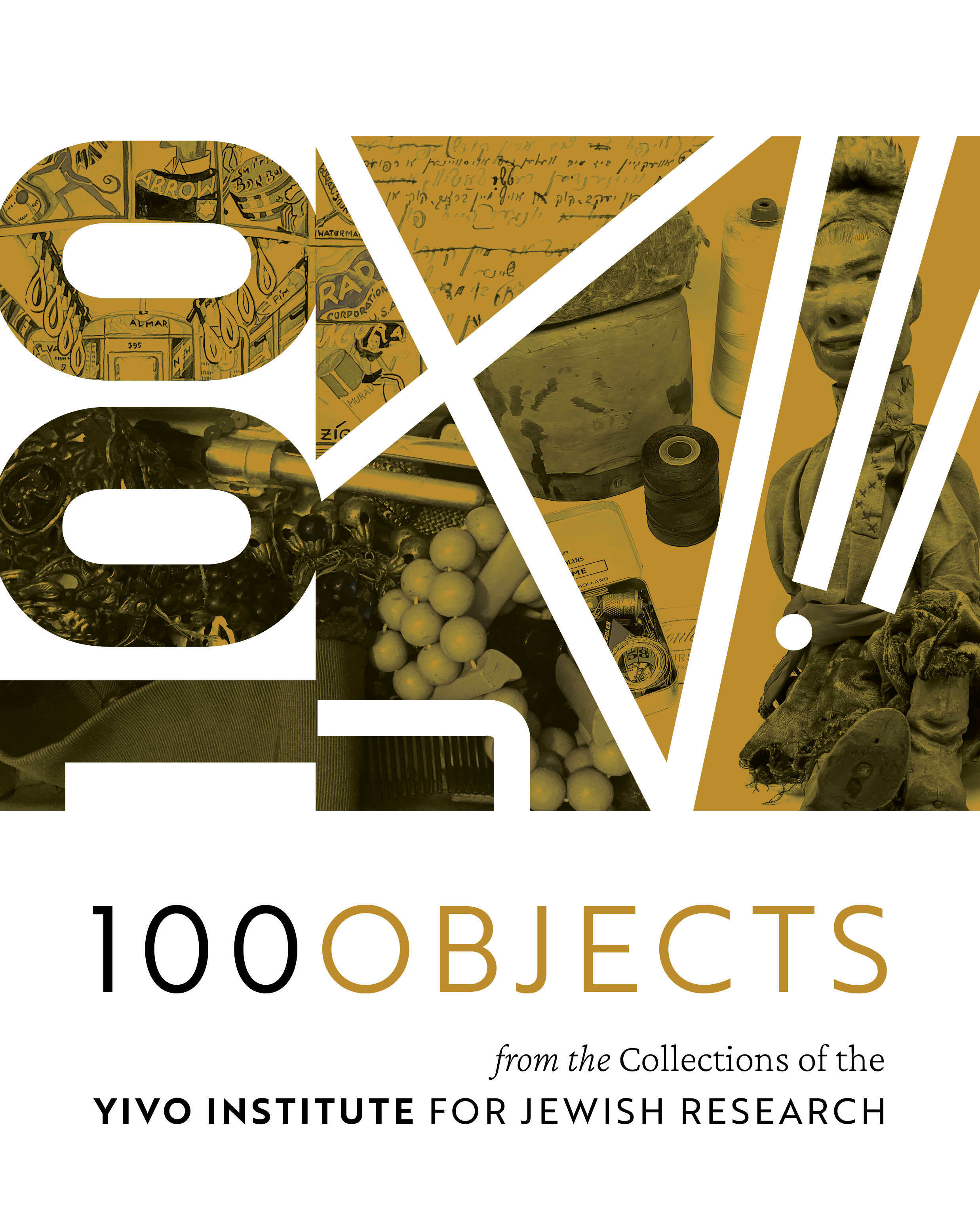
YIVO’s centennial marks a further shift in focus toward serving a broader public through projects that open the archives up. There was the publication of 100 Objects from the Collections of the YIVO Institute for Jewish Research, an accompanying YouTube series featuring objects from the book, and now, as of August 2025, YIVO’s Learning and Media Center, a learning lab for visiting student and adult groups. There was never before a space where one could “visit” YIVO as a tourist or a member of the public. This new initiative transforms YIVO’s space into a more accessible museum, as befits its desire for deeper public engagement.
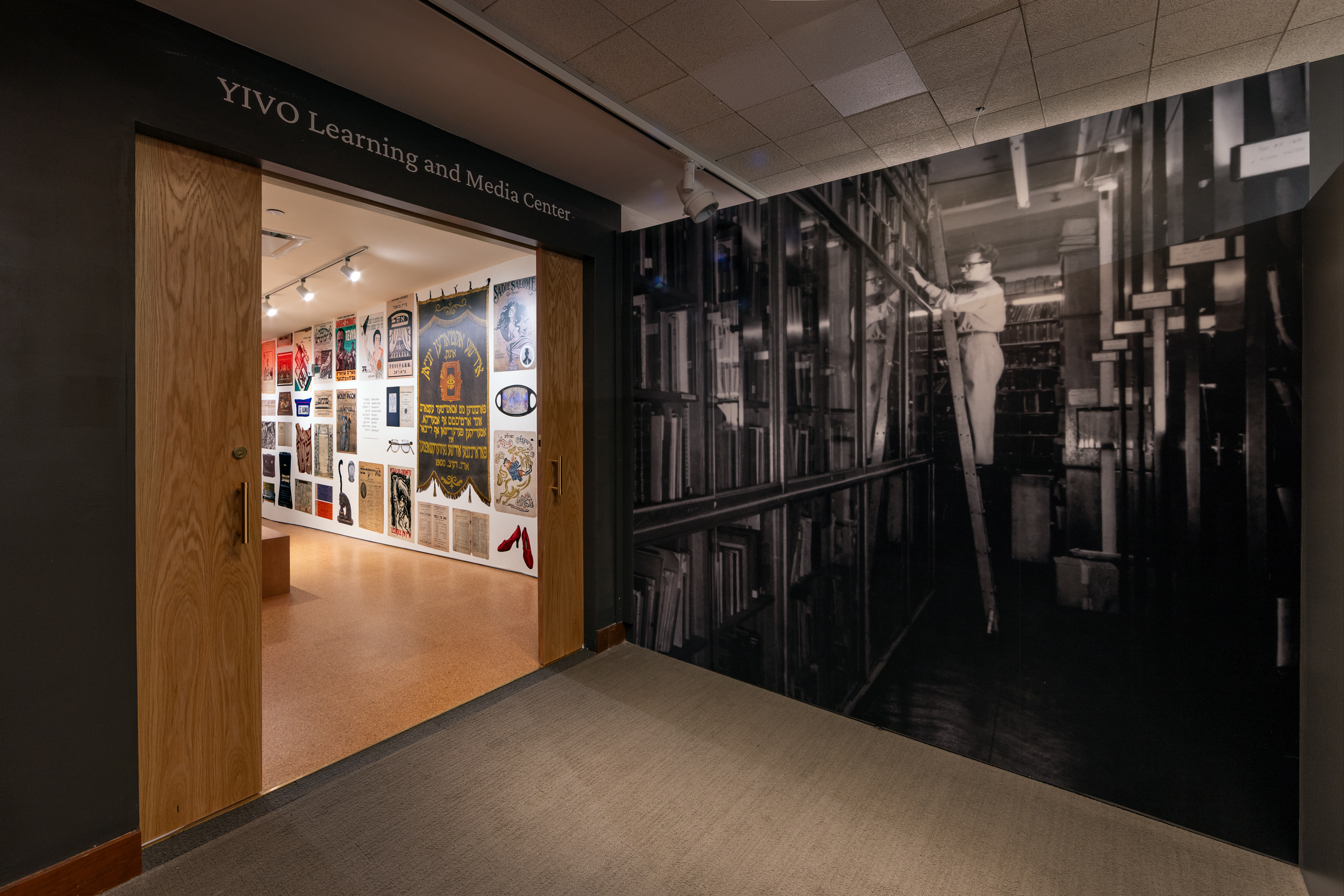
Those who enter the Learning and Media Center encounter a remarkable story. To the left, in black and white, are stills that tell the story of YIVO’s birth, destruction, and rebirth. Photographs span YIVO’s 1925 founding in Vilnius, its move to New York City in 1940, the Paper Brigade of World War II, and the destruction of the original YIVO building in 1944. And to the right, in color, are images of a landsmanshaft stamp press, sheet music, bright red high heels, and Torah portions, alongside other highlights of YIVO’s vast collection.
The Learning and Media Center has already welcomed over 1,000 visitors. The cadence of a visit, explained Trubman, the Learning and Media Center educator, is group-dependent. All visits start with a short history of YIVO, guided by the photos on the left entry wall. Trubman then draws attention to the objects pictured on the right entry wall. From there, Trubman responds to the interests of the group. If a group has an interest, say, in the Yiddish theater, or Jewish youth in interwar Poland, she will lead a lesson designed around that theme. Other visits are characterized by archival show-and-tells (where she brings in a YIVO archivist to introduce materials directly) or use of YIVO’s extensive sound archives.
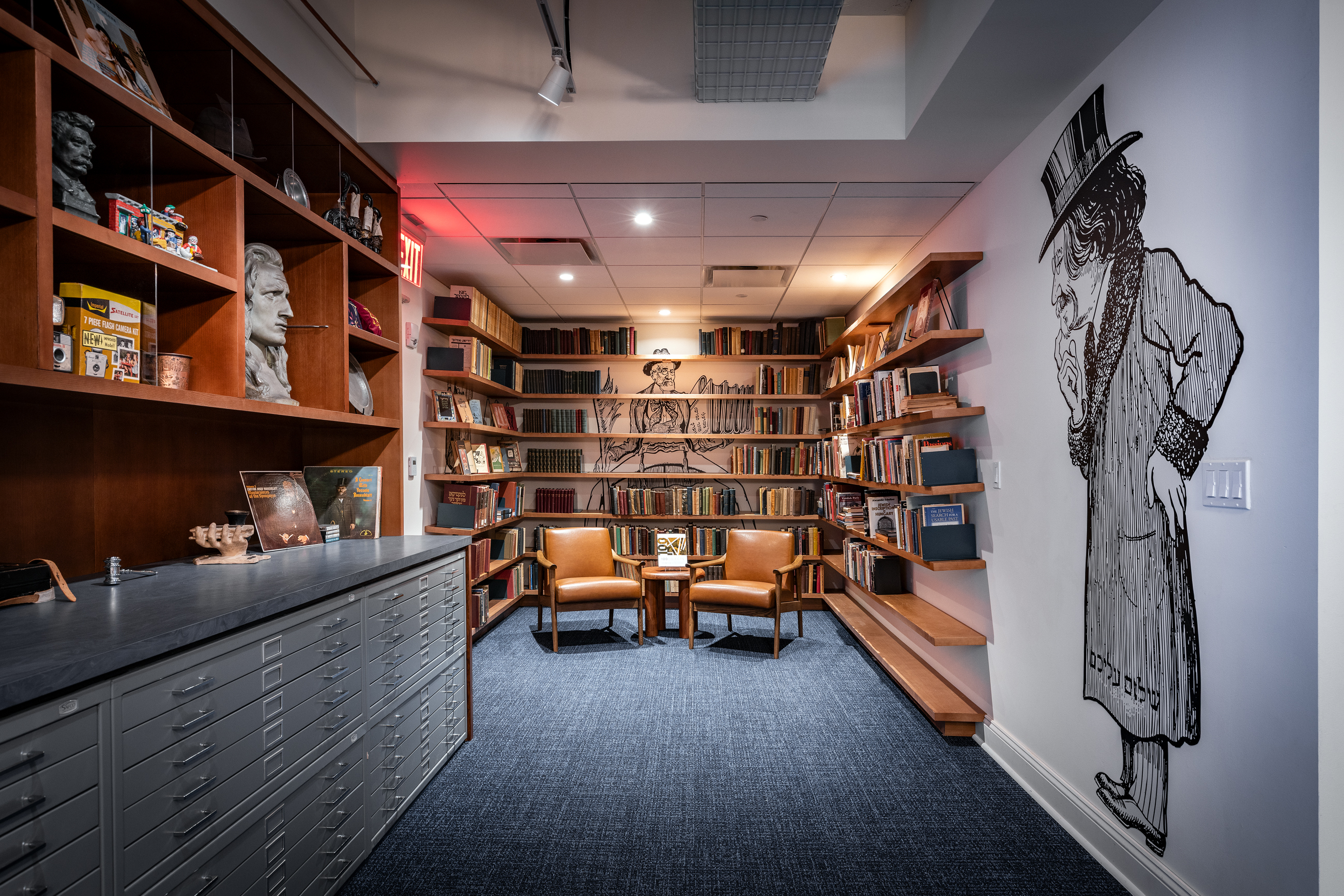
These activities may take place in the reading room, where shelves of Yiddish and English books line the walls and the portraits of Sholem Aleichem, Mendele Moykher-Sforim, and Isaac Leib Peretz adorn the walls. Facing this open space is a table, screen, and drawers filled with high-quality reproductions of materials from the archives. Here, students gather to explore posters, books, documents, and an interactive shtetl map, where shtetls across modern-day Poland have been plotted. Or they can visit the audio-visual corner, where ready-to-listen-to audio files live under wall prints of Yiddish sheet music; or the classroom, complete with a digital poster-making station, where Trubman leads most lessons.
YIVO’s Department of Public Programming is intent on building long-lasting relationships with educators, in hopes that the Learning and Media Center will provide an enriching experience for future generations of students. The majority of visiting groups, Trubman says, are from high schools and colleges, but synagogue groups, Hadassah chapters, JCC groups, a genealogist group, and teacher training groups have also taken advantage of the Learning and Media Center. These educators, said Weiser, the director of public programming, were a crucial part of the build-out process. At the beginning of the Learning and Media Center’s construction, YIVO collected survey data from teachers asking what they’d like to see in a YIVO visit, and over the course of the next two years, pilot lessons were then conducted. What the surveys showed was a desire for tactile experience and authentic, meaningful, and accessible encounters with archival material. In a traditional museum, it is rare, nearly impossible, to come into contact with archival material without the barrier of a vitrine or a sign that reads, “Please Do Not Touch.”
“We just want them to be comfortable, at home,” said Halpern, on the energy she wants the space to have. “People come into an archival institution or into a museum and they feel removed.” This intention translates to the design of the space: the lighting is warm, the colors are rich, and wood characterizes the grand table and the reading room. This coziness was realized through the creative direction of a team of YIVO employees that included Weiser, Trubman, and Halpern, in partnership with design firm Pure and Applied and architectural firm Beyer Blinder Belle. “We brought them in to help us conceive this space,” said Weiser, “and we worked with them, brainstorming together and creating mood boards, collecting relevant material. . . . We were collecting, and collecting, and they helped us formulate that into all of this.”
The space was inspired, in large part, by the YIVO offices just one floor above the Learning and Media Center, a distinctly unpretentious, comfortable, and lovingly chaotic space. “Our offices have a very particular feel, heymish, and it was important for us to translate the feel of our offices into this space,” said Halpern. Weiser added, with a smile, “Part of the idea was, ‘it’s [floor] 3S but clean, and a little bit more organized, a little more modern, sleek.’” The space is intended to inspire wonder, to push visitors to engage with the objects differently than they might in a museum. The Learning and Media Center occupies its own niche, somewhere between a gallery, classroom, and experiential space, seamlessly blending the missions of education and cultural dissemination.
“When [Halpern] and I got here in 2016, it was a different YIVO in many ways,” Weiser said. “The inherited wisdom about the archives was something along the lines of, ‘we’re protecting this material from everyone.’ It’s really shifted during this time to, ‘we’re protecting this material for everyone.’ . . . And so I think this space is a culmination of that shift.”
Continued Weiser, “I've heard stories from YIVO in the ’80s where people came to YIVO and they were told, ‘Well, have you read all these books yet? Do you have a PhD yet? Is your Yiddish good enough?’ And we don't have that philosophy. We think that you come here and learn here and discover the things that make you inspired to get your Yiddish good enough and to go read those books.”
In my own experience, it is true that, if one is not handling these materials as an employee or a scholar, it is difficult to encounter them directly. I have no knowledge of Yiddish (ironically, as an intern for In geveb), and for me this is precisely the beauty of YIVO’s public-facing shift: By making its objects legible to a lay public, YIVO has served as a site for my exploration, a place that inspired me to learn Yiddish, to dig into the history of New York’s Jewish labor unions, and to examine postwar relations between Jews in France and Morocco. Accessibility is key to cultivating a new generation of students, some of whom may be future scholars and others simply a better-educated public with foundational knowledge that can help them cultivate curiosity about what future scholars may learn, write about, and teach.
Jewish history, Weiser explained, is often seen in a purely lachrymose way. His team wanted to change that. “It's flexible, it's thought provoking, it's full of wonder, it's alive, it defies expectation,” he explained. “We want people to come and feel that they've learned something, something unexpected, but all with a positive tonality.”
This expands, says Trubman, the picture that many students have of Jewish history. “Unless they are dedicated to taking classes in Jewish history, they learn about the history of WWII and the Holocaust and maybe the pogroms, but we want to show that there was Jewish life before, during, after, and to show the continuity of everything.”
But that’s not to say that there isn’t more to see. What lies upstairs in the stacks—the floors-worth of storage where precious material is contained in rows upon rows of uniform gray boxes—is an open invitation to all whose curiosity is sparked, whose sense of wonder is activated. While some scholars might be chagrined at the notion of a YIVO that is not as centrally focussed on a core constituency of passionate researchers with deep understanding of the materials that they pore over, Weiser reminds us that the archives remain open and the goal of the Learning and Media Center is to cultivate new and broader audiences for its riches. The Learning and Media Center is simply the door—and a very beautiful door at that—that opens to what lies above in the stacks and beyond in Jewish history. “There's nothing here that's totally off limits,” said Weiser. “And some of the more off-limits stuff, you can come back. You can come upstairs.”