Apr 15, 2026
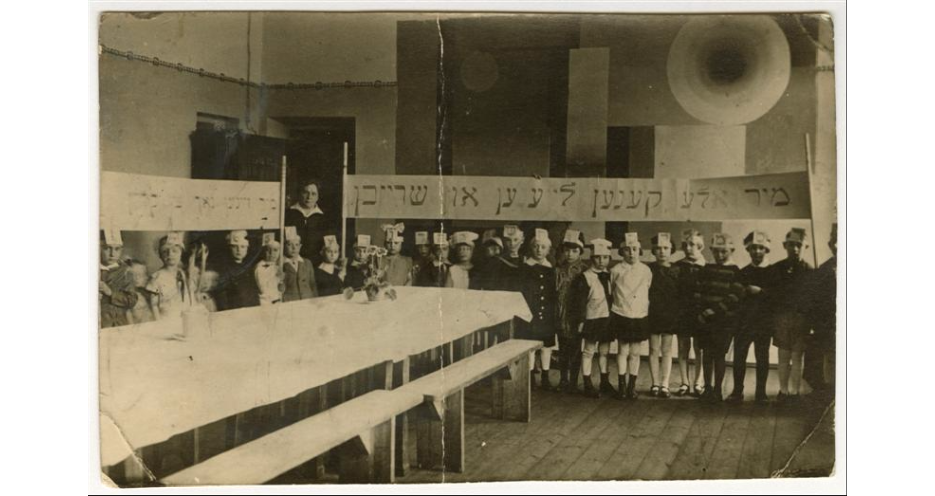
Stefania Shifra Szabad, wife of Jewish communal leader Tsemaḥ Szabad, with a class in a Yiddish school, Vilna, 1929. Children, wearing hats representing letters of the alefbeys (alphabet), hold a banner (right) that reads in Yiddish: “We can all read and write.” (YIVO)
INTRODUCTION
The editors at In geveb put out a call for readers’ and writers’ testimonials in conjunction with our 10 year anniversary fundraiser. Thank you to everyone who wrote for these lovely tributes - and for allowing us to publish them.
This piece is part of a series of reflections celebrating the 10th anniversary of In geveb’s publication. Biz hundert un tsvantsik, In geveb!
Shayna Weiss
In geveb's editors offered me the question I never thought anyone would ask: "Hey, do you have anything to say about Yiddish on Israeli TV?" That provocative ask lead me to one of the best adventures of my scholarly career, interviewing actors and producers to think about how culture gets made. That resulted in an analysis of how what was then a little-known show, Shtisel, was thinking about Yiddish in groundbreaking ways, and later inspired future research on Haredim and Israeli culture. I am so thankful to In geveb for their expansive thinking about Yiddish and scholarship, which constantly enriches my own research.
Sarah Biskowitz
In geveb serves as an incomparable forum for Yiddish studies. As a frequent reader of the site, I constantly learn from In geveb articles. As a contributor myself, In geveb has supported me throughout the process of conceptualizing, creating, and publishing several pieces that wouldn't exist without In geveb. As a Yiddish teacher, In geveb is my number one recommendation to my Yiddish students to learn more about Yiddish studies. The content is excellent, as well as free and accessible to all.
Melanie Fishbane
I was quite surprised when Jessica [Kirzane] asked me to write a review for [Yermiyahu Ahron Taub’s translation of] Ida Maze's Dineh: An Autobiographical Novel, as Yiddish Studies is not my expertise and not an area where I felt I belonged. However, working with Jessica and learning more about how the journal embraces diverse points of view made me feel like I could contribute my perspective. I've used In geveb for my research on Jewish girlhood and, most recently, for a paper that I'll be giving next month on antisemitic references in Uncle Tom's Cabin. The work that everyone is doing in preserving and reclaiming lost aspects of Yiddish literature is commendable. I'm honoured to be part of it and hope to do it again soon. Mazel tov on 10 years! May it be 10 more!
Alex Weiser
In geveb's publishing helps to establish the discourse that maintains the international digital community of Yiddish scholars and culture workers. It is an essential address for Yiddish in the twenty-first century!
Nesi Altaras
In geveb is a forum with a broad understanding of Yiddish studies that allows for exploration. When I pitched my piece about the terms Ladino speakers of the Ottoman Empire used for Yiddish speakers, I was not sure if it would find a home. Not only did it get accepted, it reached a wide readership! The story that I began with a collection of words took me to a long tangent about the sex trade between the 1890s–1910s and the flow of people, especially Jewish women, from the northern coasts of the Black Sea to Istanbul and other Ottoman ports, and as far as Argentina. This story has reached people thanks to In geveb.
Nadav Pais-Greenapple
I don't know where I'd be without In geveb. This journal has given me incredible opportunities for exposure and publication, especially given that I am a junior scholar with naught but a bachelor’s degree in history and a great deal of enthusiasm. I've been able to build professional relationships, make connections with senior scholars, and build confidence in my writing ability and the quality of my scholarship. What's even more incredible is that In geveb's whole team is dedicated to fostering not only intellectual curiosity but professional stability and mutual respect—I can't say I've ever heard of another journal paying contributors as a matter of policy. When I work with In geveb I know that I'm going to be taken seriously despite my inexperience; that I'll be treated respectfully and with patience; and that the people with whom I'm working will do everything they can to make sure my work is the best that it can be. Biz hundert un tsvantsik, In geveb!
Zackary Sholem Berger
In geveb has been one of the most important institutions in my intellectual and cultural life during its existence. In its exploration of past and present Yiddish creation, and its expansion of what matters, what exists, in Jewish, human, and Yiddish life, I have been supported, challenged, and furthered in many ways that are basic to my life.
Beth Dwoskin
In geveb gives stature and validation to the field of Yiddish Studies in three ways: by its comprehensive scope: scholars can research every aspect of Yiddish Studies, past, present, or future, on In geveb; by its innovative approach: the digital platform can accommodate every medium and meets all the needs of its users for citation, file upload, live links, etc.; by its universality: users and contributors are welcomed internationally, no matter their background or skill set.
Marc Caplan
In geveb is the most valuable resource for Yiddish Studies on the internet. It is the culmination of generations of knowledge and wisdom, and it represents the moment of transition from the Yiddish criticism of the twentieth century to the Yiddish research of the twenty-first century. It is also a moment of transit between the heyday of Yiddish modernism and the potentials of Yiddish post-modernism. As such, it is the greatest refutation of the assumption—deeply embedded within Yiddish Studies—that our work in Yiddish is a chronicle of decline, diminishment, or despair. The scholars who have made In geveb possible from the beginning are a critical, sophisticated, and creative cadre of Yiddishists. They are also a valuable and vibrant community. To publish under its auspices has both produced and re-produced some of my best critical thinking. To be reviewed on its website has been the best and most perceptive reception of my work to date. I look forward to being able to continue publishing and engaging in dialogue here for the indefinite future, and I consider it among the best reasons to own and open my laptop every day.
Mark West
I do not speak Yiddish, but many of my ancestors did. I commend In geveb for preserving the language of Yiddish and for promoting Yiddish literature and culture. In geveb is playing a major role in keeping an important part of my heritage alive and relevant in today's world.
Shachar Pinsker
There is no doubt that In geveb presents the best in Yiddish studies today. In fact, I would say the journal exemplifies the radical potential in connecting scholars, students, translators, writers, and cultural creators from all over the world in a way that is collaborative, pluralistic, and non-judgmental, and at the same time fully committed and rigorous. I especially appreciate the journal's ability to respond thoughtfully and effectively to crisis (the ongoing violence in Ukraine and in Israel/Palestine), while sustaining a sense of community. In geveb gives me hope and restores my confidence that important work of thinking, reading, and writing can be done even in dark times.
Annie Sommer Kaufman
[In geveb] is the perfect partnership of scholarly rigor and creative openness. I have now experienced the ideal of editing. Thanks for making us look and read so well!
Sean Sidky
In geveb is like no other academic space I've ever been part of—the unique blend of broad, public-facing writing, the unique approach to and flexibility with reviews, and the inclusion/recognition of the real work and value of literary translation span the full range of possibilities for engaging in Yiddish culture, research, and writing. At every step of the process, with every interaction I've had with the journal and its staff, and in every part of the website you can feel and see the care, love, and attention that the people of In geveb, the community of In geveb's staff, writers, donors, and readers, have for Yiddish culture, literature, and for exploring so much of its rich history and art. I've been lucky enough to be able to cultivate a different kind of writerly voice in these reviews than in other parts of my academic work, and that has been so much thanks to [editor-in-chief] Jessica [Kirzane], and former review editor Miranda [Cooper]'s wonderful support and editing and guidance. In geveb offered me a space and opportunity for writing my very first review of a literary work (rather than an academic work), in Jessica Kirzane's gorgeous translation of Miriam Karpilove's Judith (read my review, read the book!) and it remains one of the pieces of writing I am most proud of (and keep showing off to my friends, haha).
In geveb is a model for what academic journal spaces have the potential to be; it's also a model for the best kinds of Yiddish cultural spaces; and everything about it should be celebrated. I truly would not be the scholar or teacher I am today without the opportunities, resources, and support In geveb offers to rising and early-career Yiddishists.
Miriam Isaacs
In geveb is a rare outlet for Yiddish Studies and a meeting place for serious Yiddishists.
Ellen Cassedy
I found my way to Yiddish when my mother died in 1989 and I decided to study Yiddish as a memorial to her. My first fellow students, and my teachers, were all much older than I was—at 40, I felt like an anomaly. I was looking for a home in Jewish culture, and in my involvement with Yiddish—studying, translating, and being a translation mentor – I’ve found that home, full of warmth and shared passions. Over the years, I’ve been beyond thrilled to see a new generation of Yiddishists coming up. At a moment of tremendous anxiety about the present and future, In geveb for me is a place of hope and comfort. What a blessing and what a total delight to know that "the task" (as they say in Pirkei Avot) will be carried forward by such a trustworthy and talented bunch.
Olive Ivy Benito-Myles
In 2022, [editor-in-chief] Jessica Kirzane approached me and my friend Naomi Piper-Pell at the Yiddish Book Center’s Di froyen conference and asked if we’d be interested in writing a piece about it for In geveb. As a seventeen-year-old college freshman who hadn’t even heard of Yiddish two months prior, I doubted that I had anything meaningful to contribute to the academic dialogue. But Jessica and the In geveb staff guided us through the writing process, patching up all of the names and vocabulary we missed, and the article was a success!
Now, almost three years later, my entire life seems to revolve around Yiddish. I went to the Steiner Summer Program (which Jessica miraculously prevented me from calling a “summer camp” in our article). I was even able to share my final project, an original Yiddish song, through In geveb. It really cannot be overstated how much In geveb’s early support allowed me to take myself seriously and to let my voice be heard in the Yiddish world. I am so glad that this resource continues to exist for students and professionals alike to learn and grow together!