Apr 09, 2025
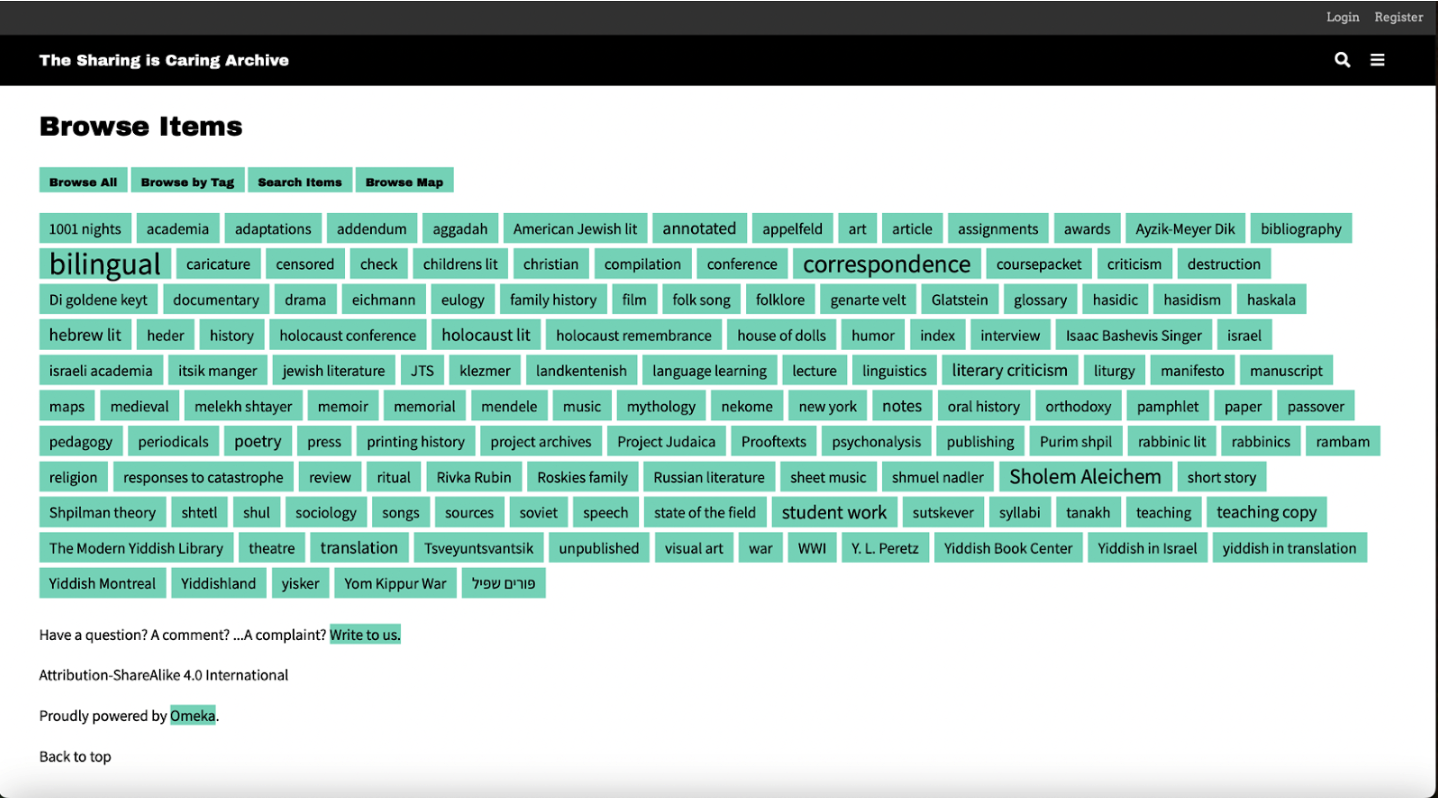
The Lerer Roskes Archive: Tag cloud. https://archive.yiddish.nu/items/tags.
Back when I was in college, Rabbi Max Ticktin at University of Chicago Hillel told me about a graduate student at Brandeis who was making waves in the Yiddish world. And wouldn’t you know it – a few months later that same student, Dovid-Hirsh Roskies, was my Yiddish literature instructor in the Uriel Weinreich Summer Yiddish Program at Columbia University. Even now, as I glance over my copies of his course syllabus and the accompanying glossaries that he painstakingly assembled for our readings, I can’t help but imagine that our 23-year-old teacher burst forth fully formed from the brow of some Yiddish Athena.
In fact, plenty of hard work went into the many courses that David Roskies has taught over more than five decades, as he emerged as one of the most accomplished Yiddish Studies scholars of his generation. He was raised in a Yiddishist household in Montreal and is a proud product of that city’s Yiddish Folkshul, as he has recounted in Yiddishlands (Wayne State University Press, 2008). In his mid-teens, Roskies became a co-founder of the Yiddishist youth group Yugntruf, and when I enrolled in the zumer-program several years later he was active in Havurat Shalom, the “mother church” of the nascent havurah movement.
His intellectual development and scholarly achievements are now amply reflected online, in All Things Yiddish: The Lerer Roskes Archive. (The spelling “Roskes” is a transliteration of his surname in Yiddish, ראָסקעס.)
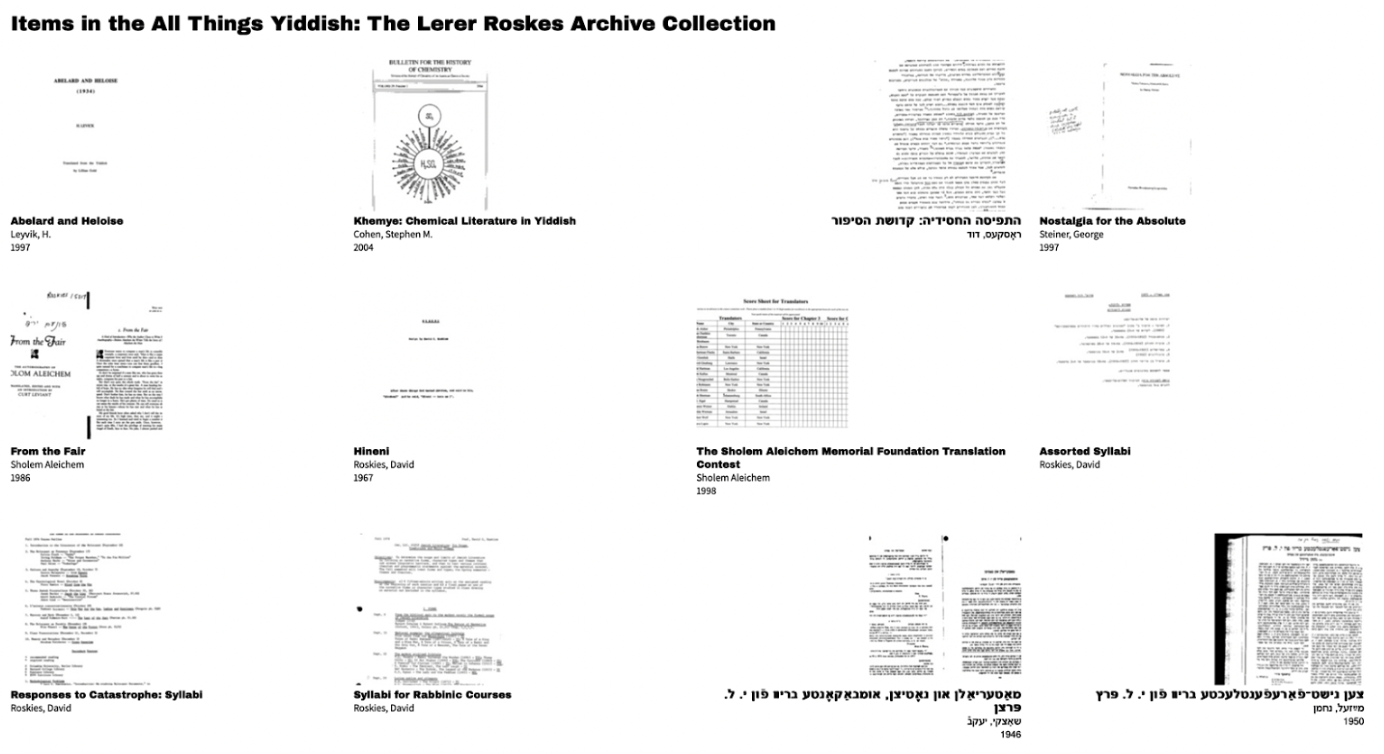
The Lerer Roskes Archive: Sample items. https://archive.yiddish.nu/collections/show/1.
The archive’s “About” page summarizes its origins and purpose:
The Lerer Roskes Archive was born out of a seemingly banal and straightforward task: to clean out the office of Professor David Roskies, scholar of Yiddish and Holocaust literature. He wanted the materials of academic value and those that were not readily available to be digitally scanned, to be retrievable for future use, and to dispose of the rest. Prof. Roskies could thus vacate his office without pounds and pounds of paper stacked in impenetrable boxes, reduced instead to a tiny USB stick with hundreds of documents organized in folders and instantly accessible with just a few clicks of a mouse….
With the field of Yiddish and Holocaust literature blooming in universities and institutions around the world, a new generation of students and teachers are taking root. Though the body of secondary and primary sources is constantly growing, there is a serious dearth of pedagogic material to work with or to build upon. The dozens of meticulously designed syllabi for courses in Holocaust and Yiddish literature, taught in English, Yiddish and Hebrew, exhaustively prepared by Prof. Roskies are thus both objects of intellectual history—they shaped this new generation—and prototypes for future syllabi and future generations.
The Lerer Roskes Archive received the financial support of the Naomi Foundation and David Roskies’s home institution, the Jewish Theological Seminary of America. The Acknowledgments page includes a brief video recording in which he states that this online archive represents “a completely new approach… [and] a model of a certain new pedagogy.” It is not exactly an exercise in online self-archiving which, strictly speaking, applies just to an author’s own works. Rather, as described on the website’s home page, The Lerer Roskes Archive “comprises materials created and collected by Professor David Roskies during many years of teaching Yiddish and Holocaust literature” (emphasis added).
The scanning and website design are the work of Raphi Halff, a digital archivist and former student of Professor Roskies who is now a doctoral candidate in Comparative Literature at Harvard. The Lerer Roskes Archive appears under the umbrella of The Sharing Is Caring Archive, which also embraces an archive devoted to the author Ka-Tzetnik 135633, “pseudonym of Yekhiel Dinur, and his prewar identity as Yekhiel Fayner,” plus a placeholder page for All Things Hebrew: The Alan Mintz Archive. (The late Hebrew literary scholar Alan Mintz was Roskies’s close colleague at JTS, and co-editor of the Jewish literary journal Prooftexts.)
The Lerer Roskes Archive: Tag cloud. https://archive.yiddish.nu/items/tags.
A glance at The Lerer Roskes Archives’ contents reveals an abundance of published sources in a wide variety of genres: books and chapbooks, book chapters, short stories, poems, literary manifestos, journals, scholarly articles and offprints (many with Roskies’s marginal annotations), newspaper issues and clippings, bilingual texts, interviews, sheet music, and maps. There are some genuine rarities here, such as Sefer marganita, by Yekhiel Mikhl (Vilna, 1803), Meir Viner’s Problemen fun folkloristik (Kharkov-Kiev, 1932), and the collection Salamandrie, edited by one Itshe Zinger (the future Bashevis) and printed in Biłgoraj in 1923.
![<p dir="ltr">The Lerer Roskes Archive: Yekhiel Mikhl, <em>Sefer Marganita</em> (Vilna: [5]563 – [1802/03]), with Dublin Core descriptive metadata. <a href="https://archive.yiddish.nu/items/show/1007" target="_blank" rel="noreferrer noopener">https://archive.yiddish.nu/items/show/1007</a>. <br></p>](https://ingeveb.s3.amazonaws.com/images/Screenshot-2025-04-08-at-11.51.45-AM.png)
The Lerer Roskes Archive: Yekhiel Mikhl, Sefer Marganita (Vilna: [5]563 – [1802/03]), with Dublin Core descriptive metadata. https://archive.yiddish.nu/items/show/1007.
Unpublished sources include research notes, course syllabi, reading lists, conference programs, literary manuscripts, correspondence, memorabilia (e.g., photographs, scrapbooks), dissertations, and student papers. Correspondence in the archive includes letters to Roskies from notable literary and academic personalities (e.g., Chimen Abramsky, Aharon Appelfeld, Haïm Be’er, Melech Ravitch, Aaron Zeitlin), letters of important Yiddish writers of the late nineteenth and early twentieth centuries (e.g., Sholem Yankev Abramovitsh, Sh. An-sky, I. L. Peretz, Sholem Aleichem – reproduced from manuscripts and published versions), and letters by David Roskies himself (among them, printouts of emails from the early 2000s, bearing the tag “Travel Writing, Tel Aviv”). For those interested in Roskies as a figure of controversy in the world of Yiddish scholarship, there is “Di polemik vegn Roskesn,” relating to his 1977 article in the Yiddish literary journal Di goldene keyt, “Hoyptshtromen fun der hayntiker yidisher literatur-forshung” (“Mainstreams of Current Yiddish Literary Research”). These examples barely scratch the surface of the archive’s many layers.
The vast majority of the archive’s contents have been scanned from paper versions (originals and photocopies) and are in PDF format, though not OCR-searchable as far as I can tell. The archive also contains Word documents, Excel spreadsheets, jpeg images, and audio and video files. All of these items can be downloaded.
According to Raphi Halff (email, February 18, 2025), the collection numbers “precisely 1,384 items.” But an “item” can range in size from a single page to a multi-volume collection, such as Ayzik Meir Dik’s collected works (containing 73 discrete titles in subfolders). So, including its many subfolders, the archive comprises a total of 3,099 units. The predominant languages are, not surprisingly, Yiddish, English, and to a lesser extent, Hebrew. In addition, there are a few works in Polish and Russian.
Bilingual texts in Yiddish and Russian were likely intended for students enrolled in courses that Roskies taught in Moscow in the 1990s and early 2000s, as a faculty member associated with Project Judaica. His notes and correspondence from that pathbreaking academic program – which was initiated by Roskies’s JTS colleague and fellow Yiddishist, David E. Fishman – evoke a more hopeful era in academic interchange between Russia and the West.
There are various ways of navigating the site. One way to do so is by clicking on each of its main categories and subcategories, as listed on its Collection Tree:
- Hebrew Studies
Bilingual Editions
- Holocaust Studies
Lesson Plans: Holocaust Studies
Institutional History
- Jewish Studies
Bilingual Editions
Literary Studies
- Personal Memorabilia
Personal Correspondence
- Yiddish Studies
Bilingual Editions
Lesson Plans: Yiddish Studies
Teaching Copies
Yiddish in Translation
Not surprisingly, Yiddish Studies, with 855 items, is by far the most extensive main category. Its subcategory Bilingual Editions, with 134 items (many of them from course packs), is also quite substantial.
Each item in the archive includes its description according to Dublin Core metadata principles. I’ve found the associated Search Items interface to be somewhat unpredictable and unwieldy, with the partial exception of top-level, keyword searching. Users interested in specific topics might find it quicker to use the Browse All tags function, where 139 tags are displayed alphabetically. The four largest of these are, in descending order, “bilingual” (153 items), “correspondence” (106 items), “Sholem Aleichem” (69 items), and “student work” (61 items).
However, to take the example of “Ayzik-Meir Dik,” clicking on a tag is not a foolproof approach toward gathering all of the related items one might wish to see. The 73 titles of that author’s Geklibene verk are not among the seven items displayed under that tag. A keyword search under the phrase “Ayzik-Meir Dik” (with or without the hyphen) yielded zero results. And a keyword search under the name “Ayzik” yielded just three of the seven items that are tagged “Ayzik-Meir Dik” – plus his Geklibene verk. I don’t have a ready explanation for the variations in these search results. That said, each item in The Lerer Roskes Archive includes a “Comments” form for feedback – which provides an opportunity for users to pose their questions and offer suggestions and possible corrections. In addition, on the archive’s home page there is a “write to us” link for feedback.
From the intellectual property standpoint, items in The Lerer Roskes Archive fall into the following categories:
1) Works by David Roskies, both published and unpublished, which this archive may of course share online.
(2) Items in the public domain as defined by U.S. copyright law; the archive may freely share these as well. (As of 2025, this encompasses publications issued through 1929. In January 2026, the “moving wall” will advance to works produced in 1930.)
(3) Beyond that, though, lies the vast gray area of items produced issued from 1930 to the mid-1960s, including “orphan works” whose copyright-holder status cannot be readily ascertained. These are not necessarily in the public domain. That said, the Lerer Roskes Archive is on reasonably safe ground in providing access to works published in Eastern Europe during the 1930s, such as the journal Afn shprakhfront (Kiev, 1939) and Meir Viner’s Problemen fun folkloristik.
(4) Finally, almost all works produced since the mid-1960s remain under copyright. Jacob Sloan’s English translation of A Day in Regensburg, by Joseph Opatoshu (Jewish Publication Society of America, 1968) belongs to this category, as do scholarly journal articles by authors other than David Roskies. The legal risk of putting these works online might be negligible but it is not nonexistent.
(5) Related to this, ascertaining the copyright status of the student papers written under Professor Roskies’s supervision might well merit exploring. Specifically, is copyright held by the papers’ authors, the institution where they took his courses, or (indeed) by Roskies himself?
As the foregoing suggests, rights management is a morass – one that motivates research libraries to publish “best practices” guides to copyright and fair use such as the University of Texas Libraries’ Copyright Crash Course. Thanks to the Authors Guild lawsuit, Google and the HathiTrust Digital Library take an ultra-cautious approach regarding access to their corpus of digitized works. And even though the Internet Archive is more lenient, it too has been successfully sued, mostly recently by the mega-publisher Hachette. (The Yiddish Book Center uses the Internet Archive rather than Google as the platform for books in its Digital Library.) Many publishers, too, now require due diligence regarding the dissemination of ancillary content (e.g., illustrations) that might be copyright restricted.
A separate concern for any digital endeavor (including In geveb!) is the matter of its permanence. Over time, a website can experience maintenance issues or platform upgrades. Sometimes new hosting arrangements are required – and in any event hosting fees need to be paid. I hope that steps will be taken to ensure that The Lerer Roskes Archive remains a permanent presence in the digital landscape of Yiddish Studies scholarship. One way of doing so would be via an offline backup, involving sharing of its digital files with an institutional repository.
These cautionary remarks in no way detract from the extraordinary value of The Lerer Roskes Archive. The sources and syllabi serve as excellent resources for research and pedagogy in Yiddish Studies. In sum, through its in-depth documentation of the interests and passions of one of our field’s most distinguished figures, this rich archive reflects David Roskies’s splendid achievements and outstanding influence as a Yiddish intellectual, scholar, and teacher.