Mar 31, 2026
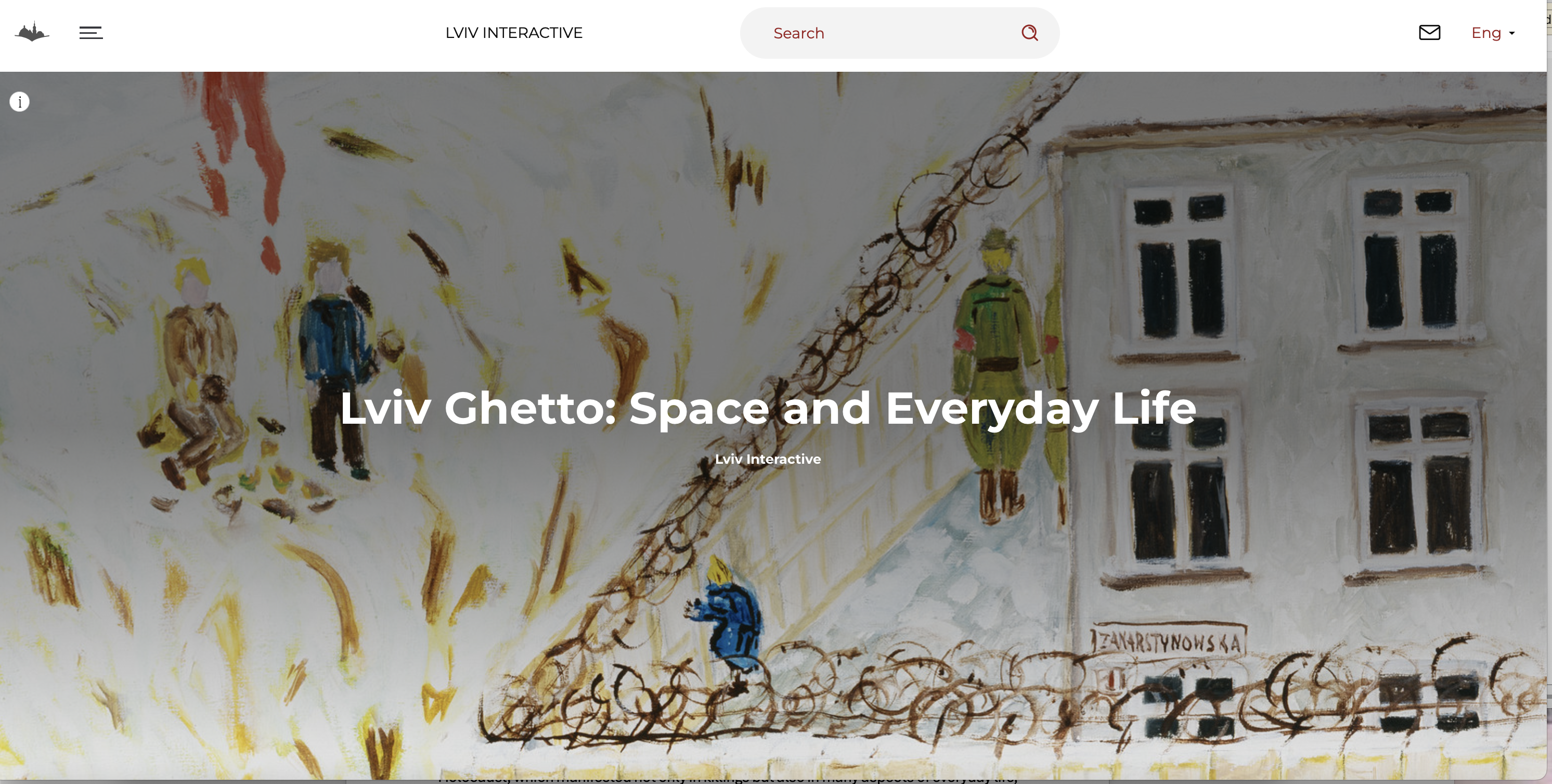
“Lviv Ghetto: Space and Everyday Life,” Lviv Interactive, Center for Urban History, 2025, https://lia.lvivcenter.org/en/themes/lviv-ghetto-everyday-life.
University teaching can sometimes feel like a monotonous routine of lectures, discussions, and final papers, with no direct outcome other than student grades and professorial fatigue or satisfaction. Though many of the thoughts and ideas that emerge during classes are innovative and interesting, and student research papers reflect genuine and original work, these accomplishments rarely leave the classroom. That is why I so appreciated the experience of conducting the digital project “Lviv Ghetto: Space and Everyday Life.” 1 1 “Lviv Ghetto: Space and Everyday Life,” Lviv Interactive, Center for Urban History, 2025, https://lia.lvivcenter.org/en/themes/lviv-ghetto-everyday-life.
“Lviv Ghetto: Space and Everyday Life” was a joint project of the students of the history program at Ukrainian Catholic University and my colleagues at the Center for Urban History of East Central Europe. It was part of a service-learning approach used at the university to apply learning to community change. I led the project during my course "The Economic History of the Holocaust," and our goal was to create a digital map representing the daily life in the Lviv ghetto by illustrating it spatially. This map would allow viewers to visualize the ghetto, to understand the distances and time needed to travel between locations and the connection between the ghetto and the city beyond its walls, and to recognize where key sites of the ghetto are located in contemporary Lviv. This project combined active learning, research, and Holocaust commemoration, thus making an impact beyond the university walls.
The city of Lviv, where Ukrainian Catholic University is located, has a long history of Jewish life and a tragic Holocaust past: The Lviv ghetto was one of the largest ghettos in eastern Europe. The ghetto was created in November 1941 and existed for two years, during which time more than one hundred thousand Lviv Jews resided there. Many people did not survive incarceration in the ghetto, due to starvation and, on occasion, killings. Most of the surviving Jews who were ghettoized were later killed in the Belżec death camp or at the Pisky killing site near the Janowska camp outside of Lviv. There is no known ghetto archive, as there is for Warsaw, but documentation of what happened in Lviv is preserved in various ego-documents as well as in the archives produced by the Nazi administration. One of the earliest texts documenting the Holocaust in Lviv is the testimony of Dr. Philip Friedman in “The Destruction of the Jews of Lwów, 1941–1944” (1945). 2 2 Philip Friedman, “The Destruction of the Jews of Lwów, 1941–1944,” in Roads to Extinction: Essays on the Holocaust, ed. Ada June Friedman (Conference on Jewish Social Studies, 1980). Another is that of Janina Hesheles, a ghetto survivor, who documented life in the Janowska camp, from which she was rescued by Żegota (1946). 3 3 Janina Hescheles, Oczyma dwunastoletniej dziewczyny (“Through the Eyes of a 12-year-old girl”) (Organization of Polish Jews in Kraków, 1946). German ed. Mit den Augen eines zwölfjährigen Mädchens (East Germany, 1958; West Germany, 1963). Since 2011 it has been published in ten different languages. English ed. My Lvov: A Holocaust Memoir of a twelve-year-old girl (Amsterdam Publishers, 2020). More widely known is the memoir The Girl in the Green Sweater: A Life in the Shadow of the Holocaust (2008) by Krystyna Chiger, who, together with her family, survived the Holocaust by hiding in the city sewers with the aid of the Polish worker Leopold Socha. 4 4 Krystyna Chiger with Daniel Paisner, The Girl in the Green Sweater: A Life in Holocaust’s Shadow. (St. Martin’s Press, 2008). Further, there is the account of Rabbi David Kahane, who was rescued by Ukrainian Greek Catholic Metropolitan Andrei Sheptytsky. 5 5 David Kahane, Yoman geto Lvov (“Lvov Ghetto Diary”) (Jerusalem, 1978). English ed. Lvov Ghetto Diary (University of Massachusetts Press, 1990). And finally, there is the important work Notes from the Other World: The Destruction of Lviv in the Diary of a Professor and the Memories of His Grandson (2011)[ by Leszek Allerhand. 6 6 Maurycy Allerhand and Leszek Allerhand, Zapiski z Tamtego Świata: Zagłada we Lwowie w Dzienniku Profesora i Wspomnieniach Jego Wnuka (Kraków: Instytut Allerhanda. Wydawnictwo Wysoki Zamek, 2011). Allerhand survived the Holocaust as a teenager with his mother and father and later published his memoir together with a diary from occupied Lviv written by his grandfather, Holocaust victim Maurycy Allerhand. Many of these stories have one thing in common: The authors survived the Holocaust by hiding beyond the ghetto walls, by being rescued by Polish or Ukrainian residents, or by fleeing elsewhere, and thus their descriptions of the ghetto, where they spent only a short time, are brief. There are also very few mentions of the ghetto from non-Jewish residents of Lviv, who could only see its walls.
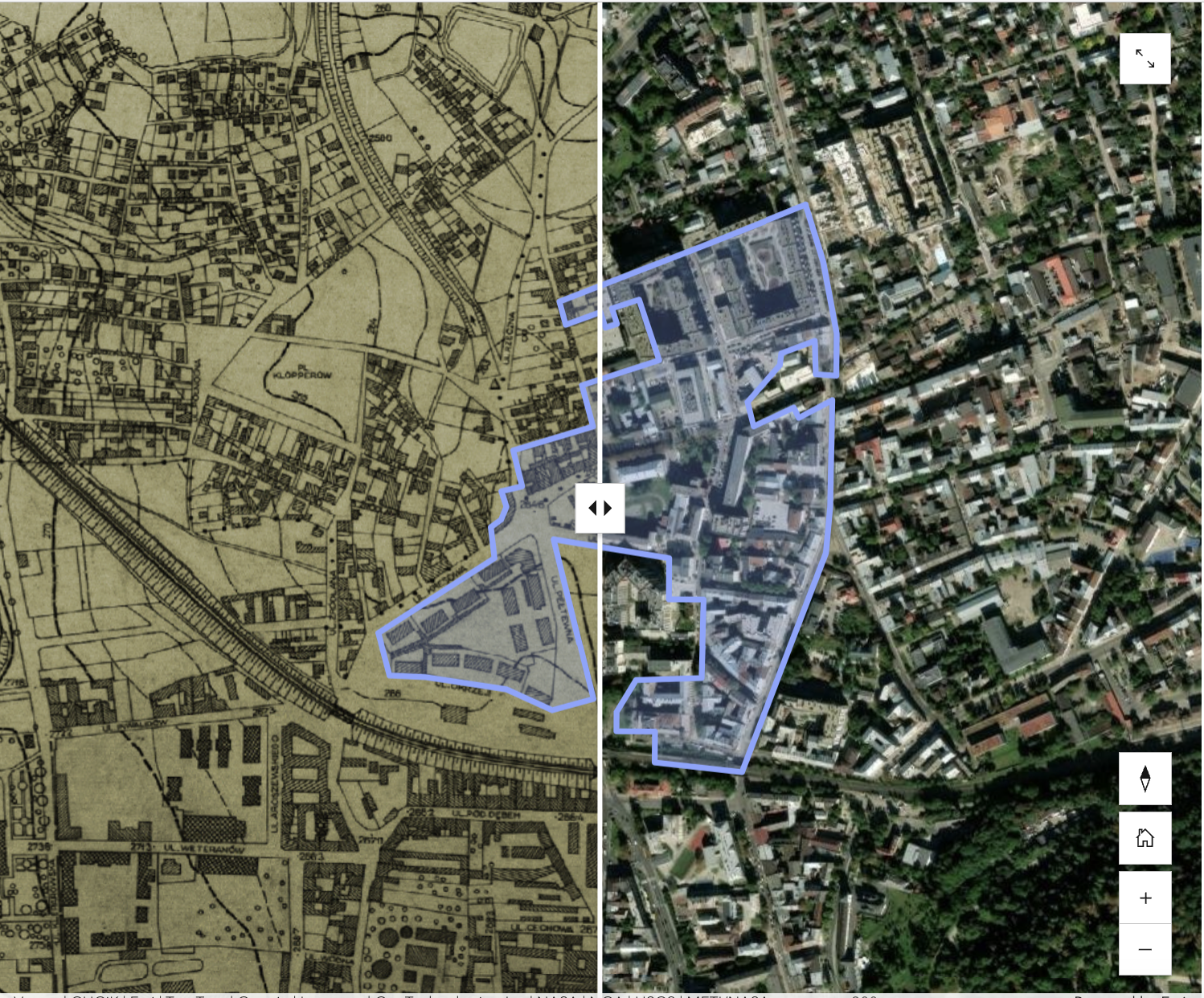
Map of the ghetto using historical sources and current images.
We started our project with the students by taking a tour of the former ghetto neighborhood. Beginning in the early modern period, this was the neighborhood of the so-called suburban Jewish community. The wealthy Jewish bourgeoisie and intelligentsia left after 1867, when restrictions on Jews living in particular city areas were lifted. In the interwar period, the neighborhood was poor and neglected and subject to overcrowding. It was still home, however, to many important synagogues, including two Hasidic synagogues: the Tempel Synagogue; and the Great Suburban Synagogue with the suburban Beit Hamidrash. During World War II, the Nazis did not bomb the city indiscriminately but rather targeted particular synagogues. Thus Jewish tours of the neighborhood pass through many empty spaces between buildings, spaces that signify the former synagogues. The only one surviving, the one on Vuhilna Street, belongs to a Jewish community and is a center for extra-religious activities. “How do we know it is a synagogue?” asked student Andre Kolesha, because the building has no memorial plaque. Though I tried to explain about the peculiarities of Jewish architecture, this question made me conscious of how little history of the Jewish neighborhood is visible to the contemporary observer.
In other places, however, the former Jewish neighborhood is, in fact, commemorated. Plaques mark the sites of missing synagogues, and the newly reestablished Jewish community erected a large memorial to the victims of the Lviv ghetto in 1992, around the first anniversary of Ukraine's independence. 7 7https://lia.lvivcenter.org/en/objects/memorial-lviv-ghetto. Some buildings from the old neighborhood remain intact, including a few former locations of the Judenrat. A huge mural dedicated to Naftali Herz Imber, the author of “Hatikva,” decorates the wall in front of the former Judenrat building. However, unlike in Warsaw or Vilnius, there is little mention that the ghetto was there and few markings to indicate its location. The former street layout is confusing; the old streets have been removed and new ones have been built in their place. The 2003 Aheym Project documentary features Borys Dorfman, a local Jewish community member, who shows the locations of former houses in the ghetto. 8 8https://aheym.com. However, these houses have no historical value, and the neighborhood is now being rapidly redeveloped into an expensive residential area. Following Russia's full-scale invasion in 2022, property prices in Lviv and other relatively safe cities in western Ukraine increased, and developers have seized the opportunity to build new homes.
Thus this digital project that marked the locations of everyday life in the ghetto or institutions seemed meaningful not only because of its research and educational value but also because of its commemorative significance, particularly given the dearth of other memorialization. If people can no longer see the ghetto streets, they can nonetheless explore them via the digital map. The platform we used is a long-standing project of the Center for Urban History of East Central Europe called Lviv Interactive. 9 9https://lia.lvivcenter.org/en. It is a digital encyclopedia of urban life in Lviv that includes information about architecture, institutions, notable people, and events in the city. The project is based on a digital interactive map that adds a spatial dimension to exploring the city. Currently, Lviv Interactive includes more than fifteen hundred entries, thoroughly prepared by scholars and peer-reviewed. The platform already had articles about the Holocaust and the ghetto, some of which were prepared in 2018–2019 as part of the ReHerit project, which aimed to help tour guides talk about the World War II period and its aftermath. The “Lviv Ghetto: Space and Everyday Life” map was designed to bring all the texts and story maps related to the ghetto into one place and serve as an index for Lviv Interactive materials and other related resources.
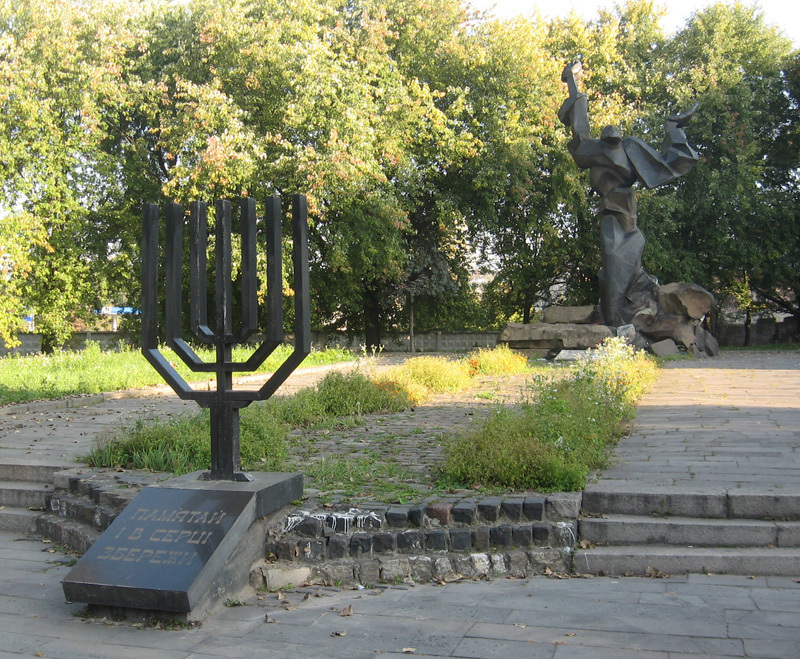
Lviv Ghetto Memorial
The students performed the research for the map primarily drawing on Holocaust memoirs from Lviv (see above), as these are the most accessible sources for understanding the daily experience of living in the ghetto. These were complemented by materials from Yad Vashem and the United States Holocaust Memorial Museum (USHMM) in Washington, DC, as well as secondary literature—an article by Natalia Aleksiun on trade and barter in the Lviv ghetto was particularly useful. 10 10 Natalia Aleksiun, “Food, Money and Barter in the Lvov Ghetto, Eastern Galicia,” in Coping with Hunger and Shortage under German Occupation in World War II, ed. Tatjana Tönsmeyer, Peter Haslinger, and Agnes Laba, (Palgrave Macmillan, 2018), 223–47. Together we designed the structure of the map and wrote the accompanying narrative explaining the context. There were seven students participating in the service-learning project, and each was responsible for a subtopic. Anastasia Monhold marked the ghetto boundaries, complementing the map made previously by historian Taras Martynenko. I think it was one of the most impactful parts in that it showed the gradual narrowing of the life space leading finally to extermination. Andre Kolesha described the self-government in the ghetto, mapping the locations of different institutions, which had changed several times. Diana Yarmus was responsible for the section on the transport and logistics of movement, exploring the dynamics of the ghetto and its connections to the rest of the city. This was related to Yuliia Pysklynets’s section on places of forced labor, usually located outside of the ghetto boundaries. Viktoriia Lohvynchuk explored places of trade and barter and inquired how they connected the ghetto to the city beyond the gate. The sixth section, written by Kamila Chernietsova, was dedicated to social infrastructure, describing primarily hospitals, soup kitchens, and public kitchens. In the final, seventh section, Liliana Moskaliuk examined places of hiding in the ghetto.
The mapping project was completed in cooperation with Roksolyana Holovata and Vladyslav Muravskyi, experts on digital humanities at the Center for Urban History of East Central Europe. The experts helped the students create digital maps of different locations in the ghetto, which were later transferred to the Lviv Interactive platform. The mapping was done using the 1936 Lviv city plan, as it is the most detailed map of the city before the war. This part was the most engaging for the students, though it required diligence and attention. Many street names have changed several times since World War II, and some memoirs give unclear or contradictory information. Thus each point on the map includes the original name from the source and a note with additional information to make it easier for users to understand the mapping decisions, such as quotes from the source material. Maps showing the ghetto borders were combined with an aerial map from 1944 and contemporary Google Maps images. Writing the text was more time-consuming, as it involved adding footnotes, verifying information, and unifying the voices of seven authors.
Another challenge was incorporating illustrations into the project. As is often the case with ghettos, there are no images of the interior—only a few pictures showing prisoners riding a special tram to forced-labor sites. This situation led us to consider other illustrative options, such as artwork. The USHMM holds paintings by Sophia Kalski, who was imprisoned in the ghetto as a child and survived the Holocaust. Many years later, in the 1980s, Kalski created a series of paintings depicting her childhood experiences. With their vivid colors, the paintings resemble children's artwork and depict everyday life in the ghetto. In many cases, there were no other visual sources to draw upon. One of the paintings, for instance, depicts a restaurant in the ghetto which she visited with her father. The entire meal in the restaurant consisted only of soup and one potato, which she and her father shared.
After the project was finished—later than expected but on a larger scale than initially planned—I started wondering about the outcomes and what we had learned from it. First, it was an active learning tool in which students had acquired knowledge through active research, comparing and evaluating primary sources and situating spatially the data they had acquired. For me and my colleagues at the Center for Urban History, the project was an opportunity to organize our knowledge of the ghetto borders. We were now able to understand the boundaries of the ghetto after several restrictions had been put in place. We also became more aware of how the ghetto borders coincide with Lviv's modern urban landscape.
Student Yuliia Pysklynets observed, “Standard sources often provide individual stories or testimonies, while mapping allows these events to be placed within the physical and urban landscape.” Kamila Chernietsova said, “This approach helped me rethink the history of Lviv and the importance of preserving memory through modern technology.”
Before I started teaching about the Holocaust and especially while conducting the project, I worried about the emotional impact of reading about violence during Russia's current, ongoing war against Ukraine. Although Lviv is relatively safe, missile attacks occur every few months, forcing us to run to bomb shelters in the middle of the night. Many of us have friends and relatives in cities that are constantly under attack or on the front lines. Nevertheless, my students chose my course and readily participated in the readings and discussions. I tried to avoid showing the most disturbing images or reading about mass murder. On the other hand, learning about the Holocaust amid a war seems appropriate, as it is a topic that deserves particular attention. Even though it is disturbing and sometimes scary, we feel a greater need than ever before to learn about it. We also faced a practical issue related to the war: We did not dare take photographs of locations related to the ghetto and the Holocaust—for example, the railway bridge or the prison in the former Janowska camp—because they could be considered strategic objects.
Since we all currently live in Lviv, preparing the map became an emotional experience that made us look at familiar streets with new eyes. Personally, I realized that before the ghetto was rebuilt, it probably looked similar to how it did in 1942–1943. I also viewed the process of producing sources differently. Most of the survivors were able to do so because they left the ghetto or even Lviv. Thus we do not know much about the personal experiences of those who lived—and died—there.
The map that we prepared was a learning project that also, hopefully, can become a teaching project for future classes. There are many more types of sources that can be included, and thus the map can inspire other kinds of collective projects in the future.