Mar 18, 2026
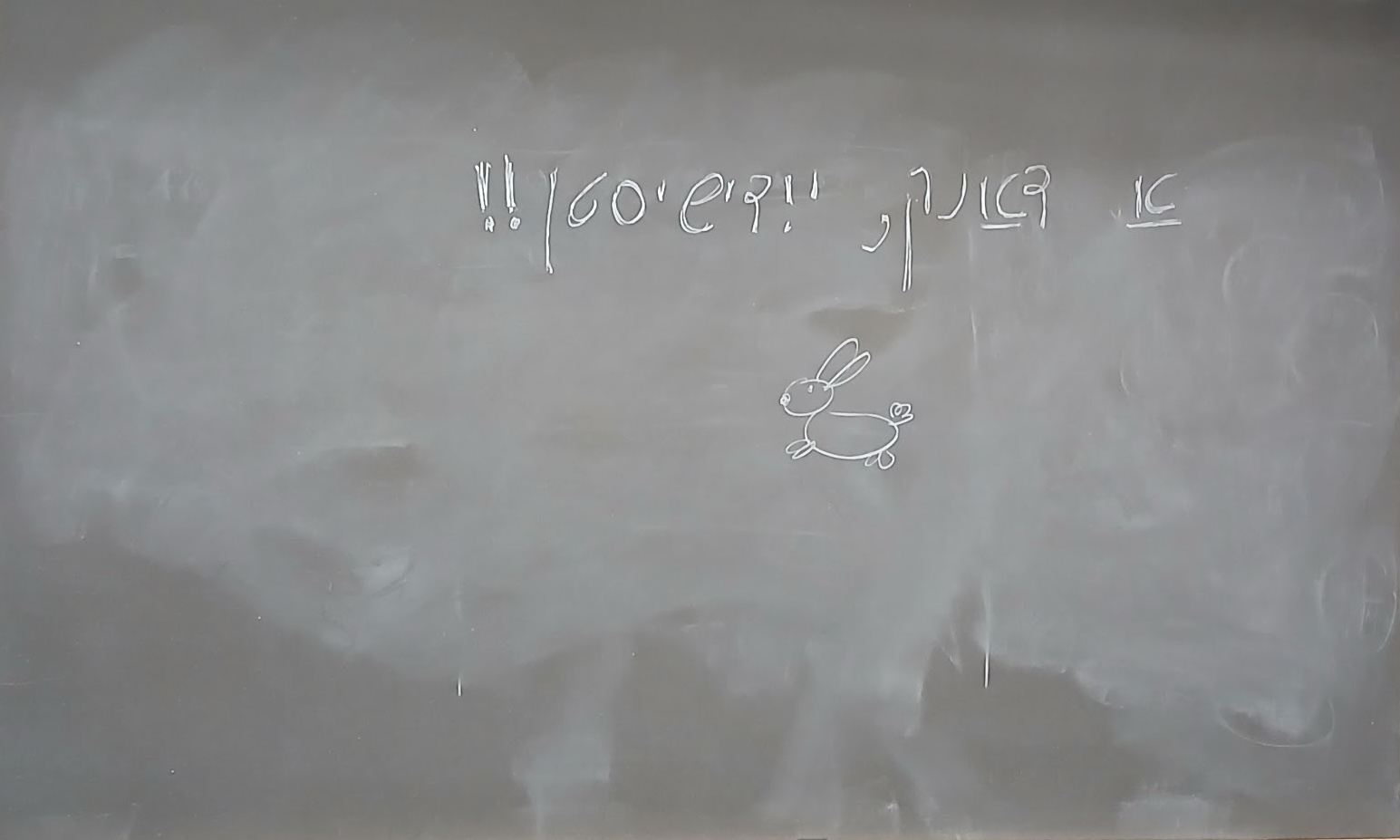
A chalk message from Yidish tish
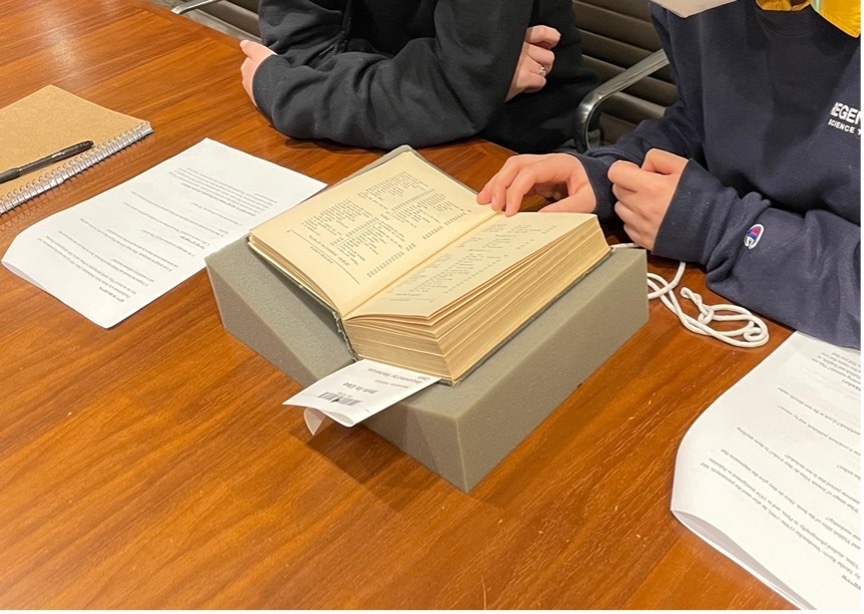
The Lubavitcher Rebbe said, “If you know alef, teach alef.” Just eight months after beginning to learn Yiddish, I found myself sitting at a plastic table in Oberlin College’s Mudd library across from two brand-new Yiddish students, who were looking at me with expectancy and hope. I felt the urge to apologize to them. At the time, I was myself a brand-new Yiddishist and still sometimes got langer fey and langer tsadek mixed up. I was not the fluent, confident teacher that these students deserved.
It was my first day on the job as Oberlin’s Yidish tish facilitator. I had naively expected that somehow, Yidish tish would reveal a vibrant Yiddish-speaking community at Oberlin that was previously unknown to me, and that my job would entail facilitating conversations among people who already spoke Yiddish. This was not the case. For there to be a Yiddish-speaking community at Oberlin, someone needed to teach the community Yiddish. It seemed that that someone, despite my inexperience and uncertainty, would need to be me.
Oberlin has a fluctuating relationship with yidishkayt. Dozens of Oberlin alumni have made incredible contributions to the Yiddish world, including Levyosn’s amazing Adah Hetko and Raffi Boden, Klezmer flute virtuoso Adrianne Greenbaum, the Yiddish Book Center’s education specialist Sonia Bloom, and so many others. Nearly twenty Oberlin alumni were in attendance at Yiddish New York in December 2025. Oberlin students formed Lorain County’s premier klezmer band, Shtick and Poke. That being said, the college itself has not typically offered a consistent, dedicated space for students to study Yiddish. Years ago, a handful of professors in the Jewish Studies and German departments had offered private reading courses in Yiddish, but that was before my time at Oberlin.
Much to my delight, this changed in January 2024, when Alona Bach, PhD candidate at MIT, taught an inspiring, vibrant, monthlong intensive course at Oberlin during Winter Term. Jewish studies professor Shari Rabin had begun to foster a new Jewish languages program at Oberlin. The program’s new primary projects were the short, immersive Winter Term course “Exploring Jewish Languages,” which consisted of two cohorts of students studying modern Hebrew and Yiddish respectively, as well as Yidish tish, a long-term, student-led shmueskrayz that would take place during the fall and spring semesters. The Winter Term course was my introduction to Yiddish, and like many other students in my generation, I fell in love with the language that formed a bridge between my heritage and my future. I continued my studies that semester through Yidish tish, which was then facilitated by Abe Gold ’24. Abe and I met for an hour each week that semester to chat in Yiddish. As an adept, confident Yiddish speaker, Abe helped me acquire new vocabulary and improve my conversational fluency. This prepared me to spend that same summer as an intermediate student at the Steiner Summer Program at the Yiddish Book Center, where I was lucky enough to study under Asya Vaisman Schulman, Rivke Margolis, and Eydl Smith. My attendance at Steiner was supported by a Jewish Language and Culture grant from the Oberlin Jewish Studies department, another key aspect of the new Jewish languages program. When I returned to campus that fall, I began working as Oberlin’s new Yidish tish facilitator, tasked with facilitating not just a shmueskrayz but also an active learning environment for a group of students with no prior Yiddish experience. I had a responsibility to develop my language skills and my teaching skills to support Yidish tish attendees in their learning journeys as best as I could.
Since that first day of Yidish tish in Fall 2024, I developed a peer teaching approach that adapts contemporary theories in communicative language teaching to the peer-to-peer context. I am incredibly fortunate to report that a group of brilliant students not only shows up to Yidish tish each week but goes above and beyond, taking advantage of every opportunity to learn, working hard to develop their Yiddish reading, writing, and conversational skills, and after some time even leading their own Yiddish language and culture events. Together, we have built a close-knit, collaborative learning community. I offer the following suggestions to others tasked with facilitating learning among a group of peers.
1. Develop your curriculum in collaboration with your community.
One of the greatest privileges of teaching in any context is that your students each bring to the table their own unique questions, curiosities, and goals about the topic. Especially as a peer teacher, this is your greatest asset. While developing your own curriculum that teaches grammar and vocabulary at an appropriate pace, tailor your plans to the community’s interests. This technique avoids creating a power imbalance and develops a community where everyone feels heard.
After each weekly meeting, I ask Yidish tish attendees what they would like to cover in the next meeting, and I let this guide my lesson-planning. During the early stages of Yidish tish and the early stages of the students’ Yiddish-learning journeys, we started with the basics such as introducing oneself, learning colors and numbers, and verbs in the present tense. As I had hoped, these building blocks gave participants more questions than answers, and I developed my subsequent lesson plans based on their questions. Still, even when planning the brunt of classroom activities around the group’s interests, I always have another supplemental activity in my back pocket, whether that’s a grammatical topic, a song, a poem, a game, or an excerpt from a Yiddish film. You can never be too prepared—and teaching necessary, foundational grammar and vocabulary topics will serve you well.
For example, after Yidish tish participants expressed an interest in Yiddish-English translation, we spent the next Yidish tish crafting a collaborative translation of Beyle Schaechter-Gottesman’s poem “Himlen in november” for Binele, a new Yiddish zine. When they asked me about modal verbs, I assigned worksheets from the second volume of In eynem, and we listened to the songs “Tsar bale khayim” and “Volt ikh gehat koyekh.” Rather than immediately explaining the grammatical rules to them, I gave participants the opportunity to examine the lyrics to each song and identify the grammatical patterns on their own (with cues and support from me as needed).
When Yidish tish attendees told me they wanted more practice with the past tense, we spent the next meeting applying their skills through storytelling games such as “Exquisite Corpse” and “Fortunately, Unfortunately” (Tsum glik, tsum umglik). I had first learned these games in a middle school creative writing class, but they suited this context perfectly, demanding past tense use and calling for light-hearted creativity.
To play Exquisite Corpse, each player writes one sentence of a short story on a sheet of paper and then folds the sheet over and passes the paper to their left, so the next student does not see what was previously written. During the first round, players write the name of the main character to whom the following events will occur. During the second round, players write an action completed by the main character. During the third round, players describe how “the people” or an imaginary audience react to this action. During the fourth round, players explain how the main character, in turn, responds to the audience. The fifth round contains some kind of resolution. These five rounds provide students with the opportunity to be humorous while strengthening their past-tense writing skills. Furthermore, since Yidish tish participants were still refining their alef-beys, this activity helped them practice reading and writing in script. Each short story gets read out loud at the end of the round.
Tsum glik, tsum umglik , on the other hand, is fast-paced and conversational. One player starts by describing an event that happens to a character they devise. The next player starts their sentence with tsum umglik (unfortunately) and describes a subsequent unfortunate event that builds off the first. The third player starts their sentence with tsum glik (fortunately), and the game continues until the story reaches a natural resolution. This works best with an odd number of people, so that someone who was tasked with a tsum glik sentence gets a tsum umglik sentence in the next round, and vice versa.
Shaping your lesson plans around the community’s interests provides students with a constant sense of progress, gives them autonomy in their learning journeys, and keeps them engaged and excited to come to class (and when the group only gets to meet once a week, motivation and attendance are especially important).
2. You are never as alone as you think you are.
It can be daunting to come up with lesson plans, especially when you are new to peer teaching. Know that you are not alone, and that there are amazing resources available for and by Yiddish teachers. You do not always have to work from scratch.
It should go without saying that textbooks such as Asya Vasiman Schulman, Jordan Brown, and Mikhl Yashinsky’s In eynem and Uriel Weinreich’s College Yiddish are incredible resources for in-class activities and homework assignments. Furthermore, In geveb’s pedagogy section is a treasure trove of dozens of brilliant articles and lesson plans. I especially found Mindl Cohen’s “Teaching Morris Rosenfeld’s ‘Mayn rue plats’” to be a stellar resource in teaching Yidish tish attendees (a few of whom come from a German-language learning background) about daytsmerish orthography. I combined Cohen’s materials with a translation activity in which students first created their own English translations of the poem “Mayn rue plats,” then we listened to Daniel Kahn’s arrangement and discussed the differences between translating for the page versus translating for songs. This primed the group for a Workers Circle-sponsored field trip—organized by Yidish tish attendee and Workers Circle College Network Ambassador Aurelia Browning—to Detroit just a week later, in which we saw Daniel Kahn perform his version of “Mayn rue plats,” as well as a many other songs from his phenomenal new album Umru.
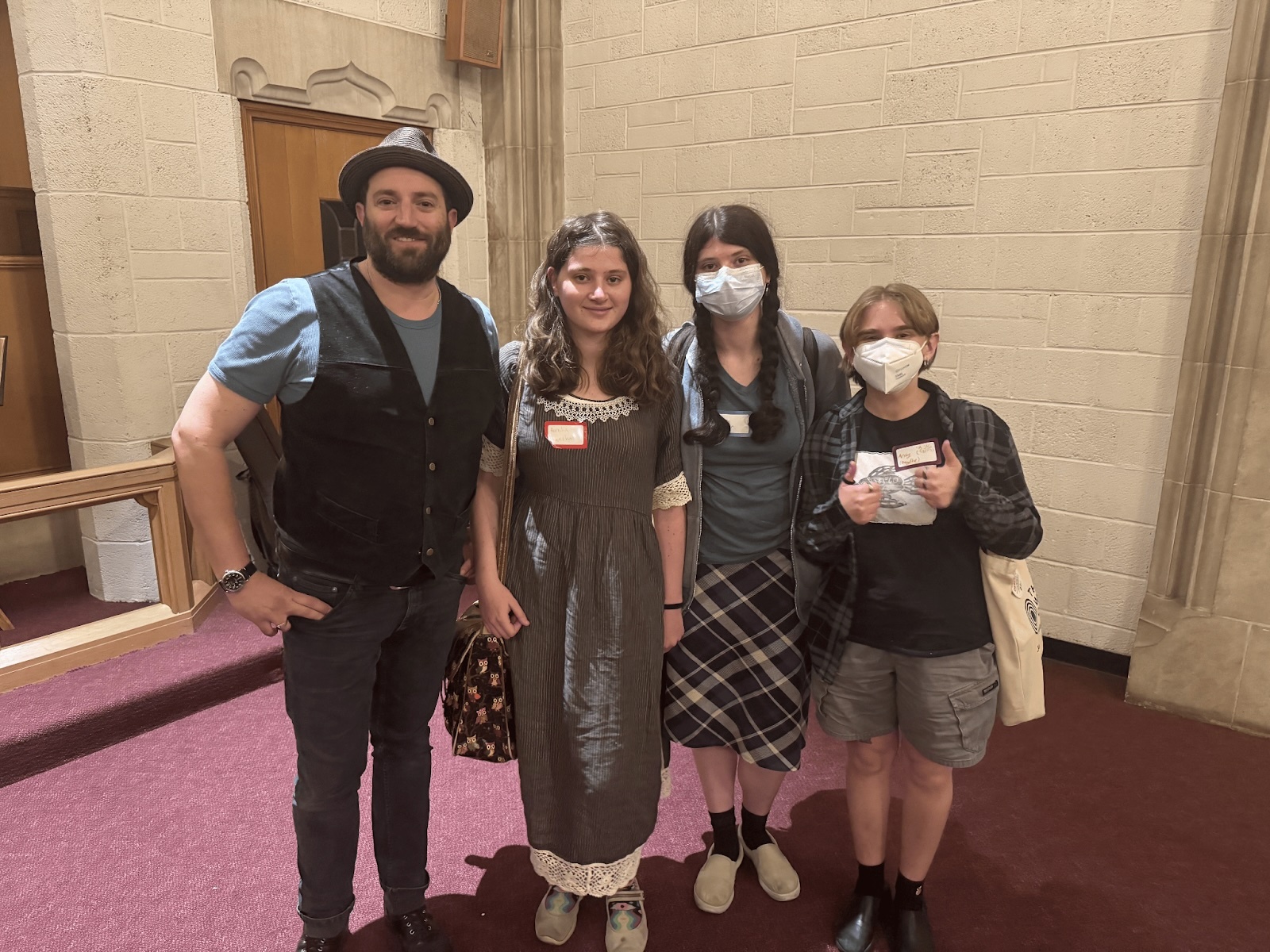
(Left to right) Daniel Kahn, Aurelia Browning, Farren Browning, Andy Roshal
Digital archives are also a great place to look for classroom materials. The Wexler Oral History Project is a fantastic resource that provides students with examples of fluent Yiddish speech within a variety of dialects. YouTube is also an excellent resource, containing hours of Dzigan and Schumacher sketches, pre-war films such as Tevye and Yidl mitn fidl, and contemporary songs and skits by artists such as Riki Rose, Lea Kalisch, and TEHILA, just to name a few. These can easily serve as centerpieces for valuable discussions on Yiddish culture and history for intermediate and advanced students, or examples of vocabulary and grammatical topics for beginner students, enabling you to use the same resource for multiple activities if you are working with a multi-level learning community.
I also encourage you to seek advice from other language teachers, even (and especially) if their background is in a different language. I am lucky to have been trained in communicative, task-based, usage-based language teaching by Oberlin’s Professor Kim Faber; and although my training was geared toward my experience as an ESOL teaching assistant, many takeaways transcended context and were applicable to my work as Yidish tish facilitator. Faber’s lesson-planning model “MIPA” was particularly handy. This stands for Motivation, Information, Practice, and Application. This is an easy way to remember the crucial components of any effective, communicative lesson plan. The “M” is a hook or a centerpiece that raises a question for students—at Yidish tish, this often looks like listening to a song or reading a poem together. The “I” often looks like a discussion in which students identify a particular grammatical feature, cultural trait, orthographical quirk, or dialect marker. Once Yidish tish participants have noticed this feature (typically with some prompting and a guided discussion), I typically provide them with an organized explanation of this feature. The “P” varies depending on the context and topics, but this could take the form of identifying this same feature in a different form of media and/or reproducing their own small-scale creative project during class, employing knowledge of this linguistic or cultural feature. The “A” tends to take the form of homework in which students create larger-scale creative projects (e.g., a short essay, a reflection, or a worksheet).
More broadly, think about what kinds of activities you have enjoyed and/or found useful in your own language-learning background. What made these lessons interesting to you? How can you translate these concepts into your classroom, even when your classroom is a cramped study room in the library?
3. Develop your own teaching style.
Just as each Yiddish student brings their own unique questions, curiosities, and goals pertaining to the class, each Yiddish instructor brings their own obsessions and idiosyncrasies to their students. This can be a strength if you lean into it. What is important to you about Yiddish? How can you convey this to your community? What can you bring to the table that is specific to your knowledge or experiences?
As a student of linguistics with a keen interest in linguistic anthropology and usage-based linguistics, a central tenet of my teaching is a variationist approach to language pedagogy. This sociolinguistic term describes pedagogy that is maximally inclusive of language variation. The standardization of Yiddish and the development of YIVO or klal Yiddish has allowed Yiddish to be more easily transmitted to students past, present, and future. However, this has sometimes led to the erasure of non-standardized varieties. In order for your students to gain a holistic understanding of Yiddish as a living language, it is key that they be familiar with as many varieties of Yiddish as possible. Early into their Yiddish-learning journey, students should know what variety they are being taught and be given the resources to make a conscious decision as to which variety they are speaking. It is important to emphasize that everyone has a dialect and an accent. As someone who speaks klal, I am not able to replicate varieties such as Satmar Hasidic Yiddish or Ukrainian Yiddish, but many resources are available online. Videos such as Wikitongues’ “Suri speaking Yiddish,” the Wexler Oral History Project’s “My Specific Ukrainian Yiddish Accent,” featuring Naftali Ejdelman, and this interview with Dora Fiksler provide accessible examples of different dialects of Yiddish, giving students a sense of the diversity of Yiddish varieties as well as a chance to hear these individuals’ stories.
A variationist approach to language pedagogy is one of my interests and passions, and I urge you to include a multitude of dialects in your teaching. I also encourage you to consider what topics you personally consider to be crucial to a holistic education in Yiddish language and culture, and to bring these to your peer teaching context. Enthusiasm is contagious.
4. Continue to strengthen your own language skills.
Finding myself in the role of a peer Yiddish teacher did not give me the illusion that I was in any way done learning Yiddish; on the contrary, I felt all the more motivated to strengthen my Yiddish through taking online classes with the Workers Circle, keeping in touch with my Yiddish friends, classmates, and teachers, and studying on my own as much as possible. The stronger my Yiddish, the stronger Yidish tish attendees’ Yiddish could be (and the more people on campus I would get to speak Yiddish to).
Two years after beginning to learn Yiddish through Alona Bach’s Winter Term course at Oberlin, I had the privilege of returning to this same course as the teaching assistant and teaching in a more formal context, which brings its own exciting set of opportunities, challenges, and joys. And as I spend one final semester as Yidish tish facilitator, I am excited to continue learning how to be a Yiddish teacher, with help from my students. I encourage you—even if you think you can’t—to try your hand at teaching Yiddish. In order for Yiddish to thrive, every Yiddish student must be a teacher, and every Yiddish teacher must be a student.