Dec 01, 2025
INTRODUCTION
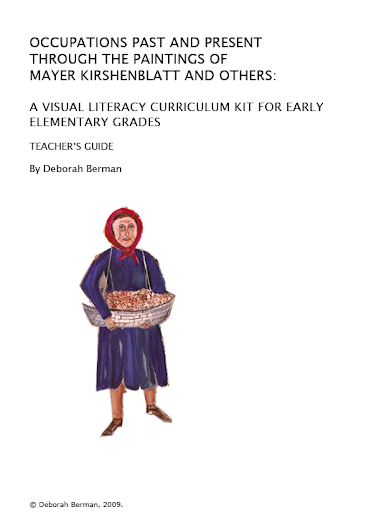
A pdf of the Occupations Past and Present curriculum can be found here.
Occupations Past and Present is a visual literacy curriculum drawing on Mayer Kirshenblatt’s images of eastern European Jewish life to teach general (not only Jewish) grade school audiences how to relate to, ask questions of, and learn from images. The curriculum Occupations Past and Present fulfilled the final requirements for a class in media literacy run by Project Look Sharp, an outreach program of Ithaca College aimed at training educators in teaching critical thinking and media literacy skills. It has been a number of years since I created this curriculum in 2009, and the road toward creating it was circuitous.
My first masters was in library science, and I worked as a children’s librarian for some time. In 1992, to complete the requirements for a masters in social work, I wrote a thesis entitled “Roots To Routes: Evolving An Ethnic Identity,” which focused on KlezKamp, a foundational festival of Yiddish folk arts that ran for thirty years, beginning in 1985. I have now worked as a psychotherapist for many years. My motivation for this project was not only an interest in pedagogy or psychology per se but rather one that runs through my work in both these fields (and my life): the creation of beauty as a force of healing. I have drawn from the world of Yiddish, especially language, music, and—most recently—visual expression, to that end. As an artist my work happens to often be appealing to children. I am drawn to those fundamental preoccupations that are with us from childhood to death.
When I began creating this curriculum I had been working with Jennie Romaine at KlezKamp in the children’s program for many years. One of our many projects was a very successful toy theater dramatizing moments in Jewish life. The book They Called Me Mayer July had recently come out, along with the exhibit of Mayer Kirshenblatt’s paintings at the Jewish Museum. The book, compiled by Barbara Kirshenblatt-Gimblett, included narratives about Mayer Kirshenblatt’s life, together with lively “memory paintings” (Kirshenblatt-Gimblett’s evocative term) depicting his youth in Opatów. I was entranced with the way the world of Yiddish came alive for me through these images, and I wanted to encourage young people to engage with them.
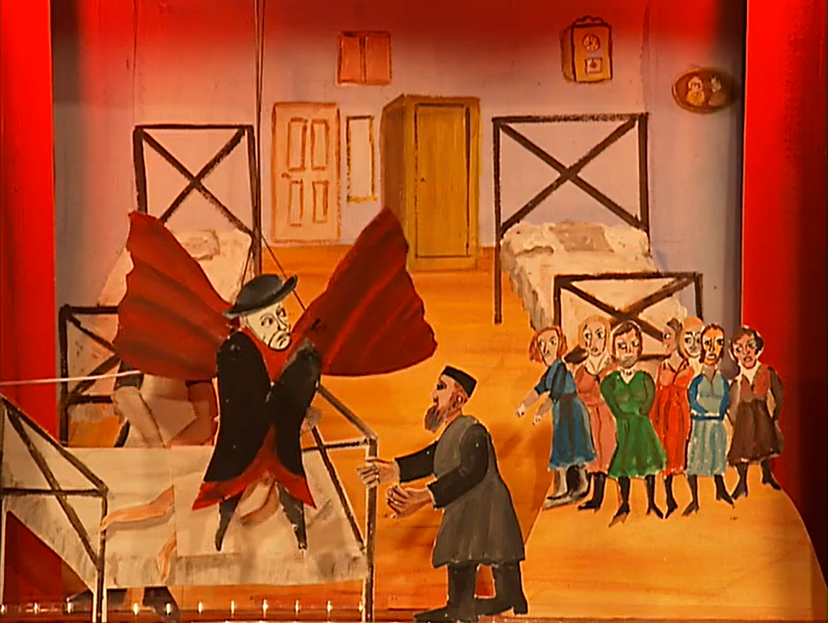
My previous work with children at KlezKamp and my excitement about Mayer Kirshenblatt’s paintings came together for me when I was attending the media literacy course and decided to draw on the Kirshenblatt book for my final project. The parameters of the project were to create a media literacy program that would support a second-grade learning goal. I seemed to have a ready-made formula with Kirshenblatt's images and my toy theater work. I fit my own passions for Yiddish culture, puppetry, and children into the requirements for the workshop. I wanted to expose children to “serious” work while making it truly accessible to them, using the images to help them ask questions that often arise for curious children: What will I do when I grow up? How do people live in different times? What did people do before I was born? The exploration of occupations is on the list of curriculum requirements, and it is also a universal life concern. Visual images and puppet theater are children’s language. Although it has been some years since I created this material, when I looked at it again recently my first thought was that it was beautiful and still vibrant, and I wanted to share it with In geveb’s readers.
While the ostensible goal of the project was a school curriculum for second graders, this presentation could work for all ages in many languages, asking how we know what we know and how we can convey our message to others. Mayer Kirshenblatt’s book could be a foundation for the creation of curricula or lessons for many subjects and contexts across cultures: history, anthropology, food customs, and architecture.
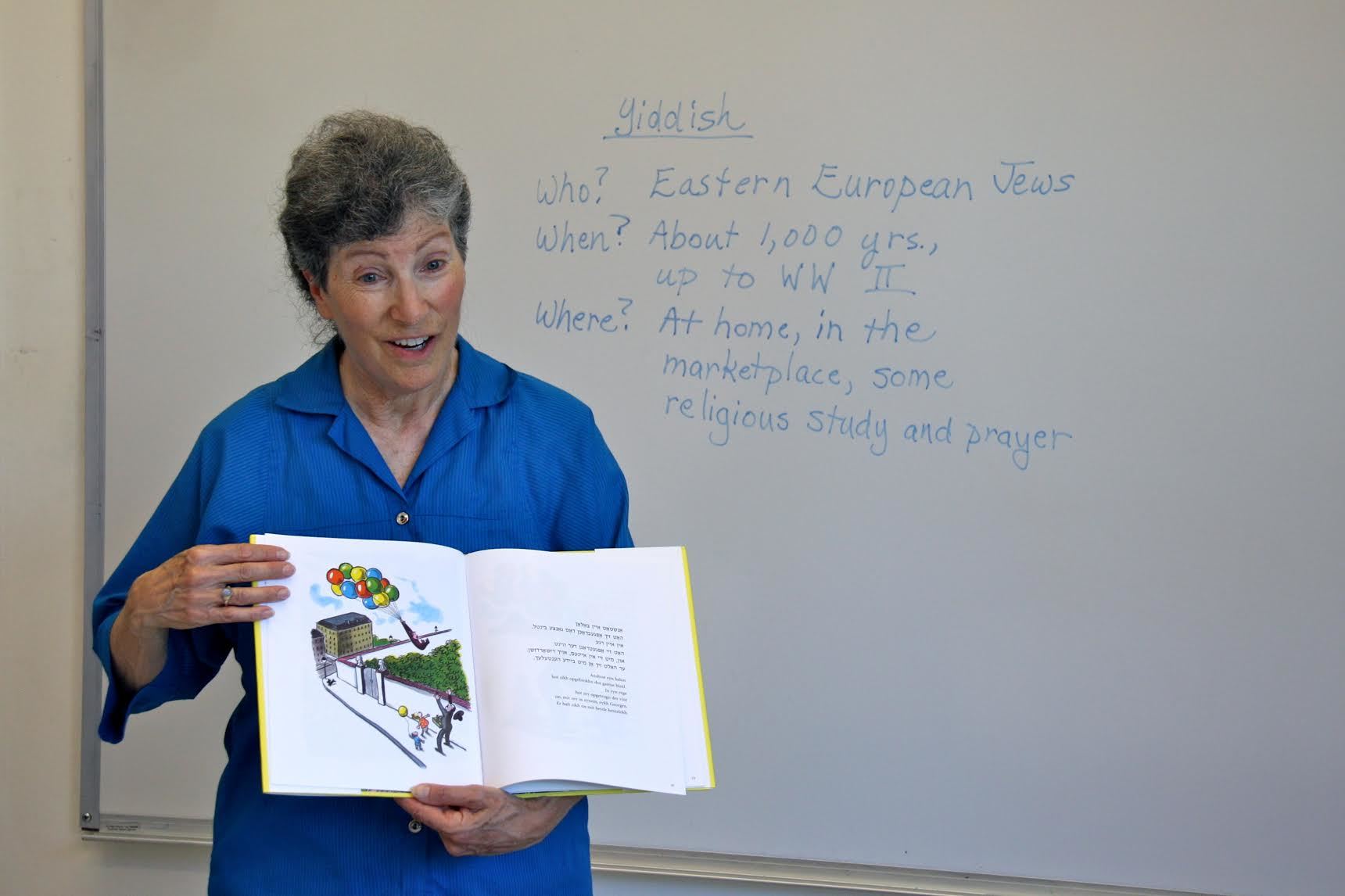
Translated into Yiddish, the curriculum could be particularly suited for the language classroom, for students of all ages whose language capacity is limited but growing: The visual medium allows information to be conveyed without difficult grammatical constructions or not-yet-learned vocabulary and can be an early access point for what can become a deeper exploration of these topics among elementary speakers. Perhaps Yiddish instructors who read In geveb would be interested in translating this resource, and I would welcome that.
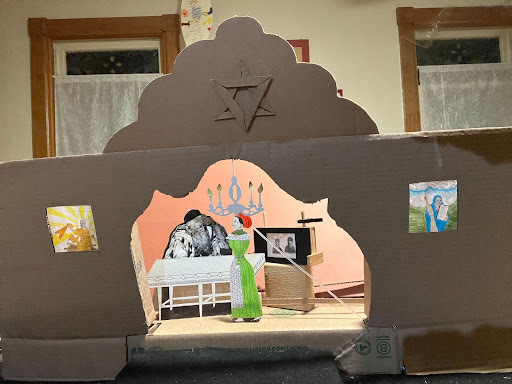
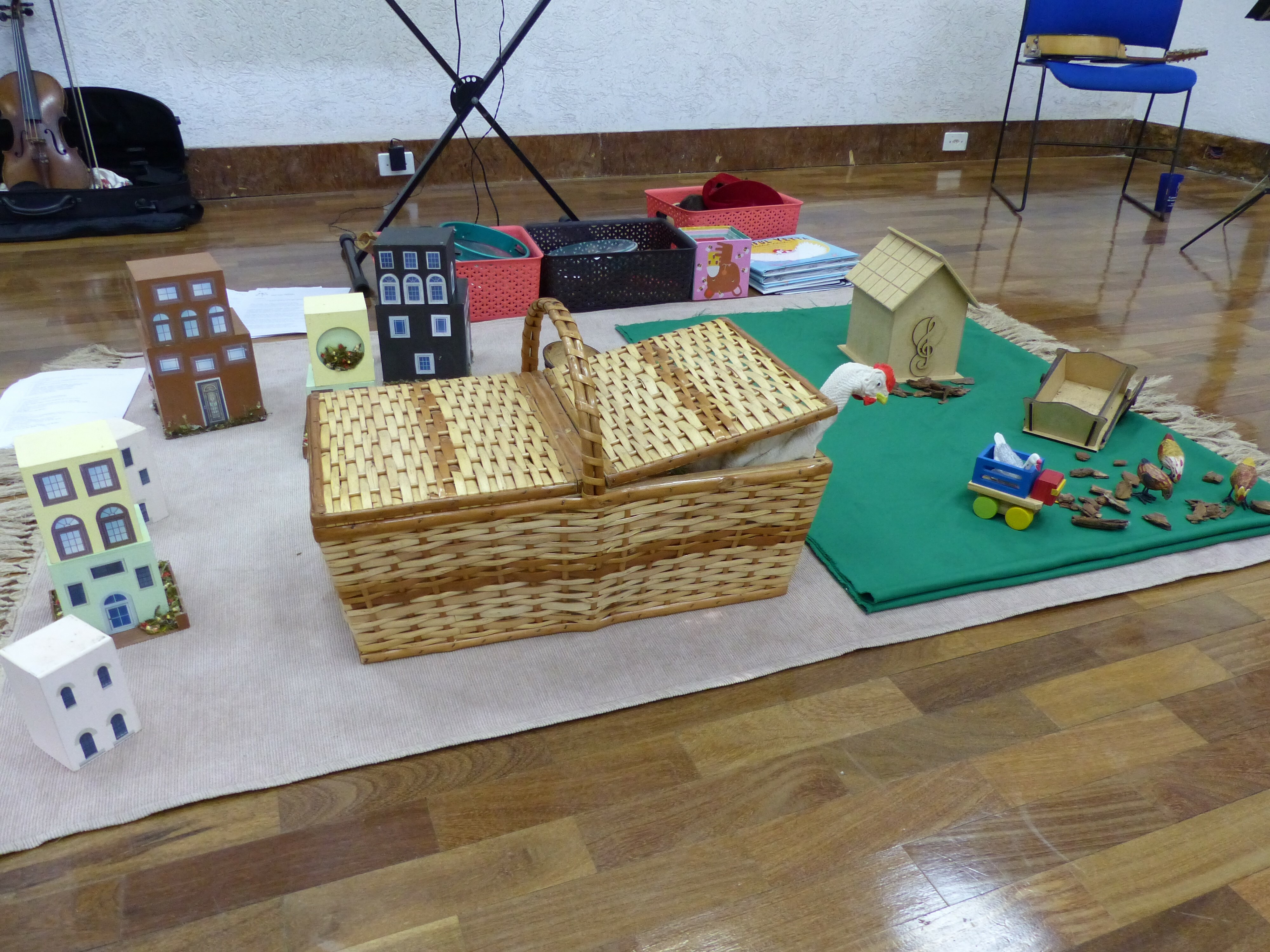
While toy theater is a bonus activity in the original project, it enriches the learning. Toy theater involves the manipulation of paper characters in a box theater that can be placed on a tabletop. Build-your-own toy theaters were popular in Europe during the nineteenth century, and the art experienced a revival in the 1990s among puppeteers recovering older theater techniques. It lends itself to an educational setting because it is a format through which children can see their thoughts and creations come alive using the visual information they absorb from careful observation of the variety of images that they study.
(Here you can see a clip of my toy theater performance with fellow puppeteer Edith McCrea at the Yiddish Folklife Festival of the Finger Lakes in Ithaca, New York, March 2025. With thanks to Maya Connolly for capturing the performance on video).
A pdf of the Occupations Past and Present curriculum can be found here.
The images in this resource come from several sources. Primarily, they are from They Called Me Mayer July: Painted Memories of a Jewish Childhood in Poland Before the Holocaust (University of California Press, 2007). Other images include paintings of Toby Knobel Flueck, which can be found in her self-illustrated memoir Memories of a Polish Village, 1930–1949 (Alfred A. Knopf, 1990), and photographs by Roman Vishniac from his volume Children of a Vanished World (University of California Press, 1999). This guide is for educational purposes only; it is a supplement that is in no way meant to replace the purchase of these books. Rather, I strongly encourage educators to purchase and refer to the source material, which provides vital context for this educational resource.
Note from the editors: If teachers teach, adapt, translate, or expand on this material, In geveb encourages you to reach out and tell us about it!