Jan 26, 2026
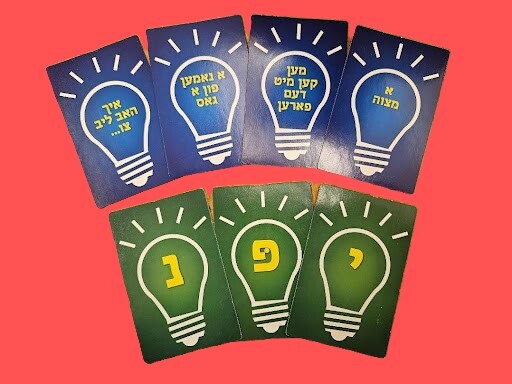
Cards from the board game שפּיץ קאָפּ
Playing card games, board games, and party games in a Yiddish language class can build student confidence and create an environment that allows students to feel successful at language learning through humor and relaxed interactions. Games allow students to practice the language in a structured but fun way – with the aid of games, teachers can reinforce vocabulary and grammatical structures while engaging students in an activity that allows them to express themselves with silly or serious answers.
In recent years, numerous games have been developed in Hasidic communities that can be utilized for language learning for beginner, intermediate, and advanced levels of Yiddish. These games are becoming increasingly accessible to learners outside of Hasidic communities with the proliferation of online catalogues and websites where the games can be purchased. Learning about contemporary Hasidic Yiddish culture through authentic materials offers students valuable insights into living Yiddish speech communities and their creative expression. Games, in particular, can serve as accessible entry points into cultural contexts that might otherwise remain difficult to encounter due to geographic distance or community insularity.
Yiddish teachers have a number of considerations to keep in mind when choosing games to use in their classes, such as the cultural content of the games (which in some cases might be thick with Jewish religious content not familiar to all students), the differences in dialect and orthography between the (often standardized) Yiddish taught in class and the Hasidic Yiddish used in the games, the level of language needed to successfully play the games, and the age and interests of the students in relation to the target audience of the games. In many cases, games can be adapted and adjusted to suit the needs of learners. These adaptations can include labeling game cards with standardized orthography and/or grammatical information such as noun genders; requiring students to narrate their actions during a game to increase the game’s linguistic component; adjusting game rules to encourage certain types of linguistic interactions; and removing selected cards from a game that are inaccessible at the students’ cultural or linguistic knowledge levels. Furthermore, many games may need to be treated as authentic texts, which could involve pre-teaching relevant vocabulary and cultural concepts and addressing the cultural products, practices, and perspectives that students may encounter during gameplay.
Over the past fifteen years, I have purchased over thirty Hasidic games and tested them out with various groups of Yiddish learners to find ones that work most effectively in different contexts and varying levels of classes. For the list below, I selected sixteen games that I have found to be most relevant and engaging for language classes; the games are organized roughly by their accessibility to different levels of students (from Novice to Advanced). I have marked my favorite games with the ♥ symbol. When relevant, I have included my suggestions for ways to adapt or adjust the games, as well as sample models of language use during gameplay. I did not include the most popular games, such as עפּל צו עפּל (Apples to Apples) and װער בין איך (Guess Who), since most people are already familiar with these games and how to use them in class. At the end, I have provided a list of other games that I have tested, with notes about why I did not find them suitable. Note that this list is far from comprehensive. Because I had limited information about games before choosing which ones to purchase, the selection presented here reflects my educated guesses about which games would be best suited to language teaching among those I was able to find in New York, Montreal, and online. Given how rapidly new games are being produced, it is also important to note that the list represents only what was available at the time of selection.