Mar 31, 2024
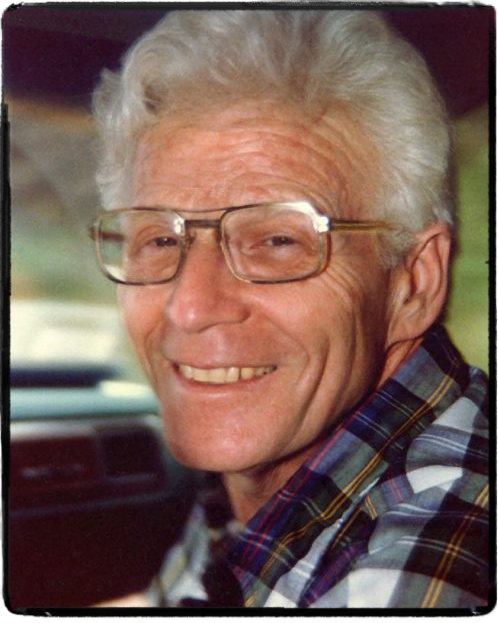
Fishl Kutner, z”l, 1926-2024.
INTRODUCTION
Philip “Fishl” Kutner, z”l, was a visionary leader in connecting Yiddish speakers to one another and promoting a robust volunteer-run Yiddishland. A retired science teacher from New Jersey who spoke Yiddish from the home, in his free time Kutner organized a local Yiddish conversation group in San Francisco. From there, he launched a newsletter promoting Yiddish events and groups in the Bay Area, titled Der Bay. This newsletter fast became essential in connecting Yiddish groups and their events accross the country and internationally in the burgeoining days of the internet, long before the Facebook groups, zoom events, and websites so many of us now turn to on a regular basis to participate in virtual Yiddishland. Kutner also served as president of the International Association of Yiddish Clubs (IAYC), and ultimately Der Bay became the newsletter of this organization.
In 2016, the Yiddish Book Center’s Christa Whitney conducted an interview with Kutner, which you can watch here. You can read an obituary by Zach Golden for the Forverts here.
Kutner was remarkable not only for his warmth and passion for the Yiddish language and its speakers, but also for his ability to leverage technology in service of language activism. This sensibility continued to the very last years of his life, when his local Yiddish conversation group pivoted to Zoom during the pandemic. The resulting international group, Fishl’s Yiddish Group (FYG), not only serves to create community among those who wish to “experience the Yiddish language while exploring heritage through our lives, history, literature and music,” but also provides a rich archive of Zoom recordings, preserving their community’s Yiddish speaking as a resource for current and future Yiddish learners.
Sarah Biskowitz recently spoke with Assia Azenkot, Director of the Program for FYG.
SB: Can you tell us about Fishl's Yiddish Group?
AA: Fishl’s Yiddish Group originated in Philip Kutner’s — Fishl’s — living room in San Mateo, California. A small group of Yiddish lovers met every week to talk about themselves, their Yiddish-speaking families, Yiddish humor they enjoy remembering, expressions, and anything that had to do with the Yiddish world past and present. A few years before the pandemic, the group moved to the newly built JCC Palo Alto, California. Then the pandemic hit and Fishl took the meetings online. Amazing Fishl! He was already in his nineties but the internet didn’t frighten him at all!
SB: How did you become involved?
AA: With the beginning of the pandemic, I was looking for a way to connect with my interests online. A few years after my retirement, in September of 2019, I decided to undertake learning Yiddish, something that I had never had a chance to do before. I found Kolya Borodulin, the educational director of The Workers Circle, who invited me to come to his class, which was then already offered online. I discovered a whole Yiddish civilization that I wasn’t aware of.
I was born in Soviet Vilna/Vilnius, Lithuania. My parents spoke Yiddish at home, but my sister and I always answered in Russian. My parents came from Litvishe shtetlekh. They loved to sing Yiddish songs and celebrated Yiddishkayt at home with the family as much as they could. My childhood was laced with stories about the shtetl, about my extended family members, all of whom perished in the Holocaust like most Lithuanian Jews, and my parents’ miraculous survival during the war. However, outside our home, we never wanted to stand out with our Yiddishkayt. I was the only Jewish girl in my class. That was hard enough. It was safer to blend in.
We made aliyah to Israel in 1971. I have been living in San Jose, California with my husband and my children since 1995.
After the pandemic started, I heard from a friend that there was a Yiddish group that meets online every Tuesday. I decided to try it in the fall of 2020. At that time, the group was around 12-15 people. Fishl was the leader. His daughter, Debbie Herman, was managing the recordings and technology. I really wanted to practice my Yiddish and made a point of speaking only in Yiddish. Fishl would often turn to me to sing a song or to translate a word from English to Yiddish. Fishl, Debbie, and I formed a team that started planning the meetings together. The name “Fishl’s Yiddish Group” was born. We started inviting Yiddish-speaking guests and spoke mostly Yiddish during our meetings. Debbie Herman created our website and started recording our programs. Many more people from around the world started joining our program. We accepted and welcomed everybody as long as they were enthusiastic about Yiddish.
SB: How did the COVID-19 pandemic change the group?
AA: Today, there are between 55-70 members who meet every week. We speak mostly Yiddish. There are members from Canada, Israel, Russia, France, Sweden, Germany, and other countries, and from all around the United States. In addition to our outside guests, our members give presentations in Yiddish at every meeting. Since there are many participants, we sometimes break into smaller groups for more intimate discussions. Or we hold a discussion together, led by our member Suellen Siboni.
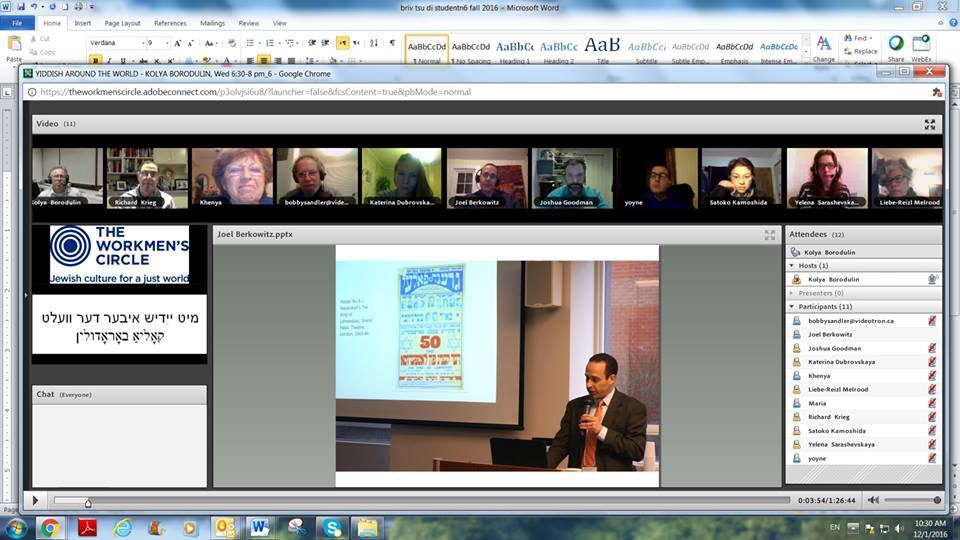
A meeting of Fishl’s Yiddish Group on the theme of “Yiddish in Argentina” with guest speakers Abraham Lichtenbaum, Yiddish literature and culture teacher in YIVO in Buenos Aires and at the Worker’s Circle online and Sergio ‘Shimshon’ Lerer, Yiddish singer and actor, and professor of psychology.
SB: Your founder, Phillip "Fishl" Kutner, passed away in February. What was it like to work with him?
AA: Fishl was and still is my inspiration for leading FYG — Fishl’s Yiddish Group. He was an exceptional person. His love for the Yiddish language was contagious. He wanted to pass on this love to other people and did it with a lot of dedication and generosity. He was modest, an optimist and had a wonderful sense of humor. It was a pleasure to have team meetings with him. He was always clear and to the point with his ideas.
SB: How have you selected your guest speakers?
AA: I take lots of Yiddish classes and meet very interesting Yiddish speakers there. I write to them and invite them to give a 30 minute presentation to FYG. Most of them agree. Sometimes, I see Yiddish speakers in various programs online and get very excited about their Yiddish and and/or their subject. I write to them, too. Sometimes, I get recommendations from our members who hear an impressive Yiddish speaker and report to me. Ana Berman, a retired Yiddish teacher from Toronto, a member of our group who is also my mentor and friend, helps out too. Sometimes, our weekly speakers are our own members. These are usually the fluent Yiddish speakers.
SB: What moments stick out as memorable from your years of meeting?
AA: Coincidences of the small Jewish/Yiddish worlds. We had a few cases where people who went to elementary school together and haven’t met since then suddenly recognized each other after 60 or more years in our meeting. People who have been attending quietly for a while made a presentation and suddenly revealed very interesting things about their lives in Yiddish. A feeling of togetherness when we mourned Fishl’s passing. Also, how many members have improved their Yiddish skills over the four years that we’ve been meeting.
SB: What are your goals for Fishl’s’ Yiddish Group in the coming years?
AA: My goal in FYG is to create a Yiddish speaking kehile — a community where members can share a special joy in using our beloved Yiddish language through which we can celebrate our wonderful rich heritage as we live our lives.
Find out more about Fishl's Yiddish Group at www.ilovefyg.org.
Fishl’s Yiddish Group logo