May 03, 2025
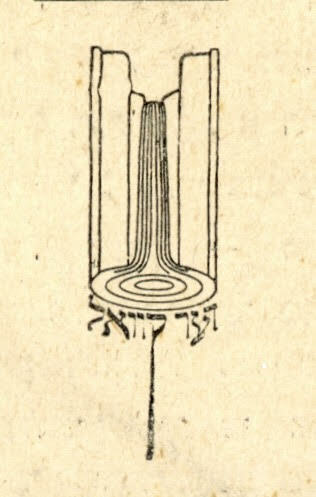
The logo, designed by Uriel Birnbaum, of the Vienesse Yiddish press Der kval, established in 1919.
INTRODUCTION
The occasion of this essay is the completion of Thomas Soxberger’s twenty-year quest to establish the contours of Yiddish in Vienna: its politics, culture, and book-production. The first part describes Soxberger’s trifecta of works, which are in German, but a significant portion is accessible to non-German speakers. The second part presents the contours of Yiddish in Vienna based on Soxberger’s work and my own research and book collection. In this essay, Yiddish in Vienna means not the submerged Yiddish of the first- and second-generation late-nineteenth-century migrants to the city, or the revived Yiddish of turn-of the century-German-speaking enthusiasts and political activists, but the world of active Yiddish used and cultivated by twentieth-century literary migrants to Vienna. It was a short-lived but socially and emotionally intense phenomenon.
I. Three Works on Yiddish in Vienna
In the last days of 2024, Arco Verlag, a small but ambitious and well-respected press in Vienna that focuses on underappreciated Jewish and Eastern European writers, published a beautifully designed and superbly executed bibliography of Yiddish printing in Vienna. 1 1 Thomas Soxberger, “Gründen wir einen jiddischen Verlag!” Jiddische Bücher, Zeitschriften und Broschüren aus Wien. Eine kommentierte Bibliographie. Wien: Arco Verlag, 2024. The bibliography was announced for October 2019; production difficulties delayed the publication for five years. It is the third work by the independent scholar Thomas Soxberger It completes a two decades-long endeavor to define, describe, and make visible a neglected area of Yiddish literary creativity.
bits and pieces of Yiddish in Vienna have been explored by scholars in the context of other endeavors, most notably the seminal ideas about Yiddish and its uses by Ber Borochov, Nathan Birnbaum, and Meir Wiener, all of whom had worked in Vienna for a few years, 2 2 Barry Trachtenberg, The Revolutionary Roots of Modern Yiddish 1903-1917 (Syracuse: Syracuse University Press, 2008), 108-134 (on Borochov); Jess Olson, Nathan Birnbaum and Jewish Modernity: Architect of Zionism, Yiddishism, and Orthodoxy (Stanford: Stanford University Press, 2013); Mikhail Krutikov, From Kabbalah to Class Struggle: Expressionism, Marxism and Yiddish Literature in the Life and Work of Meir Wiener (Stanford: Stanford University Press, 2011). Yiddish literature written and printed in Vienna, and the effort to create a stable home for Yiddish literature in Vienna are largely unknown among Yiddish scholars, perhaps for two reasons: It was limited to a very short period (1916 to 1938) during which most of its writers, editors, and printers transitioned out of Vienna to produce significant works in other cities (Warsaw, Paris, New York); and Yiddish in Vienna is tied up with its German-language environment, and German is no longer part of the toolbox of most Yiddish scholars.
Soxberger’s fully annotated and lavishly illustrated bibliography offers a handy and competent guide to this unexplored area of literary Vienna. It is a useful resource that, because of its nature as a list, is accessible even to readers not fluent in German.

Soxberger, Nackte Lieder
Born in 1965 in rural Waidhofen an der Ybbs (Lower Austria), Soxberger fell in love with Yiddish in the early 1980s, studied Yiddish at Oxford, and pursued a degree in history and Jewish Studies at the University of Vienna. 3 3 Anita Pollack, “Renaissance oder Folklore? ‘Jiddisch war ja nie ganz tot’.” [Interview with Thomas Soxberger.] Wina: Das jüdische Stadtmagazin (March 2023), https://www.wina-magazin.at/renaissance-oder-folklore-jiddisch-war-ja-nie-ganz-tot/, accessed March 17, 2025. A poet himself, he first presented Vienna’s Yiddish literary milieu in 2008, in a ground-breaking anthology that took its title from a collection of poems by Melech Ravitch, Nakete lider, published in Vienna in 1921. Soxberger’s anthology Nackte Lieder (Naked Poems: Yiddish Literature from Vienna, 1915-1938), 4 4 Thomas Soxberger, Nackte Lieder: Jiddische Literatur aus Wien 1915-1938 (Wien: Mandelbaum, 2008). gathered poems and stories by twenty-two writers, only five of whom are household names (Meir Wiener, Melech Ravitch, Rokhl Korn, Mendl Naygreshl, and Deborah Vogel). Three are somewhat known (A. M. Fuchs, Samuel Jacob Imber, Melech Chmelnitzky). One, D. Y. Silberbusch, made a name as a Hebrew writer and editor, working with Peretz Smolenskin. The remaining thirteen are almost entirely unknown (S J. Harendorf, J. A. Lubetski, Aaron Leib Schussheim, David Königsberg, Joseph Grob, Jakob Mestel, Mosche Silburg/Moyshe Zilburg, Yehoshue Tiger, Sigmund Löw/Ziskind Lyev, Ber Horowitz, Moses Liwschitz, 5 5 Moses Liwschitz was the author’s preferred spelling. Names are given either in the YIVO spelling or the person’s preferred spelling. When neither is available, a spelling is used that makes the person findable on the internet. Ber Sznaper, and Y. I. Liski). Nine of the twenty-two writers were killed between 1937 and 1942; three died of natural causes before 1940; of the remaining ten, only one, Y. I. Liski, A. M. Fuchs’s younger brother, died as a nonagenarian. None died in Vienna or in his or her place of birth.
Soxberger’s anthology presents these writers in accomplished German translations, without the Yiddish originals. The bibliographic notes (in YIVO transcription) for the fifty-one texts illuminate the extraordinary difficulty of getting a grip on the phenomenon of Yiddish literature in Vienna since the works appeared in now extremely rare issues of flimsy journals and equally rare books, or as reprints in far-flung places of publications. It was a matter of finding out who had actually lived and worked in Vienna, which Soxberger accomplished by combing through the Leksikon fun der nayer yidisher literatur, and then of tracking down their publications. Soxberger’s anthology Nackte Lieder was the first comprehensive attempt at assembling the panoply of Vienna’s Yiddish writers in one place. 6 6 There had been two earlier attempts. In 1993, Armin Eidherr put together a short dossier consisting of poems by Melech Ravitch, Meylekh Khmelnitski, and Mendl Naygreshl. Armin Eidherr, “Auf stillem Pfad… Jiddische Schriftsteller in Wien.” Literatur und Kritik No. 273/4 (April 1993), 47-83. Mendl Naygreshl’s Kleyne antologye fun der yidisher lirik in galitsye 1897 biz 1935 (Vin: A.B. Tserata, 1936), presents 31 poets. Some of them migrated to Vienna; most did not. The themes are urban and modern with tinges of nostalgia and pinches of social criticism. The stories depict a soldier returning from the battle fields of the First World War; young seamstresses worked to the bone longing for shabbes back home; an elegant Hebrew writer turned by poverty into a deceitful shabby shnorrer; and a gossipy goy taking a walk with a shy Jew who learns to bark at others like his ‘master’. The stylistic range is broad, from Harendorf’s dry reporting to Fuchs’s acerbic, sharp, and at times baroque style (“ibergelodenem stil”). 7 7 Melech Ravitch, My Lexicon: Pen-Portraits of 156 Yiddish and Hebrew Writers in Israel (Montreal: a komitet in montreal, kanade, 1958), 335. מלך ראַװיטש, מײַן לעקסיקאָן: פּען-פּראָפֿילן פֿון יידישע און העברעישע שרײבערס אין מדינת ישראל (מאָנטרעאַל: אַרויסגעגעבן פֿון אַ קאָמיטעט אין מאָנטרעאַל, קאַנאַדע, 1958), 335. About Fuchs’s style, see also Karl Müller, “Aspekte jiddischer Prosa am Beispiel von Abraham Mosche Fuchs.” In Jiddische Kultur und Literatur aus Österreich, edited by Armin Eidherr and Karl Müller (Wien: Drava Verlag, 2003), 167-184. There are traditionalist, modernist, symbolist and expressionist poems by Imber, Khmelnitski, Naygreshl, Ravitch, Korn, and several others abounding in enigmatic, graciously sad, and sinuous lines. It is a compelling read, but confusing because the writers are disembodied voices, the complexities of their diverse lives squeezed into short biographical blurbs.
Anthologies tend to reduce rather than emphasize differences. This together with the smoothness of Soxberger’s translations and the uniformity of the print generated the impression that the twenty-two writers should be considered a cohesive group of Yiddish literati in Vienna.

Soxberger, Revolution am Donaukanal
Four years later, in 2013, Soxberger revealed the messiness of Yiddish Vienna, its generational differences and political fault lines, its stinging material poverty and fierce creativity, when he published a slightly revised version of his dissertation under the title Revolution at the Danube Canal: Yiddish Culture and Politics in Vienna 1904 to 1938. 8 8 Thomas Soxberger, Revolution am Donaukanal: Jiddische Kultur und Politik in Wien 1904 bis 1938 (Wien: Mandelbaum, 2013). The dissertation, however, provides an easier start for newcomers to Yiddish in Vienna because its detailed table of content is both precise and concrete, and like a physical mal offers an instant overview of the lay of the land. Thomas Soxberger, Literatur und Politik – Moderne jiddische Literatur und “Jiddischismus” in Wien (1904 bis 1938). Diss. Universität Wien, 2010; https://phaidra.univie.ac.at/detail/o:1274446 , accessed March 19, 2025. The Danube Canal (Donaukanal) separates the distinctly Jewish and working class suburbs Leopoldstadt and Brigittenau on the canal’s left bank from the city’s inner core (Innere Stadt) with its bourgeois residential area just to the north, where, for example, Siegmund Freud resided and practiced for forty-seven years at Berggasse 19, a quarter of a mile from the right bank of the Donaukanal. The revolution Soxberger alludes to in his title occurred in 1919 during a leisurely walk by six Yiddish writers along the waterway, when, suddenly, Moyshe Zilburg, a chain smoker, coughed his cigarette into the canal and announced his vision: “Khaveyrim - lomir grindn a yidishn farlag.“ – “Friends, let’s found a Yiddish press.” In December 1919 the idea had become reality. The press was called “Der kval” (the fountain) and its monthly literary journal Kritik. In the long history of Jews in Vienna, these were the first outlets for literature in Yiddish; both were based on an utterly bizarre financial scheme (elucidated below). 9 9 Ravitsh, Dos mayse-bukh fun mayn lebn, 1908-1921 (1964), 487-488; Soxberger,“Gründen wir einen jiddischen Verlag!”, 9; Revolution am Donaukanal, 148-156.

Soxberger, “Gründen wir einen jiddischen Verlag”
It is Soxberger’s bibliography, Gründen wir einen jiddischen Verlag! that finally gives us the unadorned facts, di untershte shure, the actual books. It presents a catalogue of the numerically quite modest, but culturally significant production of Vienna’s Yiddish writers. The series of 108 items begins in 1916 with David Yesha’yah Silberbusch’s Shtrekhelakh fun der milkhome-tsayt: A dertseylung un skitsn, and Melech Ravitch’s volume of poetry Ruinengroz (both printed in the shop of the Catholic Adolf Holzhausen who as a university publisher owned Hebrew type for academic works in ‘Oriental Studies’). 10 10 Ravitch, who was serving in the Austrian army in 1916, tells the story that the name of the Catholic Holzhausen saved his neck when his commanding officer discovered that he was publishing a book without the required official permission by the army. Ravitsh, Dos mayse-bukh fun mayn lebn, 1908-1921 (1964), 310-314. While Silberbusch’s work was self-published, Ravitch’s was published by the press of Max Hickl. It ends in 1938 with Ber Horovits, Fun Itsik Vatenmakher biz Itsik Gutkind: Yidishe motivn in der poylisher poezye: Iberzetsungen (published by A. B. Tserata).
Soxberger’s Viennese publisher Christoph Haacker, an experienced publicist, craftsman, and bibliophile, who runs Arco Verlag as a one-man operation, produced this must-own book using smooth, creamy paper, clear print, generous format, wide margins, never more than three bibliographic entries per page, with the titles in Yiddish letters and in YIVO transcription, augmented by pertinent commentaries in German. Numerous color photos of writers and books create immediacy and convey the book’s material diversity. The result elicits admiration for the immense care and discipline that went into producing such typographically sophisticated books both in the difficult circumstances of 2024 and in the interwar years when the books represented in this bibliography were themselves created. At that time it was important to Vienna’s impoverished Yiddish artists to create beautiful works because succeeding validated their hand-to-mouth existence.
Soxberger’s trio of books is a trifecta of texts, history, and bibliography that allows us to see Yiddish Vienna as its own highly specific niche. By tracing the extraordinary difficulties of Yiddish kultur-tuers to gain a foothold in Vienna, Soxberger also illuminates the degree to which Vienna differs substantially from Berlin, where Jewish refugees were able to establish a plethora of small Yiddish, Hebrew, and Russian (Jewish) presses and journals in the interwar years. 11 11 Marc Caplan, Yiddish Writers in Weimar Germany: A Fugitive Modernism (Bloomington, IN: Indiana University Press, 2021); Susanne Marten-Finnis, “Art as Refuge: Jewish Publishers as Cultural Brokers in Early 1920s Russian Berlin.” Transcultural Studies 1 (July 2016),9-42; Matthias Hambrock “Das ‘jüdische Buch’ und seine Verlage im deutschsprachigen Raum.” Handbuch der Deutsch-jüdischen Literatur, edited by Hans Otto Horch (Berlin and Boston: De Gruyter, 2016), 548. While the massive influx of tens of thousands of refugees, most of them Yiddish-speaking, during the First World War triggered aggressive antisemitic resentment in both cities, the cultural productivity developed by refugees and the degrees of their success differed substantially. Social and economic diversity, vocal class politics, and an activist cultural scene made Berlin more porous than Vienna and hospitable to diverse cultural enterprises. Vienna, in contrast, the capital of a disintegrating multi-ethnic empire, was fiercely striving to keep its realm together, and proved ultimately inhospitable to nonconformist Jewish cultural expression. Among the contributing factors was that Vienna’s Jewish upper and middle class had left Yiddish behind and felt they had done right to do so. Soxberger’s works document what was possible for and in Yiddish; what was possible was delimited not just by poverty and overt antisemitism, but also by a stifling social context of Jewish assimilation and conformism.
II. The Contours of Yiddish Vienna
Soxberger dates the beginning of a conscious engagement with Yiddish in Vienna to 1904. But a small number of books in Yiddish were published in Vienna throughout the nineteenth century. Soxberger lists six of them, two maskilic works by Hersh Reytman (1863) and Wolf Ehrenkranz (Velvl Zbarzher, 1865) and four religious works. There were other books, of course, in particular beautiful mahzorim (im loshn ashkenaz) printed in classic mashket (tsur or vaybertaytsh font) in the first decade of the nineteenth century. By the second decade, bibles published in Vienna had all made the switch to Moses Mendelssohn’s translation printed in merube (square type) with the accompanying Hebrew commentary (bi’ur) in Rashi-type.
By 1815, as Hasidic masterpieces were being published in Hebrew and Yiddish in distant eastern towns (Kopust, Ostrog, Moghilev), Jews in Vienna willingly assimilated to German. Some Viennese mahzorim retained variants of mashket for translations well into the 1860s, but the language of the translations was German. Yiddish books disappeared. Interest in Yiddish by Viennese Jewish intellectuals became antiquarian and wissenschaftlich in nature. The meticulous scholarship of Alfred Landau and Bernhard Wachstein, librarian of the Israelitsche Kultusgemeinde Wien, was cherished at YIVO in Vilna. 12 12 The first volume of the Vilner YIVO’s new journal Filologishe shriftn (1925) was a festschrift for Alfred Landau in honor of his 75th birthday and became known as the Landoy-bukh (Eugene Ornstein: correct would be Lande-bukh).
The efforts by Matthias Mieses, in contrast, whose speech in defense of Yiddish passionately delivered at age 23 at the Czernowitz language conference in 1908 had been both praised and vilified, were dismissed by Ber Borochov. He met Mieses in Vienna in March 1913 to discuss an article for Shmuel Niger’s emerging volume Der pinkes (Vilne 1913), and called him “dafke a voyler mentsh un an entuziast fun gedanken […] nor a geboyrener diletant”. 13 13 Ber Borokhov, letter to Shmuel Niger, March 11, 1913. In: Ber Borokhov, Shprakh-forshung un literatur-geshikhte. Edited by Nakhmen Mayzel (Tel Aviv: I.L. Peretz, 1966), 412. Mieses researched the evolution of Yiddish dialects. Borochov combined Zionism and socialism, and considered philology a tool to promote the national and economic emancipation of the Jews. He was a sharp and precise thinker. His two seminal articles “Di oyfgabe fun der yidisher filologye” and “Di biblyotek funem yidishn filolog” were written during his sojourn in Vienna. 14 14 Ber Borokhov, “Di oyfgabe fun der yidisher filologye.” Der Pinkes, edited by Shmuel Niger (Vilna: Kletskin, 1913), 1-22; “Di biblyotek funem yidishn filolog.” Section XXIV of Der Pinkes, 1-65. Borochov and Niger did not include a work by Mieses in this seminal volume. It probably irritated him that Mieses pursued Yiddish studies in German. It reflected the old gaze from above onto Yiddish.
It is in the giddy atmosphere of the newly discovered political uses of Yiddish that Soxberger starts his exploration of Vienna’s Yiddish culture. In the summer of 1904 Avrom Reyzen planned to change trains in Vienna and ended up giving a reading. He was amused by the spiritually denuded German-speaking Jewish students who considered Yiddish almost as holy as Hebrew: 15 15 Avrom Reyzen, Epizodn fun mayn lebn, Vol. 2 (Vilne: Kletskin, 1929), 244.
איז טאַקע געװען רירנד צו זען אַ ײדיש⸗דײטשישן סטודענט זיך אַרומטראָגן מיט אַ באַנד שלום⸗עליצם מיט אַן ערנסט, שיר ניט הײליקן אויסדרוק אויפֿן פּנים, װי ער װאָלט געטראָגן אונטערן אָרעם אַן ״עין⸗יעקב״ צי אַ משניות און ניט אַ בּוך פֿון דעם גרעסטן ײדישן הומאָריסט.
“It was touching to see a Jewish-German student carry a volume of Sholem Aleichem around with a serious, almost pious expression, as if he was carrying under his arm a volume of Ein Ya’acov or the Mishna and not a book by the greatest Yiddish humorist.”
Mendl Naygreshl observed in an essential essay that the emergence of a modern Yiddish literature in Galicia, which he dates to just that year, 1904, was due to the “national longing” of a young generation alienated from the language of the people. 16 16 Mendl Naygreshl, “Di moderne yidishe literatur in galitsye (1904-1938).” Fun noentn over (New York: Alveltlekher yidisher kultur kongres, 1955-1959), 267-396 (esp. 360). Nathan Birnbaum, who had left Zionism in 1899 and moved to diaspora-nationalism, knew how to bundle and focus these longings toward a political goal. 17 17 Jess Olson, The Late Zionism of Nathan Birnbaum: The Herzl Controversy Reconsidered.” AJS Review Vol. 31, No. 2 (2007), 273. In 1904-05, he founded Jewish student societies to whom he talked about agitating for the recognition of Yiddish as a fully functional language of the Jews (Volkssprache), rather than a German dialect. In the Habsburg Empire, having a well-defined language was a precondition for being counted as a people and thus eligible for minority rights.
In Austrian censuses, conducted every ten years, Jews were counted as members of a religion (Konfession) and not as members of a nation or ethnicity (Volk). The presence of ethnicities was measured by counting the languages spoken in a given area. On the census sheets, the language could only be picked from a preset list of typical regional languages (landesübliche Sprachen). Yiddish was not on the list, because it was not recognized as a language. 18 18 Soxberger, Revolution am Donaukanal, pp. 21-35. As a result, the census data for Galicia in 1910 show 58.2% of the population speaking Polish, 39.98% speaking Ruthenian, 1.12% speaking German, and 0.11% speaking Bohemian-Moravian-Slovakian. At that time the Jews were 10.9% of the population, that is 872,000 people. 19 19 Paul R. Magocsi, History of Ukraine (Toronto: Toronto UP, 1996), 423-424. “Volkszählung in Österreich-Ungarn 1910.” Wikipedia, https://de.wikipedia.org/wiki/Volkszählung_in_Österreich-Ungarn_1910#Übersicht_XII , accessed February 27, 2025. Nationalist Jewish students tried to enter “Jewish” as their native language when matriculating at universities. This was the pot Birnbaum tried to stir. When the Yiddish language conference in Czernowitz came to nothing, Birnbaum was spiritually and financially exhausted and joined religious Orthodoxy. With the defeat of the Habsburg Empire in 1918, the Yiddish nationalist endeavor in Austria became moot.
The First World War changed everything. The neoromantic writers of Yung Galitsye 20 20 The concept of Yung Galitsye was established in 1910 by way of the Yung galitsisher almanakh edited by Gershom Bader, Yankev Mestel, and Zvi Bikels-Spitzer. had been congregating around the Lemberger togblat, the city’s first Yiddish daily, founded by Gershom Bader in 1904. By 1912 they were beginning to move to Vienna. Ravitch, Litwin, and Chmelnitzki (a medical student) came first; others followed during the war. Shmuel Yankev Imber, the acknowledged mentor of the Yung Galitsyaners, and Uri Zvi Greenberg came after they had lived through the pogrom in Lemberg in November 1918.
Many of the Yiddish writers had served in the Austrian army and returned home with horrific memories. In May 1918, Imber published a collection of poems under the title Inter arma (between arms) and explained in his introduction that the authors had been in uniform for years which constricts the throat of the Muse - “Di oytoren […] trogen zayt yorn dem rok, velkher shnirt eng tsuzamen dem halz fun der muze.”
21
21
Shmuel Yankev Imber, ed., Inter Arma: A zamlbukh lirik (Wien – Brünn: Jüdischer Buch- und Kunstverlag, Max Hickl, 1918), preface.
He asked them about new work, but wanted poems untouched by the events they had lived through. Apart from his own work, of course, Imber printed only verse by the core group of Yung Galitsye: Greenberg, Mestel, Königsberg, and Ravitch.
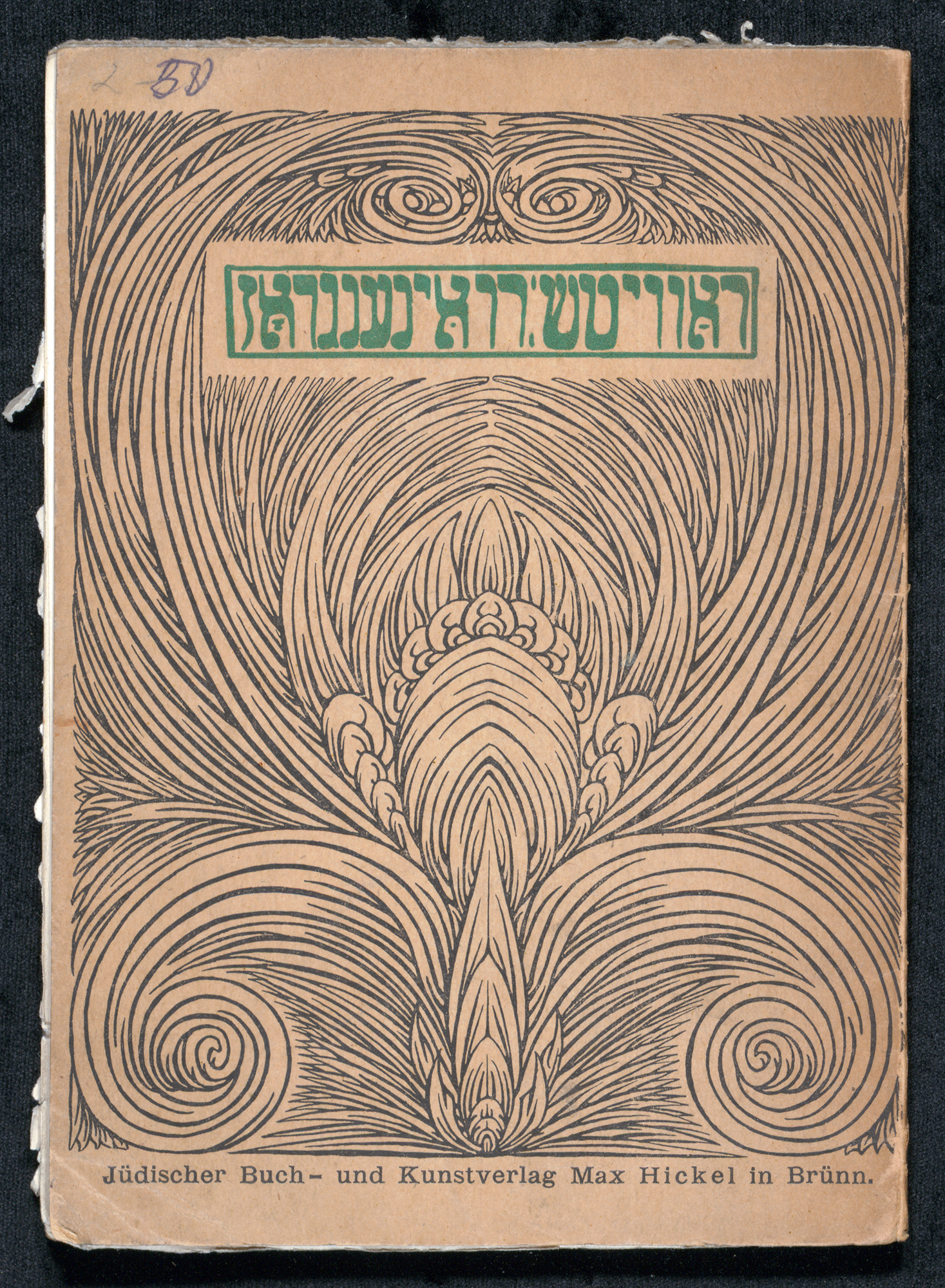
Ravitch, Melekh. Ruinengroz, 1916.
The slim volume of eighty pages was beautifully typeset by Israel London at the shop of Adolf Holzhausen and published by the substantial Jewish Book and Art Press Max Hickl. 22 22 Imber, ed., Inter Arma, the typesetter is mentioned on the last page below the line; Ravitch confirmed that London was not employed by Hickl but by Holzhausen in Dos mayse-bukh fun mayn lebn, 1908-1921 (1964), 492. The press’s business was Zionist material, but between 1916 and 1918, Hickl put out a small number of Yiddish books in Vienna, including Ravitch’s volume Ruinengroz in 1916. In late 1918, Hickl moved his business to Prague, maintaining only a small office in his hometown Brünn (Brno). His absence from Vienna created the need for an active, modern intellectual publishing house and journal of criticism and short works. Both would be born in Zilburg’s Eureka-moment at the Donaukanal in 1919.
In 1910, 175,000 Jews lived in Vienna. They constituted 8.6% of the population. At the end of 1915, about 137 000 refugees from the war had made their way to Vienna, some 77,000 of them were Jews. By 1918, the number of registered destitute Jewish refugees had declined to 30,000. 23 23 Barbara Staudinger, “’Juden auf Wanderschaft’: Galizische Kriegsflüchtlinge in Wien.” Forschungen zu Vertreibung und Holocaust (Dokumentationsarchiv des österreichischen Widerstandes, 2018), 199, 202, 206; https://www.doew.at/cms/download/2c9ks/jahrbuch2018_staudinger.pdf , accessed March 20, 2025. The large influx of Yiddish-speaking refugees in 1915 led to the founding of Vienna’s first Yiddish daily, Viner morgentsaytung. When the number of refugees diminished, the paper declined.
Zilburg did not see this as a warning. He wanted a Yiddish publishing house that would make Vienna a center of Yiddish literature, while its monthly journal, to be edited by Zilburg, would function as a bridge between Eastern Europe (meaning Kiev) and America. 24 24 Ravitsh, Dos mayse-bukh fun mayn lebn, 1908-1921 (1964), 490; Krutikov, From Kabbalah to Class Struggle, 102-103. He proposed to call it Brik (Bridge), but did later call it Kritik (Criticism), which was more in line with his pugnacious temperament. 25 25 Ravitch presents a moving portrait of Zilburg in Mayn leksikon: Yiddishe dikhter, dertseyler, dramaturgn in poyln tsvishn di tsvey groyse velt-milkhomes (Montreal: a komitet, 1945), 88-90. But the idea the bridge triggered his Eureka-moment about financing: The output of the new publishing house, Der kval, would be purchased by its American counterpart, the publishing house of Di yunge, and the purchasing power of American dollars in the high-inflation environment of postwar Vienna would sustain the press. What did arrive in early 1920 were not dollars but Yiddish books from David Ignatoff’s “Farlag America”. Melech Ravitch described the scene:
When you entered Der kval, you were immediately confronted by the fact that its floor – vast and, eternally black like Ukrainian chernozem – looked like a shtetl’s vegetable market. The only difference was that in instead of onions, radishes, carrots there were volumes of poetry by Mani Leyb, Zishe Landau, Ruvn Ayzland, Ber Horowits, Meylekh Khmelnitski, Moyshe Levi und Dovid Kenigsberg. And right among the heaps of poetry stood the salesmen of “Der kval” bartering […]. Piles were moved round; one exchanged a Landau for a Levi, an Ayzland for a Kenigsberg. The only ones who made a profit in this business were the post offices in America and Austria. 26 26 Ravitsh, Dos mayse-bukh fun mayn lebn, 1908-1921 (1964), 494.
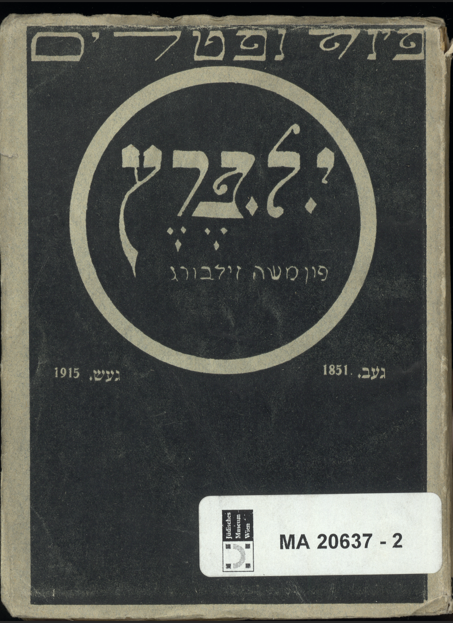
Cover of the Y. L. Peretz volume of Finf niftorim, owned by the Jewish Museum in Vienna. Cover design and the fonts by Israel London.
Der kval, whose logo was designed by Uriel Birnbaum, had barely settled into its dingy quarters in Leopoldstadt (Taborstrasse 7), when Israel London showed up: 21 years old with five years of experience of setting type, short, wiry, energetic, determined to leave his mark on modern Yiddish literature and to sell the products. That’s when Zilburg had his second idea: Der kval would hitch a free ride on the coattails of the five best-known Yiddish writers at the time: Sholem Aleichem, Y. L. Peretz, Mendele Moykher Sforim, Yankev Dinezon, and Shimen Frug. The pirating of their works in a series called Finf niftorim would be disguised by emphasizing the author of the introductory essay on the cover and the title page: for example, Y. L Peretz fun Moyshe Zilburg. 27 27 The heirs of Yankev Dinezon were not deceived which led to a costly settlement of their copyright claims. Illustrations in Soxberger, “Gründen wir einen jiddischen Verlag!”, 101-102 The series was designed and typeset by Israel London and illustrated by Uriel Birnbaum. The books were appealing but did not result in the success Zilburg needed. Melech Ravitch imagines London, who appointed himself Der Kval’s traveling salesmen, hawking his wares in Warsaw:
“Sit down, Mr. London. Do you have good merchandise?
“Quite respectable.”
“Such as?”
“Dead folks. Five of them (Niftorim. Finf niftorim)”.
28
28
Ravitsh, Dos mayse-bukh fun mayn lebn, 1908-1921 (1964), 495.
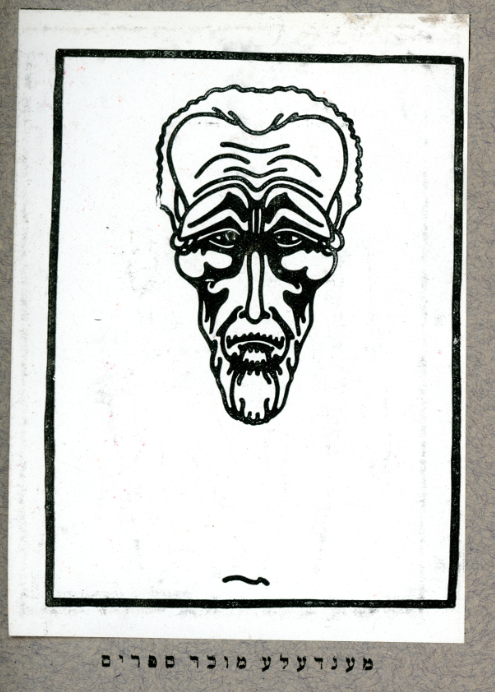
Portrait of Mendele drawn by Birnboym, as it appears in Uriel Birnboym album (Vienna: Der kval, 1921).
The books’ dark covers did not help. After a year at Der kval, London left in frustration. Zilburg soldiered on with Melech Ravitch as his main author. Their relationship dated back to Lemberg in 1910. Five of Der kval’s remaining nine publications were by Ravitch.
The fierce polemicist Zilburg, whom the Austrian scholar Armin Eidherr in an excellent analysis compares to Cynthia Ozick, 29 29 Armin Eidherr, “Die jiddische Kultur im Wien der Zwischenkriegszeit und ihre Positionierung in Bezug auf Akkulturation, Diasporanationalismus und Zionismus.” In Wien und die jüdische Erfahrung 1900-1938, edited by Frank Stern and Barbara Eichinger (Wien: Böhlau, 2009), 176-195. focused his energy on the monthly issues of Kritik, turning them into what Mikhail Krutikov called “the intellectual outlet of modern Yiddish culture in Vienna.” 30 30 Krutikov, From Kabbalah to Class Struggle, 103. Zilburg managed to keep the journal alive for an astonishing ten numbers (February 1920 to April 1921). In five of them he ran installments of his essay “Vos ikh hob aykh tsu zogn” (What I have to tell you), published as a pamphlet in 1921. It is here that he rails against the arrogance of the western, assimilated German-speaking Jews, who are alienated from the core of Judaism and the reality of Jewish life outside their studies and salons, yet had the temerity to dictate to the Ostjuden what was good for them, including Zionism. But what Eastern Jews wanted was recognition and support in the fight for economic justice and autonomy, a Jewish existence not in translation, not measured against Buberian parodies of themselves, but in Yiddish and at home as working class or religious Jews. 31 31 Moyshe Zilburg, “Vos ikh vil aykh tsu zogn.” Kritik Issues 1-6 (February-December 1920). Issues of Kritik are hard to come by. Translations into German of parts 1, 2 and 5 appear in Soxberger, Nackte Lieder, 104-124.
We are a physically and mentally tortured, beaten people. Our lives become impoverished every day, our literature is rapidly declining […] But our decline brings also your demise, because everything you are and you have is based on us, supported by who we are.
32
32
Moyshe Zilburg, “Vos ikh vil aykh tsu zogn.” Kritik. Issue 1 (February 1920),7.
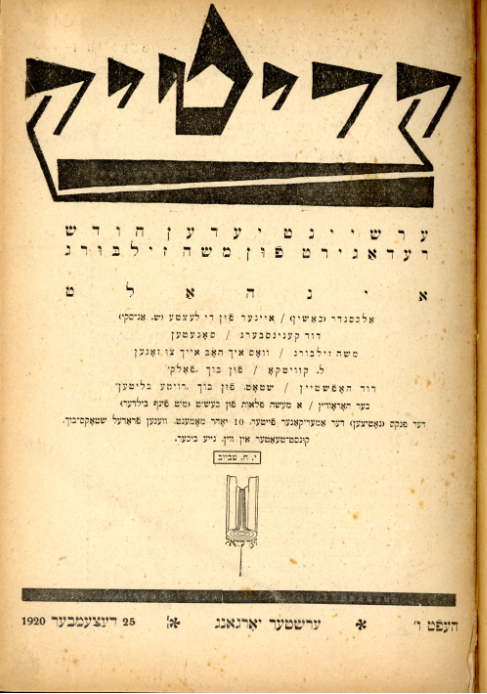
Cover of Kritik (December 1920).
In any other city, Zilburg might have been less furious. But in Vienna, a city full of accomplished and often well-to-do Jewish intellectuals, writers, artists, musicians, mathematicians, philosophers, doctors and bankers, the pain of the closed doors and the palpable disdain for Yiddish triggered feelings of powerlessness, desperation, and rage. For Vienna’s Jews, Yiddish was the unthinkable. In Schnitzler’s novel Road into the Open, as the large cast of Jewish characters discusses every conceivable way to move into the future, Yiddish never comes up. Yiddish is the absolute past.
33
33
About the complexities of Viennese Jews considering Yiddish in the past see the first chapter in Naomi Seidman, Translating the Jewish Freud: Psychoanalysis in Hebrew and Yiddish (Stanford: Stanford University Press, 2024).
Ravitch called Yiddish Vienna “Don Quixote-land,” and the period “filled with illusions, fantasies and dreams.” 34 34 Ravitsh, Dos mayse-bukh fun mayn lebn, 1908-1921 (1964), 486. Zilburg’s plan to make Vienna a center of Yiddish literature had been fueled by hope based on illusions. One by one the writers left: London left for Berlin in late 1920, Ravitch for Warsaw in 1921, and even Zilburg departed for Vilna in 1923. Some writers stayed into the 1930s: A. M. Fuchs, M. Chmelnitzky, and Mendl Naygreshel among them. Fuchs was arrested by the Gestapo in 1938 and his manuscripts destroyed. Upon his release he fled with his family to England.
Then the war came. Ber Sznaper was killed in Lemberg in 1939. Ber Horowitz disappeared October 1941. In 1942 Imber was murdered in Zlochow. Debora Vogel was murdered in Lemberg. Königsberg was killed by the NKVD. Zilburg, caught in the Vilna Ghetto, was shot at Ponar with his wife and daughter. Matthias Mieses died in January 1945 on a death march from camp Plaszów to KZ Gleiwitz.
III. Vos vet blaybn?
Israel London had moved to Paris in 1921.
35
35
David Mazower, “The Yiddish Publisher and Printer Israel London, 1898-1969.” Vol. 06.004 (13 April 2002), https://yiddish.haifa.ac.il/tmr/tmr06/tmr06004.txt, accessed March 2, 2025. Mazower describes London’s fruitful stay in Paris where he mingled with the avant-garde artists on Montparnasse and bought their works.
He reached Cuba in 1941 and New York in 1943, where he purchased a decommissioned printing press in 1944. In 1957 he founded his own publishing house and named it Der kval to realize in New York what he hadn’t been able to carry out in Vienna: the production of Yiddish books in which text, illustration, type, layout, paper, binding, cover matched in quality. He was fond of saying: "Vos iz kinstlerishe literatur on kinstlerishn druk un vos iz sheyner druk on hoykh-kinstlerisher literatur?" (What is artistic literature without artistic printing, and what is the point of beautiful printing without high-quality literature?).
36
36
Quoted in Mazower, “The Yiddish Publisher and Printer Israel London.” The original source is Melech Ravitch’s obituary for Israel London in Der veg (1 November 1968).
Of the writers London had met in Vienna, he published only A. M. Fuchs, Di nakht un der tog (1961), and Ravitch’s translation of Franz Kafka’s The Trial, (Der protses, 1966). The other writers he chose were (in chronological order) Yitskhok Bashevis, Zalman Shneour, H. Leivick, Yankev Pat, Yankev Glatshteyn, Avrom Sutzkever, Arn Glants-Leyeles, A. Reuveni, and Meyer Shtiker. The translations he published included Ernest Hemingway, Der alter un der yam (1958), S.Y. Agnon, A poshete mayse (1958), and Chaim Hazaz, Der taykh geyt (1964).
37
37
In 2014, Mazower’s list of London’s American production was expanded and illustrated with book covers and title pages by the book seller Henry Hollander in 2014. The combined work constitutes the first attempt at compiling a bibliography of London’s work. Hollander’s three “checklists” of London’s works are linked to his authorized reprinting of Mazower’s article on London: “’Israel London’s Life and Work’ by David Mazower.” Hollander Books Blog (10 June 2014), http://hollanderbooks.blogspot.com/2014/06/israel-londons-life-and-work-by-david.html , accessed March 2, 2025.
It was an eclectic list.

Ravitch’s translation of Franz Kafka’s The Trial, (Der protses, 1966).
Before the re-founding of Der kval, London had already produced Yiddish books in Paris and on the retired press he had bought in 1944, and whose name, Marstin Press, he retained. Among the first Yiddish books he chose to typeset in New York was Kalevala: Folks epos fun die finem, in the astonishing translation of Hersh Rosenfeld (1954). London made his point: Yiddish had survived, fully capable of artistic excellence. He answered Sutzkever’s now-famous question, What will remain?: Literatur vet blaybn.

In geveb is turning t(s)en! If we want In geveb to continue to grow and thrive and remain a central address for the study of all things Yiddish online, we need your help to launch our second decade. Our goal is to raise $20,000 by our official tenth birthday: August 15, 2025. We invite you to donate to support In geveb and to honor everyone who has got us this far.