Oct 17, 2025

INTRODUCTION
Stefanie Halpern is the director of collections at the YIVO Institute for Jewish Research and the editor of 100 Objects from the Collections of the YIVO Institute for Jewish Research, released as part of YIVO’s centennial anniversary. The book profiles one hundred objects chosen from YIVO’s twenty-four million, each accompanied by a short essay by one of fifty-seven leading scholars.
Halpern and her colleagues worked for over fourteen months to illuminate both Jewish and YIVO history through archival objects in celebration of the organization’s hundredth year. Halpern authored the book’s introduction as well as introductions for each of its ten thematic sections: beliefs and customs, history, the written word, performing arts, visual arts, labor, youth, the Holocaust and its aftermath, immigration, and YIVO history.
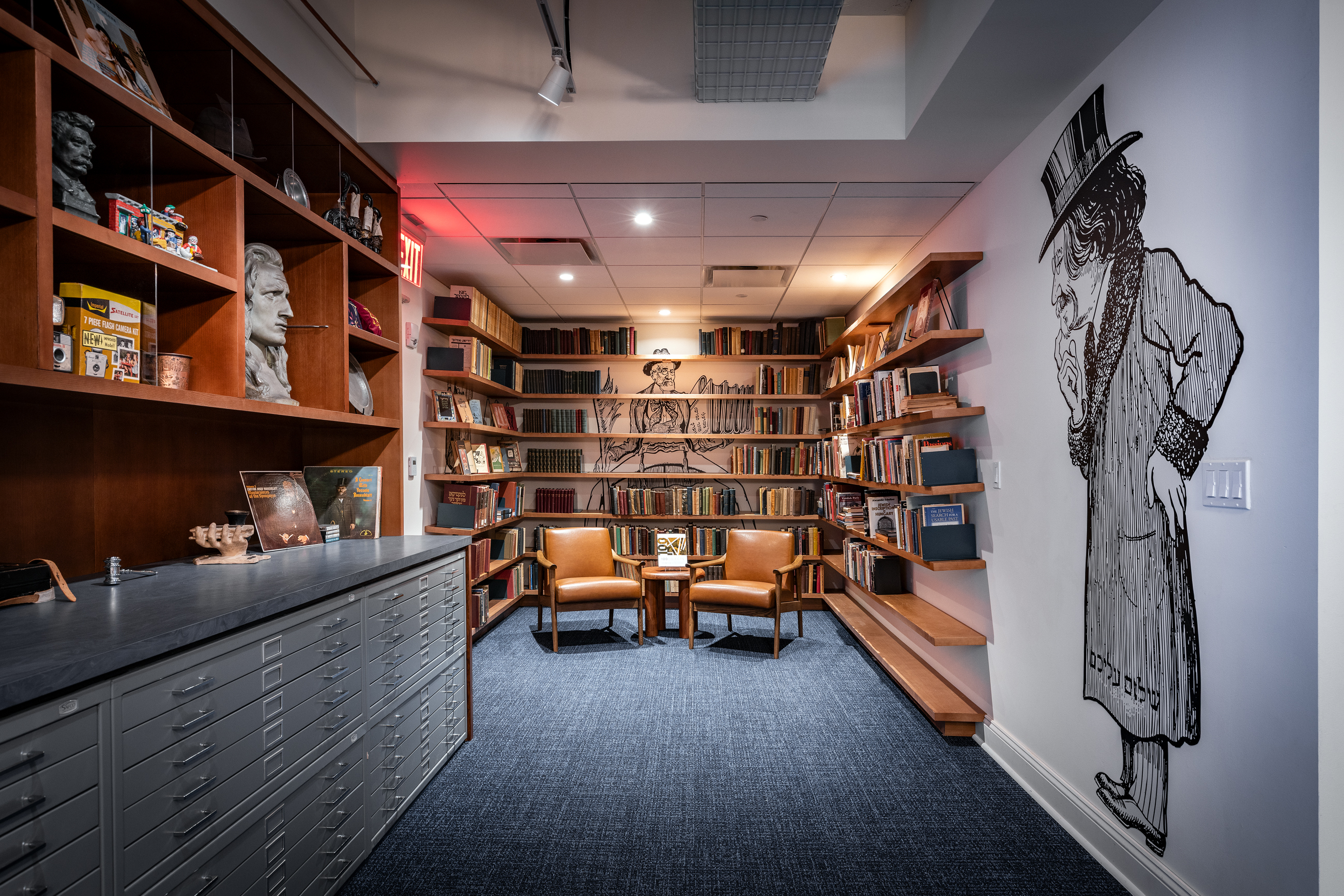
Two months after its release, Halpern and In geveb editorial intern Dinah Megibow-Taylor sat down in YIVO’s newly built Learning and Media Center to talk 100 Objects. There, the book comes to life: Its featured prints adorn the walls, a hand seal press sits atop a shelf, and the drawers are filled with reproduced reproduced posters from YIVO’s collections. The two took note of their surroundings and discussed, among other things, the process of choosing the one hundred objects, how Yiddish remains all-encompassing within the pages, and their personal connections to their favorite objects.
Dinah Megibow-Taylor: What was the process like of choosing the objects, profiling an object, as well as choosing contributors?
Stefanie Halpern: Creating the list is obviously something I worked on for this book, but it’s something I’ve been thinking about for a very long time, since the earliest days that I’ve been here at YIVO. There are so many amazing materials in the archives. I have been through a lot of the collections; I have my favorites, and I have pieces that I know have an interesting provenance or have a really interesting story behind them. Over the years, in my mind, I’ve been creating a list of materials to highlight. A lot of these are actually materials I highlight when I’m giving show-and-tells or tours.
Of course, curating one hundred objects for a book is a lot more difficult than just having cool things floating around in your head. I worked with a few colleagues here at YIVO to throw as many noteworthy objects as we could into a spreadsheet. We had a couple hundred objects, and we were able to see the broad patterns that emerged and the ways in which they fit into these ten thematic areas that we envisioned the book having, each of which aligned with collecting initiatives of YIVO’s.
I didn’t want any object to tell the same story, or to come from the same source, necessarily. I thought it was important to have one hundred unique tidbits that could be pieced together in different and interesting ways. And so if you follow the thread through the book, these objects, taken together, tell their individual stories, but they tell a broader history as well. It was a lot of negotiation, and it was good to have colleagues to bounce ideas off of.
The first three-quarters of the objects that were chosen, those are the easy ones, right? It’s the last twenty-five that were difficult, asking “what are we missing? What could be better represented? What is over-represented?” I didn’t want to have too much of one type of object. It would be really easy to have a book of photographs or a book of posters. Those are very visually appealing. A lot of them have great stories. But I didn’t want more than a few of each of those, just because the breadth of the collection is so wide that I wanted to make sure that all of these different types of things were represented. Honestly, I could have chosen one hundred different objects for this book.
DM: I think I’m remembering correctly from your introduction, and it stuck with me, that archival work is decisive and it’s subjective. So how do you approach that work, and what are the principles that guide you through that process?
SH: Archival work is meant to be without bias, right? But of course, that’s not possible. It’s not, truly. And so you always need to think, when collecting something, or processing something, or highlighting something, what are we excluding? What voices are not present in the historic record that we are keeping? And I think that YIVO was really good at that, historically, at saying “We need to represent the folk, and we need to collect those materials, because no one else is doing that.” And so in the work that we do here at YIVO, we try to stay true to that. But there are, of course, gaps in the collections. There are many stories from different groups of people that are just not present in what we have. So you can try to fill those gaps—and I think the first step is being conscious that the gaps exist—and you can try to fill those gaps by collecting in those areas or by highlighting the materials that you do have. Because at the end of the day, historians and scholars need to use something to tell a story. So when they come to an archive and they see that these are the materials that are available, they’re going to rely on what’s there, rather than what isn’t. So you always have to think, as an archivist, about the absences.
DM: And I’m sure the process, at least for those first seventy-five objects of the book, was fairly organic. But once you get down to maybe the last twenty-five, or even thinking about the project as a whole, how do you go about filling those gaps, or making sure there’s a consideration for varied geography or chronology?
SH: Yeah, at the most basic level, what we were doing with the book was, on a much smaller scale, what we do here in the archives. These are the areas that we have represented, and some of it is the reality of our collections. Our collections are from eastern Europe, mainly, and from America, and in an even smaller way, New York. We said, “Okay, we have thirty objects from eastern Europe. Where else, what other geographic locations do we have and can we represent, and how does representing that fit into the broader narrative?” This is maybe most apparent in the immigration section, right? Our collections reflect the realities of Jewish immigration. There are a lot of Jews here in the United States, but I tried not to have the entire immigration section just have materials from the United States, or just have materials from New York. So there’s maybe 40–50 percent from the United States. And then we have other areas where Jews went and were represented. But the beauty of a book like this is that geography didn’t have to be limited just to immigration. We’re able to fill in other locations throughout other sections of the book. Things may appear in sections that you might not think they should, or you wouldn’t at first think they should, and you can piece together different narratives throughout the ten sections. But it was hard, and I don’t think we did a perfect job. There’s always something that is missed or something that has to be excluded. One hundred objects is not very many.
DM: True.
SH: I grappled a lot with moments in history that don’t appear in the book, or that appear only fleetingly, or that someone mentions just in passing, but I think at a certain point you just have to let things go because, if not, the book would never have been completed.
DM: Looking at the production process, when did this idea come into conception, and what did that look like until its release day?
SH: Like I said, I’ve been thinking about one hundred objects as something for many years. We have this Shine Online educational series, a series of free online classes that YIVO creates. And at first I thought it could be a nice class. You would have different scholars talking about these objects. But it never really took off. When the one hundredth anniversary came up I thought, “Well, what better time to do this?” And I think for me, the book was the most comfortable medium, and it made sense to be able to highlight the objects and also to be able to highlight all of these amazing scholars who have come through YIVO over the years. That was very important: We had fifty-seven contributors from scholars and also from YIVO staff. I thought it was important to highlight the people that have made meaning of our collections over all of these decades, and to celebrate their work and their contributions through these little essays, because this really is a group effort. So much of what YIVO has done over the years has been because of the whole community.
But to actually answer your question, we probably started the list maybe a year or fourteen months before the release, and we did all of the graphic design in-house working with Alix Brandwein—she’s a very talented graphic designer.
DM: Yeah, the book is beautiful.
SH: Thank you. We did all of the photography in-house or in our digital lab. We worked based on when all of that stuff needed to be done. I edited essays while I was on maternity leave. It was a real labor of love for everyone who was involved, because it was one of several big initiatives that we had this year on top of all of the normal functioning of the institute.
DM: On that note, what I’d love to hear about—I mean, we’re sitting in a room that’s been an initiative, and last time I was here, I remember, on my last day we were sitting in the rare books room and filming the videos [accompanying the book]—so what were other initiatives to celebrate YIVO’s hundredth anniversary? [editorial note: Dinah Megibow-Taylor worked as a summer intern at YIVO in 2024.]
SH: Yeah, we’re sitting in the Learning and Media Center—perhaps the most major initiative that we’ve undertaken in this hundredth year—which is a center, a physical space, meant to bring high school and college groups and also adult education groups to encounter archives, to encounter objects, to demystify what we do here at YIVO behind the closed stacks.
We also, like you said, filmed object videos, so there’s a bit of overlap between the book and the videos. We are releasing one object video each week for the hundredth year. Each video features a staff member highlighting an object that is meaningful to them or that they find interesting. That was a really nice opportunity to get staff members who are usually behind the scenes in front of the camera, to talk about what they found or what they’ve encountered or what they do. And it’s another way for us to engage with our audience who might not pick up a book but who will watch a one-minute video that they see on YouTube or on Instagram.
We’ve also had a series of public programs and lectures throughout the year on various YIVO topics. We had a major conference focusing on YIVO in America in June, and we opened a three-part exhibition highlighting materials from the YIVO collections which tell the story of pre-war YIVO and the zamlers, the story of the Paper Brigade during the war, and the Strashun Library, which is open from now until December 2025. We’re also having a big gala celebration, and in the fall, there will be other related lectures and programs.
DM: This is the year for YIVO.
SH: Yeah, it is.
DM: And In geveb, too—their tenth anniversary is this week.
SH: And we had In geveb’s tenth anniversary event here, too. [editorial note: Stefanie Halpern is a long-time editorial board member of In geveb and the newest member of our Board of Directors!]
DM: Yeah. Looking at the role of Yiddish in the book, you note in the introduction that Yiddish doesn’t have a section because it’s “all-encompassing.” I’m curious about how Yiddish is “all-encompassing” in the book.
SH: Each section is an area that YIVO really collected in, or that relates to one of YIVO’s collections. YIVO had a philological section, but it was so much more than just word lists, going into folklore. And Yiddish in YIVO’s collection is just so wide, right? There is Yiddish theater, Yiddish art, Yiddish schools, Yiddish political movements, Yiddish literature. How do you pluck out the ten most important things that are in the archive that relate to Yiddish?
There certainly are those things, but they exist in the book already. The Takones fun yidishn oysleyg (Spelling Rules of Yiddish) exists in the book as an important part of YIVO history; there’s Sholem Aleichem’s Funem yarid; a chapbook by Isaac Meyer Dik; Ansky’s The Dybbuk; a TYSHO school notebook; and the list goes on.
I felt that limiting Yiddish to one section and saying, “Well, that’s where the Yiddish objects are going to live,” wouldn’t really do justice to the way in which Yiddish permeates every single section of the book. I think it’s also interesting to see these Yiddish materials alongside materials in other languages, which is the reality of our collections here. Our materials are not just in Yiddish; YIVO has always been interested in materials in all of the languages that Jews functioned in. I think it tells a different and broader story about YIVO than maybe the one that people have come to place on it, which is that YIVO was only Yiddish. It was Yiddish and all of these other things as well.
DM: And lastly, I want to hear about your favorite object in the book, or about one that has a particularly interesting story.
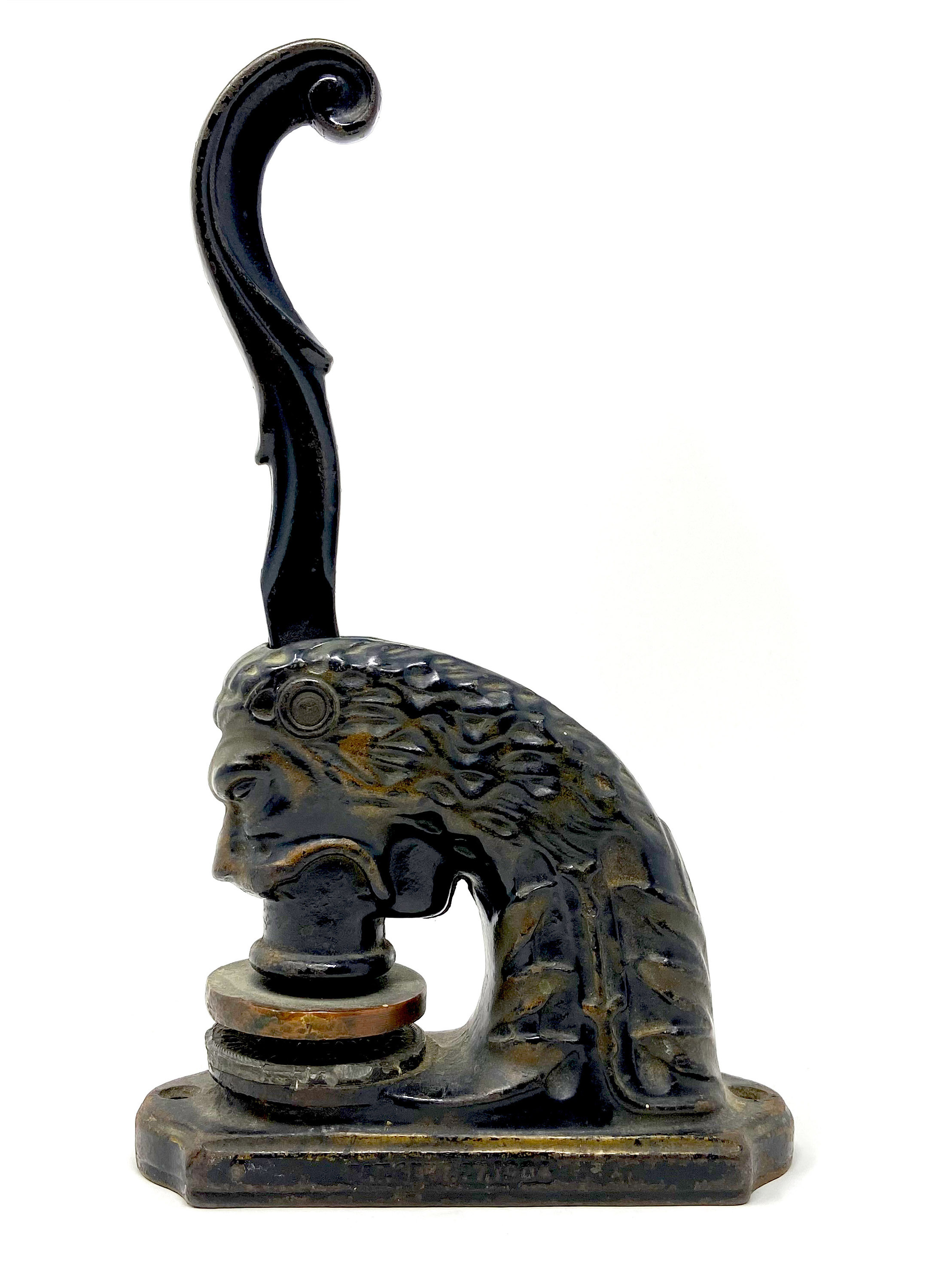
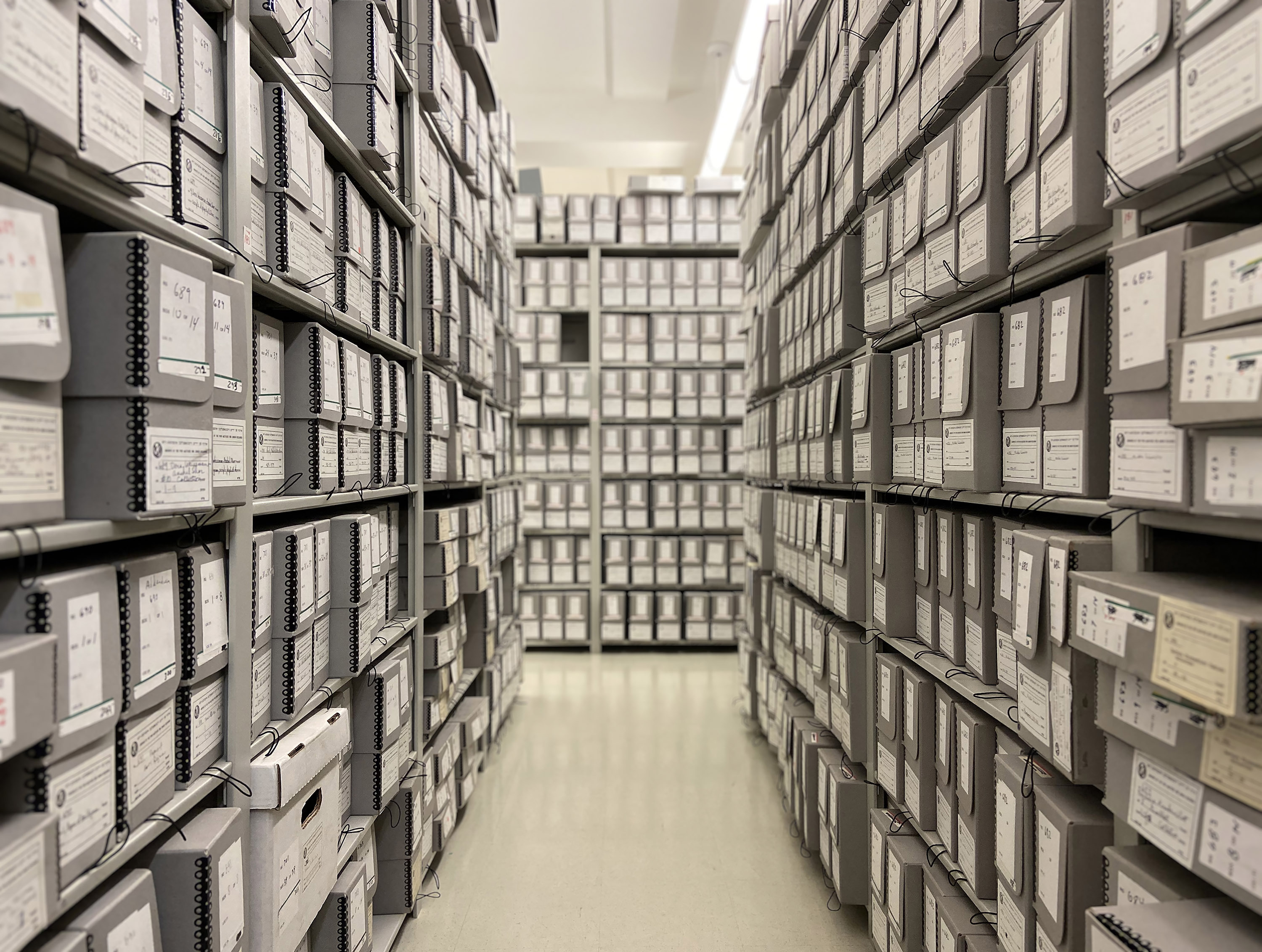
SH: There are a lot of things in here that I’ve always been very partial to. I’ve always liked the landsmanshaft embossers—the hand seal press with the ornately decorated lion. And I like them, because we have so many of them. Every landsmanshaft had a hand seal press, and they would use it to mark official documents. You often think of a press, a seal, as being something on government documents. All of these landsmanshaftn had these hand seal presses, and they have this air of being very official, and I like that idea. They’re also very beautiful, and they’re one of the first things that I encountered here at YIVO when I was a grad student. I was taken into the stacks, and you go through the stacks and there are just thousands and thousands of gray boxes, and they don’t mean anything until you open them up, but then on top of a row, there were just hundreds of these hand seal presses sitting there, and I thought to myself, “Wow, this is such a strange, interesting thing that is at YIVO,” and that, I think, was my first encounter with understanding that YIVO had more than just paper documents. So that’s a very personal thing. And I have one that I look at in my office every day. Let me think, what other things are there? There are so many.
DM: There are ninety-nine others.
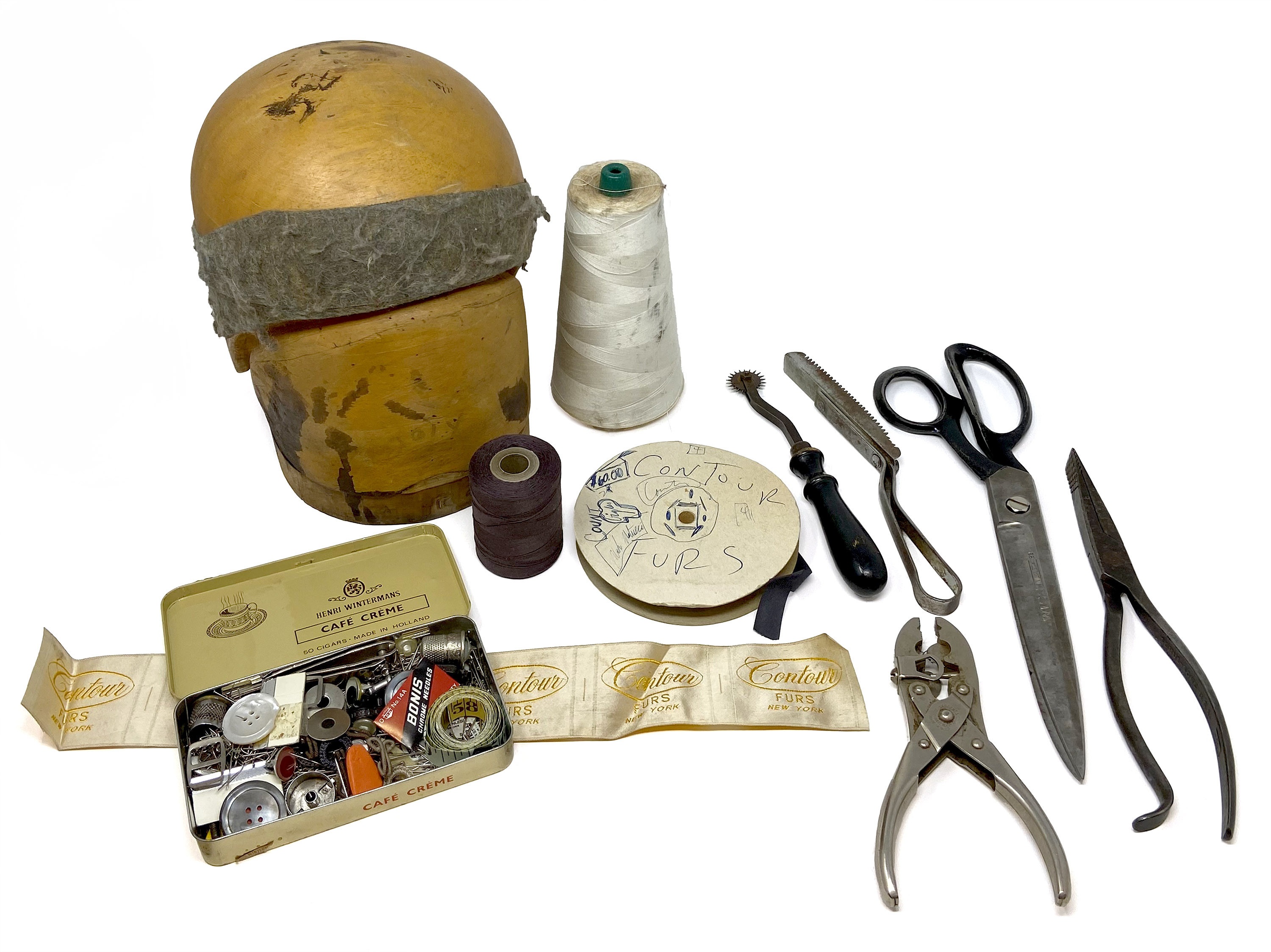
SH: It’s very hard to choose. I also really like the furrier’s toolkit—another very strange thing that we have here that you wouldn’t think would be in a place like YIVO. And it’s all this machinery that this person—whose name is Albert Snyder, who made fur garments—donated to YIVO. So, the idea of taking a hat stretcher, or all of this very heavy machinery that still has little bits of fur, along with this huge pair of scissors that he could use to cut the fur, and ribbons, and the labels bearing his company name, “Contour Furs,” that he would’ve sewn into the garments, and also a metal box that I think held chocolates or cigars or something that’s filled with pins and little buttons, and placing it in an archive is unexpected. This furrier’s toolkit is from a particular moment in time, and it tells a story about the garment industry and the fur industry, but also, my grandmother had a box of buttons and needles just like that. So it’s also something that feels very personal, though it didn’t, you know, belong to me.
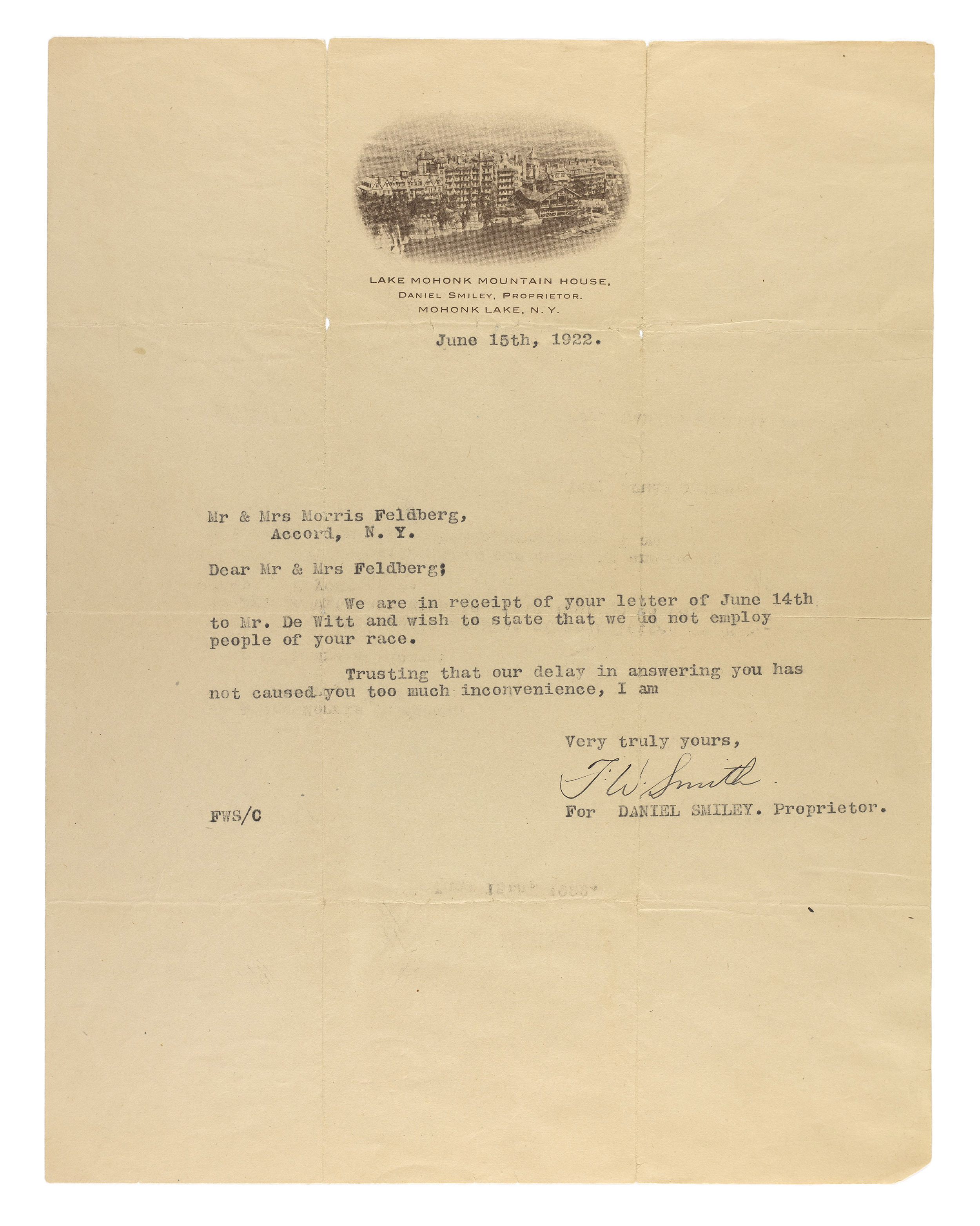
DM: That’s great. I have a favorite object, just because it stuck out in my brain. It’s not a particularly positive object, but it’s the letter from Mohonk Mountain House. My best friend since we were maybe five or six, her family, for generations, has been going to Mohonk Mountain House, and I’ve been a couple times with her family. And so when I was reading through the book, I saw it in the list, and I was like, “Oh, what, what could this possibly be? It could be great.” And then I read the letter. And, the double effect, too, is that I went to a Quaker school, and [Mohonk was] founded by Quakers, and I always taught that the Quakers were at the forefront of all civil rights movements. But then there they were, in the 1920s, where antisemitism was just the norm, no matter where you were or what religious group you were a part of. And I just thought it so interesting, and it really places you in that time. But also, what are the odds that this was a place that I had gone to?
SH: Well, I think that’s part of what is special about the book, that—and I’ve heard this from a lot of people—they go through it, and they find something that does have some kind of personal resonance that they wouldn’t have expected. And that’s the thing that gets them to enter YIVO, and that’s what I really hoped could happen through a book like this, that it just piques people’s curiosity, and they say, “Wow, there is something at YIVO for me, and I would like to explore more.”
100 Objects from the Collections of the YIVO Institute for Jewish Research is available for purchase on YIVO’s online store.