Apr 22, 2025
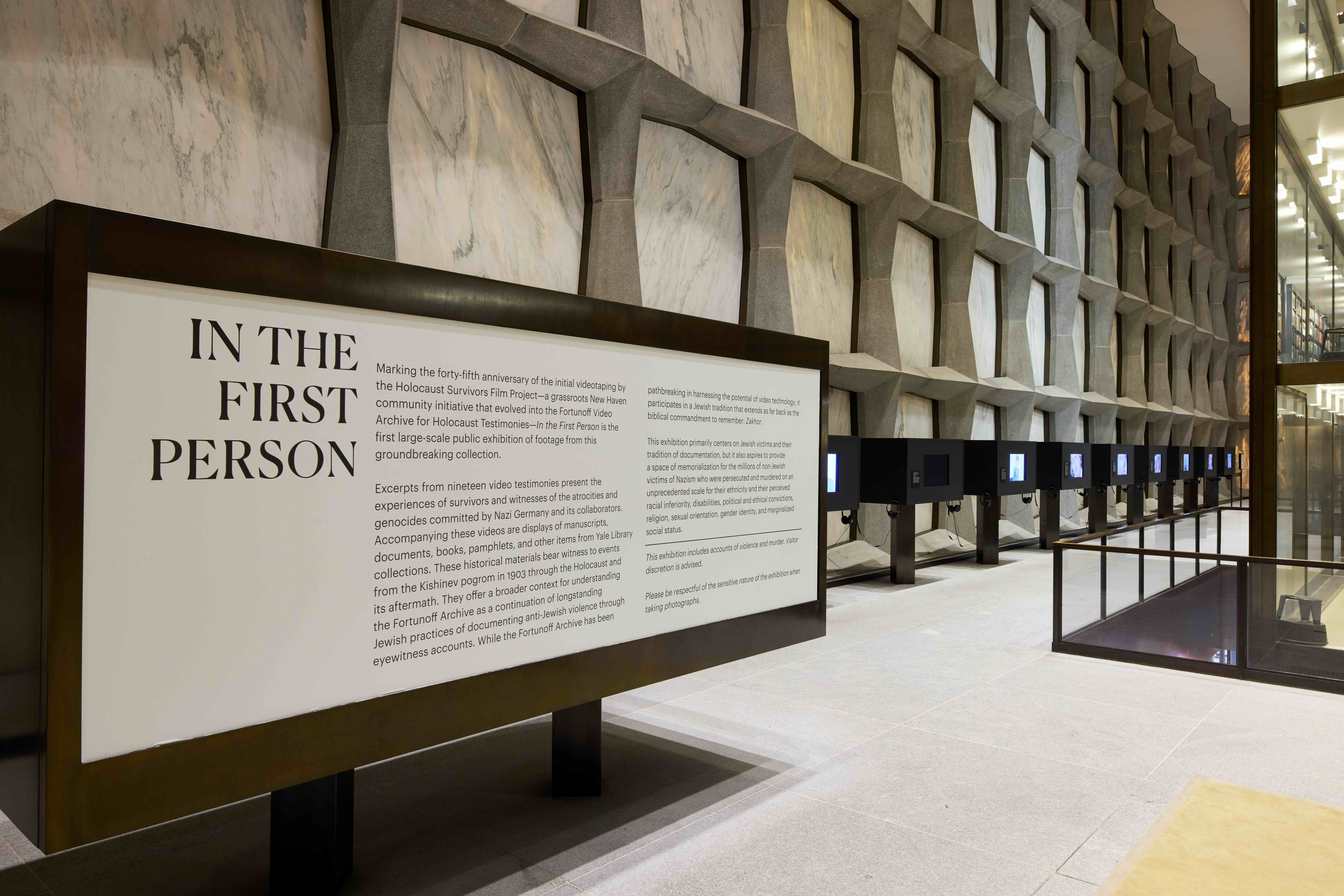
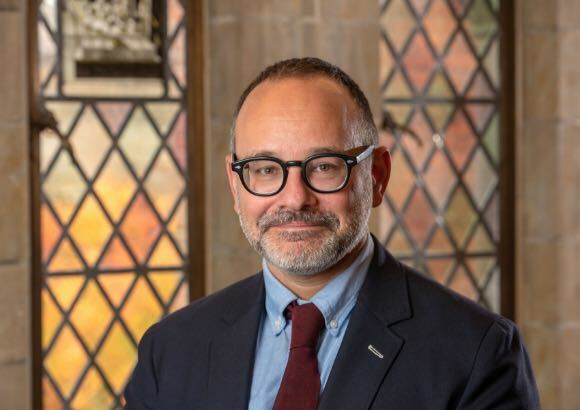
“In the First Person: The Fortunoff Video Archive for Holocaust Testimonies” at Yale University’s Beinecke Library, July 25, 2024-January 28, 2025. Photo Credit: Robert Lisak.
This week, as we do every year, the Fortunoff Archive will mark Yom Hazikaron Lashoah Ve-legevurah, Holocaust and Heroism Remembrance Day, usually referred to as Yom Hashoah. Yom Hashoah was established as a national day of mourning by the young State of Israel, and enshrined in law in 1959. Many of our readers probably know the backstory of this day of mourning, and other “competitors” for a fitting universal date of commemorating the khurbn, the destruction or catastrophe, that we now refer to as the Holocaust. Some Jews preferred the tenth of Tevet or Tisha b’Av, both tradition days of mourning and fasting for the destruction of the Temple. Then there’s International Holocaust Remembrance Day on January 27th, marking the liberation of Auschwitz by the Soviet army. International Holocaust Remembrance Day is by comparison a late addition, only added as an official day of remembrance by the United Nations in 2005. Still, this abundance of potentially suitable dates, and the inability to agree on one sole, clean moment in time sufficient to remember the most brutal crimes of the twentieth century, seems a suitable expression of the horrific scope of the destruction. The Holocaust is simply an event that explodes any boundaries with which one tries to confine it. Moreover, this friction seems a fitting reminder not just of the scope of the crime, but the beautiful and messy diversity of the Jewish people(s), before, during, and after the Holocaust, and the way that memory is a living thing that refuses to be fixed to only one interpretation or agenda. This “lack of agreement” is welcome at the Fortunoff Video Archive for Holocaust Testimonies At Yale University, as it is at In geveb. Discourse and debate are essential to the production of knowledge, and besides, at the archive, every day is “Yom Hashoah.” Every day we work to preserve and project into the public sphere the memories of the victims and survivors of the Holocaust recorded painstakingly on videotape for the last forty-five years.
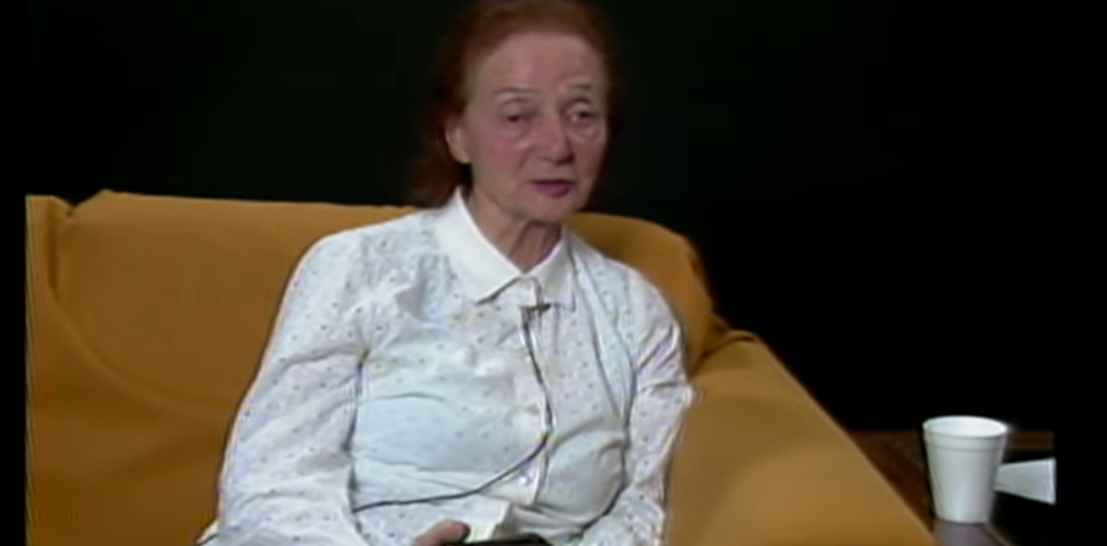
The Fortunoff Archive began in 1979 in New Haven, Connecticut as a local grassroots effort by Holocaust survivors to record, on videotape, the life stories of survivors and witnesses. Hence the archive didn’t begin as an archive, but rather as a community effort led by a group of volunteers. These volunteers consisted mostly of survivors and children of survivors. Two main figures were Dori Laub, a psychoanalyst and child survivor from Czernowitz and William Rosenberg, born in Czestochowa, Poland, who was the head of the local Labor Zionist survivor organization the Farband in New Haven. Together with Laurel Vlock, a local television reporter, they formed a non-profit, the Holocaust Survivors Film Project (HSFP). Rosenberg would serve as president of the HSFP and the major conduit to the survivor community. Not only did Rosenberg encourage survivors to participate in the tapings, but he and survivors in the community raised the initial funds for the tapings. Hence from the start, it was very much an effort by survivors for survivors, and this rootedness in the survivor community has been crucial how the archive thinks about the use of the collection.
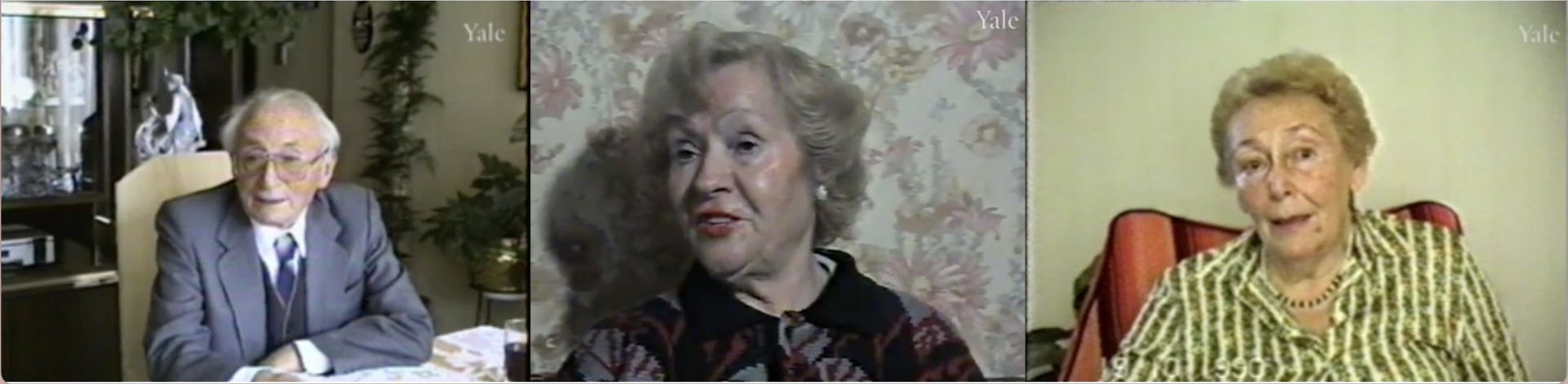
The collection didn’t come to Yale until 1981, when the first 183 testimonies recorded by the HSFP were deposited. Since then, the collection has grown to encompass more than 4,400 testimonies of survivors, witnesses, and bystanders recorded here at Yale, across North America, South America, Europe, and Israel with the help of three dozen formally affiliated projects. The material, more than 10,000 hours of video, was recorded in more than a dozen countries and many more languages. It is an incredibly diverse collection, geographically, linguistically, thematically. This serves as a counter to a tendency many have to imagine survivors as some monolithic, undifferentiated group. This archive, if anything, is proof of the true polyphony of survivor voices. There is not one kind of survivor. There are Jews and non-Jewish survivors in this collection, socialists and bundists, Zionists and non-Zionists, people who lost their faith in God during the war, people that found faith!
And while the Fortunoff Archive still records testimony, albeit infrequently, this unique, richly diverse collection of material, now in digital form, begs the question: now what? Not that we have built this incredible digital archive, what is it for? One of the answers to these questions is the current partnership between Fortunoff Archive and In geveb to create a series of fellowships focused on engagement with the Yiddish-language materials in this collection, the results of which are presented in this special issue. In geveb’s mission is to broaden and deepen academic and related conversations around Yiddish Studies, broadly construed, and to ask how placing Yiddish sources in the center of our analysis can enrich and refine our understandings of a variety of fields and subjects, and we are pleased to further extend our conversation to offer opportunities for Fellows to think analytically and creatively not only about the events of the Holocaust but about video testimony as such.
What you will find here are essays describing the projects that our fellows have undertaken to interpret materials from the archive artistically, musically, and for educative purposes. In doing so, they ensure that the archive is not just memory stored in a vault, but something with which they can actively engage to draw new insights that help us understand the complexity of the Holocaust. They interrogate and interpret elements of the testimony that might be less obviously legible as bearing meaning – silences, hand gestures, voice and pacing. They bring forward the experiences of the viewer and listener as someone who accesses the testimonies as a window through which to see pivotal moments from the past. They consider the role the Holocaust played in the lives of survivors whose stories stretch beyond the horrors they experienced and into new geographic and political realities that shaped their memories of the past. And, fitting for their publication in a Yiddish Studies journal, they bring attention to the use of the Yiddish language in the testimonies and the role of linguistic diversity in relaying narrators’ experiences.
From the start, when the founders of what would become the Fortunoff Archive brought the collection to Yale, they recognized the potential research and educational value of the archive. By inviting these scholars and artists to work with these Yiddish language testimonies, we are simply fulfilling the mission they laid out decades ago. And like the collection, this first cohort of Fortunoff/In geveb fellows consist of a varied group of scholars and artists. Collectively, their work provides us with a small sense of not only the richness of the Yiddish languages materials in the collection, much of which is still waiting to be more closely examined, but also what the encounter with video testimony means to scholars and artists working today, in an intellectual environment buffeted by current crises, both within academia and in the wider world. In these times, it is no surprise that the searing pain of the past can cause us to question the connections, or disconnections, between mass violence today and the echoes of history.
We look forward to circulating a call for a new cohort of Fortunoff/In geveb Fellows this spring and are certain we will learn a great deal from their work with the Archive.
In geveb is turning t(s)en! We need your help to launch our second decade and help In geveb to continue to grow and thrive and remain a central address for the study of all things Yiddish online. Our goal is to raise $20,000 by our official tenth birthday: August 15, 2025. We invite you to donate to support In geveb and to honor everyone who has got us this far.
In geveb is turning t(s)en! If we want In geveb to continue to grow and thrive and remain a central address for the study of all things Yiddish online, we need your help to launch our second decade. Our goal is to raise $20,000 by our official tenth birthday: August 15, 2025. We invite you to donate to support In geveb and to honor everyone who has got us this far.