Jun 16, 2025
INTRODUCTION
This is a translation of a slightly revised version of “‘Mordkos’ sista brev till Pär Lagerkvist,” first published in Swedish in Svenska Dagbladet (November 18, 2024). The original Swedish authors are Olof Bortz and Eric Joas; the English translator is Matthew Johnson.
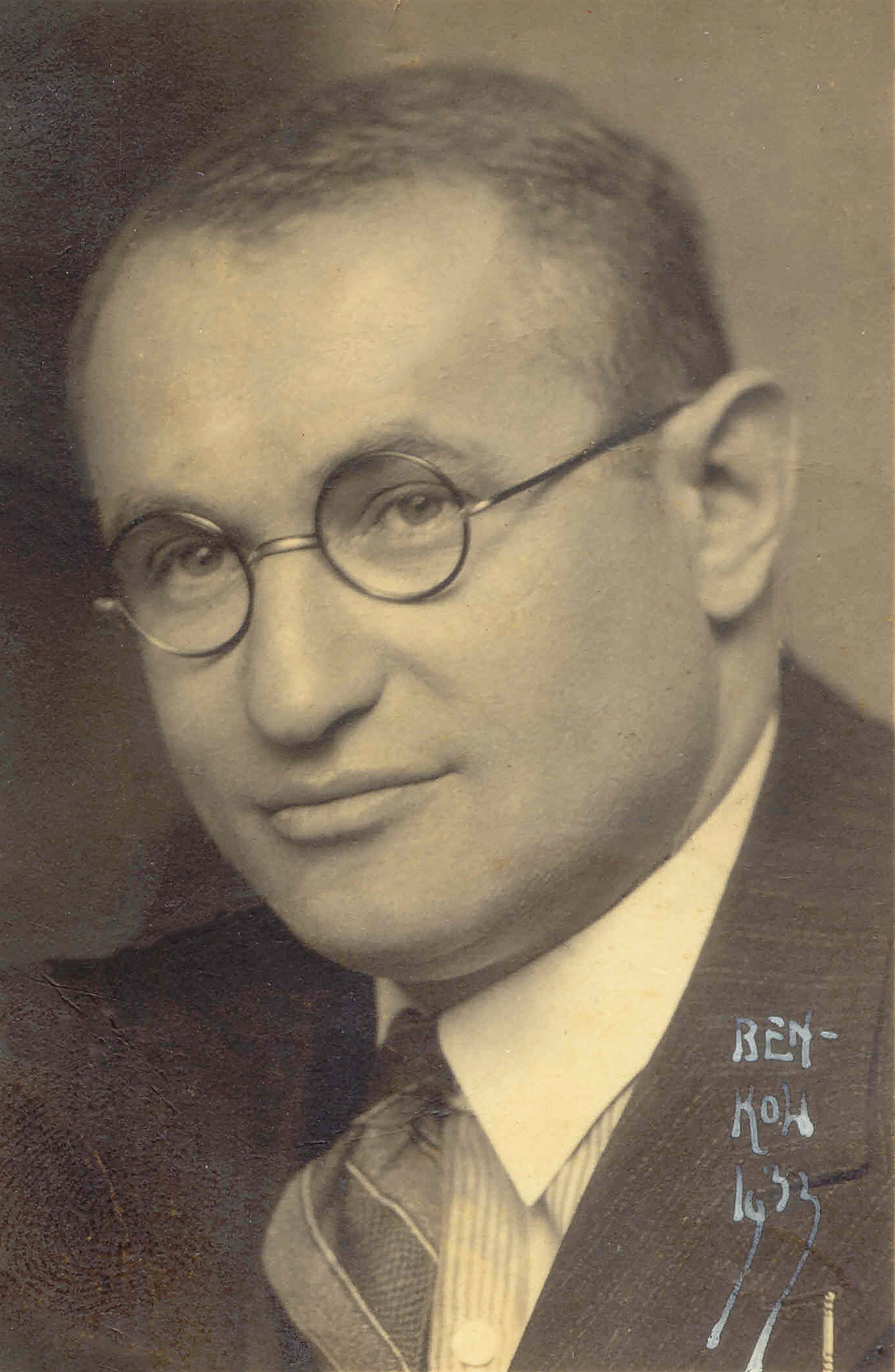
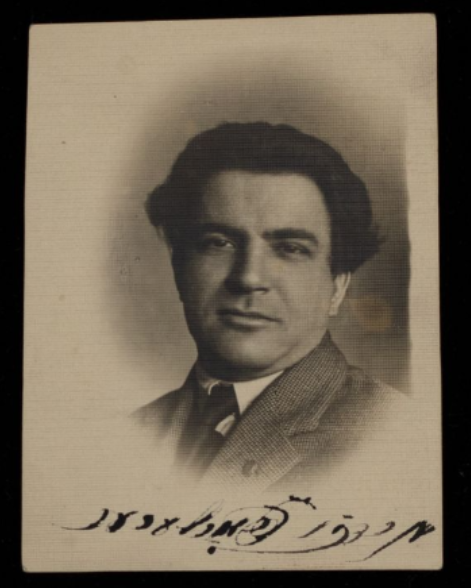
In April 1941, the Swedish author Pär Lagerkvist, an eventual winner of the Nobel Prize in Literature, received a postcard from the Warsaw Ghetto. The postcard was from his friend Mordechai “Mordko” Forlerer, a “Swedish-Jewish man of letters” (“Svensk-Judisk litteratör”) according to the business cards that are preserved in various archives. Forlerer was reaching out to the network of contacts that he had developed within the Swedish cultural world during the interwar period. This time, unlike in his previous correspondence with Lagerkvist, Forlerer was not writing about literature, but rather to prevent himself and his son from starving to death.
Forlerer is today largely forgotten, even in Sweden, but during the interwar period he dedicated himself to what he called “propaganda for Swedish literature” (“propaganda för svensk litteratur”) in the Yiddish-speaking world. He spent a few years in Sweden during and after World War I, and his encounter with modern Swedish literature changed the course of his life. During the 1920s Forlerer translated several Swedish works into Yiddish, including the Nobel laureate Selma Lagerlöf’s Gösta Berling’s Saga (Gösta Berlings saga), her famous debut about a fallen priest, and The Emperor of Portugallia (Kejsarn av Portugallien), a novel that she referred to as a “Swedish King Lear.” He also translated selected works by Tua Ström, the author of a “film novella” and several plays; Vilhelm Moberg, the author of a widely read series of novels about Swedish emigration to the United States; and Rudolf Värnlund, a novelist and playwright linked to the proletarian movement. Forlerer developed his deepest relationship with Lagerkvist, a writer who grappled with the crisis of faith in the modern world and an early and vociferous critic of Nazism. Lagerkvist received the Nobel Prize in Literature in 1951.
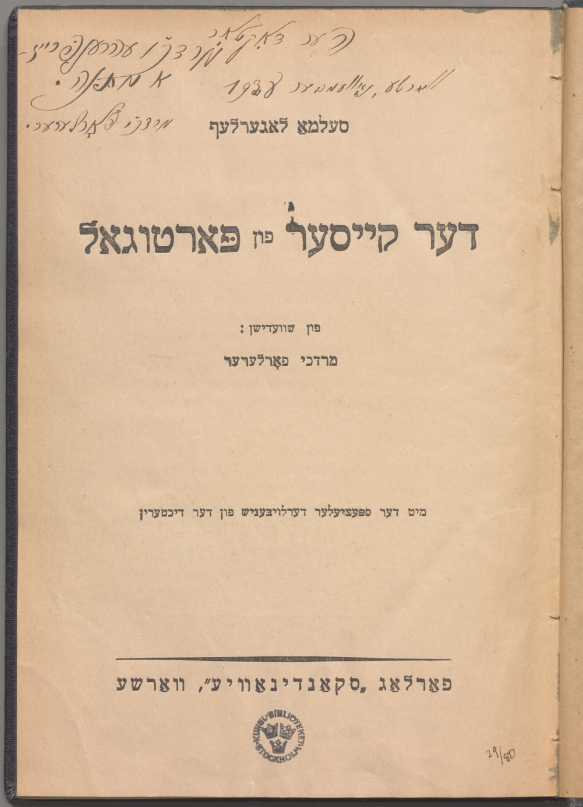
Selma Lagerlöf’s The Emperor of Portugallia (Kejsarn av Portugallien), translated into Yiddish by Mordechai Forlerer.
Forlerer was born in Warsaw in 1895. Like most Jewish boys at the time, he attended a traditional religious school (cheder), but he also trained as a craftsman. In 1914, Forlerer went to Berlin to continue his training, but, as a citizen of an enemy nation, he became an enemy alien when war broke out. He made his way to Stockholm in the coal hold of a steamer and stayed in Sweden for six years, where he worked as a manual laborer and archivist. He came into contact there with Jewish émigré intellectuals, including Labor Zionist activists, and learned Swedish. In 1920, Forlerer returned to Warsaw, which, after the war, had become the capital of an independent Poland.
At the time, Warsaw had over 300,000 Jewish inhabitants, a community that constituted a literary and political milieu in its own right. While modern Yiddish literature had gained increasing recognition in the late 19th and early 20th century, writing in Yiddish was still not a given, and this was not only due to the opposition of the Polish state. Yiddish literature was subject to a political struggle that elicited a ferocity of which might be difficult to imagine today. Forlerer explained, in a letter to an Icelandic scholar, that Polish Jewish traditionalists would go so far as to adopt what Forlerer called “medieval inquisitional means,” including burning down – “pogroming” (“pogromera”) – the libraries of the Jewish working-class youth.
For Forlerer, Yiddish was the obvious choice. In 1924, he published his first articles in Literarishe bleter, the leading literary journal in Yiddish in interwar Poland. Its founders were intellectual luminaries, including Israel Joshua Singer. The circulation of Literarishe bleter was about 1,000 copies, and its readers were, as Forlerer put it, “intelligent manual laborers, schoolteachers, writers, etc.” Forlerer was responsible for translations and articles about Scandinavian literature. One of his contributions was a substantial introduction to Lagerlöf’s novels. Although he demonstrated a broad interest in the Nordic countries, translated from Norwegian and Danish, and wrote about contemporary Icelandic literature, Forlerer never wavered in his love of Swedish culture, which he also tried to transmit to his son Notele by reading aloud from Lagerlöf’s The Wonderful Adventures of Nils (Nils Holgerssons underbara resa genom Sverige), a tale of a young boy discovering Sweden on the back of a goose, which is a beloved classic for generations of Swedish school children.
Forlerer’s most significant contribution was his work with Lagerlöf’s oeuvre. His translation of Gösta Berling’s Saga, as Di legende fun Yesta Berling, published in 1927 by the prestigious publishing house Kultur Lige, was a significant attempt to bring world literature to Yiddishland. The review in Literarishe bleter was effusive, describing it as one of the finest translations in the history of Yiddish literature. Sales were slow, however, with only 700 copies sold a year later. Forlerer asked Lagerlöf for permission to translate several other novels and started Farlag Skandinavye for this purpose. In 1929, his translation of The Emperor of Portugallia, as Der kayser fun Portugal, was first published. Nine years later, one could read the following advertisement for it in a Polish-Jewish journal: “The work of the great Swedish author, Nobel Prize winner Selma Lagerlöf, should be in every home in which true art is valued.” (“Dos verk fun der groyser shvedisher shraybern, di Nobel-prayz tregerin, iz vert tsu hobn in yeder shtub vu men hot lib emes’e kunst.”) The advertisement included the publisher’s address, which was the same as Forlerer’s home address.
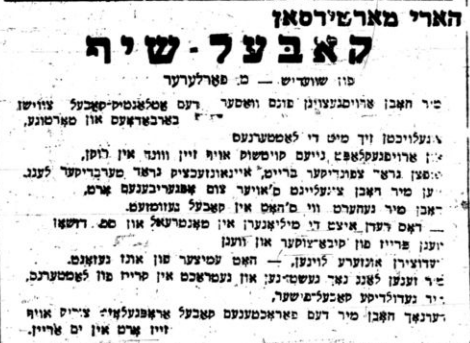
A poem by Swedish poet Harry Martinson (1904-1978), translated into Yiddish by Forlerer. Vokhenshrift far Literatur, May 16, 1935.
During the 1930s, Forlerer began to focus more and more on the theatre world and on translating Swedish drama. The transition from novels to plays had to do with the economic reality in the aftermath of the Great Depression. Dramas involved less work and greater opportunity for financial compensation. Nevertheless, it did not prove easy to stage Swedish modernist theatre in 1930s Poland. In 1931, Forlerer asked Lagerkvist for exclusive rights to the play He Who Lived His Life Over Again (Han som fick leva om sitt liv) and pointed out that Yiddish was a world language.
The following year, Forlerer stated: “The times are not favorable for your works.” According to him, the main theatre in Warsaw – Teatr Polski – had been transformed into an “operetta stage”: “Superficiality is spreading everywhere.” A year later, however, Forlerer emphasized that people were turning to “the great authors” for advice in choosing between socialism, communism, and fascism. Building on this analysis of the political relevance of literature, Forlerer suggested: “If you were to tackle a more realistic depiction of the class struggles of our time, I mean one that is truer to life, then you would create a masterpiece.”
This was not the only example of Forlerer’s boldness bordering on audacity, or chutzpah, in his correspondence with Swedish writers. In 1935, he wrote to Tua Ström about the play Come and Let Us Beat 'em (Kommer och låter oss slå’n). Without having read the play in question, he wondered if it could be “remade” (“göras om”) to deal, for example, with the issue of the “state monopoly on foreign trade,” a theme Forlerer considered relevant in Poland. At this time, he began to translate more and more into Polish instead of Yiddish, most likely due to the worsening economic conditions and general crisis of Yiddish-speaking culture. In 1936, Forlerer enjoyed his first and, by all accounts, only success with Swedish drama when his Polish translation of the proletarian writer Rudolf Värnlund’s The Holy Family (Den heliga familjen) was performed in Łódź, as the Swedish newspaper Dagens Nyheter announced.
However, the theatre was forced to take down the poster for the play, probably due to political pressure. At this time, Forlerer wrote to Lagerkvist, noting the stricter censorship in Poland: “Don’t you have any new apolitical play? Because with political plays it is very difficult. The only ones of that kind that have any prospects are pro-fascist.” His changing and even contradictory advice to Swedish playwrights was an expression of the shifting currents of Polish politics.
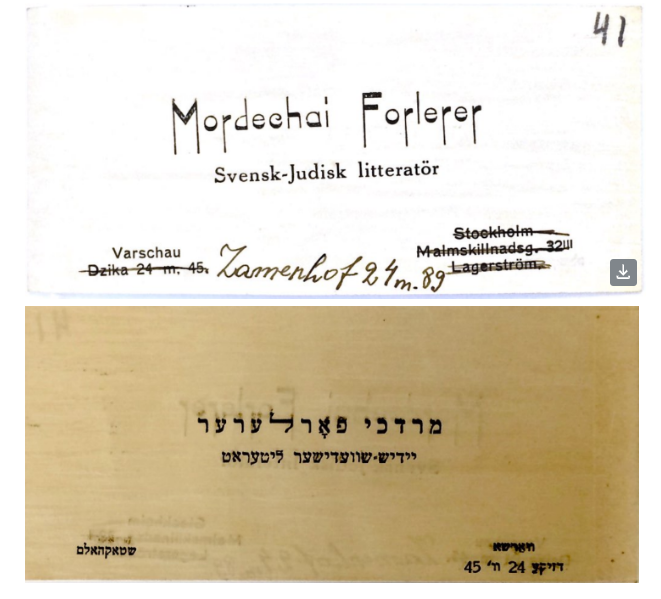
two images of Forlerer’s business card
Forlerer’s difficulties in trying to make a living from his passion for Swedish and Scandinavian literature were related to the crises affecting Polish Jewry in the years before the outbreak of World War II. The economic depression in the early 1930s was followed by an anti-Jewish turn after the death of Józef Piłsudski, the father of the Second Polish Republic, in 1935. A more radical and anti-Jewish Polish nationalism led to pogroms and repression. After the German invasion in 1939, the situation of Polish Jews went from precarious to catastrophic. Massacres and other acts of violence by German forces were followed by ghettoization in 1940 and 1941 as a temporary step in the Nazi leadership’s pursuit of the “final solution.”
The famine and diseases that the German administration forced into the ghettos of occupied Poland were of a genocidal nature long before the systematic mass killings began in the late summer of 1941. After what appears to have been a long pause in correspondence, Forlerer contacted Lagerkvist in April 1941. At that time, he had been living with his son in the ghetto for barely five months. In June, Forlerer thanked Lagerkvist for two kilos of rye bread, which were unfortunately inedible by the time they had reached him. He asked for more packages and, at the same time, tried to reach several of his Swedish contacts through Lagerkvist, including Marcus Ehrenpreis, the Chief Rabbi of Stockholm. The last extant postcard from Forlerer to Lagerkvist is dated August 20, 1941. However, through material in the archives of the Jewish Congregation of Stockholm, we know that Lagerkvist, with Ehrenpreis’s help, tried to send Forlerer 50 złoty and a food package from Portugal in February 1942.
Rokhl Auerbach, perhaps the most prominent surviving historian of the Warsaw Ghetto, described Forlerer’s time in the ghetto as follows:
1
1
Rokhl Auerbach, Baym letstn veg (Tel Aviv: Farlag Yisroel-bukh), 157.
בשעת דער מלחמה האָט זיך פֿאָרלערער שטאַרק געמוטשעט, זיך דערקייקלט צום האַנדלען מיט אַלטע זאַכן. קיין שום זאַך איז אים אָבער נישט געװען צו שװער, װײַל ער האָט געהאַט צו דערנערן און צו דערציִען זײַן 7־יאָריקן זון נאָטעלע, װאָס די מאַמע זײַנע איז געשטאָרבן נאָך פֿאַר דער מלחמה. ער האָט זיך צערטלעך געניאַנטשעט און אָפּגעגעבן מיטן ייִנגעלע זײַנעם װי אַ טאַטע און אַ מאַמע אין איין פּערזאָן. אויך נאָטעלע איז געװען אַן ״ערן־קאָנסומענט" פֿון אונדזער קיך, אַ ליבלינג פֿון אונדזער גאָספּאָדיניע און די אַנדערע מיטאַרבעטערינס פֿון דער קיך. די זופּ פֿלעגט מען אים אַרײַנגיסן אין אַ קליינעם עמערל, מיט װעלכן ער פֿלעגט זיך פֿאַר דער מלחמה שפּילן אין זאַמד.
During the war, Forlerer suffered, leading him to do business by selling old things. But nothing was too difficult for him, since he also had to feed and bring up his seven-year-old son Notele, whose mother had died before the war. Forlerer tenderly coddled and devoted himself to the boy like a father and mother in one person. Notele was also an ‘honored guest’ in our kitchen [Auerbach worked in a soup kitchen in the Warsaw ghetto], a favorite of our housemaster and the other kitchen workers. They used to pour his soup into a small bucket, which, before the war, he had played with in the sand.
According to testimony given to Yad Vashem, Mordko Forlerer and his son were murdered in Treblinka in 1942.
Although Forlerer has passed into oblivion in both Sweden and Poland, he is a prime example of the transnational nature of Yiddish culture during the interwar period. While Forlerer approached Sweden's literary luminaries with reverence he was at the same time cognizant of representing a language that, contrary to the provinciality of Swedish and Nordic culture, spanned the globe. In addition to his character, this might go some way in explaining Forlerer’s boldness when asking Swedish authors to adapt their work to the swiftly changing politics of interwar Poland. Indeed, if Forlerer’s chutzpah can be taken as an epitaph of a life in letters, steeped in economic hardships and cut short by the Holocaust, his love of Swedish modernism bequeathed a remarkable transcultural legacy.
- translated into English by Matthew Johnson

In geveb is turning t(s)en! If we want In geveb to continue to grow and thrive and remain a central address for the study of all things Yiddish online, we need your help to launch our second decade. Our goal is to raise $20,000 by our official tenth birthday: August 15, 2025. We invite you to donate to support In geveb and to honor everyone who has got us this far.