Dec 18, 2025
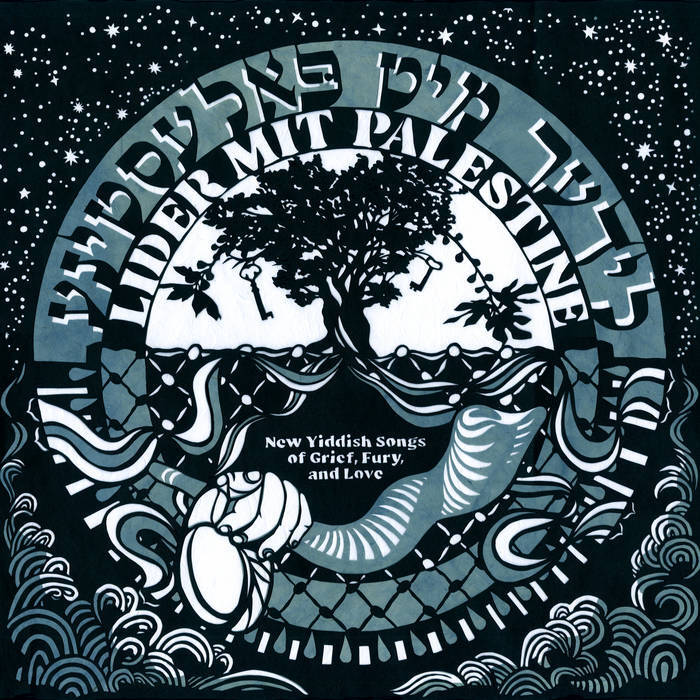
LIDER MIT PALESTINE לידער מיט פּאַלעסטינע: New Yiddish Songs of Grief, Fury, and Love, produced by Joe Dobkin, Josh Waletzky, and Isabel Frey, 2025
It would be pleasant for me, as a singer, literary critic, and Yiddishist, to review LIDER MIT PALESTINE לידער מיט פּאַלעסטינע: New Yiddish Songs of Grief, Fury, and Love apolitically. I would describe the artistic strengths and weaknesses of the music, the lyrics, the performances of these Yiddish songs about Palestine as if reviewing a new recording of a Handel opera.
But that is not possible. These are forthrightly political songs, denunciations of Israel’s war in Gaza, many of them calling that war a genocide. They are laments for the Palestinian victims of that war. Some of them are explicitly anti-Zionist, many implicitly so. The reviews and accounts I have seen, even those seeking not to judge the politics, end up judging the politics anyway. No exclusion of politics is possible.
That does not mean, though, that reviewers should attend only to the politics; rather it means that reviewers should attempt a juggling act, attend to both politics and aesthetics, both aesthetics and politics, equally and simultaneously.
It also means that reviewers should identify their own political kukvinkl, their own perspective, lest political judgments masquerade as artistic ones. Mine is that of a left-wing pacifist Jew, a person who denounced Hamas’s murderous attacks and regards Israel’s war in Gaza as a genocide, who is sympathetic to analogies between the Shoah and that war, who finds anti-Zionism a possible position for a committed Jew.
One prefatory question, then some comments on the songs, then a concluding reflection.
Why Yiddish? The Yiddishist Vera Szabó asks that question in her anguished and angry comments on the album in the Forward’s Yiddish-language section. Her question is legitimate.
In an interview with NPR, Joe Dobkin, one of the album’s producers, offers an answer and an origin story. He saw a video of an Israeli soldier on a tank rolling into Gaza, singing the great Yiddish resistance song "Zog nit keynmol" (“Never Say”). He had also been seeing, day after day, images of slaughtered children in Gaza. So in response to the soldier’s song, he wrote a song called “falndike vent (Falling Walls),” its title taken from a line in the Yiddish song the soldier was singing.
One meaning of that story is presumably that Dobkin is calling out to the soldier, “it’s our language too.” Or even, “it’s more our language than yours, you can only sing an old song, we can create new ones.” I take that motive to be general. But it is not the only one at work. There is also an eagerness to explore what Yiddish makes possible for poets and lyricists, even if it makes that possible by its constraints. There is also the desire to have a Jewish audience. In a recent letter to me, the anti-Zionist Yiddishist and performer Corbin Allardice describes this well: “Writing in English means writing not only for Jews. . . . There is an obligation, I think, to think and write beyond my particular dalet ames [mental framework]. In Yiddish, on the other hand, if I’m writing for anyone, it’s for people who share an overriding and perhaps narcissistic concern with Jews. Writing in Yiddish, the comparisons between Holocaust and Nakba are basically unavoidable[,] . . . a function of figurative language as much as historical conjuncture.”
The first step in judging the songs themselves is getting their genre right. They are protest songs, in the useful sense of that term offered in Dorian Lynskey’s admirable 33 Revolutions per Minute: A History of Protest Songs, from Billie Holiday to Green Day: “a song which addresses a political issue in a way which aligns itself with the underdog.” 1 1 Dorian Lynskey, 33 Revolutions per Minute: A History of Protest Songs, from Billie Holiday to Green Day (HarperCollins, 2011), xiv. Many artists look down on such songs, even artists who sing them. Joan Baez said, “I hate protest songs, but some songs do make themselves clear.” 2 2 Lynskey, 33 Revolutions per Minute, xiv. Protest songs have a palpable design upon us, in Keats's phrase; they take sides. They are sometimes written in haste, lest the crisis pass and the song not be written, and show signs of that haste. Some of these Yiddish songs have larger ambitions and larger successes, I should note; the verbal adroitness and density of Jordan Wax’s “keler fun ash (Voices of Ash)” stand out, as do Zackary Sholem Berger’s wrenching poem “nisht (Not)” and Josh Waletzky’s complex, artful setting of it, sung on the album by Esther Gottesman. (For Berger’s poem in the original and in translation, see “New Yiddish Poetry from the Israel-Gaza War.”) But earlier protest songs too have had similar ambitions and successes, e.g., Bob Dylan’s “Masters of War.” As Lynskey writes, “if [the category] is a box, then it is a huge one” (xiv).
As protest songs, then, how do they do, what do they do?
One thing they do not do is satirize, though many protest songs have done that. Presumably the war in Gaza is too cruel, in the writers’ judgment, to permit satire. Even the one parody—a Yiddish rewriting of “Hatikvah”—does not satirize the text it replaces; rather, it replaces it with a utopian diasporic vision. Compare Mark Twain’s parody of the “Battle Hymn of the Republic," “Mine eyes have seen the orgy of the launching of the Sword; / He is searching out the hoardings where the stranger’s wealth is stored." 3 3 Lawrence Rosenwald, ed., War No More (Library of America, 2016), 108.
What the songs and singers do best is lament and denounce. Some of the most moving laments and indictments draw on the language of tkhines, among them rosza daniel lang/levitsky’s “a tkhine far di yorn fun sirenes, fun bruklin tsu khan yunis (A Tkhine for the Years of Sirens, from Brooklyn to Khan Yunis” and Maia Brown and Noam Lerman’s “mir muzn farhitn dem genotsid (We Must Interrupt Genocide).” (The latter is a test case; listeners who do not think Israel has been committing genocide will find it self-righteous and simplistic, listeners who do will find it economical and fluent.) They have not lost their power, these tkhines, and all honor to the artists and activists of the Tkhines Proyekt for exploring and animating that repertory. The simplest among these tkhine-influenced songs, and for me the best, expressively declaimed and idiomatically ornamented, is Lerman’s “fargisn blut (Spilled Blood),” with its haunting refrain: “zol di heylike blut broyzn un royshn/ azoy vi di khvalyes fun yam (Let the holy blood boil and murmur like waves from the sea).” Other songs of lamentation are more personal, their diction more singer-songwriterish, e.g., Daniel Kahn’s “got-bruder (Godbrother),” poignantly and attentively lamenting the rupture of a friendship, and in a similar vein Josh Waletzky’s “a shtik fun harts (A Piece of My Heart).”
Weaver’s beautifully economical song “afn breg funem yam hagodl (On the Shore of the Mediterranean)” stands out for me, equally intense in lamentation and denunciation. In its rousing, klezmer-idiom chorus, the pebbles on the shore are at first only weeping for the murdered. Later, though, those same pebbles are summoned to action: “lomir zikh varfn inem ratskhn arayn,” “let us fling ourselves at the murderer.” The tune is lucid and well made, the singing touching and melodious. (For Weaver’s Yiddish translation of Refaat Alareer’s “If I Must Die,” see In geveb’s “New Yiddish Poetry from the Israel-Gaza War.”)
What the songs do less well is imagine peace and justice. Consider Michael Alpert’s “khorbn aze (The Devastation of Gaza)." Alpert is a flat-out terrific singer of Yiddish, one of the best in the world. His song is superb, just at the upper limit of a protest song’s possible density, with its adroit interweaving of Hebrew and Yiddish and its plain but passionate metaphors—aza borsht zol ikh sheyn nit hobn gegesn / . . . / az fun milkh un honik zol vern bitere gal (“would that I had never tasted such a borsht . . . that milk and honey should become bitter as bile”). Its heartbreaking melody is drawn from a Yiddish lament for the Titanic.
Or rather, the song is superb as long as it remains an indictment and lament. When it turns positive it becomes vaguer, more abstract: es darfn firn undzere vegn sheyn in naye zaytn / fun ale shvartse yorn in a likhtikern haynt . . . ikh hob di gantse mentshhayt lib . . . ikh hob di likhtike velt azey lib (“our paths must lead us now in new directions, / From all the dark years into a brighter present . . . I hold all humanity dear . . . I so love the bright world”). I share those aspirations and loves, but the language here is not vivid or concrete enough.
Nor is it vivid or concrete enough in other songs’ passages of aspiration. The “Hatikvah” parody offers abstract negations: undzer koyekh kumt nisht fun keyn harmat. What does our strength come from, then? Adah Hetko sings in her plaintive song “zoymen (Seeds)” of “[building] an ark from compassion and dreams,” but how does the building take place? How does that metaphor work?
One thing that hinders the writers from being vivid and concrete is that none of them imagines peace and justice as having anything to do with violence. Fine with me, card-carrying pacifist that I am. But that reluctance might be a limitation, an exclusion of the revolutionary violence that is after all a part of Jewish tradition – e.g., to keep within the world of Yiddish song, the ballad of Hersh Lekert’s attempted assassination of the governor of Vilna. Joe Dobkin’s song, the one with which the project began, derives its title, “falndike vent,” from Hersh Glik’s "partizanerlid.” But Glik speaks of a “people amid falling walls [singing] this song with pistols in their hands.” Dobkin cannot allow himself that, so says only, “We’re screaming that this can not, must not be.” Pistols are a concrete means of resistance; screaming is less so, and perhaps less powerful. Linda Gritz’s song, “a dor vos hot farloyrn di moyre (A Generation That Lost Its Fear),” evokes two earlier generations as models of fearlessness, but both of those earlier generations, the one oppressed by the Czar and the one imprisoned in the Warsaw Ghetto, resisted with violence. For this generation, Gritz recommends only a “new world . . . without fear, without enemies.” How should we get there?
I am not asking for accounts of political strategy, e.g., a mechanism for governing Gaza after the war. Protest songs don’t offer such accounts; even labor songs for the most part restrict themselves to exhortations to join the union. I am not asking for an unsingably vivid positive language. I love Mahmoud Darwish’s “State of Siege,” with its quirky, undeferential images of peace: “Peace, elegy for a youth hit squarely in the heart/ not by bullets or a bomb, but by a woman's beauty-mark.” 4 4 “Stage of Siege,” Mahmoud Darwish, in State of Siege, trans. Munir Akash and Daniel Abdal-hayy Moore (Syracuse University Press, 2010), 183. But they would be hard to set. I am not meaning to minimize the difficulty of creating vivid positive language.
But difficult is not impossible. Bits of Hebrew prophecies would provide material, and heaven knows some of them have been set to beautiful music. The best-known American protest song, Woody Guthrie’s “This Land Is Your Land,” offers some language of this kind. “When the sun comes shining, then I was strolling / And the wheat fields waving and the dust clouds rolling, / A voice come chanting as the fog was lifting.” Not a blueprint for tax reform, but not bland either, acknowledging dust clouds as well as celebrating wheat fields. Ed McCurdy’s “Strangest Dream,” with its admittedly utopian vision of world peace, vividly imagines the scene after the treaty is signed: “And the people in the streets below / Were dancing 'round and 'round / And guns, and swords, and uniforms / Were scattered on the ground.” One could stage or film it. And if a protest song can be made from Berger’s "Nisht," one could also be made from Alareer’s “If I Should Die” in Weaver’s Yiddish translation. Maybe Weaver, who has all the necessary gifts, might set aside the time to make it?
I offer only reflections and possibilities. I imagine these writers will find their own ways towards their political and artistic goals, and better ways than these.
To conclude, some reflections on what one might call paratexts. There is the album as heard, and there is everything else that the CD booklet contains, the world it evokes. It contains texts, transliterations, and translations, the two latter being significant gestures towards a listener who knows no Yiddish, and thus a definition, or aspiration, regarding audience. (The translations are not as literal as I would like them. In the first song, for example, di gzeyre is sometimes translated as “the evil decree,” sometimes simply as “the decree.” Why the inconsistency? And is “systematic” really a translation of geveyntlekh [as referring to the bombings of Gaza] or a polemicization of it? Perhaps, of course, the translators took translation as an opportunity for commentary, and see these more as adaptations.) The album contains origin stories and stated intentions for particular songs, somewhat like the patter that singers improvise on stage. It contains biographies of the songwriters and performers, it contains the beautiful image on the cover and the producers’ reading of that image:
This papercut (a traditional Jewish folk art) brings together some essential themes of this collection: the fig tree, a native plant signifying the security of home; the keys, a symbol and instrument of return; the fishnet pattern (found in the keffiyeh), a connection to the sea; water, source of life, in the droplets and waves; the stars, witnesses over us all; and the shofar, used as a wake-up call, a call to reflection and repentance, a call to action.
It also contains an account of where any money that raised by sales will go: to Gaza Birds Singing, “a music therapy and education project . . . to support and nurture the children of Gaza,” and to the Free Gaza Circus Center, to support it in “inspiring joy and hope through movement, laughter and performance.” The NPR story about the album refers to it as “a fundraising album of songs for Gaza” (emphasis added). That is an oversimplification but also a truth.
Taken together, these materials offer a glimpse of a flourishing, active, diverse radical left Yiddish community, reaching from New Mexico to Paris to Vienna: a global culture, like Yiddish itself. I quote the "partizanerlid" one last time: Whatever one thinks of these songs and these singers, their strengths and weaknesses, zey zenen do, they are here.