Jan 30, 2023
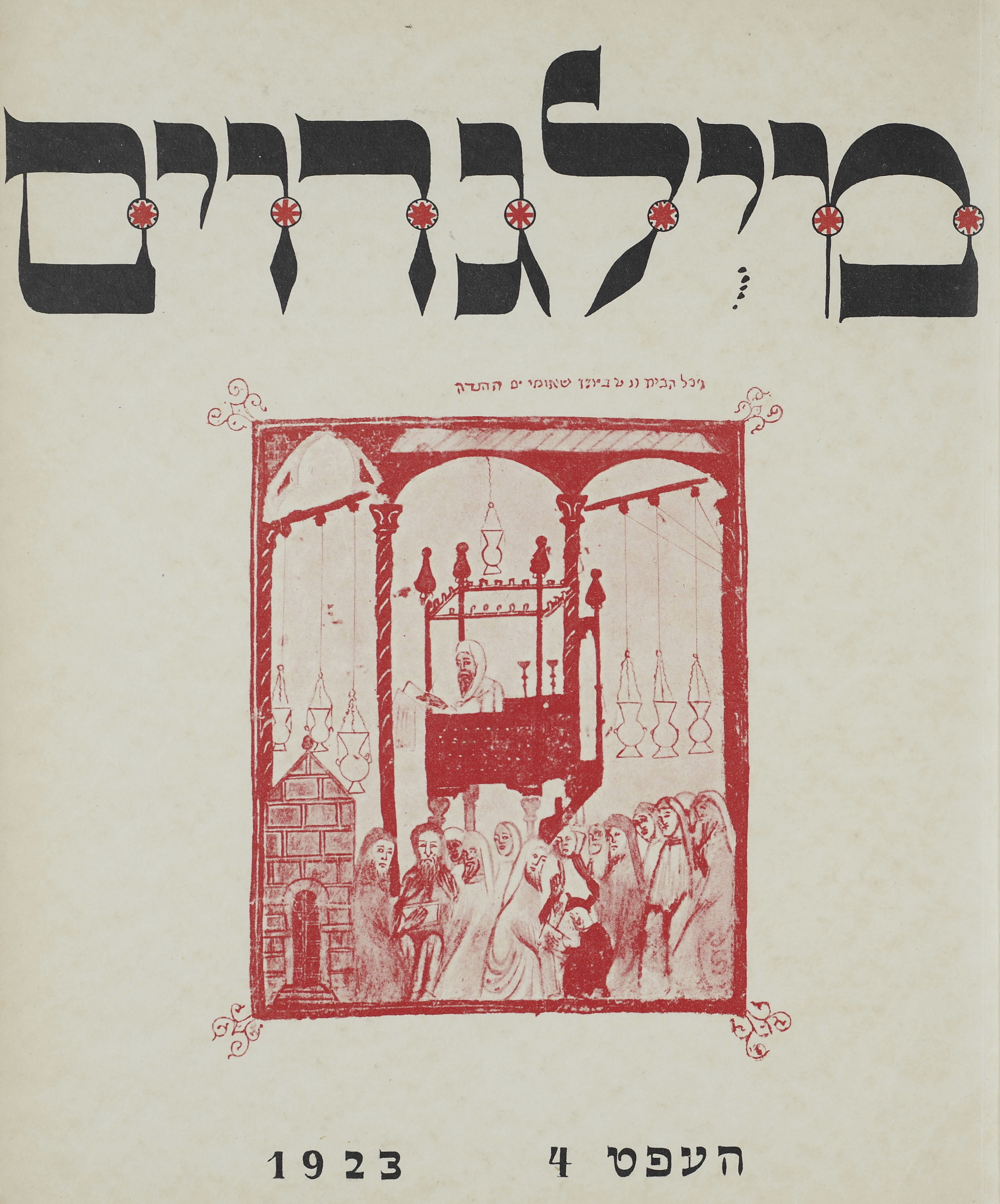
“מיר האָבן אויפֿגעגריסן דעם צוויי-הונדערט-אַכט-און-פֿערציק-שטאָטיקן מגדל פֿון די גרינע טאָלנדיקע פּלעצער, אים אײַנגעטונקען אינעם עטנע-קראַטער פֿון דער מענטשישער נשמה און אויסגעקריצט מיט אים אויף הימלען פֿון אויגן – א ו מ ר ו -.” פּרץ מאַרקיש, כאַליאַסטרע 1, 1922. 1 1Perets Markish, Khalyastre, 1, 1922: 1.
“We tore down the two-hundred-forty-eight limb tower from the verdant, hollowed city-squares, submerged it in the Etna crater of the human soul, and carved with it onto the heaven of the eyes a single word – U N R E S T – .”
Di khalyastre (The Gang) was a fleeting yet fervent phenomenon in the landscape of modern Yiddish culture. During its two-year existence (1922-1924), members Peretz Markish, Melech Ravitch, and Uri Tzvi Grinberg managed to come together in Warsaw and produced an ample amount of poetry, prose, manifestos, programmatic writing, and journals before splitting over ideological differences. The above quote, taken from Markish’s opening proclamation of Di khalyastre’s eponymous journal, provides a sense of the group’s poetics: using graphic, visceral, often profane language to express acute anxiety alongside messianic hopes of redemption. In the quote, the poets tear a monumental bodily-structure away from its surroundings, submerge it in volcanic soul-matter, and then use it to carve onto their inner eyelids a single word – u n r e s t.
Di khalyastre was part of a transnational, interdisciplinary nexus of writers and visual artists who were bound by mutual rejection of tradition and a zealous search for a new Jewish aesthetic. Members of the Yiddish avant-garde worked in cultural centers across Poland and the Soviet Union and were as occupied with art’s formal concerns as they were with its national function. This dialectic relation between the Universal and the Particular was the movement’s raison d'etre. It also explains its transitory nature—the inability to reconcile the two ends in an increasingly nationalist political climate. Despite being situated on the margins of the broader historical avant-garde movement, the Jewish avant gardists were up to date with the latest modernisms, namely German expressionism and Russian cubofuturism; they maintained close ties with contemporaries in Western Europe and across the Atlantic (think Milgroym in Berlin or Di yunge or In zikh in New York); and were in conversation with other oppressed minorities. Leyb Kvitko’s 1922 translations of Belarussian and Ukrainian folktales are a telling example of a gesture that both celebrates neighboring vernacular cultures and implicitly promotes related struggles for national determination.
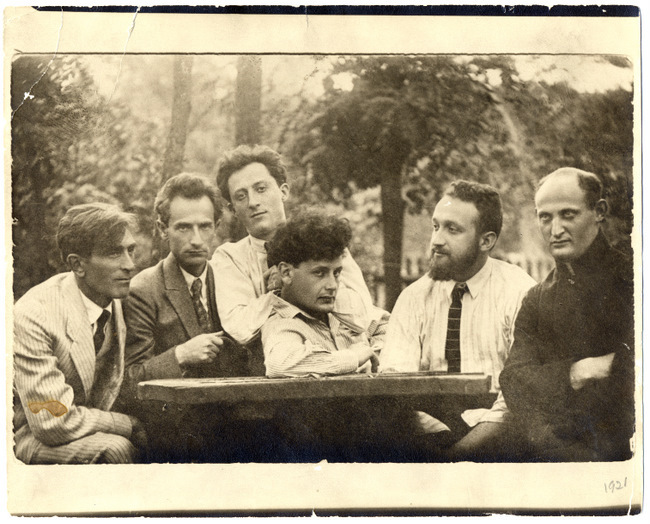
The Khalyastre: Mendl Elkin, Peretz Hirschbein, Uri Zvi Greenburg, Peretz Markish, Melech Ravitch, and Israel Joshua Singer, Warszawa, 1922. Image via YIVO.
The multifaceted phenomenon of the Yiddish avant-garde holds a borderline mythic status among scholars—a short lived, often contradictory utopian project whose protagonists all tragically perished. 2 2Well, most of them. Seth Wolitz placed the movement within the comparative context of European modernisms and set the tone for future scholarship. Avraham Novershtern and David Roskies contributed to the mystique of the interwar Yiddish avant-garde by highlighting its apocalyptic tone and messianic drive. Other crucial contributions were made by Gennady Estraikh and Michael Krutikov whose journalistic work within the USSR and subsequent academic careers recovered and mapped the body of literary work that was produced by Soviet Yiddish writers. Their invaluable editorial work for Studies in Yiddish continues this effort with volumes dedicated to key figures, literary centers, and genres. Their list of contributors brings together American and European scholars such as Harriet Murav, David Shneer, Amelia Glaser, Karolina Szymaniak, and Sabine Koller, to name a few. Their work considers transcultural and multilingual contexts and centers, theoretical frameworks, uncharted institutional histories, and overlooked interdisciplinary relations. Annual programs commemorating “The Night of the Murdered Poets'' attest to continued fascination with the Yiddish avant-garde. Recent memorial services were held by the Congress for Jewish Culture, the Jewish Museum in Berlin, and even indie bookstores, and attest to a growing sense of vigilance outside the academic setting. Indeed, the martyrology of the phenomenon proves relevant as democracy is being weakened worldwide.
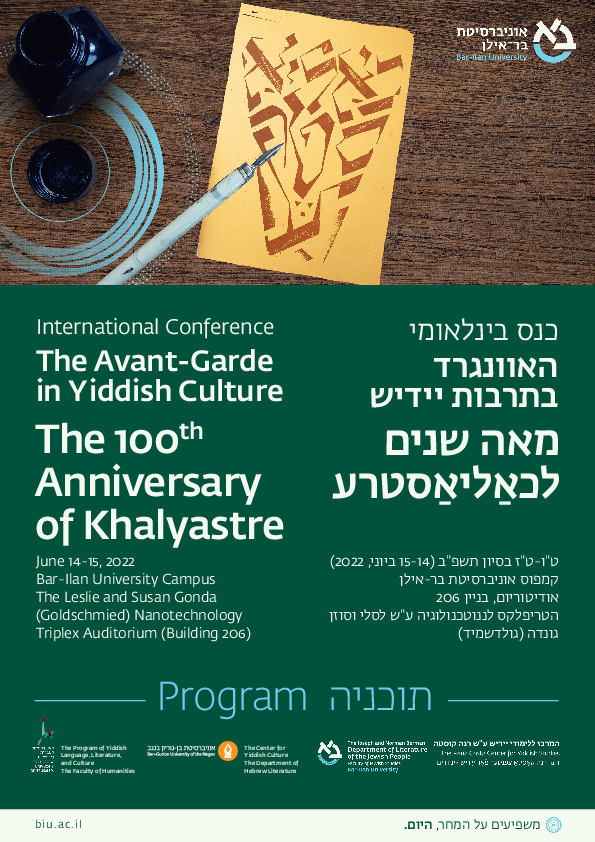
Prof. Nathan Cohen (Bar Ilan University) and Prof. Roy Greenwald (Ben Gurion University), co-organizers of the conference “The Avant-Garde in Yiddish Culture: The 100th Anniversary of Khalyastre,” are keenly aware of the larger-than-life status that the Yiddish avant-garde holds in scholarship and amongst the Yiddishist community. Cohen has written extensively about Warsaw’s literary organizations during the interwar period, 3 3 Nathan Cohen, Sefer sofer ve-iton [Book, Writer and Newspaper] (Jerusalem: Magnes Press, 2003). while Greenwald’s reading of Markish’s Di kupe 4 4 Roy Greenwald, “Pogrom and Avant-Garde: Peretz Markish’s Di Kupe,” Jewish Social Studies 16, no. 3 (2010): 65–84, https://doi.org/10.2979/jewiso.... offers a crucial analysis of Yiddish culture’s most gruesome modernist dirge. 5 5 Seth L. Wolitz, “A Yiddish Modernist Dirge: Di Kupe of Perets Markish,” Modern Jewish Studies Annual, no. 6 (1987): 56–72. Yet the two-day program that they put together at Bar Ilan University makes clear that they were not content to settle for a festive yahrzeit that would further aggrandize these writers. Rather, they sought to demythologize and diversify the discourse around the topic. The conference brought together academics, independent scholars, and archivists, mostly from Israel, with some representation from the US and Europe. Their presentations spanned visual culture, linguistics, thematic and stylistic aspects, ideological contexts, and even methodology. The diverse range of topics underscores the organizers’ priority–to follow the subject matter’s inherent heterogeneity. To that end, a few presentations in particular illuminated the ideological, thematic, and aesthetic strands of the Yiddish avant-garde by bringing new, relevant perspectives into the conversation.
Elaine Wilson, a PhD student at the Slavic Department of Columbia University, chose to tackle none other than Markish’s Di kupe by situating it in dialogue with Andrei Platonov’s Russian novella Kotlovan (The Foundation Pit). This juxtaposition reveals a mesmerizing mirror image: one’s towering mass grave is reflected in the other’s underground massive grave. Wilson demonstrated how both works, though separated by time and genre, employed a similar poetics of deconstruction to critique, complicate, and eventually dismantle hegemonic structures. Her argument resituated the poem’s protagonist–the mound–as a queer edifice that defies patriarchical order. Drawing on Sara Ahmed’s theory of queer phenomenology 6 6 Sara Ahmed, Queer Phenomenology: Orientations, Objects, Others, 2006, https://doi.org/10.1215/978082.... and Elissa Bemporad’s “Legacy of Blood,” Wilson showed how the mound embodies a normative deviation. Consider the opening verse, an orgy of dismembered body parts, oozing with eros and decay:
ניט! לעק ניט, חלב הימלשער, מײַנע פֿאַרפּאָפּטע בערד,
פֿון מײַנע מיילער כליוּפּען ברוינע ריטשקעס דזיעגעכץ,
אָ, ברוינע ראָשטשינע פֿון בלוט און פֿון געזעגעכץ,
ניט! ריר ניט דאָס געברעך אויף שוואַרצער דיך פֿון דר'ערד.
No! Celestial milk, do not splash my spattered beard,
Out of my mouths pour brown streams of tar,
Oh, a brown dough of blood and dust,
No! Do not touch this cavity in the black thigh of the ground.
Where Wolitz and Novershtern previously emphasized projectile bodily fluids as acts of defiance, Wilson emphasizes orifices. Where Greenwald traced the mounds upward geometric trajectory as a way out of history, Wilson follows its crumbling motion as it becomes a hollow cavity. Instead of fixating on male gods - "יהוה, כריסטאָס און אַללאַ!..." - Wilson encourages the reader to reorient herself to the gender-fluid ".מלכה-באַרג" The accumulating impression renders monotheism, historical progress, and even revolution, as hegemonic structures that must be subsumed in favor of a different matrix altogether. Wilson applied the same framework on the discursive level; her analysis proposed an alternative perspective to the lineage of scholarship that has shaped our understanding of Markish’s poetics.
A paper by Leah Gilula, a historian and the director of the The Israel Goor Theatre Archive and Museum, offered a presentation that was an unconventional inclusion in an academic conference program. In a talk titled “Avant-Garde in Boxes: Yiddish Treasure Troves,” she gave an introduction to the Israel Goor Theatre archive. Hardly anyone at the conference had previously heard of the archive’s existence, which speaks to how crucial such pragmatic presentations can be. Gilula was concise and thorough, quickly moving into the heart of the matter – the plethora of primary sources that have not yet been researched: plays, memoirs, and autobiographies that are effectively unexplored and kept off the grid due to lack of institutional resources. A designated category for GosET (Gosudarstvennyij yevrejskij teatr) — the Yiddish state theater in the Soviet Union of the interwar period — is an example of sources that prove highly relevant at a time where access to archives in Russia and Ukraine is ethically contested or simply precarious. Other collections include posters, photos, and models of stage design that urge scholars to consider the role that Yiddish played in visual and material production. As the presentation went on, it became clear that even niche topics have their margins. Whether historical or historiographical, Gilula’s presentation was a reminder that marginalization is an ideological endeavor. The organizers’ decision to skirt the center by shining a light on an overlooked archive testifies to their deep understanding of their role – to approach both past and present with radical criticism.
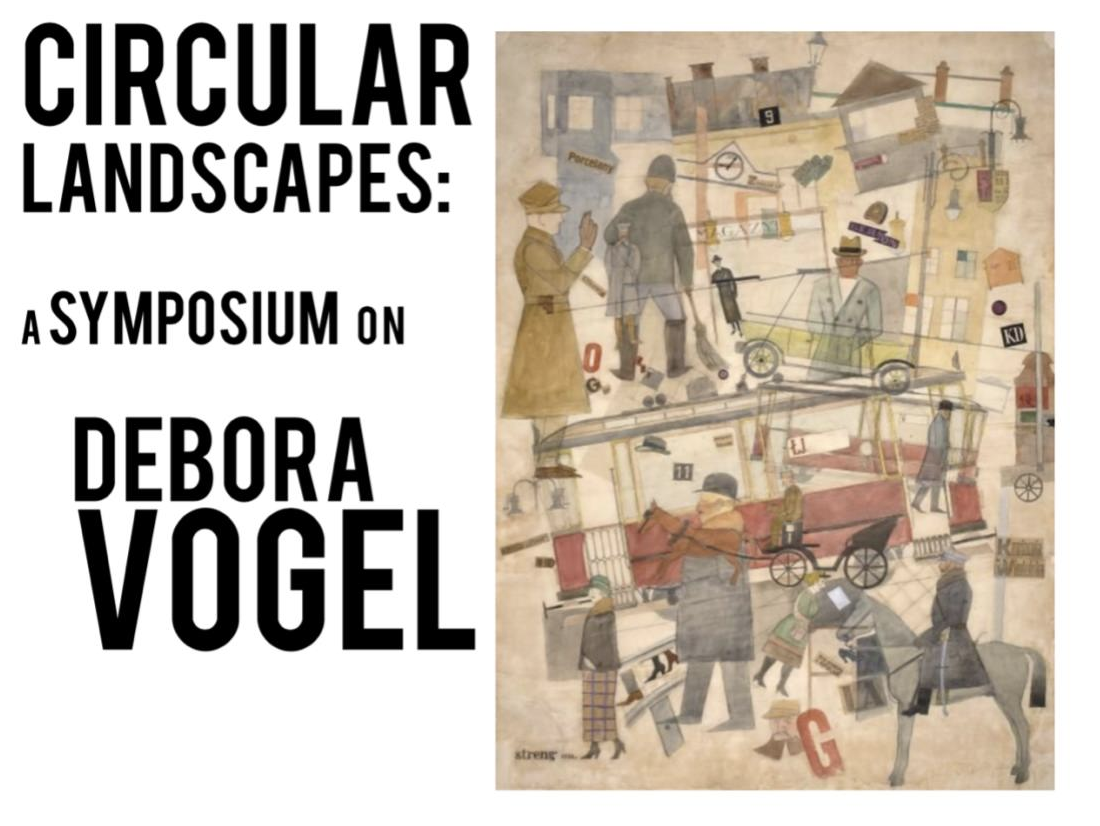
Yael Levi’s paper on Devorah Fogel revealed a type of poetic radicalism that can only be the result of an enduring and intimate encounter with the material. A postdoctoral fellow at The Halpern Center for the Study of Jewish Self-Perception at Bar Ilan University, Levi recently published a bilingual Yiddish-Hebrew edition of Fogel’s poetry and lyrical prose titled The Spirit that Materials Bear. The book joins recent scholarship on the multilingual, Lviv-based art critic, theorist, poet, and author, whose work has been written out of the canon by virtue of her various marginalized identities: a Galician Jew and a woman who was committed to avant-garde experimentation.
7
7
Anna Elena Torres, “CIRCULAR LANDSCAPES: MONTAGE AND MYTH IN DVOYRE FOGEL’S YIDDISH POETRY,“Nashim: A Journal of Jewish Women’s Studies and Gender Issues, no. 35, fall 2019, pp. 40+. Gale Literature Resource Center, link.gale.com/apps/doc/A619742960/LitRC?u=anon~d8168165&sid=googleScholar&xid=ddcc6165. Accessed 13 Sept. 2022; Anastasiya Lyubas, Blooming Spaces: The Collected Poetry, Prose, Critical Writing, and Letters of Debora Vogel, Jews of Poland (Academic Studies Press, 2020); In geveb’s Special Issue on Fogel: https://ingeveb.org/articles/w....
Levi’s close reading of the poem ",די זון אין געלע גאַסן" elucidated Fogel’s fierce aesthetic stance – certitude in her means of representation which threatens the supremacy of real life. For Fogel, language was raw material that demanded manipulation, and it is through manipulation that she was able to reconstruct a realm often more desirable than reality. In the poem, an empty street with houses disintegrates into singular components of colors, material, and shapes. Fogel then uses language as the material with which she reconstructs the elements into an augmented, heightened figurative reality. It is precisely there that drama takes place: light becomes a sticky substance, glass becomes watery, and the sun becomes a burning lion, a sun-lion to be exact, that wanders through the empty streets. Fogel’s manipulation is so virtuosic that at its best she herself becomes disoriented. She ends the poem with an aesthetic question of the highest order: why would anyone prefer a real lion over the sun-lion?
צו וואָס נאָך גיין
צו אַ צווייטן לייב מיט הענט און פֿיס.
די זון איז אַ לייב. אַ הייסער. און שלעפּט אין גאַסן.
Why go
To another lion with arms and feet
The sun is a lion. A hot one. And dragging through streets.
Levi’s paper asserted that Fogel’s radicalism was not stylistic but the result of a severe ideological stance that disregards hierarchy and considers art on par with life. Indeed, it is the same severity which Peter Bürger identified at the heart of the avant-garde gesture – to bring art into the praxis of life.
Markish, Greenberg, Ravitch, Fogel, and their allies varied in style and political affiliation, to mention the least of their differences. It was through Yiddish that they made normative frameworks questionable.
One hundred years later, the affective implication of this gesture is still unmistakable – א ו מ ר ו.