May 15, 2025
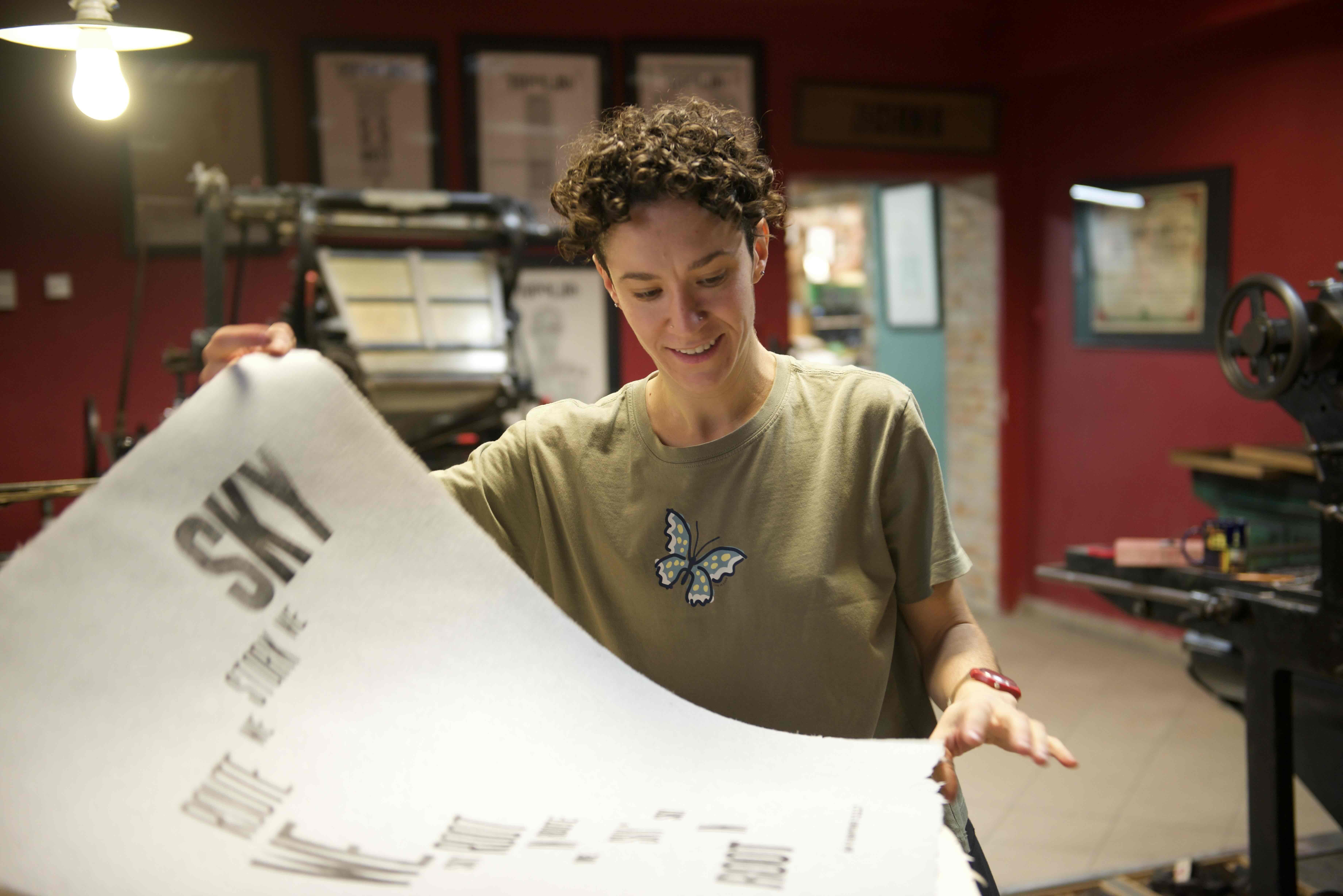
emet ezell pulling a print.
INTRODUCTION
I was thrilled to encounter ezell’s work as a fellow Jewish printmaker and resonated with their desire for, at once, a connection to the past that holds the immensity and specificity of loss, and alongside this, their yearning for — and working toward — a more livable future. With a touch of lovely diasporic irony, ezell and I connected virtually between the U.S. and Germany to discuss the very tactile topics of type setting and navigating the intense physicality of return to an ancestral land.
ER-F: emet, Destruction Is and Is Not Forever speaks to your familial, but also communal, history of the deportation of Jews from the Baltics in May 1915. This is a history of displacement often left out of dominant narratives. What background is important for contextualizing these events and how did you come to your own understanding of this history?
EE: A few years ago, I received a phone call from my mother’s cousin. I had just moved to Germany, and I remember that it was spring, cherry blossoms bursting into pink loofahs. Prior to this phone call, I was unaware that my mother even had a cousin. Like many of us, I had inherited stutters and holes regarding my family’s origins. No one could meaningfully tell me where I was from. In all directions, amnesia. Yet my mother’s cousin, Mark Blumenthal, generously sent me scans of family photographs and documents. He also gave me the name of our ancestral village: Sabile, Latvia. From that moment on, the land propelled me.
I began to probe national archives and historical scholarship, straining to comprehend the gaps. What geopolitical forces led to my family’s expulsion? What had become of our home, our land, our ritual objects? Through research, I learned that the retreating Russian military ethnically cleansed 200,000 Jews from the Baltics in May 1915. These deportations were part of larger efforts to ethnically reconstitute the entire region.
In the heat of World War I, Jews were deemed an ”enemy nation,” a venomous force hidden within the Russian Empire that needed to be plucked out, cordoned off, disciplined, and removed. Frequently, Jews were blamed for collaborating with the Germans, imagined as untrustworthy spies. Through a series of violent pogroms, Russian soldiers burnt down Jewish homes, looted property, and gouged out the eyes of hostages with spoons. At the time of these deportations, Sabile contained roughly 130 homes and a sizeable Jewish population. My ancestors were sent to labor camps in Russia’s interior, their homes raided, and their precious objects stolen. Across the Baltics, these deportations were carried out on Shavous.
As you noted, this history remains largely unknown, eclipsed by the Holocaust and other subsequent maelstroms. Even still, the 1915 deportations were the largest case of forced migration before World War II, impacting not only Jews, but also Germans, Poles, and Muslims in various border regions. The number of displaced civilians has been estimated between five and six million. Scholar Eric Lohr argues that the Russian Empire’s campaign of ethnic cleansing was meant to transform the multiethnic Russian Empire into a homogeneous “nation-state.” 1 1 Eric Lohr, Nationalizing the Russian Empire: The Campaign against Enemy Aliens during World War I. Harvard University Press, 2003. Although the Russian Empire collapsed shortly thereafter, an independent Latvian Republic was established following these deportations, only later to be occupied by Nazi Germany and then forcibly incorporated into the USSR. When I look at this stretch of time, I see the ways in which ethnic cleansing and nation-state formation remain indelibly linked.
For most of my life, major events in my family were obscured. I am not alone in this. Pain has a way of evading language, re-surfacing in gestures that defy the acts of speech. But the land itself spoke to me. In the summers of 2023 and 2024, I travelled to Sabile for artist residencies at Pedvāle International Art Park. These residencies initiated much of my writing, bringing me into direct contact with soil and sky. I came to conceptualize this project as deportation’s afterbirth. Here I was, a hundred years later, returning to deliver the placenta.
ER-F: Another way you have described this project is that you’re processing history through a series of transmutations, first into poems and then poems into visual printed works. How did interpreting these themes through these creative modalities change your understanding or relationship to this history? Were there specific cultural lineages or archival source material that you drew from in your conceptualization and writing for this project?
EE: These transmutations were multi-directional. First, I put myself inside of the land and the land inside of me. I stuffed yarrow into my mouth, a medicinal plant which grows in abundance through Sabile’s hills and valleys. I ran after giant storks, who circled the horizon in cosmic bleat. I attuned to a song that could no longer be heard; and yet, the song was everywhere, rising with thrumming joy and sorrow to greet me. Simultaneously, I scoured newspaper articles, legal texts, historical scholarship, and family correspondences. In this way, I absorbed information from multiple times and worlds, my ancestors ringing the sky. I shaped these transmissions into a book of poetry entitled Wretched Heaven, an auto-ethnographic work that maps my family’s dispossession and my subsequent return to Latvia.
The next transmutation occurred in Lublin, Poland. For centuries, Lublin was a vibrant center of Hebrew printing and bookmaking. The city was home to worlds of Hassidic learning, study, and song—site of the famous Chachmei Yeshiva Lublin. Those worlds have been utterly ravaged; in Lublin, I work inside the ruins, paddling across the cobblestones of the old Jewish ghetto. In many ways, papermaking and typesetting have allowed me to preserve forgotten techniques through practice. I place myself in anachronistic parallel with Jewish typesetters and Yiddish printers. While in Lublin, I took poems from Wretched Heaven and rendered them into visual and tactile form. I designed, typeset, and printed each piece, working with both Polish and Hebrew typefaces. I used the Hebrew typefaces to print secret Kabbalistic names of God into the poems, charging each work like an amulet.
Many of the machines and letters with which I work are over a hundred years old. Handling these tools drops me into a visceral and specific history, one that is material rather than abstracted. Typesetting thrusts me into a physical exchange with language, it’s weight and history. With the letters in my hands, I touch a time that otherwise remains occluded by the shiny plastics of modernity. We cannot return to the past, but the past can still reach us.
By far the most important source material for this project has been the Pinkas Khevre Kadisha of Sabile, which I found preserved and digitized by the Russian State Library in Moscow. Working in tandem with my partner, Avinoam Stillman, we transcribed and translated this manuscript from its original tangle of Hebrew and Yiddish. The Pinkas is written entirely by hand, swirls of cursive crisscross the folds. Working with this Pinkas has allowed me to resurrect distinct details from Sabile’s vanished Jewish world. I then condense and transmute those details into poetry.
ER-F: What is a Pinkas, for those hearing this term for the first time? How are these manuscripts related to and unique from other Jewish textual modalities? What parts of Jewish communal life do pinkasim in particular offer us windows to as contemporary readers?
EE: A pinkas is a handwritten notebook that records the everyday activities of Jewish communal life. Midwives, businessmen, rabbis, and, in the case of Sabile, the Khevre Kadisha [Burial Society]—kept their own pinkasim. The notebooks functioned as both a legal record and communal diary. They are full of human detail and variation, carrying snippets of gossip, halachic discussions, and lists of names. In many ways, they reflect the social architecture of a Jewish world erased. The historian Elisheva Carlebach describes pinkasim as an episodic literary form that spans both individual and communal modes of writing. 2 2 Elisheva Carlebach, “Character and Community: Aspects of Jewish Identity in Early-Modern Germany,” in Rachel Blumenthal, Daniel M. Herskowitz, Kerstin Mayerhofer, eds., Constructing and Experiencing Jewish Identity (Paderborn: Brill Schöningh, 2022), 79-89. In this, pinkasim are a unique literary style, one that falls outside the more traditional realms of religious text or legal record. In a time of ever-increasing homogeneity, pinkasim offer a rare glimpse into the diverse ritual practices and traditions that were specific to each place and to each community.
My suspicion is that the Pinkas Khevre Kadisha of Sabile was one of few objects smuggled out of Sabile when the Jews were deported, and that the manuscript remained in Russia thereafter. Written in a mixture of Hebrew and Yiddish, the 200 folios of the manuscript begin in 1789 and end abruptly in 1915.
The text itself records Sabile’s distinctive burial customs as well as communal anecdotes.
The Pinkas begins with specific instructions regarding the digging of graves. “It is forbidden to leave a grave open until the next day. On the day of digging, you must bury the dead. There is great danger in this matter,” reads the Pinkas. Sabile’s tradition was to chose one scribe for the entire year. At Rosh Hashannah, the community would vote on the next scribe. My family’s signatures are scattered throughout, attesting to their involvement in the ongoing work of washing the dead. Scrawls of Blumenthal, Blumenthal, Blumenthal for centuries.
In the wake of the destruction caused by both World War I and World War II, it is a miracle that this pinkas survives. In one particularly moving entry, the Khevre Kadisha describe their yearly fast on the 15th of Kislev (Winter Solstice). At the same time as their Latvian neighbors would perform surviving pagan rituals of feasting, drinking, and masquerade, the Khevre Kadisha in Sabile would prostrate on the graves of the local tsadikim and chant slihot. When I imagine these overlapping and intertwined worlds, I am deeply moved.
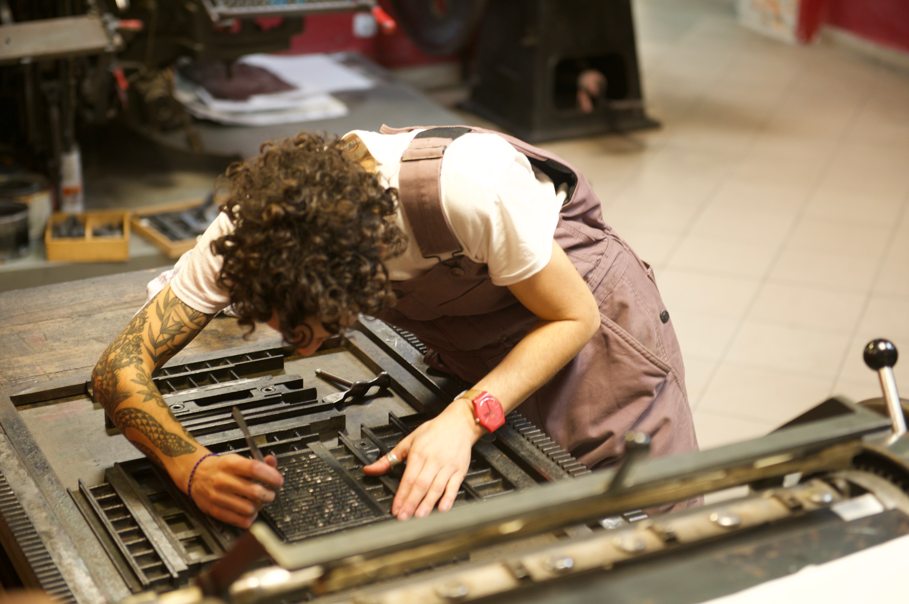
emet ezell adjusting the form
ER-F: Incredible. And the richly detailed “social architecture” of the pinkasim then becomes the scaffolding for building your own relationship to this world through your poems. I want to return to your physical process of giving these poems visual form through letterpress printing. Traditional typesetting and printing is in itself a lineage with a long history of knowledge passed from mentor to apprentice. How did you come into this practice and who transmitted this knowledge to you?
EE: The soul knows how to find what it’s looking for. Unbeknownst to me, my soul was looking for typesetting—for this physical and repetitive work with language. I came into this practice while visiting Lublin, Poland, in 2023, on the invitation of curator Tal Schwartz. During a tour at Dom Słów, a local museum focusing on historical book printing and manufacturing, I met the Polish typographer Robert Sawa. Standing beside him, my energetic field was flooded with relief, as if, after years of panting, I could finally breathe.
There’s much to be said about the mysterious alchemy of a mentor. How silence generates meaning, how secrets click into place. For the past two years, Robert has taught me the forgotten craft of typesetting, pushing me beyond my own limits with total precision and attention. We work in silence and grunts, a broken English between us. Not everything is understood through speech; rather, wisdom resurrects through repetition, Robert’s hands instructing my own. I am indebted to him the way all artists are indebted to their masters; every work I produce bears his trace.
ER-F: The mentorship role you describe here goes beyond passing on technical skills to encouraging your personal relationship to the type. This emphasis on a dialogue with the type resonates with my printing practice. What looks like a slow, monotonous practice can be incredibly dynamic under the surface, with the unique physical engagement with the letterforms opening new ways of understanding familiar words and phrases. Can you take us inside your printing process and what it offers to your relationship to writing alongside this history?
EE: Like you said, manual typesetting is an inherently physical and repetitive practice. I pluck each individual letter from heavy font drawers, locking them into what is called a composition stick. These leaden letters become lines of language, which I then slide onto a composition table. Not only must I arrange the letters, but also the space between each letter, and the space between each word, each line. As language disintegrates into leaden blocks, the meaning of the poem evaporates. With great effort, I abandon sign and signifier and hurtle, instead, into a more visual dimension. Words are arranged upside down and in-reverse. Letter by letter, line by line, the poem begins to congeal. The composition takes on a mystical exchange and a contemplative tempo opens. In this, the practice mimics the ritual of prayer. Back and forth, back and forth, my body concatenates past and present.
Once I’ve arranged the poem, I slide the form onto a metal tray and carry it across the studio to the bed of the printer. I must lock everything into place. It is suspension and pressure that allow the alphabet to speak. I ink the form with a roller and print my proofs. I check for errors, engaging directly with the type. I ask the letters what they need; they hum a song back to me. I almost always have spelling errors. As Robert frequently tells me, “It takes at least an entire day to recognize mistakes.”
I remain mesmerized by the phenomenon of typesetting, how the alphabet accumulates a material history that is then reflected and refracted through print. Language bruised by experience. The human being stands between mirrored worlds: one outside and one within. It is language that allows us to transit between the two, hidden and revealed, allowing the invisible and the visible to touch. (I wrote about this at greater length for The American Poetry Review in an essay entitled “Letter the Language, Language the Letter.” That essay will appear in their next issue, Vol. 54, No. 4).
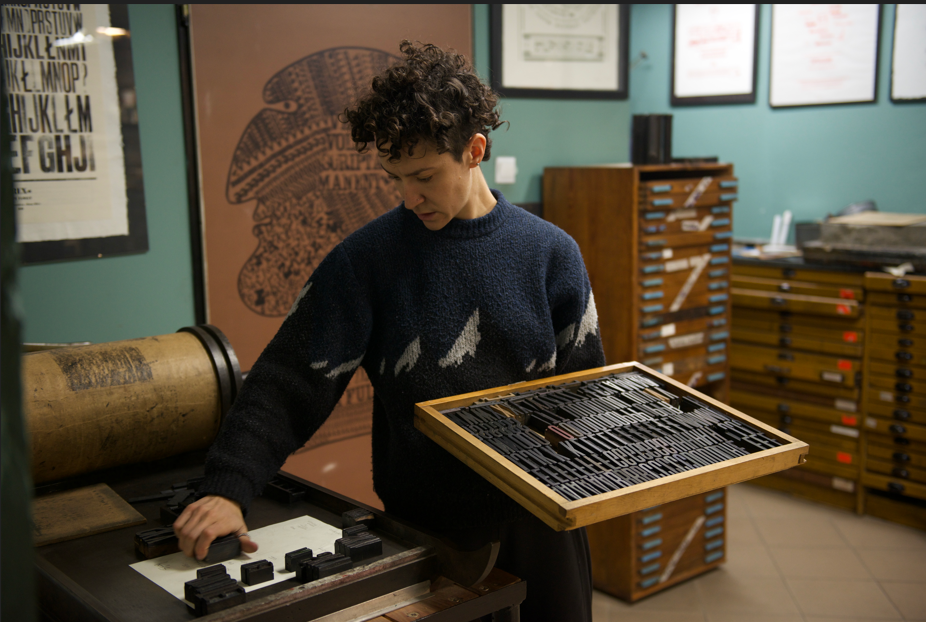
emet ezell pulling wooden letters
ER-F: You are sharing your typographic prints as part of an exhibition in Sabile in the Jewish Community’s abducted synagogue, which now functions as a professional art museum. What are your hopes and intentions for the kinds of encounters with the past that this exhibition and the accompanying events will foster for those attending? How can folks throughout the diaspora engage with this work and follow along with this beautiful, site-specific event?
EE: The synagogue was constructed by the Jewish community in 1890. In 1941, German and Latvian soldiers set fire to the shul. Under Soviet Occupation, the synagogue became a warehouse for storing vegetables and fruit. When the Soviet Union fell, the building was purchased by sculptor Ojars Feldberg, who restored the synagogue with funding from the European Union. Now it belongs to the Talsi Municipality and functions as an art gallery and cultural center.
It is my deepest prayer that this exhibition subverts, transcends, and offers a corrective to the extractive system of colonial memory-making. The violence of national conquest cannot be disappeared. It does not go away. Nothing resolves. What, then, remains? How to inhabit the ruins?
The exhibition will open to the public on May 15th, on the 110th anniversary of the Jewish community’s deportation. It will be followed by a performance. The performance is, itself, a prayer—a closed Friday Night Kabbalat Shabbat ceremony and dinner. On May 16th, about thirty people from all over the world will come (by invitation, only) to Sabile’s abducted synagogue in rural Latvia to daven with me. Acting as chazan, I will lead a traditional prayer service, resurrecting sounds that have not been heard in over a century. Our voices will fill the synagogue and then disappear.
My intention is for the performance to offer a foil to the violent theft of my family’s home, property, land, and communal practices. It is also an attempt to reshape dialogues on Jewish culture and heritage, upending the ways in which our histories have been co-opted and suppressed for imperial conquest and nationalist myth. By deliberate choice, there will be no photographic or video documentation of this ritual.
The exhibition will run from May 15th through July 15th, a time that coincides with the seasonal migration of white storks from occupied Palestine to Latvia. All summer long, the storks will be raising their young in giant nests; by August, the birds will return to the Jordan Valley. I follow these storks to trace, among other things, the intersection between ecocide and genocide, and the relationship between ethnic cleansing and State formation. Last year, the storks arrived covered in ash, their wings carrying war’s gray debris: bombs over Lebanon, Syria, Palestine, Ukraine. What do these storks know about genocide and gentrification? Can I mimic their rhythms, their clicking of beak?
I’ll be sharing updates and press from the exhibition in my personal newsletter, but I am also beginning to dream into the exhibition’s migration, where it might go next. What museums or collections might be appropriate for these delicate works on paper? What conversations might emerge from this research and place-based production?
In developing Destruction Is and Is Not Forever, scholar Eve Tuck’s essay, “A Glossary of Haunting,” 3 3 Tuck, E., & Ree, C. (2016). A glossary of haunting. In Handbook of Autoethnography (pp. 639-658). Taylor and Francis. has been my guiding theory. I first came across Tuck’s work in a reading group facilitated by Sanabel Abdelrahman in Berlin, Germany. As Tuck defines it, “Haunting is the cost of subjugation. It is the price paid for violence, for genocide.” (Glossary of Haunting, 643). In other words, nothing is over when it’s over. Return of the relentless ghost. In Latvia, I am the ghost. I am the thing that was not supposed to come back and yet, I keep resurfacing. At the same time, this history haunts my family, coming out sideways in erratic behavior and stilted silence. “Haunting is both acute and general,” writes Tuck, “individuals are haunted, but so are societies.” (Glossary of Haunting, 642). Oh, haunted world. We can all gauge our eyes out with the wreckage of the past. With Destruction Is and Is Not Forever, I wanted to do something more complex, something full of the ambivalences that I myself experience in Latvia. I wanted to enact what Tuck describes, to “wrong the wrongs” of history.
This exhibition activates complicated entanglements—the double-helix of defacement in Sabile itself. The poetry interrogates the visceral ways in which ecocide and genocide overlap—the violence in the land and the violence in the people. These forces cannot be separated. In fact, they persist, metastasizing in ever ebullient forms. Refusing to calcify, Destruction Is and Is Not Forever ends by boomeranging towards the present.
Hear now, the storks in the sky.
ER-F: Can you leave us with a pinkas excerpt and your companion poem?
EE: Yes! Attached below is an excerpt from the Pinkas (folio 82r-82v), translated by Stillman. The excerpt is from the final will of Kalman Ben Yosef Leuchter, transcribed on the day before Pesach 1915, just moments before the community’s deportation.
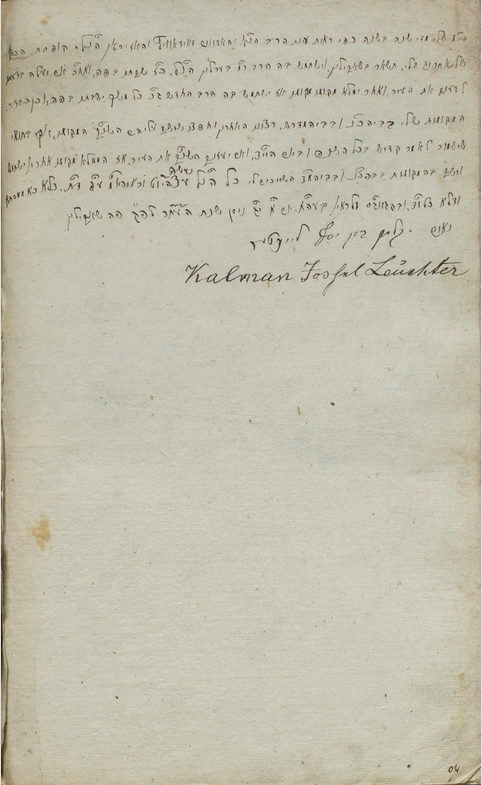
Sabile Pinkas Hevra Kadisha f. 82r-82v
… this is my final desire, which I decided with a clear and settled mind and a willing and generous spirit: my silver etrog box, the silver box of my etrog, shall remain in Sabile. and the Rabbi, Rabbi Meir Berlin, shall use it as long as he remains in dwelling here. and afterwards, if it occurs to him to abandon the city, and another Rabbi shall fill his place, then the new Rabbi shall also use my etrog box for as long as he dwells in this place, and so on and so on and so on forever.
as for my seats in the synagogue and in the study hall, my last desire and greatest yearning is that the local shochet shall sit there, but only on condition that he be careful to say Kaddish all year and on the day of my Yartzhiet. and if the shochet shall leave Sabile, then the one who fills his place shall use and sit in these seats, which belong to me.
all the above has been done on the day before the holiday of Passover, Sunday the 13th of Nisan in the year 1915 here in Sabile.
Sealed,
Kalman Ben Yosef Leuchter
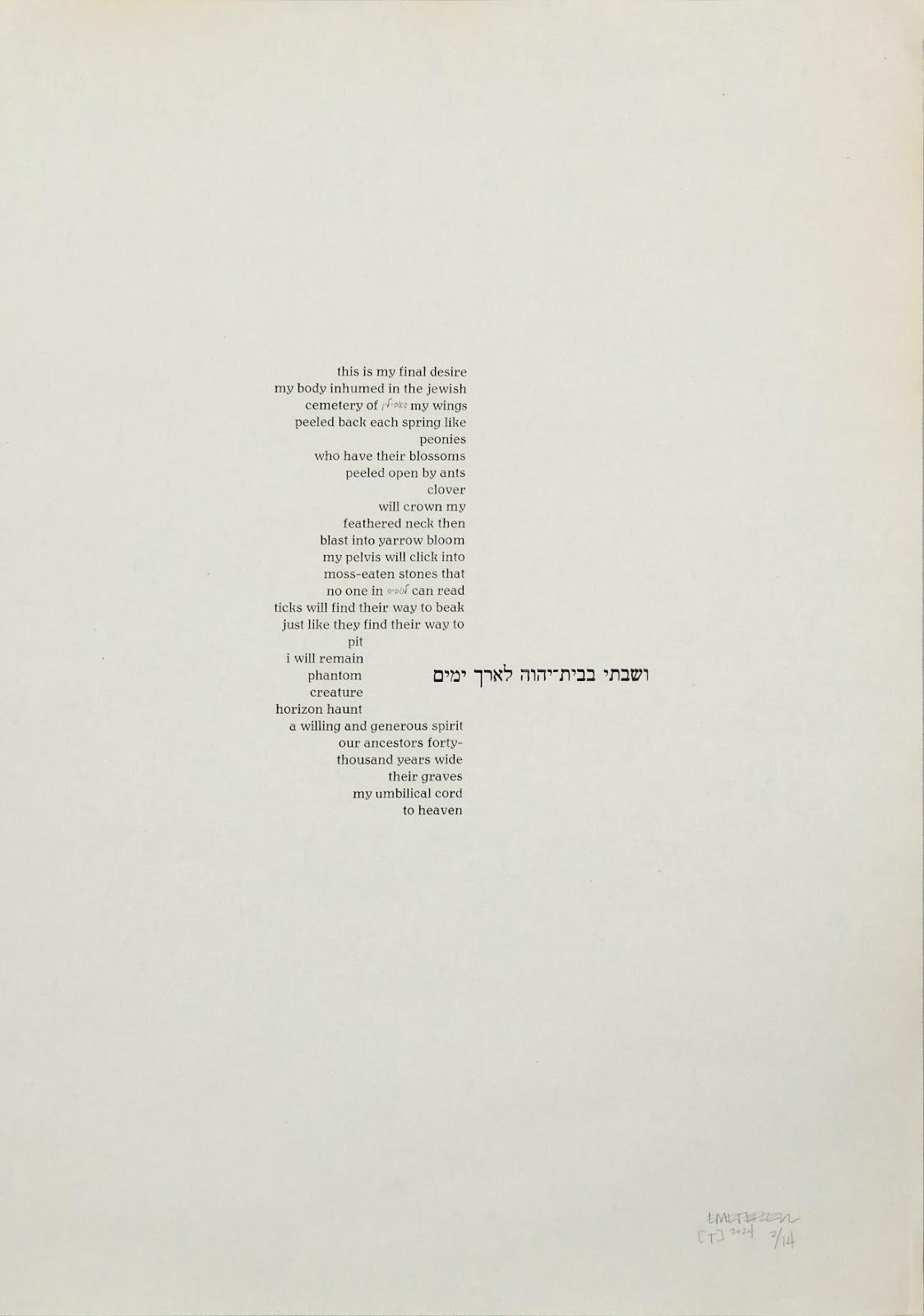
And I Will Dwell in the House of the Lord Forever, 2024
490mm X 700mm, edition of 14.

In geveb is turning t(s)en! If we want In geveb to continue to grow and thrive and remain a central address for the study of all things Yiddish online, we need your help to launch our second decade. Our goal is to raise $20,000 by our official tenth birthday: August 15, 2025. We invite you to donate to support In geveb and to honor everyone who has got us this far.