Dec 19, 2025
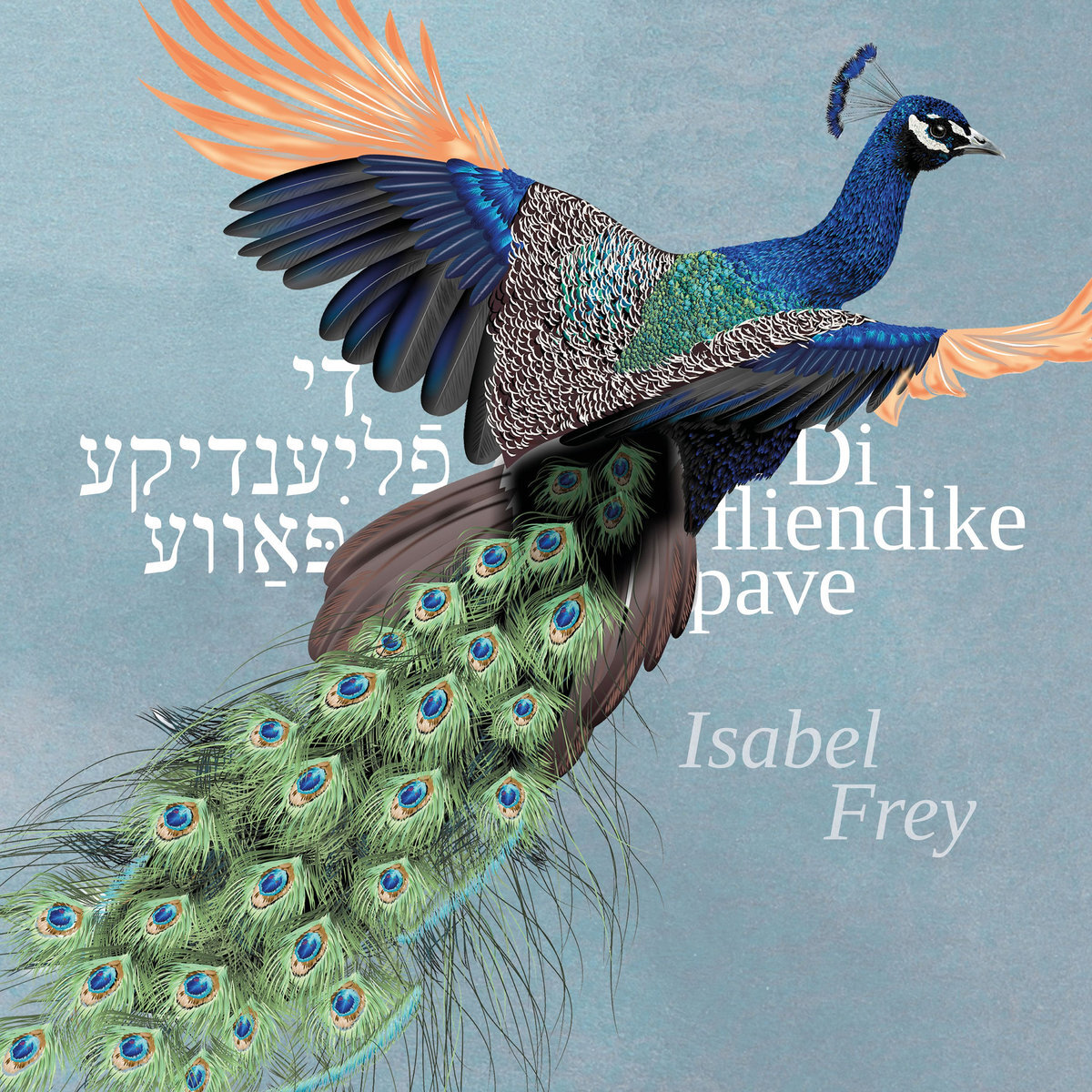
Isabel Frey, Di fliendike pave די פֿליִענדיקע פּאַװע. Borscht Beat, 2024.
About a year ago, I received a very exciting brown paper envelope in the mail. By some miracle this envelope had traveled all the way from Vienna, and had safely arrived at the doorstep of my poorly marked apartment in Boston. Inside the envelope I found a copy of Di fliendike pave (The Flying Peacock), an album of Yiddish songs performed by 31-year-old Viennese singer/songwriter Isabel Frey, and released by Borscht Beat in October 2024. Do not be misled by the humble brown paper packaging: Di fliendike pave is a very ambitious project. Through Di fliendike pave, Isabel Frey shows the world what Yiddish song can be and what it can do:
1. Yiddish song can satisfy the high standards of the discerning Yiddishist. For the listener who is well-versed in yidishkayt, the album’s title serves as a reference to the “goldene pave,” or the “golden peacock,” an ambiguous but enduring symbol in Yiddish song and poetry, and to Yiddish cultural creativity more broadly. The imaginary golden peacock—sometimes described in Yiddish song as having a magically mellifluous voice—always seems to be on the wing. Her flight has been used to evoke longing for loved ones, exile, and delight in creativity.
“Di goldene pave” also brings to mind “di goldene keyt,” the golden chain: a symbol of Yiddish literary generations connecting one to the next. Variants of “Di goldene pave” have been used as titles for Yiddish literary collections such as Di gilderne pave: lider un ferzn (1949), and the recently re-issued The Golden Peacock: the Voice of the Yiddish Writer (2001). Evoking the “goldene pave” and its adjoining “goldene keyt” is fitting for Frey’s album, since the album acts as a curated survey of pieces from different generations of Yiddish song tradition, all the while carrying its own creative momentum. Frey takes her deserving place in the golden chain of Yiddish culture.
She brings many years of experience as a performer and researcher of Yiddish song to this recording. This is an album that Yiddish teachers and students should use and study for its deeply expressive language and wonderful repertoire. One discerning Yiddishist™, musicologist, and pianist Uri Schreter, in fact told me at a barbecue that Di fliendike pave is one of his favorite Yiddish song albums. But this album is not just for the in-the-know Yiddishist who dreams of golden peacocks at night…
2. Yiddish song can have broad appeal. With its tidy production and elegant presentation, Di fliendike pave also serves as a gateway drug for audiences new to Yiddish song. Its audience includes non-Jewish, Yiddish-curious Europeans, as evidenced by its nomination for the German record critics' award in the category of “traditional ethnic music.” As an outspoken activist and as the co-curator of KlezMORE Festival in Vienna, Frey is no stranger to representing her Jewish identity and her work as a Yiddish singer to a broader public, and she puts her sensitivity to use by selecting songs that simultaneously convey universal themes and gently deliver a full dose of beautiful Yiddish.
As a compilation for a wide audience featuring the work of one accomplished vocalist, Di fliendike pave follows in the footsteps of albums such as Martha Schlamme Sings Jewish Folk Songs (1957) and Theodore Bikel Sings Yiddish Folk Songs (1958), which have had lasting impacts as touchstones for representing Yiddish song to broader audiences at times when Jewish and Yiddish identity were in flux. (Schlamme and Bikel spent most of their lives and careers in the US but, perhaps not coincidentally, both were born and raised in Frey’s hometown of Vienna.)
The selection of songs on Di fliendike pave, like the tail feathers of the peacock on the stunning album cover by Myrte de Zeeuw, form a lovely array. The album includes original works by Frey and others, lesser-known traditional songs, and well-chosen chestnuts, with an emphasis on works by women. Frey assembled a group of highly skilled instrumentalists for this recording: Ivan Trenev (accordion), Moritz Weiß (clarinet), Zoë Aqua (fiddle), Benjy Fox-Rosen (bass, guitar, vocals), Alexander Yannilos (percussion), and the Styrian Klezmore Orchestra. Weiß and Fox-Rosen also contributed arrangements, and Aqua wrote one of the compositions. Frey delivers each song with exquisite clarity and confidence.
3. Yiddish song can lead one to dance and swoon. These songs are full of beautiful movement. One of the tracks that stood out for me was “Velosiped-nign” (Bicycle Nign), a peppy wordless tune that delightfully makes use of the sound of a bicycle bell. I also loved “Mayko mashmelon” (What is the Meaning), which features an unexpected, effervescent clarinet accompaniment that lends the song momentum.
I was also so, so excited to see “Langzam un likhtik” (Unhurried and Radiant) on the track list. This song, Frey’s stunning setting of a poem by Anna Margolin, has one of the most excellent melodies that I have ever heard. After hearing Frey perform it live at the Yiddish New York Festival in 2023, I was possessed by the melody of “Langzam un likhtik” for months. I felt like Leah in Der dybbuk, except during the Dance of Death I didn’t see Khonen’s face, I heard “Langzam un likhtik.” I remain obsessed. The motion of the melody is gorgeous and fits the moody, ecstatic lines of the poem perfectly. I can’t imagine a better setting.
Another stand-out track is the last one: “Azoy lang” (So Long), written by Beyle Schaechter-Gottesman and sung as a duet by Frey and her long-time mentor and collaborator Benjy Fox-Rosen, who also did the arrangement. In this track, Frey’s skill as a vibrant collaborator shines through most brightly. The warmth with which Frey and Rosen sing together shows that they are listening to each other, and hints at their deep communication and mutual trust. These are the qualities that give a recording the energy of a live performance, and make you want to listen again and again.
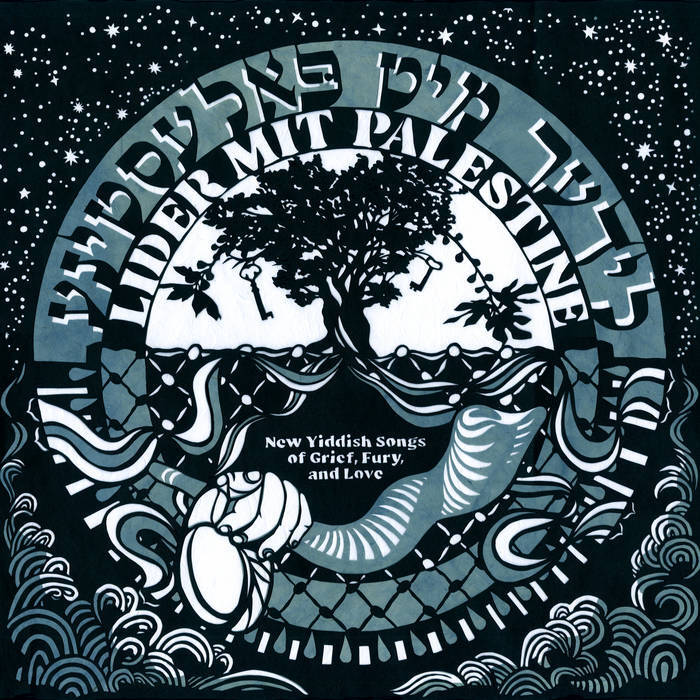
4) Yiddish song can subtly critique Zionism. Finally, Di fliendike pave is an apt title because the image of the peacock on the wing subtly suggests Frey’s pro-diasporic politics. Frey’s politics, which are directly reflected in her first album, Millennial Bundist (2020), and in her co-curation of 2025 compilation album Lider mit Palestine (to which I contributed) emerge in this album on the track “Nit heymish” (Not Homey). This song, originally written in German by Georg Kreisler and recorded in 1966, was translated into Yiddish by Frey with the help of Daniel Kahn. On the surface, it’s a cheerful cabaret ditty, but it ends with a poignant critique of Zionism. In each verse, the speaker attempts to live with a different family member in a new location: Berlin, New York, Buenos Aires, and then Israel. Each verse is followed by a new version of the refrain explaining why each place is “nit heymish” (not homey). “I suddenly understood where I’m from,” the Israel verse reads in Daniel Kahn’s translation for the album booklet:
I jump on a ship and across the sea
Straight to my homeland: Israel.
But that wasn’t so bright.
No one here gives me any credit.
I’ve had enough of all this farmwork
And everyone just speaks Ivrit.
After deciding that Israel isn’t heymish, the speaker goes back to his shtetl, where at least people are used to him. That this critique of Zionism is in the last verse, not apparent in the title of the track, and contained in a peppy cabaret tune is very strategic, in a time when it is a constant struggle to figure out how to perform pro-diasporic songs to general audiences in a way that brings listeners in so that they can hear them. Frey’s politics are also grounded in action: Frey is a co-founder of Standing Together Vienna, a Jewish-Arab alliance for peace in the Middle East.
So, where does Isabel Frey’s “fliendike pave” take us? The winged peacock flies us to where a woman, deeply invested in Yiddish song as a researcher, practitioner, and organizer, and someone looking to make the world a better place, continues to tread her own path and make her mark. To me, that’s heymish.