Mar 23, 2024
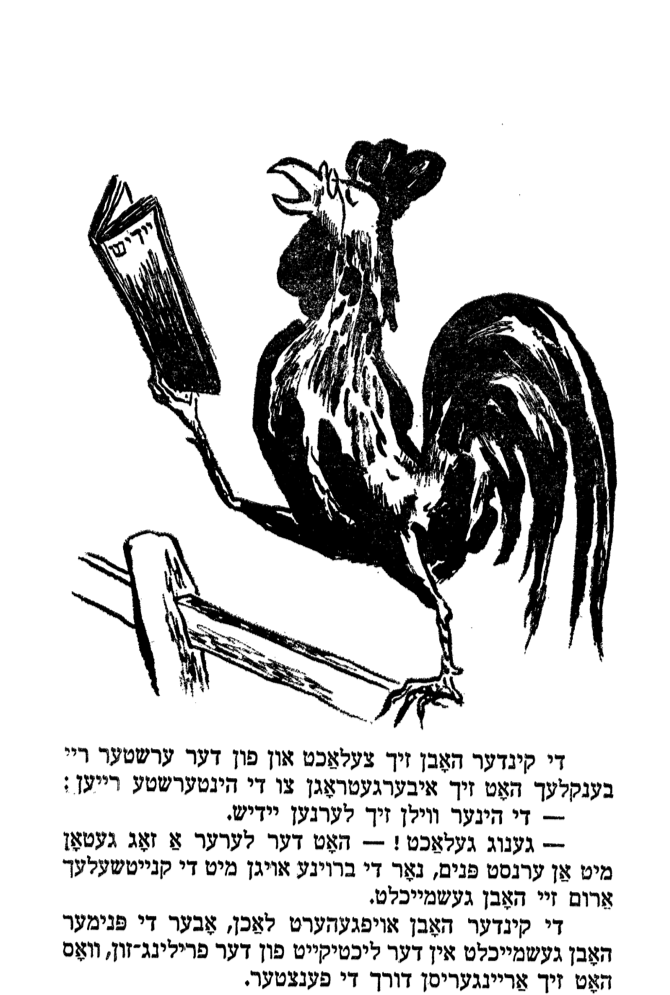
Foygl kanarik un andere mayses (1950), Moishe Shifris, illustrations by Herb Kruckman. Accessed via the Spielberg Digital Yiddish Library.
CFP: Farbinduckn 2025
Theme: Yiddish Chickens
Host Institution: Yiddish Farm
We are delighted to announce that Farbinduckn 2025: Yiddish Chickens is now accepting proposals for papers and workshops in Yiddish Studies from graduate students, advanced undergraduates, and early career professionals. Attendance at the conference will be open for plucky lovers of Yiddish at all levels, from spring chickens to empty-nesters.
In our fourth annual gathering, we aim to build the future of the field, cultivate it, harvest it, and then feed the milled grains to fowl. In doing so, we hope to incubate the next generation of downy Yiddish scholars.
In previous years we've made it a crucial part of our mission to hold the conference virtually, to enable international scholars or those who cannot travel to take part. Not this year. We have reconsidered our priorities, and our priorities are chickens.
About our Theme: Yiddish Chickens
The majestic chicken is a mainstay of Yiddish literature and culture. Often overlooked in favor of the goldene pave or the white goat, chickens get into everything from Yiddish folkways to foodways. We invite papers that take a broad interpretation of "Yiddish Chickens." Submissions might consider the following:
- Famous Hindes
- Chicken-scratch: Hantshrift and beyond
- Henpecking: Yiddish nagging, gender, and power
- Nebekh, food studies approaches to chickens and eggs (Yum!)
- Incubating Boychiks: Terms of endearment through linguistic, literary, cultural, or agricultural lenses; narratives of nurture and upbringing in the Yiddish literary tradition
- The Coop and the Chicken Wire: Imprisonment, (constrained) mobility, and/or security
- Labor histories of chickens: chicken farming; chickens on strike; chickens onstage
- “What are you, chicken!?”: Affective readings of Yiddish Studies/Yiddishists; tales of legendary shvakhlingen (wimps) of Yiddish history
- Jewish Humor, Yiddish Hiner: Livestock and the development of Yiddish idioms
We value papers that cause us to rethink what we know about the chicken and expand the category of what we consider a chicken. We are particularly interested in papers that highlight historically understudied chickens, such as rubber chickens, chickens in Antarctica, and easy weeknight 20-minute chicken dinners. Please note that papers that study any other fowl—whether grouse, pheasant, partridge, or quail—will be returned to sender via chicken.
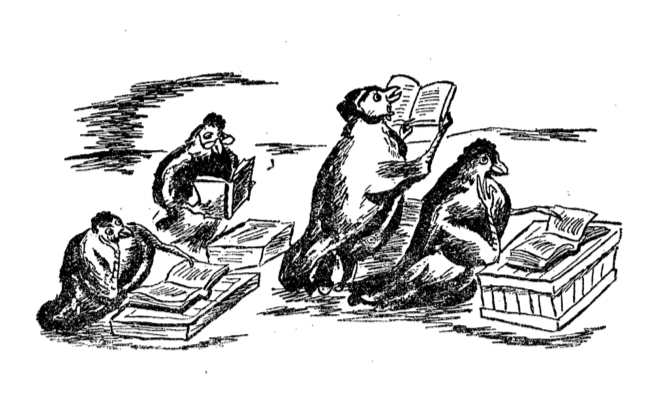
Foygl kanarik un andere mayses (1950), Moishe Shifris, illustrations by Herb Kruckman. Accessed via the Spielberg Digital Yiddish Library.
About the Conference
Our conference will offer three session formats: moderated panels of paper presentations (15 minutes each), interactive workshops (60 minutes each), and collective clucking (ongoing, beginning at dawn upon the rooster’s first crow).
Moderated panels will feature paper presentations on original research grouped by subtopic. Presenters are encouraged to use visual aids (i.e. slides, eggs) as supplements. Moderators will establish a pecking order and facilitate conversation.
Interactive workshops offer participants the opportunity to actively and collaboratively (h)engage in a topic. In an interactive workshop, a facilitator will take participants under their wing through a 60-minute discussion of source material (chicken and/or egg), pedagogical practice, schmaltz, or a topic of professionalization.
Collective clucking will focus on the state of the field, and whether the feed has been adequate this year. All participants are invited to come home to roost for these sessions.
Proposals (abstracts) for papers and workshops may be in English, Yiddish, or fowl language and should clearly address the theme of Yiddish Chickens. Proposals should not exceed 250 eggs in one basket and should be submitted by Sunday, March 24, 2024 at the barn down the road. If you have questions, please run around in a circle like your head has been cut off, and we will get in touch!
We hope to secure funding to ensure that each participant will have access to a chicken for the duration of the conference.
AUTHORS
Members of the Farbinduckn Organizing Committee: Alona Bok-Bok-Bok, Chickolyn Beard, Cameroost Bernstein, Yolk-ob Hermant, Sophia Shouls-hen, and Sean Sidkegg